just now


Liquidity Finder Ltd is incorporated in England and Wales, company number 10610740, registered address 167-169 Great Portland Street, Fifth Floor, London W1W 5PF, United Kingdom.
Published: just now


This week is set to be a defining moment for global currency markets, as traders brace for key policy decisions from the Bank of Japan (BoJ) and the Federal Reserve (FOMC). With the yen under renewed pressure and shifting expectations around US monetary policy, market participants are preparing for significant moves in FX.
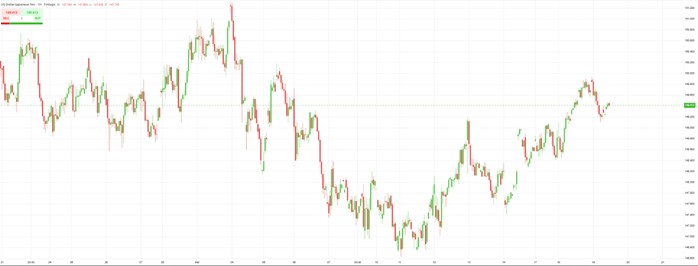
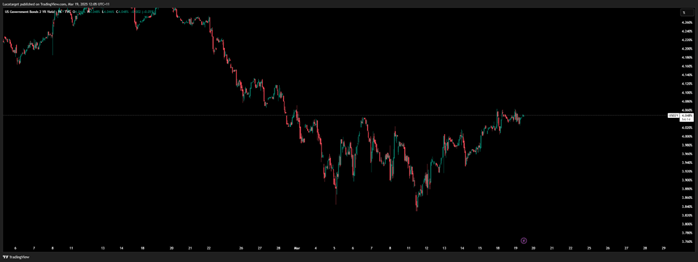
The Japanese yen has continued its decline, with the USD/JPY pair climbing back to the 150.00 level ahead of tomorrow’s BoJ policy meeting. The recent uptick in US Treasury yields has provided further support for the dollar, as the 2-year US Treasury yield surged from 3.83% on March 11 to a high of 4.06%, reflecting shifting expectations for US monetary policy.
A major driver behind this movement has been the release of US retail sales data for February, which helped ease concerns about a sharp slowdown in the US economy. The retail control group—a measure that strips out volatile components such as autos and gas—posted a stronger-than-expected 1.0% month-over-month increase, following a revised -1.0% decline in January. Growth was led by online sales (+2.4%) and health & personal care stores (+1.7%), signalling that consumer demand remains resilient despite mounting economic uncertainties.

However, a closer look at broader consumption trends suggests that spending growth is cooling. The three-month annualized growth rate for control retail sales has slowed to 2.6% in February, down from 3.1% in January and well below the peak of 5.9% seen in September. This moderation aligns with expectations that US consumption growth will decelerate significantly in the first quarter, following the unsustainably strong expansion of 3.7% in Q3 and 4.2% in Q4 of last year. Weakness in spending on autos, furniture, and sporting goods suggests a potential payback effect after robust demand in late 2024.
Against this backdrop, the Federal Reserve is expected to acknowledge rising downside risks to US growth in its policy statement, but without signalling an immediate need for rate cuts. While markets have increasingly priced in a first rate cut by June, the Fed remains cautious, likely preferring to monitor upcoming data before committing to a shift in policy.
For the yen, the BoJ’s policy decision will be the main event this week, followed later in the day by the Fed’s announcement. While the BoJ is widely expected to keep policy unchanged, recent discussions around the terminal rate—the peak level for interest rates—suggest that markets will be closely watching for any hints from Governor Kazuo Ueda. A Bloomberg survey of 52 analysts places the median expectation for Japan’s terminal rate at 1.25%, with a range of 0.50% to 2.50%. However, the central bank’s cautious approach has left some investors concerned that it may fall behind the curve.
A key factor in shaping future BoJ policy decisions is wage growth, particularly the outcome of Japan’s annual ‘shunto’ wage negotiations. The latest Rengo wage settlement of 5.46%, with a base pay increase of 3.84%, exceeded expectations and provides further justification for policy normalization. If the BoJ does begin to move, the next rate hike could come as soon as June or July, marking a critical turning point for Japan’s monetary policy.
With these developments in mind, the overall bias in the market remains selling USD/JPY on rallies, as traders anticipate a potential policy shift in Japan later this year.
Beyond the major central bank decisions, emerging market currencies have been quietly staging a remarkable comeback in early 2025. This quarter is shaping up to be the strongest for EM FX since Q4 2020, when markets rebounded from the initial COVID-19 shock.
Among the standout performers, the Russian rubble (RUB) has surged by 4.1% against the USD, bolstered by growing optimism over a potential Russia-Ukraine ceasefire. Reports suggest that former US President Donald Trump and Russian President Vladimir Putin are set to hold further discussions on territorial negotiations, fuelling speculation that an agreement may be within reach.
Latin American currencies have also seen robust gains, with the Brazilian real (BRL) up 2.2%, the Mexican peso (MXN) rising 1.6%, and the Chilean peso (CLP) climbing 1.5%. Much of this strength can be attributed to the rally in commodity prices, particularly copper, which has reached its highest level since mid-2024. The surge follows an investigation into US copper imports, initiated by President Trump’s administration, prompting market participants to accelerate purchases amid supply concerns.
At the same time, China’s economy has shown signs of resilience, providing additional support for commodity-linked currencies. February’s economic data from China came in stronger than expected, with retail sales up 4.0% year-over-year, industrial production rising 5.9%, and fixed asset investment excluding rural projects increasing by 4.1%. While China remains under pressure from heightened US trade tariffs, policymakers have introduced new stimulus measures aimed at bolstering domestic consumption, including expanded trade-in programs and childcare subsidies.
The recent pullback in the US dollar and lower US yields have also acted as a tailwind for emerging market currencies. Market sentiment is shifting toward expectations of multiple Fed rate cuts in 2025, as concerns over slower US growth and rising trade uncertainties weigh on business confidence. With the Fed likely to acknowledge increasing risks to economic momentum at this week’s FOMC meeting, the US rate market has already begun pricing in the next rate cut for June, with expectations of two to three additional cuts by the end of the year.
If this trajectory holds, EM FX could continue to outperform in the coming months, benefiting from a weaker USD environment and improved global risk appetite.
As markets digest these developments, several key events will shape the outlook for currency markets:
This week’s market moves will be shaped by how central banks navigate the growing divide between economic resilience and monetary policy risks. With yen weakness, emerging market momentum, and the Fed’s evolving stance on rate cuts all in play, currency markets remain poised for volatility.
This content may have been written by a third party. ACY makes no representation or warranty and assumes no liability as to the accuracy or completeness of the information provided, nor any loss arising from any investment based on a recommendation, forecast or other information supplies by any third-party. This content is information only, and does not constitute financial, investment or other advice on which you can rely.
ACY Securities is one of Australia's fastest growing multi-asset online trading providers, offering ultra-low-cost trading, rock-solid execution, technologically superior account management and premium market analysis.

Select the categories and companies you wish to follow directly to your person rss feed.
Create Custom RSS FeedSign up and join over 5,000 professional members who receive personalized news alerts, curated professional connections, and more for free!
Bybit has launched Perp Options, described as the first options contracts built on TradFi perpetuals, giving traders round-the-clock access to US equity options. SpaceX and Nvidia are the first underlying assets, with USDT settlement and integration into Bybit's Unified Trading Account.
Use this trading preparation checklist to plan your session, define entry rules, manage risk, and build a disciplined trading routine in seven steps.
Your Bourse expands its crypto liquidity ecosystem with Caladan, giving brokers access to broader market coverage, institutional execution capacity and streamlined settlement.
Scope Markets, the retail brokerage part of Rostro Group, has appointed Ibrahim Hossny as Head of Research and Marketing for the Middle East and North Africa.
Hantec Prime, the institutional division of Hantec Markets, has reported trading volume up more than 300% year-to-date, alongside the addition of 42 new institutional clients since December, capping one of its strongest years of growth to date.
Learn how to refine XAUUSD support and resistance on the daily chart using candle bodies, market structure and weekly gold levels for swing trading. A slug alone cannot guarantee a top Google ranking. Keep it focused rather than adding every supporting keyword.
The week in Dubai will be focused on connecting directly with the industry and discussing how technology can help modern brokerages simplify operations, automate workflows, strengthen operational control, and scale efficiently.
Devexperts has launched a turnkey solution giving brokers in South Korea access to US equity markets, combining its DXtrade trading platform, dxFeed market data, and execution services. The offering targets South Korea's growing retail demand for US stocks, worth several billion USD monthly.
Assess why WTI crude oil surged past $105 per barrel amid Saudi pipeline disruptions, record tanker charter rates, and escalating geopolitical tensions.
Bitcoin price forecast: BTC/USD retests $78,460–$80,215 resistance. Watch bearish confirmation toward $72,480 or a bullish breakout toward $86,150.