
just now


Liquidity Finder Ltd is incorporated in England and Wales, company number 10610740, registered address 167-169 Great Portland Street, Fifth Floor, London W1W 5PF, United Kingdom.
Published: just now


Despite a muted macro calendar, the FX market continues to paint a narrative of cautious divergence. The dollar's recent weakness while not a new theme is becoming harder to ignore as it fails to mount any meaningful rebound from recent lows. Behind this lies a cocktail of global capital rotation, risk recalibration, and market fatigue with the U.S. exceptionalism trade.
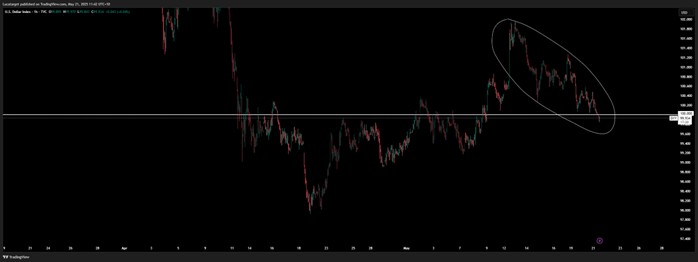
Dollar softness has become the market’s background music not disruptive, but persistent. While U.S. long-end yields have pulled back slightly, there’s been no fundamental shift to justify a deeper dollar rout. What’s changed, arguably, is positioning and patience. Investors increasingly seem to be preparing for a world in which the U.S. fiscal imbalance weighs more on the greenback than on yields. The market is still digesting the implication of a government that talks about deficit control but keeps spending, and the idea that the dollar rather than bonds could be the release valve.
This explains the bid under non-USD risk assets. When traditional hedges lose appeal, investors reach for new ones. And that’s what we’re seeing: a subtle pivot toward non-dollar denominated inflation hedges European equities, select commodities, and cross-currency exposure.
The euro has quietly reclaimed ground, bouncing back from last Friday’s dip with a consistency that feels more like quiet accumulation than speculative push. There’s little in the macro to drive this Europe’s fundamentals remain tepid, but capital seems to be looking for somewhere to go. With the U.S. fiscal situation unresolved and the ceasefire hopes in Ukraine still fragile (Polymarket odds for a July ceasefire remain stuck at 20%), Europe benefits from simply not being the source of the problem.
That said, EURUSD’s inability to convincingly reclaim the 1.13 handle remains a red flag. Until we get a clean break higher, the euro remains a tactical long not a structural one.
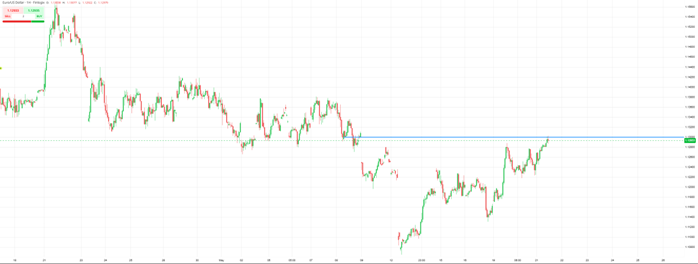
The pound’s modest rally feels increasingly tired. Optimism around the UK-EU "reset" has fizzled under the weight of economic reality. Trade deals with the U.S. and EU are in place but underwhelming, and markets are bracing for a potentially soft CPI print and dour PMIs. Gilt yields are high, tax hikes are biting, and the growth narrative is losing steam. For now, EURGBP long remains a sensible relative value play, as sterling struggles to justify any standalone strength.
The yen’s price action has been one of the most puzzling stories of the week. Despite a poor 20-year auction longest tail since 1987 and consistently hawkish market chatter, the yen continues to attract bids, particularly around the Tokyo fix. The upcoming Kato Bessent meeting could bring some clarity, but for now, the yen appears to be the beneficiary of growing scepticism around the dollar.
Still, the contradiction is hard to ignore Japan’s long-term debt dynamics are worsening, yet JPY is strengthening on higher yield impulses. This may work for now, but the macro math doesn’t add up long term. We're still tactically short CHFJPY but increasingly watching for a spot to renter JPY longs on broader G7 disappointment.
The Swiss franc remains stuck in limbo. USDCHF has pulled away from recent highs, but the broader narrative is unchanged. On one side, CHF still attracts safe-haven demand amid “sell America” flows. On the other, its low yield and SNB’s clear openness to NIRP makes it a cheap funder against higher yielders like AUD and EUR. Until one of those narratives breaks, expect more sideways chop in CHF.
The RBA's 25bps cut was expected, but Governor Bullock’s post-meeting comments misinterpreted or not were taken as a dovish tilt. Despite this, AUD has outperformed, suggesting markets had priced in a worse outcome. However, the conviction behind AUD longs has wavered somewhat. With inflation surprising to the upside, the RBA is now caught between two narratives, and that uncertainty is dampening enthusiasm.
By contrast, NZD may emerge stronger in the near term, especially as the dollar continues to offer little resistance. We maintain a medium-term bullish bias on AUD but are scaling exposure accordingly.
All attention today is on the Canadian CPI print. The YoY inflation rate is expected to fall, but core measures may remain sticky. The market is already pricing in significant easing for the June BoC meeting, which sets up a classic asymmetric risk: any upside surprise in inflation data could force a repricing and drive CAD strength. That’s not our base case but the risk exists. We remain short CAD for now, betting the BoC will move early before tariff effects start bleeding into the data.
The FX market feels like it’s in a holding pattern but one that’s slowly tilting away from the dollar. With rate hikes largely behind us, positioning and macro sentiment are becoming the dominant drivers. The dollar’s inability to catch a sustained bid, despite relative U.S. economic strength, speaks volumes. And while no one wants to declare the start of a new regime, capital flows suggest investors are quietly preparing for one.
As always, I stay data dependent but not dollar dependent.
This content may have been written by a third party. ACY makes no representation or warranty and assumes no liability as to the accuracy or completeness of the information provided, nor any loss arising from any investment based on a recommendation, forecast or other information supplies by any third-party. This content is information only, and does not constitute financial, investment or other advice on which you can rely.
ACY Securities is one of Australia's fastest growing multi-asset online trading providers, offering ultra-low-cost trading, rock-solid execution, technologically superior account management and premium market analysis.

Select the categories and companies you wish to follow directly to your person rss feed.
Create Custom RSS FeedSign up and join over 5,000 professional members who receive personalized news alerts, curated professional connections, and more for free!
Theorem has integrated Symbiotic’s Liquid Lane RFQ network, letting holders of tokenised real-world assets trade against on-chain pool liquidity and market-maker quotes. The integration is live on Ethereum, with Midas’s yield-bearing mHYPER fund as the first supported asset. Holders can trade for the USDC stablecoin.
US equities were volatile with technology selloff erasing much of the earlier rebound.
FM Summit London 2026 returns to Old Billingsgate on 24 November for its 15th edition, with LMAX Group, Plus500 and oneZero among confirmed exhibitors. The one-day event adds Business Connect meetings and roundtables, and opens with a networking evening at The Folly on 23 November.
Finance Magnates Summit London returns to Old Billingsgate on 24 November 2026 for its 15th edition. The one-day event brings together brokers, liquidity providers, institutional firms, trading technology vendors, payments businesses and digital asset firms.
iSAM Securities Apex has integrated with Match-Prime, giving brokers access to liquidity across more than 2,000 instruments, with tailored pricing and up to 10 levels of market depth.
propfunding.com's free-entry instant funding changes the order of prop funding. Start trading first. Its free-entry instant funding model offers two qualification attempts without an upfront activation fee.
US stocks closed higher on Wednesday, with the Nasdaq gaining 1%, the S&P 500 rising 0.6%, and the Dow advancing 0.7%, as renewed enthusiasm for AI-related stocks lifted market sentiment.
SpaceX went public in June as a rocket company. On October 20 it reported as something else entirely: an AI infrastructure business, financed by a satellite broadband network, with a launch division attached. Rockets generated 12% of third quarter revenue and lost money. The AI segment generated 52% of revenue and consumed 84% of capital expenditure. Starlink generated 85% of operating profit.
Standard Chartered has signed definitive agreements to acquire 100% of Zodia Custody UK Limited, folding its regulated digital asset custody business into Securities Services. Zodia Solutions will be set up under SC Ventures with bank investors including Northern Trust, NAB Ventures, Emirates NBD and Investcorp.
Bybit Fintech FZE has secured a Virtual Asset Service Provider licence from Dubai’s Virtual Assets Regulatory Authority for Exchange Services, covering spot trading. Bybit’s Peter Loo said the firm hopes to add derivatives, subject to regulatory approvals. Its international Dubai headquarters opened in 2022.