just now


Liquidity Finder Ltd is incorporated in England and Wales, company number 10610740, registered address 167-169 Great Portland Street, Fifth Floor, London W1W 5PF, United Kingdom.
Published: just now
If you have ever stared at a losing position and thought, “I knew this would happen. Why did I still do it?”, then you are exactly who this series is written for.
On paper, you might already know how to read price action, spot liquidity, and time sessions. You may have even gone through multiple playbooks like Why Smart Money Concepts Work: The Truth Behind Liquidity and Price Action and built your own rules. Yet in real time, you still break those rules. You move stops. You add to losers. You chase candles you promised yourself you would ignore.
In The Disciplined Trader: Developing Winning Attitudes, Mark Douglas argues that this gap between knowing and doing is not a strategy issue. It is a psychological issue. He was one of the first to say bluntly that trading is mostly about how you think, not what you know. The market does not punish you for a lack of information. It punishes you for a lack of internal control.

This first part sets the foundation. Before we talk about routines and checklists, we need to confront a hard truth: your mind was not designed for this environment.
Douglas starts by pointing out something so obvious that most traders never see it.
From childhood, your behavior has mostly been controlled by external structure. Parents, teachers, bosses and rules defined what was allowed and what was not. You learned to behave because of supervision, grades, penalties and praise. In that world, discipline was enforced from the outside.
Trading deletes all of that in one click.
This is what Douglas calls an unstructured environment. There are no built in brakes. No natural boundaries.
The platform will not stop you from pressing buy three times in a row. The only person who can is you.
That is why many traders who look disciplined in other areas of life fall apart in front of a chart. In your normal life, structure is given to you. In the market, it must be built from inside. That shift from external discipline to internal discipline is the heart of a truly disciplined trader mindset and it is the same shift you are asked to make in pieces like Identity-Based Trading: Become Your Trading System for Consistency.
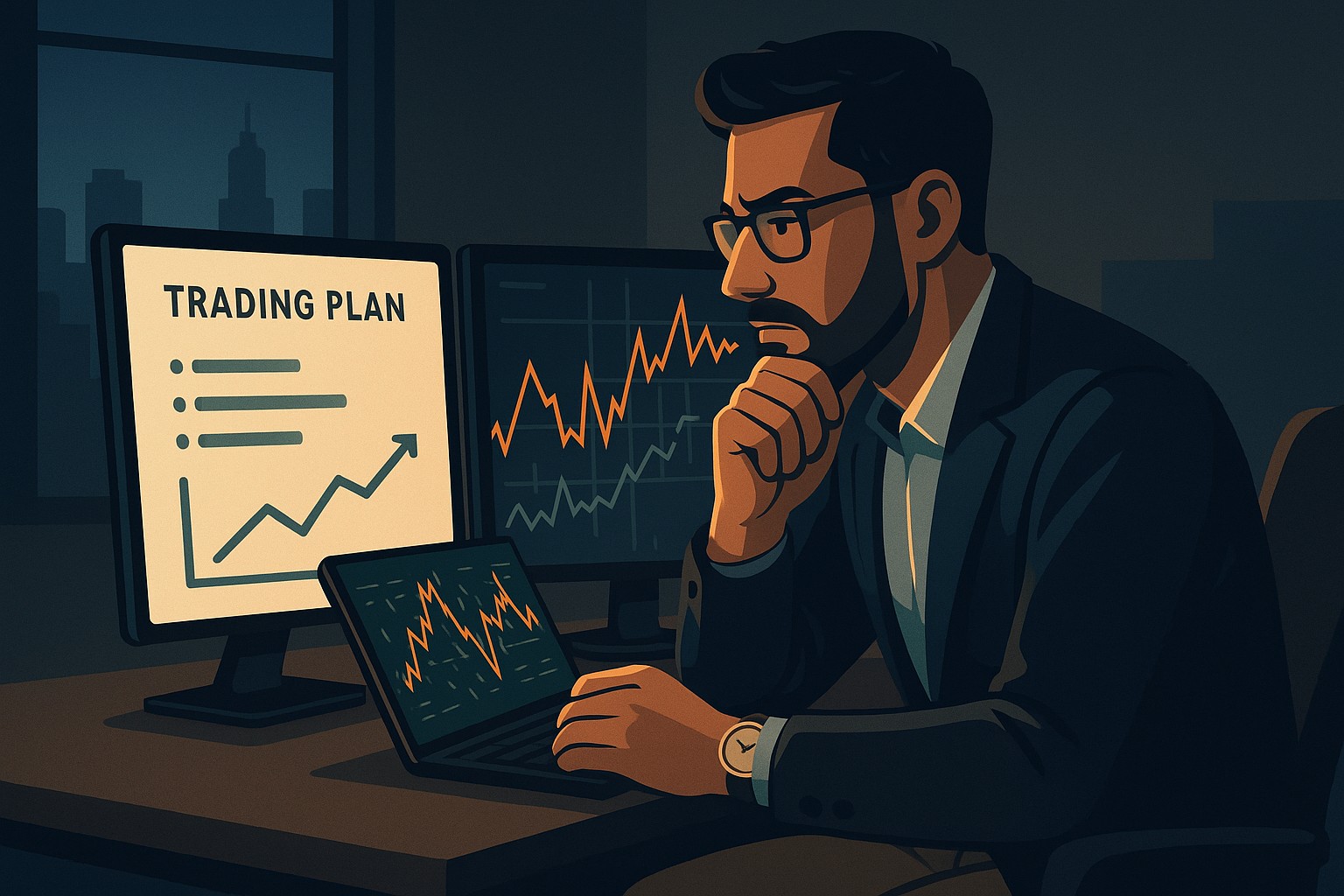
Think about the last time you broke your plan. Did the market force you to do it, or did something inside you justify it?
Douglas explains that traders live in a constant tug of war between two forces:
In calm moments you say:
In the live market you think:
The market does not change. Your emotional state does. Your brain tries to escape short term pain, especially the pain of being wrong or taking a loss. This leads to exactly the kind of impulsive trading that pieces like Discipline vs. Impulse in Trading - Step-by Step Guide How to Build Control are built to address.
Douglas’ main point is brutal and beautiful at the same time: the market is not the enemy. Your untrained responses to uncertainty are.
One of Douglas’ most powerful ideas is that the market does not cause your emotional pain. Your expectations do.
You enter a trade with a quiet story in your head:
When price does something different, you feel betrayed, angry or anxious. The market did not violate anything. It simply revealed that your mental picture was not reality.
In other words, you are not trading price alone. You are trading your beliefs about price. That is why two traders can look at the same chart and feel completely different emotions.
This is also why a trader can be completely calm when they follow a data backed edge, like the probability focused mindset taught in Trading in the Zone: Thinking in Probabilities, yet become wildly emotional when they trade based on hope or prediction.
Once you accept that your inner narrative is the real source of pain, something shifts. You stop asking, “Why did the market do this to me?” and start asking, “What expectation was I attached to that reality just crushed?”
That question is the beginning of discipline.

Imagine you grew up in a house where every stove was always cold. You leaned on it, placed objects on it, even sat on it as a kid. For years nothing bad happened.
Then one day, you walk into a new house, see a stove and casually put your hand on it.
This time, it burns.
The stove did not change who you are. It revealed that your assumptions about stoves were outdated. From that moment, you have two choices:
Trading is that second house.
You step into the market with assumptions from a structured world. Assumptions like “effort equals reward” and “following orders leads to safety” and “there is always someone who will tell me what to do next.” But the market does not honor any of that. It behaves like that hot stove: neutral, dangerous if mishandled, completely indifferent to your feelings.
A disciplined trader is simply someone who has updated their beliefs about the stove. They no longer blame the heat. They change how they interact with it.
That is exactly what Douglas set out to do in The Disciplined Trader, which many publishers and reviewers still describe as one of the earliest classics on trading psychology and mental discipline for traders of all stylesPenguinRandomhouse.com.
Here is the trap most traders fall into:
“I will become disciplined once I am more consistent.”
It sounds logical, but it is backward.
Douglas explains that discipline is not a reward for success. It is the process that creates success. You do not suddenly become calm after a string of winning months. You become calm because you learned how to think, act and respond in a structured way despite uncertainty. That structure then leads to better results.
This is the same direction that modern pieces like Why Most Traders Fail - Trading Psychology & The Hidden Mental Game also push you toward. You stop chasing the perfect system and start building the person who can run any reasonable system well.
A disciplined trader:
You do not wake up one day with those traits. You train them, one decision at a time.

For the next week, do not try to fix everything. Start with awareness.
Do not judge yourself. Just observe. You are collecting raw material for change. This is the same kind of data driven self observation that underpins pieces like Trading Mindset Mastery: Building Confidence Through Data, where your journal slowly becomes a mirror, not a verdict.
If you commit to this for even five trading days, you will start seeing patterns in your impulses. That is where real discipline work begins.
Because The Disciplined Trader was one of the first works to map out the psychological structure behind trading behavior, not just talk about motivation. Referencing it allows this series to stand on a proven foundation while adding practical, modern angles for retail traders.
That is normal. Douglas points out that trading is a uniquely unstructured environment. You may be very disciplined in work, fitness or ministry, yet still fall apart in markets because no one is there to enforce consequences for you. This is a different skill set.
No. A solid system can reduce confusion, but it cannot override fear, greed or denial. Inconsistent behavior can destroy the edge of even the best strategy. That is why so many traders with profitable methods still blow accounts, which is exactly why resources like Top 10 Ways to Prevent Emotional Trading and Stay Disciplined in the Markets exist.
There is no fixed timeline. Discipline grows with repetition. The more often you choose the plan over the impulse, the faster your identity shifts from reactive to intentional. What matters is not perfection but trend: fewer emotional decisions and more rule aligned decisions over time.
This content may have been written by a third party. ACY makes no representation or warranty and assumes no liability as to the accuracy or completeness of the information provided, nor any loss arising from any investment based on a recommendation, forecast or other information supplies by any third-party. This content is information only, and does not constitute financial, investment or other advice on which you can rely.
ACY Securities is one of Australia's fastest growing multi-asset online trading providers, offering ultra-low-cost trading, rock-solid execution, technologically superior account management and premium market analysis.

Select the categories and companies you wish to follow directly to your person rss feed.
Create Custom RSS FeedSign up and join over 5,000 professional members who receive personalized news alerts, curated professional connections, and more for free!
Bybit has launched Perp Options, described as the first options contracts built on TradFi perpetuals, giving traders round-the-clock access to US equity options. SpaceX and Nvidia are the first underlying assets, with USDT settlement and integration into Bybit's Unified Trading Account.
Use this trading preparation checklist to plan your session, define entry rules, manage risk, and build a disciplined trading routine in seven steps.
Your Bourse expands its crypto liquidity ecosystem with Caladan, giving brokers access to broader market coverage, institutional execution capacity and streamlined settlement.
Scope Markets, the retail brokerage part of Rostro Group, has appointed Ibrahim Hossny as Head of Research and Marketing for the Middle East and North Africa.
Hantec Prime, the institutional division of Hantec Markets, has reported trading volume up more than 300% year-to-date, alongside the addition of 42 new institutional clients since December, capping one of its strongest years of growth to date.
Learn how to refine XAUUSD support and resistance on the daily chart using candle bodies, market structure and weekly gold levels for swing trading. A slug alone cannot guarantee a top Google ranking. Keep it focused rather than adding every supporting keyword.
The week in Dubai will be focused on connecting directly with the industry and discussing how technology can help modern brokerages simplify operations, automate workflows, strengthen operational control, and scale efficiently.
Devexperts has launched a turnkey solution giving brokers in South Korea access to US equity markets, combining its DXtrade trading platform, dxFeed market data, and execution services. The offering targets South Korea's growing retail demand for US stocks, worth several billion USD monthly.
Assess why WTI crude oil surged past $105 per barrel amid Saudi pipeline disruptions, record tanker charter rates, and escalating geopolitical tensions.
Bitcoin price forecast: BTC/USD retests $78,460–$80,215 resistance. Watch bearish confirmation toward $72,480 or a bullish breakout toward $86,150.