just now


Liquidity Finder Ltd is incorporated in England and Wales, company number 10610740, registered address 167-169 Great Portland Street, Fifth Floor, London W1W 5PF, United Kingdom.
Published: just now

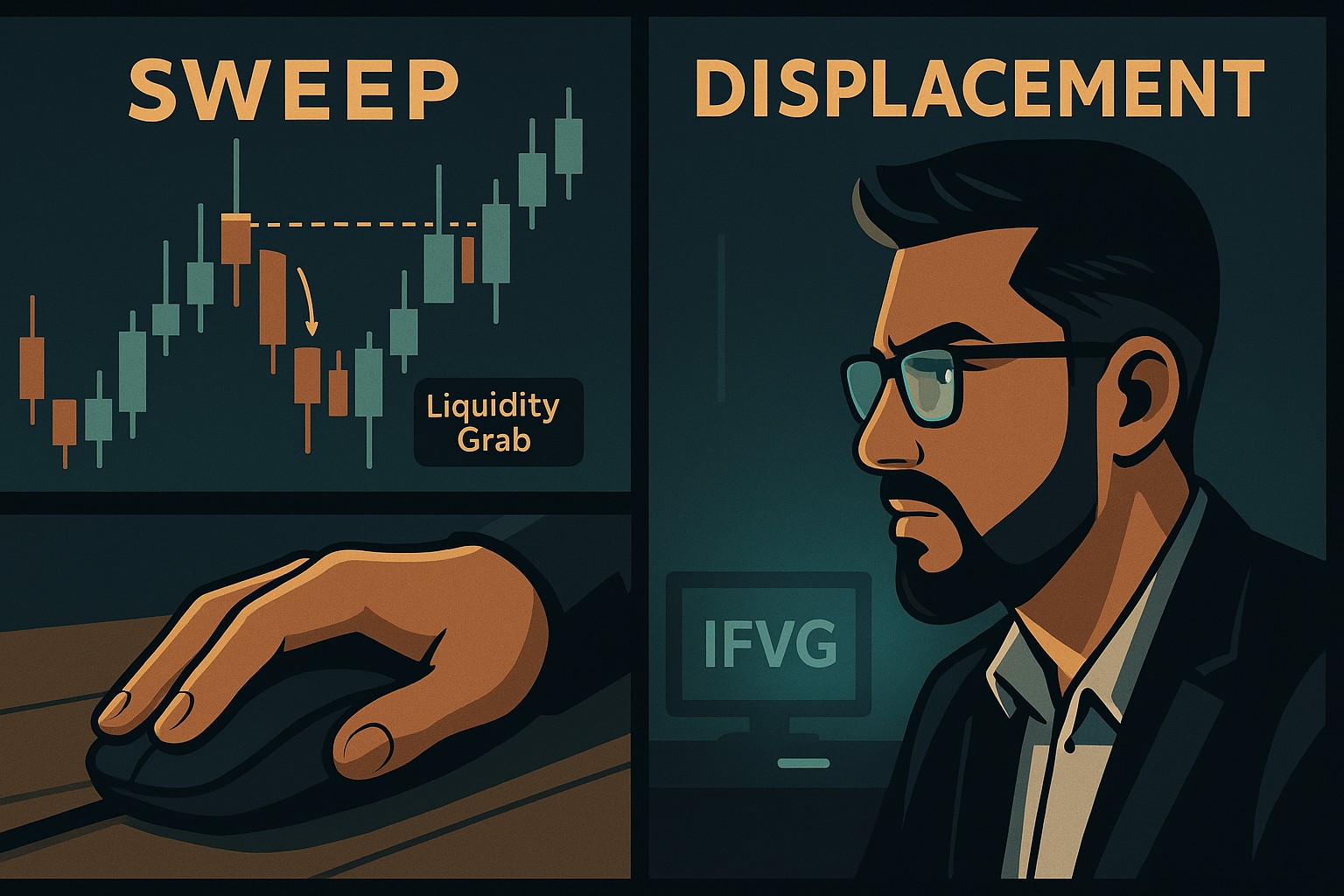
You’ve seen it unfold perfectly - a clean sweep of liquidity, a sharp displacement candle confirming bias, and a Fair Value Gap (FVG) waiting like a doorway into precision. Yet your hand hesitates. Your finger trembles over the mouse. You breathe, you stare, and before you act - the price runs away without you.
That’s not a technical mistake. That’s execution paralysis - the emotional lag between clarity and conviction.
Most traders assume their problem lies in strategy or timing, but more often it’s psychological. Execution psychology is the unseen discipline of trading: the art of acting decisively under uncertainty. It’s where technical mastery meets emotional control. And until you master it, even the perfect setup will slip through your fingers.

When you’re about to enter a trade, your brain doesn’t see “potential profit.” It sees risk - uncertainty that could lead to loss or regret.
This triggers your amygdala - the same survival center that activates during real physical danger. Your heart rate rises. Your palms sweat. Breathing shortens. The very organ you rely on to make high-quality decisions - your prefrontal cortex - starts to shut down.
You’re not scared of the chart. You’re scared of the outcome.
That’s why seasoned traders use pre-entry conditioning - a structured sequence to calm the body and clear the mind before clicking “Buy” or “Sell.” Pair it with a fast mechanical confirmation so your brain stops searching for emotional safety and follows the model. If you don’t have a rule-set yet, steal one from this step-by-step confirmation guide.
Here’s a simple yet powerful 10-second routine you can do before every trade:
You’ve just taken control of your physiology - and by extension, your psychology.
This isn’t “breathing for calm.” It’s breathing for clarity. It signals to your nervous system: I’m safe. I’m in control.
The next time you’re about to hesitate, remember - confidence isn’t the absence of fear. It’s the ability to act while fear is present.
Hesitation in trading feels logical - “Maybe it’ll retest one more time,” “Let’s wait for confirmation,” or “I’ll enter if the next candle closes bullish.”
But underneath that logic is fear disguised as patience.
True execution confidence is what elite traders call controlled aggression - the ability to strike decisively when your data-backed model confirms the move.
In Smart Money Concepts (SMC), hesitation often happens right when the market is doing what it’s supposed to do:
This is where the amateur freezes, but the professional executes - because conviction was decided before the setup appeared.
Controlled aggression is not recklessness; it’s trust in preparation.
It’s knowing that every setup you take aligns with a backtested rule, a structured risk, and an emotional acceptance of loss. You don’t “hope” it works; you allow it to play out.
If you need a clean execution blueprint, study the walkthrough in Anatomy of a Perfect Execution here: trade with precision.
One of the simplest mental scripts to use before you execute is:
“I don’t control the outcome. I control the process.”
By detaching from the result, your brain stops trying to protect your ego - and starts serving your system.

The challenge doesn’t end when you click “Buy.” In fact, that’s when the real battle begins.
You start watching every tick, every candle shadow, every minor fluctuation - and suddenly you’re not following your plan anymore; you’re reacting emotionally to noise.
Execution psychology continues after entry through presence and breath regulation.
Here’s what that looks like in practice:
Every breath you control is one less impulsive action you’ll regret. Want a structured approach to staying systematic during trends and pullbacks? Keep a simple anchor like the Moving Averages Playbook nearby to avoid micromanaging every tick.
Traders often ask, “How do I hold longer?” The answer is simple but profound - breathe through discomfort instead of reacting to it.
Think of a professional archer in competition. They draw the bow, align their sight, and breathe - not because they’re waiting for perfection, but because calm precision is the trigger.
The shot doesn’t happen in excitement. It happens in silence.
Trading is the same art form.
Your “bow” is your system, your “arrow” is your entry, and your “target” is the setup. You don’t fire when emotions peak; you fire when your breathing slows and your vision narrows to the model.
The archer doesn’t chase the bullseye - he trusts the process. The moment he overthinks the target, the shot misses.
In trading, that’s what hesitation is - overthinking in the moment of truth.

Every elite performer - athlete, soldier, or trader - relies on rituals.
Why? Because rituals reduce the cognitive load of decision-making. They train your nervous system to feel safe in familiar patterns, even under stress.
Create a pre-market and pre-entry ritual that grounds you:
Morning Routine:
Pre-Trade Ritual:
Reconfirm your execution model (e.g., liquidity grab → displacement → FVG).
Identify invalidation points and expected structure.
Perform the 10-second breathing reset.
Say this aloud:
“If it fits my model, I execute without hesitation.”
This simple habit rewires your brain through repetition and self-command.
The more you do it, the more your mind associates structure with safety - until decisive action becomes instinct, not effort.
If you trade indices, ritualize time-based conviction as well. For example, restrict first shots to the first 30 minutes and use this guide to anchor your routine at the open: scalp indices at the open.
Let’s talk numbers.
Every time you hesitate and miss a valid setup, the market doesn’t just take your opportunity - it taxes your emotional capital.
That lingering frustration? That’s your psychological drawdown. And just like financial drawdowns, it compounds over time.
You begin second-guessing the next trade. You tweak your model unnecessarily. You enter too late on the next setup, only to be stopped out where your original entry would’ve won.
Execution hesitation isn’t harmless - it’s the silent leak in your consistency bucket.
And the cure isn’t “more confidence.” It’s more clarity and repetition.
Ground your execution inside a risk-first box so losses don’t shake you: stop placement, target mapping, and size - all decided before entry. If you need a refresher, tighten up with this risk management primer.
Let’s put this into the market context.
You’re trading Nasdaq at the US open. The previous high gets swept - your liquidity model is in play. Price displaces lower, leaving an M5 FVG. You know the rules: wait for a return, confirm structure, execute.
But price pulls back fast - deep into the gap - and your pulse spikes. “Maybe it’s invalid.”
You hesitate, wait for “one more candle”… and then it drops 80 points without you.
What happened?
You didn’t lack knowledge. You lacked execution trust.
The correct behavior here is preconditioned calmness:
If you struggle to separate patience from fear, revisit the mental side here: the mental game of execution. And if FOMO or revenge knocks after a miss, reset with this short clinic on stopping emotional trading.
When you act from structure, uncertainty doesn’t scare you - it guides you.

Execution is not about finding perfection - it’s about mastering yourself when perfection fails to appear.
The difference between an average and a consistent trader is not how much they know, but how decisively they act when it matters most.
When you hesitate, the market moves on. But when you execute with structure, even a loss reinforces discipline. And that’s where long-term confidence grows - not from winning every trade, but from acting with alignment every time.
Remember this:
“Conviction is not the absence of fear - it’s the decision to act despite it.”
Your system gives you logic.
Your execution gives you power.
Together, they make you unstoppable.
Before every trade, do your 10-second breathing protocol and record your pre-entry clarity in your journal from 1–10.
At the end of the week, review your scores. You’ll start noticing a pattern - your best trades didn’t come from excitement or intuition; they came from calm aggression under structure.
If all your setup criteria are met and you still delay due to “what ifs,” it’s hesitation. Confirmation should be mechanical, not emotional - use a simple matrix like the one in the guide above.
That’s a pendulum effect. Calm down, re-center with your breathing ritual, and only execute trades that align with your rule-based checklist.
Slow breathing stabilizes the vagus nerve - it reduces adrenaline, sharpens focus, and restores logical reasoning.
Through micro-decisions: waking up without snoozing, finishing a workout rep, saying no to impulses. Small acts of follow-through build execution muscles.
It’s time to go from theory to execution - risk-free.
Create an Account. Start Your Free Demo!
Looking for step-by-step approaches you can plug straight into the charts? Start here:
Sharpen your edge with proven tools and frameworks:
News moves markets fast. Learn how to keep pace with SMC-based playbooks:
From NASDAQ opens to DAX trends, here’s how to approach indices like a pro:
Gold remains one of the most traded assets - here’s how to approach it with confidence:
Candlesticks are the building blocks of price action. Master the most powerful ones:
Ready to go intraday? Here’s how to build consistency step by step:
Markets swing between calm and chaos. Learn to read risk-on vs risk-off like a pro:
Step inside the playbook of institutional traders with SMC concepts explained:
Forex pairs aren’t created equal - some are stable, some are volatile, others tied to commodities or sessions.
If you’ve ever been stopped out right before the market reverses - this is why:
Mindset is the deciding factor between growth and blowups. Explore these essentials:
The real edge in trading isn’t strategy - it’s how you protect your capital:
If you’re not sure where to start, follow this roadmap:
This way, you’ll grow from foundation → application → mastery, instead of jumping around randomly.
Follow me for more daily market insights!
Jasper Osita - LinkedIn - FXStreet - YouTube
This content may have been written by a third party. ACY makes no representation or warranty and assumes no liability as to the accuracy or completeness of the information provided, nor any loss arising from any investment based on a recommendation, forecast or other information supplies by any third-party. This content is information only, and does not constitute financial, investment or other advice on which you can rely.
ACY Securities is one of Australia's fastest growing multi-asset online trading providers, offering ultra-low-cost trading, rock-solid execution, technologically superior account management and premium market analysis.

Select the categories and companies you wish to follow directly to your person rss feed.
Create Custom RSS FeedSign up and join over 5,000 professional members who receive personalized news alerts, curated professional connections, and more for free!
Theorem has integrated Symbiotic’s Liquid Lane RFQ network, letting holders of tokenised real-world assets trade against on-chain pool liquidity and market-maker quotes. The integration is live on Ethereum, with Midas’s yield-bearing mHYPER fund as the first supported asset. Holders can trade for the USDC stablecoin.
US equities were volatile with technology selloff erasing much of the earlier rebound.
FM Summit London 2026 returns to Old Billingsgate on 24 November for its 15th edition, with LMAX Group, Plus500 and oneZero among confirmed exhibitors. The one-day event adds Business Connect meetings and roundtables, and opens with a networking evening at The Folly on 23 November.
Finance Magnates Summit London returns to Old Billingsgate on 24 November 2026 for its 15th edition. The one-day event brings together brokers, liquidity providers, institutional firms, trading technology vendors, payments businesses and digital asset firms.
iSAM Securities Apex has integrated with Match-Prime, giving brokers access to liquidity across more than 2,000 instruments, with tailored pricing and up to 10 levels of market depth.
propfunding.com's free-entry instant funding changes the order of prop funding. Start trading first. Its free-entry instant funding model offers two qualification attempts without an upfront activation fee.
US stocks closed higher on Wednesday, with the Nasdaq gaining 1%, the S&P 500 rising 0.6%, and the Dow advancing 0.7%, as renewed enthusiasm for AI-related stocks lifted market sentiment.
SpaceX went public in June as a rocket company. On October 20 it reported as something else entirely: an AI infrastructure business, financed by a satellite broadband network, with a launch division attached. Rockets generated 12% of third quarter revenue and lost money. The AI segment generated 52% of revenue and consumed 84% of capital expenditure. Starlink generated 85% of operating profit.
Standard Chartered has signed definitive agreements to acquire 100% of Zodia Custody UK Limited, folding its regulated digital asset custody business into Securities Services. Zodia Solutions will be set up under SC Ventures with bank investors including Northern Trust, NAB Ventures, Emirates NBD and Investcorp.
Bybit Fintech FZE has secured a Virtual Asset Service Provider licence from Dubai’s Virtual Assets Regulatory Authority for Exchange Services, covering spot trading. Bybit’s Peter Loo said the firm hopes to add derivatives, subject to regulatory approvals. Its international Dubai headquarters opened in 2022.