just now


Liquidity Finder Ltd is incorporated in England and Wales, company number 10610740, registered address 167-169 Great Portland Street, Fifth Floor, London W1W 5PF, United Kingdom.
Published: just now

With markets seeing a steady decline in geopolitical tensions—most notably due to the Israeli-Iranian truce holding since yesterday—investor sentiment has turned decidedly optimistic. The once-feared risk premium in oil prices has already evaporated, indicating that traders are pricing in a sustained ceasefire. However, while the optimism is palpable, the durability of the ceasefire will remain under the microscope in the coming days.
The initial fallout of reduced geopolitical tension was clearly negative for the U.S. dollar, but this effect appears to have largely run its course. Moving forward, further dollar weakness would need to come from U.S.-centric developments—namely macroeconomic data, Federal Reserve policy, and political dynamics like Trump’s fiscal agenda and proposed tariffs.
Tuesday saw an intriguing mix of those domestic drivers at play. Consumer confidence took a surprise dip—unequivocally bearish for the dollar. But Fed Chair Jerome Powell’s testimony was more ambiguous. While he maintained a cautious tone on policy easing and pushed back against political influence, his openness to discussing rate cuts offered just enough dovish hint to stir the markets.
Markets, attuned to even the slightest signals, interpreted Powell’s words as a subtle dovish lean—especially after prior calls by Fed members Waller and Bowman for a July cut. This optimism was reflected in Treasury markets, which rallied, suggesting confidence that any forthcoming easing would not undermine Fed credibility.
Is this bearish for the dollar? Not necessarily.
If Powell manages to guide market expectations toward moderate easing without compromising the Fed’s perceived independence, the negative impact on the dollar could remain contained. In fact, a more balanced Fed could support the dollar through stabilizing Treasury yields, particularly longer-dated ones, which hold more weight in FX valuation than short-term spreads.
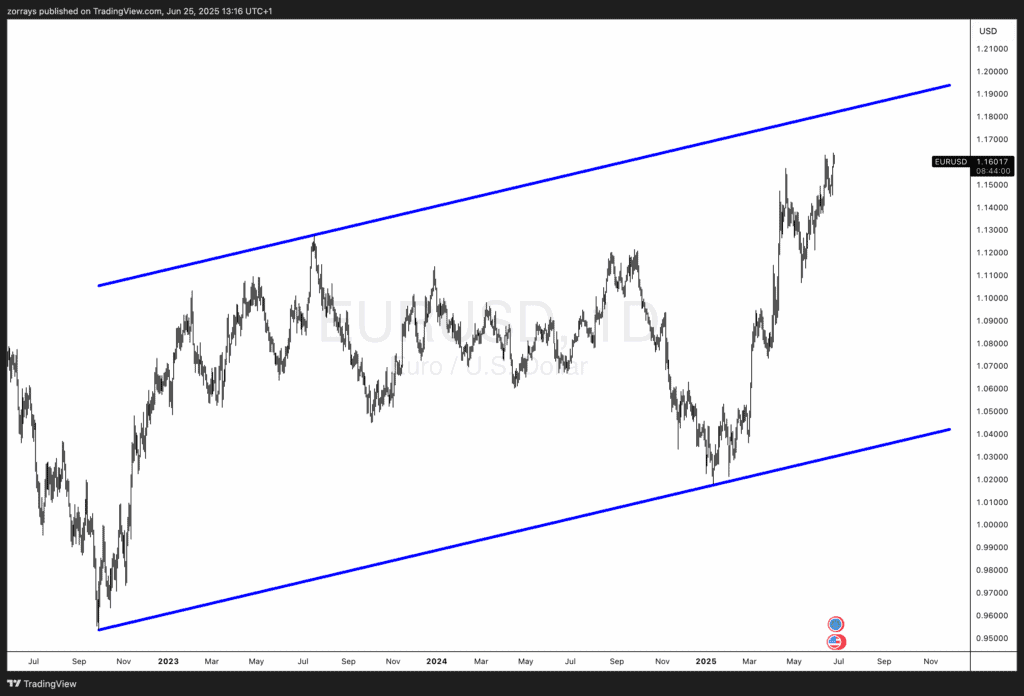
From a technical standpoint, the EUR/USD appears poised for further gains. As illustrated in the chart (see image), the pair is trading within a well-defined ascending channel, currently approaching the upper boundary near the 1.17 level. With strong momentum and little immediate resistance, the euro still has room to run.
However, breaking above the channel is another story—one that would require either a sharply dovish turn by the Fed or an unexpected negative shock to the dollar. Until then, the upper bound may act as a ceiling, inviting caution among bulls.
Today brings the second half of Powell’s congressional testimony, accompanied by U.S. housing data for May. While not market-moving in isolation, any dovish nuance in Powell’s remarks could extend dollar weakness. That said, some stabilization may occur as markets digest recent moves and reassess positioning.
With geopolitical fears receding and Powell walking a delicate line between caution and dovishness, the dollar finds itself on uncertain ground. Meanwhile, the euro is capitalizing on this ambiguity, buoyed by strong technical support and sentiment. As EUR/USD approaches the top of its channel, bulls may find more room to climb—but should be wary of overstaying the rally without a fundamental catalyst to break higher.
Alchemy Markets is a multi-asset brokerage providing retail traders with the same elite trading conditions, tools, and transparency typically reserved for institutions.

Select the categories and companies you wish to follow directly to your person rss feed.
Create Custom RSS Feedjust now
Sign up and join over 5,000 professional members who receive personalized news alerts, curated professional connections, and more for free!
Gold saw a strong rebound from $3,503. The recovery pushed price to $3,690, but momentum has since stalled and price is now around $3,624. The recent candles are relatively small and overlapping, indicating consolidation.
The Nasdaq 100 rallied nearly 7% after Nvidia reinstated Jensen Huang. Can NAS100 hold 25,665–26,155 as support and extend the recovery toward 28,250?
U.S. stock futures fell on Tuesday, giving back part of Monday’s sharp rally. Nasdaq-100 futures dropped 1%, S&P 500 futures fell 0.4%, and Dow futures slipped 0.1%. The pullback followed a 31% surge in Nvidia on Monday after Jensen Huang’s return as CEO, which reignited the broader AI and semiconductor trade. Nvidia was down more than 3% in pre-market trading Tuesday.
Last week was the worst for US technology stocks since March 2020. The Nasdaq Composite fell 10% and is now down for the year. The S&P 500 fell 8.6%, declining every day, and closed in correction, 11.6% below its October record. The semiconductor index lost about 17%, its worst week since the one after September 11, 2001. All of this came in the same week Nvidia reported revenue more than doubling and raised its outlook again.
Your Bourse and NetShop ISP have established a private fibre cross-connect between Equinix LD6 and LD4 in London. Available on demand, the link gives brokers using both providers a direct route for pricing and order traffic, bypassing the public internet and helping reduce network latency and jitter.
We spoke with Finalto’s Group Head of Liquidity, Sam Horowitz, and members of his UK team about what defines a modern liquidity operation.
Demo trading feels easier, but live trading changes your decisions. Learn how fear, loss aversion, hesitation, and risk affect your entries, exits, and trading discipline.
The CFD broker added nearly 1.7 million users in 2026 and expanded its range from 800 instruments to more than 1,100, including US share and ETF CFDs available outside regular market hours.
Zodia Markets has appointed Jan Brzezek, Founder of Swiss digital asset firm Crypto Finance AG, as chief executive.
Apolonia Capital has secured a licence to manage investment funds onshore in the United Arab Emirates.