just now


Liquidity Finder Ltd is incorporated in England and Wales, company number 10610740, registered address 167-169 Great Portland Street, Fifth Floor, London W1W 5PF, United Kingdom.
Published: just now

On July 30, 2025, the Federal Open Market Committee (FOMC) held the federal funds rate steady at 4.25%–4.50%, in line with broad market expectations.
This marks the third consecutive meeting without a rate change.
However, the vote wasn’t unanimous. Two members of the Board of Governors Michelle Bowman and Christopher Waller dissented, each favoring a 25 basis point cut.
It was the first time since 1993 that more than one governor dissented from the consensus.
In his post-decision comments, Chair Jerome Powell stated that current policy remains “modestly restrictive,” suggesting that interest rates are not holding back the economy inappropriately.
He reinforced the Fed’s data-dependent approach, noting that inflation is still running around 2.7%, and flagged that upcoming tariffs scheduled for August 1 could place additional upward pressure on prices.
Although the Fed did not explicitly commit to any future rate action, Powell left the door open for a cut later in the year if the economic data especially labor and inflation metrics support such a move.
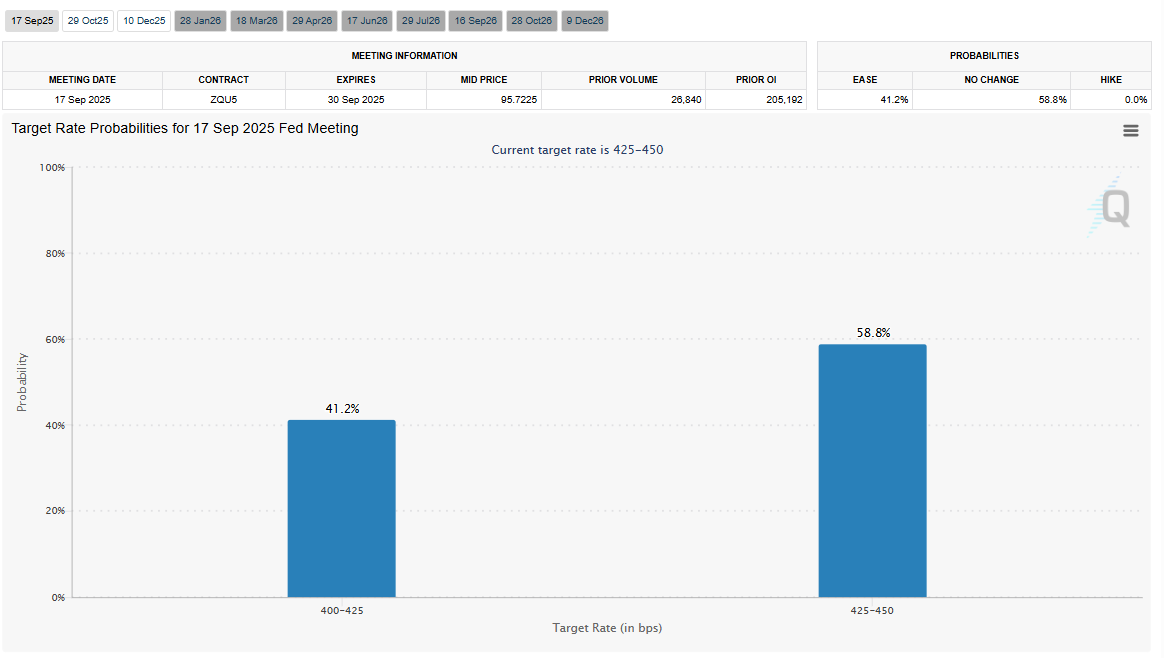
With the market pricing nearly a 50/50 change of no cuts for Sep 25
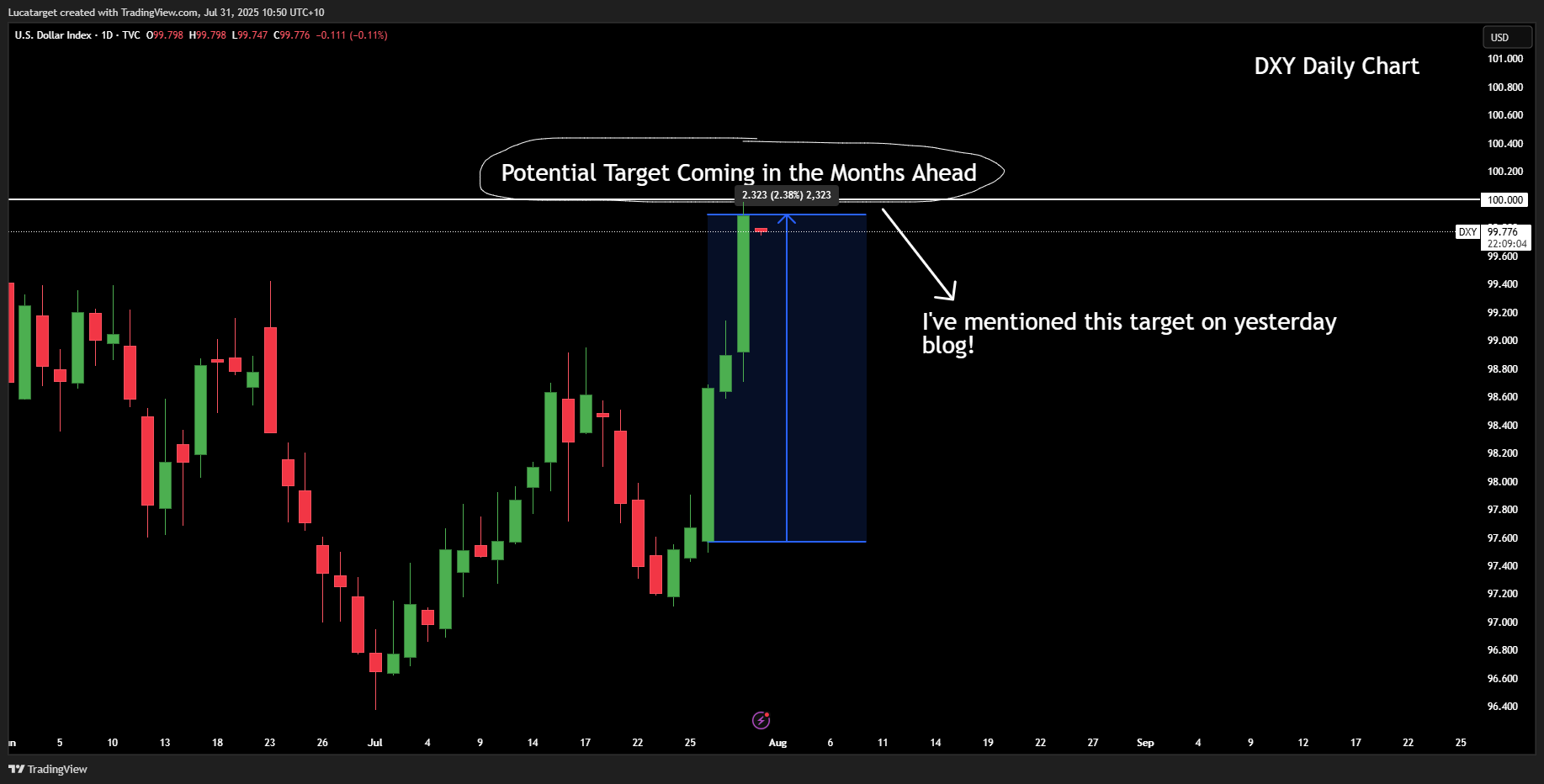
Markets moved decisively following the announcement. The U.S. Dollar Index (DXY) surged more than 2% on the week, supported by higher Treasury yields and a resilient macro backdrop.
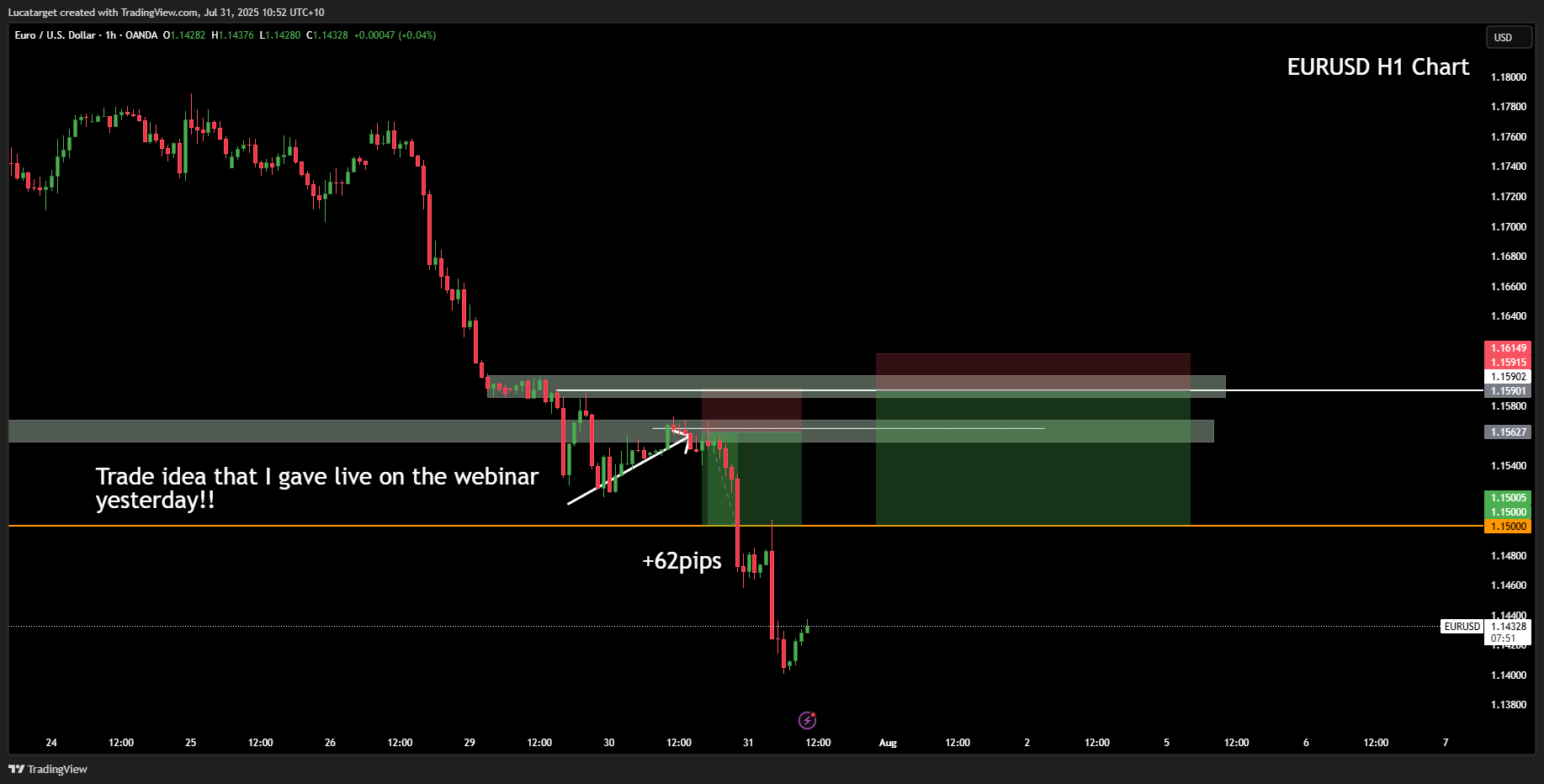
EUR/USD was hit hard, falling from pre-FOMC levels near 1.1600 to around 1.1400 a 200-pip drop that reflects shifting interest rate expectations and diverging central bank paths.
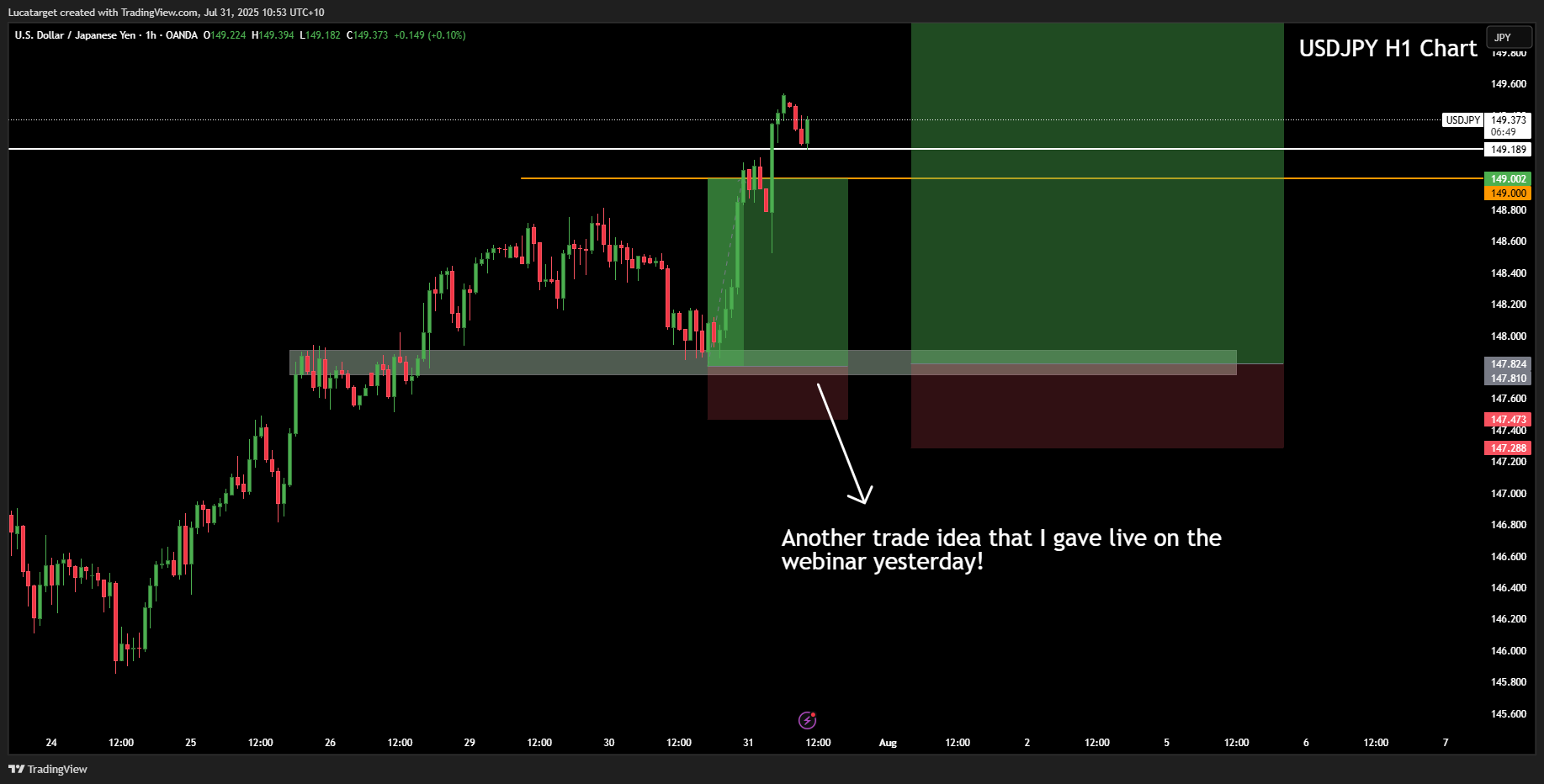
Meanwhile, USD/JPY rallied sharply from 147.80 to as high as 149.50. The move was driven by the twin effects of a stronger dollar and continued yen weakness as the Bank of Japan holds firm on its accommodative stance.
These moves collectively signal that traders are repricing risk around the Fed’s renewed hawkish tone and the fading likelihood of an imminent rate cut. The well known Higher For Longer!
Looking forward, the market’s focus now shifts to key incoming data. The August jobs report and CPI release will be crucial in shaping expectations ahead of the next FOMC meeting in September.
Chair Powell’s remarks at the Jackson Hole symposium in mid-August are also likely to be market-moving. Any shift in tone toward easing or further emphasis on staying the course will influence both yields and FX valuations.
The divergence between the Fed and other major central banks, particularly the European Central Bank and the Bank of Japan, is creating renewed momentum in favor of the dollar.
Traders are increasingly positioning for a continued carry environment, especially if the Fed holds rates steady through Q3.
The FOMC delivered no surprises on the rate decision itself, but the internal dissent and Powell’s reaffirmation of a “modestly restrictive” stance sent a clear signal: the Fed is not ready to pivot just yet. Despite political pressure and pockets of softness in the data, the Committee remains focused on inflation and macro resilience.
As the dollar reasserts its strength across major pairs, traders will be watching closely for signs of deceleration in core inflation or cracks in labor market resilience. Until then, the Fed’s steady hand may continue to dominate directional bias in FX.
1. Why did the Fed keep rates unchanged if inflation is still above 2%?
The Fed believes its current policy stance is “modestly restrictive,” meaning it's tight enough to keep inflation in check without stalling growth. Powell emphasized a data-dependent approach, allowing time to evaluate the impact of previous hikes.
2. What does dissent within the Fed mean for markets?
Dissent signals division within the Committee. When multiple governors vote against the majority, it suggests growing internal debate often a precursor to future policy shifts. In this case, two governors favoring a rate cut adds weight to dovish expectations later this year.
3. How does a steady Fed rate impact the U.S. dollar?
When the Fed holds rates steady while other central banks consider easing, it strengthens the dollar. The higher relative yield attracts capital inflows, which supports the USD across the board—as we saw with EUR/USD and USD/JPY post-decision.
4. What are the key dates to watch next?
Watch for the August nonfarm payrolls (NFP), the CPI inflation print, and Jerome Powell’s Jackson Hole speech in mid-August. These events will help shape expectations ahead of the September 17 FOMC meeting.
5. Could tariffs influence future rate decisions?
Yes. New tariffs, especially if inflationary, may force the Fed to hold off on cuts or even signal further tightening. However, if tariffs slow growth or hit consumer sentiment, they could support a policy shift toward easing.
This content may have been written by a third party. ACY makes no representation or warranty and assumes no liability as to the accuracy or completeness of the information provided, nor any loss arising from any investment based on a recommendation, forecast or other information supplies by any third-party. This content is information only, and does not constitute financial, investment or other advice on which you can rely.
ACY Securities is one of Australia's fastest growing multi-asset online trading providers, offering ultra-low-cost trading, rock-solid execution, technologically superior account management and premium market analysis.

Select the categories and companies you wish to follow directly to your person rss feed.
Create Custom RSS FeedSign up and join over 5,000 professional members who receive personalized news alerts, curated professional connections, and more for free!
Multi-asset trading broker AvaTrade has agreed to acquire the majority of FXCM Group’s business and brand, in a transaction that would bring a longstanding retail FX franchise into the AvaTrade Group.
LSEG and CMC Markets have signed a multi-year strategic data agreement expanding CMC's access to LSEG's real-time and delayed pricing, reference and corporate actions data, news and analytics, plus AI-ready content, to support new products, entry into new markets and the growth of CMC's institutional and B2B partnerships.
The Tel Aviv Stock Exchange is considering a bid for the Cyprus Stock Exchange, with Israeli media citing its EU licence, trading platform and clearing house. Euronext’s Athens exchange and India’s National Stock Exchange are also seen as contenders, and Cyprus aims to sign a sale agreement by the end of this year.
CME Group will launch baseball futures on 12 October, pending regulatory review, tracking CME FutureSports Performance Indexes built on Official League Data. Standard and micro contracts will start with the 2026 Postseason and the four clubs in the League Championship Series, trading around the clock.
ESMA has published an opinion stating that MiCA-authorised crypto-asset service providers should cease services tied to non-MiCA-compliant stablecoins for EU clients across MiCA crypto-asset services. National authorities should require remediation of existing exposures within three months, by early January 2027.
Nasdaq Ventures has made a strategic investment in Amsterdam-based derivatives and crypto exchange One Trading, with both firms to explore 24/7 trading of equity futures. The undisclosed investment follows Nasdaq's US$100 million investment in Payward, the parent of Kraken, and CME Group's move to 24/7 trading.
cTrader has opened multi-platform plugins to brokers and prop firms, which can pre-install their own tools for clients or list them in cTrader Store. The plugins run across Mobile, Web, Windows and Mac, and can be built and launched independently of core-platform releases, including trading journals and calculators.
Institutional brokerage and financial infrastructure provider Clear Street has joined TradingView’s broker network, allowing its clients to trade US stocks, exchange-traded funds and options directly through the charting and analysis platform.
Learn how to improve trading psychology, manage fear and greed, avoid revenge trading, and follow your trading strategy with discipline and a trading journal.
GTC Prime has announced a strategic partnership with Centroid Solutions to manage and distribute its liquidity through CS 360 Bridge, Centroid's multi-asset connectivity and execution engine, giving brokers and institutional clients access to tailor-made pricing, low-latency execution and real-time risk management.