just now


Liquidity Finder Ltd is incorporated in England and Wales, company number 10610740, registered address 167-169 Great Portland Street, Fifth Floor, London W1W 5PF, United Kingdom.
Published: just now


Last week, the Swiss National Bank (SNB) made its first policy rate reduction since 2019, indicating the possibility of another cut in June. Despite this adjustment to a new lower policy rate of 1.50%, inflation is still expected to fall short of the target. As a result, strategic positioning suggests that both EUR/CHF and USD/CHF will likely continue an upward trajectory in the second quarter, with the SNB ready to intervene in the foreign exchange market if necessary.
The decision to lower rates by 25 basis points to 1.50% was prompted by recent months' lower inflation trajectory. Chair Jordan's remarks on price stability and the currency since January heightened the likelihood of a policy shift this month. With new inflation projections indicating a potential further decrease to 1.25% in June, the SNB is actively responding to economic indicators.
Revisions to inflation forecasts reflect adjustments in goods prices, with this year's estimate downgraded to 1.4% and next year's to 1.2%. Additionally, weak demand from abroad and the appreciation of the Swiss franc have dampened growth prospects, with the economy anticipated to grow by approximately 1% this year, potentially leading to a gradual increase in unemployment.
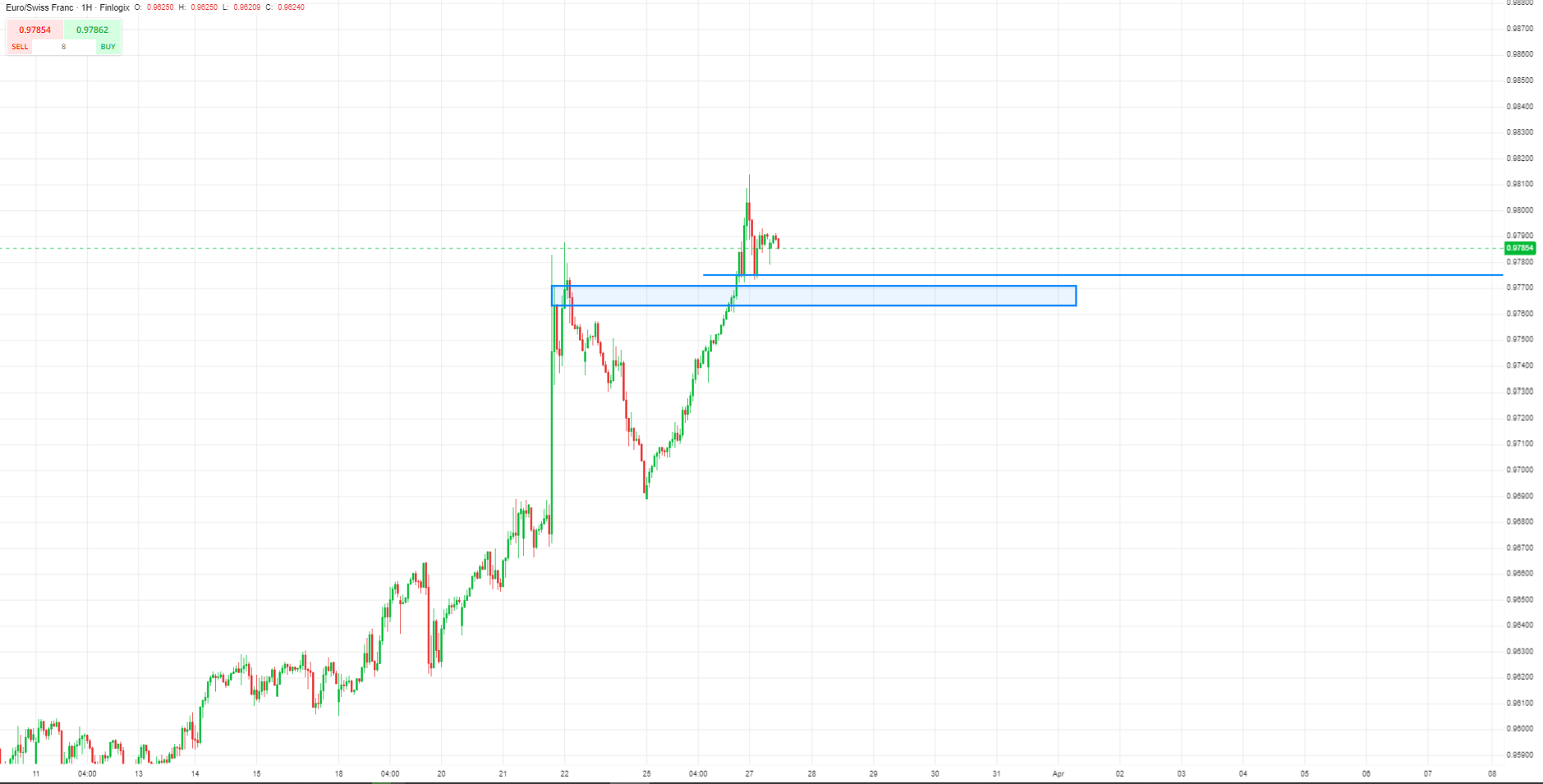
Looking at technical analysis, EUR/CHF has surpassed a significant hurdle at 0.9775, marking a 61.8% retracement from January 2023. While an initial pullback is underway, support remains crucial near last week's low of 0.9610.
EURCHF 1H
Meanwhile, despite the Bank of Japan's (BoJ) termination of negative interest rates and its decision to raise the policy rate from -0.1% to 0%, speculation surrounding FX intervention persists. The Yen weakened below 151 following the BoJ's move, prompting concerns addressed by top FX official Kanda regarding speculative pressures. USD/JPY's upward movement following the Federal Open Market Committee's decision to maintain three rate cuts this year was not challenged by retracements in U.S. Treasury yields.
The BoJ's decision to end over a decade of negative interest rates reflects confidence in achieving the 2% price stability target, with a focus on sustainable inflation through spring wage agreements. While the bank plans to maintain accommodative policies, it also indicated a willingness to counteract yen weakness with higher interest rates rather than adjustments to JGBs.
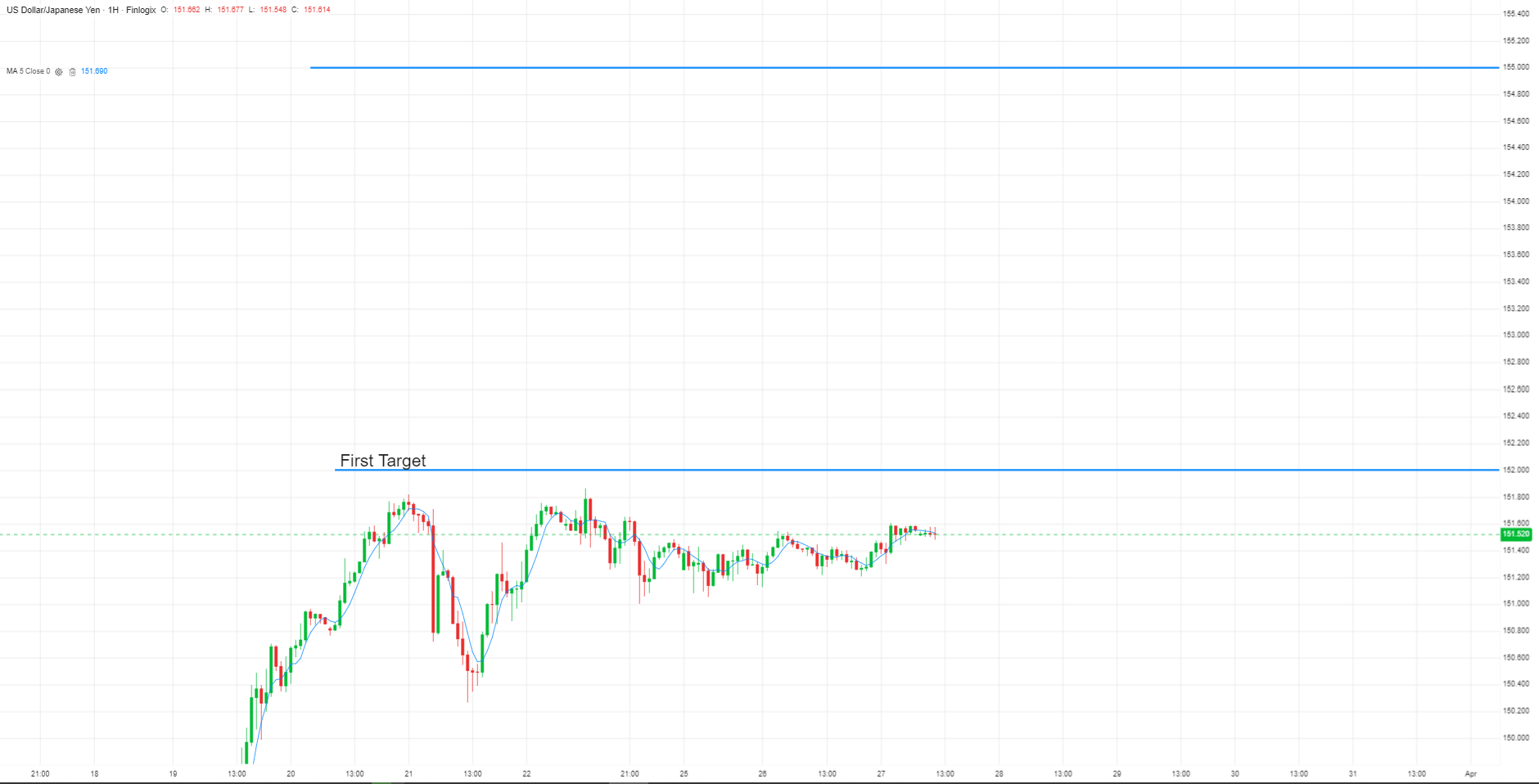
USDJPY H1
Looking ahead, economists project a potential increase to 0.25% in October, which may influence portfolio repatriation and contribute to a stronger yen over time. This, in turn, could impact long-term U.S. Treasury yields and the shape of the U.S. yield curve.
In terms of technical analysis, USD/JPY faces a critical resistance level at 152, representing last year's peak, with the ongoing uptrend likely to continue if breached. Short-term support is evident near the 50-day moving average at 149.10.
Insights Inspired by Societe Generale: Credit to Their Analysis for Shaping Some Aspects of This Text
This content may have been written by a third party. ACY makes no representation or warranty and assumes no liability as to the accuracy or completeness of the information provided, nor any loss arising from any investment based on a recommendation, forecast or other information supplied by any third-party. This content is information only, and does not constitute financial, investment or other advice on which you can rely.
ACY Securities is one of Australia's fastest growing multi-asset online trading providers, offering ultra-low-cost trading, rock-solid execution, technologically superior account management and premium market analysis.

Select the categories and companies you wish to follow directly to your person rss feed.
Create Custom RSS FeedSign up and join over 5,000 professional members who receive personalized news alerts, curated professional connections, and more for free!
Theorem has integrated Symbiotic’s Liquid Lane RFQ network, letting holders of tokenised real-world assets trade against on-chain pool liquidity and market-maker quotes. The integration is live on Ethereum, with Midas’s yield-bearing mHYPER fund as the first supported asset. Holders can trade for the USDC stablecoin.
US equities were volatile with technology selloff erasing much of the earlier rebound.
FM Summit London 2026 returns to Old Billingsgate on 24 November for its 15th edition, with LMAX Group, Plus500 and oneZero among confirmed exhibitors. The one-day event adds Business Connect meetings and roundtables, and opens with a networking evening at The Folly on 23 November.
Finance Magnates Summit London returns to Old Billingsgate on 24 November 2026 for its 15th edition. The one-day event brings together brokers, liquidity providers, institutional firms, trading technology vendors, payments businesses and digital asset firms.
iSAM Securities Apex has integrated with Match-Prime, giving brokers access to liquidity across more than 2,000 instruments, with tailored pricing and up to 10 levels of market depth.
propfunding.com's free-entry instant funding changes the order of prop funding. Start trading first. Its free-entry instant funding model offers two qualification attempts without an upfront activation fee.
US stocks closed higher on Wednesday, with the Nasdaq gaining 1%, the S&P 500 rising 0.6%, and the Dow advancing 0.7%, as renewed enthusiasm for AI-related stocks lifted market sentiment.
SpaceX went public in June as a rocket company. On October 20 it reported as something else entirely: an AI infrastructure business, financed by a satellite broadband network, with a launch division attached. Rockets generated 12% of third quarter revenue and lost money. The AI segment generated 52% of revenue and consumed 84% of capital expenditure. Starlink generated 85% of operating profit.
Standard Chartered has signed definitive agreements to acquire 100% of Zodia Custody UK Limited, folding its regulated digital asset custody business into Securities Services. Zodia Solutions will be set up under SC Ventures with bank investors including Northern Trust, NAB Ventures, Emirates NBD and Investcorp.
Bybit Fintech FZE has secured a Virtual Asset Service Provider licence from Dubai’s Virtual Assets Regulatory Authority for Exchange Services, covering spot trading. Bybit’s Peter Loo said the firm hopes to add derivatives, subject to regulatory approvals. Its international Dubai headquarters opened in 2022.