
just now


Liquidity Finder Ltd is incorporated in England and Wales, company number 10610740, registered address 167-169 Great Portland Street, Fifth Floor, London W1W 5PF, United Kingdom.
Published: just now


The FX market remains riddled with ambiguity, where positive headlines and underlying fragilities battle for influence. While USD strength has faded slightly, a cohesive narrative has yet to emerge. The recent FOMC decision, which left rates unchanged, reaffirmed the Fed’s data-dependent stance. Chair Powell didn’t push back aggressively against rate cut expectations, yet also didn’t endorse them. The takeaway: the Fed is in "wait-and-see" mode, acknowledging signs of economic softening without abandoning caution over inflation especially with trade-related price pressures looming.
If you would like to read the full article from FOMC click here
That stance aligns with market pricing. A rate cut for June is nearly priced out, but the July meeting remains in focus, contingent on how economic data unfold and whether the tariff situation deteriorates further.
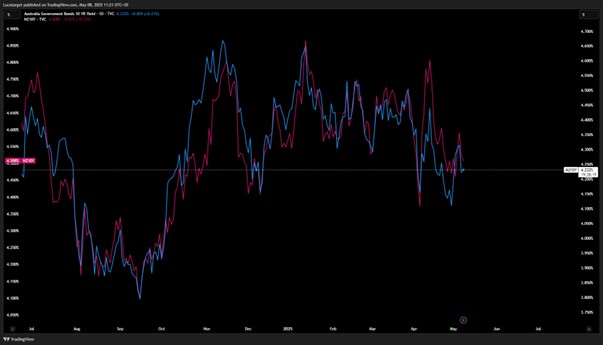
The initial lift from U.S.–China talks, set to resume in Switzerland, offered little fuel for the Aussie and Kiwi. These currencies, typically hypersensitive to global growth signals, appear desensitized. The problem isn’t that tariff de-escalation talks are unwelcome; it’s that they’re too little, too late. Market participants are working under the assumption that most of the growth damage is already baked in. Australian and New Zealand yields have slumped, underscoring the market’s conviction that rate cuts are on the horizon even if central banks are not rushing to deliver them.
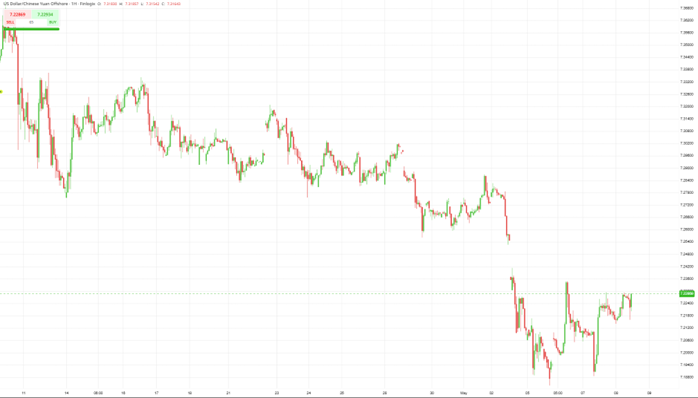
Beijing finally pulled the trigger on a widely anticipated stimulus bundle. The PBoC’s 50bps RRR cut and 10bps trim on the 7-day reverse repo rate arrived alongside structural support for sectors like elderly care and small businesses. Yet markets met the package with a shrug. The reaction in Chinese equities and bonds was tepid, not because easing was unwelcome, but because it’s been so well-telegraphed and possibly not aggressive enough given the scale of the threat.
The CNY sits near 7.23 against the dollar, but that level may be living on borrowed time. MUFG expects a move toward 7.40 in Q2 and 7.45 by Q3, and it’s hard to argue against that view. With Trump-era tariff escalation effectively reinstated, a 40% average tariff on Chinese imports is a realistic risk. That’s a major headwind not just for Chinese exports, but also for sentiment and capital flows.
Sterling has found itself in a balancing act. April’s construction PMI came in at 46.0, confirming that the UK building sector is still struggling below the 50 threshold that marks expansion. However, upcoming gilt auctions particularly the 5-year tranche may support demand for UK assets as investors seek yield amid global policy hesitation. The Bank of England, for its part, remains cautious, and the pound has shown resilience, especially against the euro, helped by relative economic stability.
The Canadian dollar has weathered the global storm better than many of its peers, though the path ahead is far from smooth. April’s leading index reading will offer another clue into the domestic economy’s pulse. Still, the CAD remains tethered to external factors, like, oil prices, U.S. policy, and risk appetite. Any disappointment in trade negotiations or a flare-up in geopolitical tensions (especially in Asia) would likely see CAD retreat alongside other risk-sensitive FX.
Despite occasional spurts of strength, the broader picture for the dollar remains bearish. Treasury yields may have rebounded modestly, but the underlying trend in U.S. data softening growth, moderating inflation, and dovish Fed sentiment is pushing investors away from USD. Even the Beige Book, often overlooked, provided a subtle red flag: negative sentiment terms like “uncertainty” and “decline” hit their most extreme since the early COVID period.
Trade policy remains the wildcard. If the upcoming U.S.–China negotiations disappoint, we may see a renewed bid for safe havens. But if talks genuinely progress unlikely as that may seem risk appetite could lift further, weakening the dollar and boosting the yen, euro, and emerging markets.
This content may have been written by a third party. ACY makes no representation or warranty and assumes no liability as to the accuracy or completeness of the information provided, nor any loss arising from any investment based on a recommendation, forecast or other information supplies by any third-party. This content is information only, and does not constitute financial, investment or other advice on which you can rely.
ACY Securities is one of Australia's fastest growing multi-asset online trading providers, offering ultra-low-cost trading, rock-solid execution, technologically superior account management and premium market analysis.

Select the categories and companies you wish to follow directly to your person rss feed.
Create Custom RSS FeedSign up and join over 5,000 professional members who receive personalized news alerts, curated professional connections, and more for free!
Bybit has launched Perp Options, described as the first options contracts built on TradFi perpetuals, giving traders round-the-clock access to US equity options. SpaceX and Nvidia are the first underlying assets, with USDT settlement and integration into Bybit's Unified Trading Account.
Use this trading preparation checklist to plan your session, define entry rules, manage risk, and build a disciplined trading routine in seven steps.
Your Bourse expands its crypto liquidity ecosystem with Caladan, giving brokers access to broader market coverage, institutional execution capacity and streamlined settlement.
Scope Markets, the retail brokerage part of Rostro Group, has appointed Ibrahim Hossny as Head of Research and Marketing for the Middle East and North Africa.
Hantec Prime, the institutional division of Hantec Markets, has reported trading volume up more than 300% year-to-date, alongside the addition of 42 new institutional clients since December, capping one of its strongest years of growth to date.
Learn how to refine XAUUSD support and resistance on the daily chart using candle bodies, market structure and weekly gold levels for swing trading. A slug alone cannot guarantee a top Google ranking. Keep it focused rather than adding every supporting keyword.
The week in Dubai will be focused on connecting directly with the industry and discussing how technology can help modern brokerages simplify operations, automate workflows, strengthen operational control, and scale efficiently.
Devexperts has launched a turnkey solution giving brokers in South Korea access to US equity markets, combining its DXtrade trading platform, dxFeed market data, and execution services. The offering targets South Korea's growing retail demand for US stocks, worth several billion USD monthly.
Assess why WTI crude oil surged past $105 per barrel amid Saudi pipeline disruptions, record tanker charter rates, and escalating geopolitical tensions.
Bitcoin price forecast: BTC/USD retests $78,460–$80,215 resistance. Watch bearish confirmation toward $72,480 or a bullish breakout toward $86,150.