
just now


Liquidity Finder Ltd is incorporated in England and Wales, company number 10610740, registered address 167-169 Great Portland Street, Fifth Floor, London W1W 5PF, United Kingdom.
Published: just now


Financial markets are in the middle of a tense recalibration. Global equities are under pressure, with the Nasdaq leading the sell-off after a sharp 4% drop this week, extending its losses from the December highs to nearly 14%. This sudden downturn has sent investors scrambling for safety, pushing bond yields lower and reigniting speculation around Federal Reserve rate cuts. But the FX market is reacting in a more nuanced way—while the US dollar remains supported, the real question is whether this is the beginning of a shift in market sentiment or just another wave of volatility.
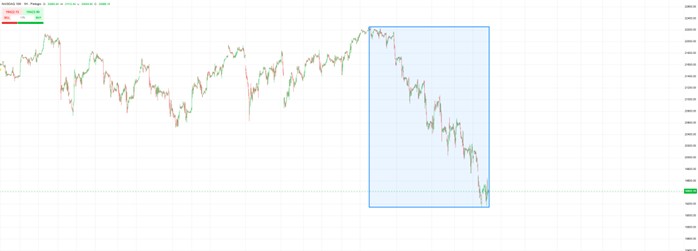
The US dollar continues to be the focal point of global FX markets. On the one hand, risk aversion has fuelled demand for safe-haven assets, allowing the USD to hold its ground despite a steep equity market sell-off. The traditional risk-off moves played out in FX markets: the yen, Swiss franc, and euro found support, while high-beta currencies, including the Australian, New Zealand, and Canadian dollars, struggled.
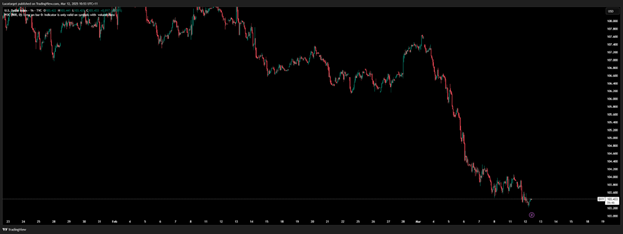
However, the backdrop for the dollar is far from straightforward. US rate market participants have quickly adjusted their expectations, now pricing in more aggressive Fed rate cuts amid mounting concerns over economic slowdown. The latest moves in the Treasury market reflect these concerns—2-year yields have dropped to fresh lows of 3.83%, while 10-year yields have broken below key technical support levels.
Today’s JOLTS job openings report will be critical in determining the near-term direction of the USD. The labour market has been the key pillar of US economic resilience, and any signs of softening—particularly in the quits rate, a leading indicator of wage growth—could lead to a fresh repricing of Fed policy expectations. If job openings disappoint, expect an increase in bets on a more dovish Fed, which could weigh on the dollar.
Despite market jitters, the euro has held relatively firm. Political headlines out of Germany have created some short-term volatility, but the broader market sentiment remains cautiously optimistic.
Chancellor-in-waiting Friedrich Merz is pushing for a major fiscal expansion, including increased spending on defence and infrastructure. However, he faces opposition from the Green Party, whose support is necessary to secure a two-thirds majority in parliament. The initial rejection of Merz’s proposal rattled markets, but more recent reports suggest that negotiations are ongoing, and a deal could still be reached before the March 25 deadline when the new parliament is seated.
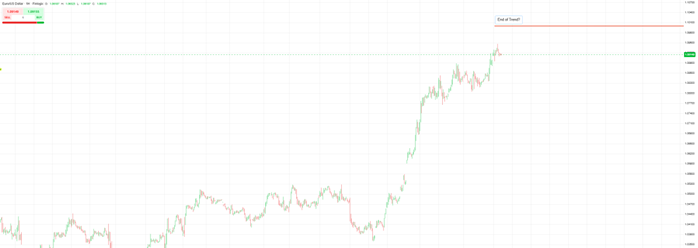
This fiscal debate is more than just a political side story—it has real implications for the euro and broader European markets. If Germany moves forward with a €500 billion infrastructure fund, it could provide a much-needed boost to economic growth, particularly in the struggling industrial sector. The prospect of stronger growth is one reason why EUR/USD has remained resilient despite external pressures.
That said, the euro is still heavily influenced by US developments. While markets may be optimistic about Germany’s fiscal outlook, a worsening US economic backdrop or renewed equity market turmoil could push EUR/USD lower in the near term. For now, the pair remains in a consolidation phase, with 1.070 as a key downside target while a move above 1.090 remains possible if sentiment improves.
The current equity market correction has been one of the most significant in months, yet the FX market has not responded with extreme volatility. Typically, a sharp sell-off in stocks would trigger stronger moves in FX, but so far, the spillover has been limited.
Part of this can be attributed to uncertainty about the USD’s role as a haven. While the dollar has benefited from risk-off flows, its rally has been restrained by expectations of a more dovish Fed. If risk appetite continues to deteriorate, it remains unclear whether the USD will strengthen further or start weakening alongside falling yields and equity prices.
Commodity-linked currencies such as the AUD, CAD, and NZD have seen some downside pressure, but the moves have been moderate. Meanwhile, the Norwegian krone, Swiss franc, and yen have outperformed slightly, though not in a dramatic fashion.
Emerging market currencies have been navigating a mixed environment. In Asia, risk aversion combined with escalating US-China trade tensions has weighed on regional currencies. President Trump’s recent tariff increases on Chinese imports—now 20% higher than during his first term—have added another layer of uncertainty. While China has signalled more fiscal and monetary stimulus, investors remain cautious about the near-term outlook.
In contrast, Central European currencies have been relative outperformers. The Czech koruna and Hungarian forint have found support from improving sentiment around Germany’s fiscal expansion and stronger economic growth prospects in Europe. Markets are also pricing in a more cautious approach from regional central banks, which could keep rate differentials supportive for CEE FX.
In Latin America, currencies have come under pressure, with the Chilean peso (-1.7%), Colombian peso (-1.2%), and Brazilian real (-1.1%) posting notable declines. The combination of weaker risk appetite and concerns over commodity demand has weighed on the region’s outlook. However, strong local rate differentials continue to provide some cushion against deeper losses.
The FX market is at a pivotal juncture. The US dollar remains supported for now, but it’s safe-haven appeal is being challenged by shifting Fed expectations. The euro is holding up, but political developments in Germany could still influence its trajectory. Meanwhile, emerging markets are showing signs of divergence, with Asian currencies under pressure while Central European FX benefits from improved sentiment.
With so many moving parts, markets are likely to remain volatile in the near term. Staying ahead of key data releases and political developments will be crucial for navigating the current landscape. As we move forward, expect sharp swings as traders adjust their positions in response to fresh economic signals and shifting global risk sentiment.
This content may have been written by a third party. ACY makes no representation or warranty and assumes no liability as to the accuracy or completeness of the information provided, nor any loss arising from any investment based on a recommendation, forecast or other information supplies by any third-party. This content is information only, and does not constitute financial, investment or other advice on which you can rely.
ACY Securities is one of Australia's fastest growing multi-asset online trading providers, offering ultra-low-cost trading, rock-solid execution, technologically superior account management and premium market analysis.

Select the categories and companies you wish to follow directly to your person rss feed.
Create Custom RSS FeedSign up and join over 5,000 professional members who receive personalized news alerts, curated professional connections, and more for free!
Bybit has launched Perp Options, described as the first options contracts built on TradFi perpetuals, giving traders round-the-clock access to US equity options. SpaceX and Nvidia are the first underlying assets, with USDT settlement and integration into Bybit's Unified Trading Account.
Use this trading preparation checklist to plan your session, define entry rules, manage risk, and build a disciplined trading routine in seven steps.
Your Bourse expands its crypto liquidity ecosystem with Caladan, giving brokers access to broader market coverage, institutional execution capacity and streamlined settlement.
Scope Markets, the retail brokerage part of Rostro Group, has appointed Ibrahim Hossny as Head of Research and Marketing for the Middle East and North Africa.
Hantec Prime, the institutional division of Hantec Markets, has reported trading volume up more than 300% year-to-date, alongside the addition of 42 new institutional clients since December, capping one of its strongest years of growth to date.
Learn how to refine XAUUSD support and resistance on the daily chart using candle bodies, market structure and weekly gold levels for swing trading. A slug alone cannot guarantee a top Google ranking. Keep it focused rather than adding every supporting keyword.
The week in Dubai will be focused on connecting directly with the industry and discussing how technology can help modern brokerages simplify operations, automate workflows, strengthen operational control, and scale efficiently.
Devexperts has launched a turnkey solution giving brokers in South Korea access to US equity markets, combining its DXtrade trading platform, dxFeed market data, and execution services. The offering targets South Korea's growing retail demand for US stocks, worth several billion USD monthly.
Assess why WTI crude oil surged past $105 per barrel amid Saudi pipeline disruptions, record tanker charter rates, and escalating geopolitical tensions.
Bitcoin price forecast: BTC/USD retests $78,460–$80,215 resistance. Watch bearish confirmation toward $72,480 or a bullish breakout toward $86,150.