just now


Liquidity Finder Ltd is incorporated in England and Wales, company number 10610740, registered address 167-169 Great Portland Street, Fifth Floor, London W1W 5PF, United Kingdom.
Published: just now


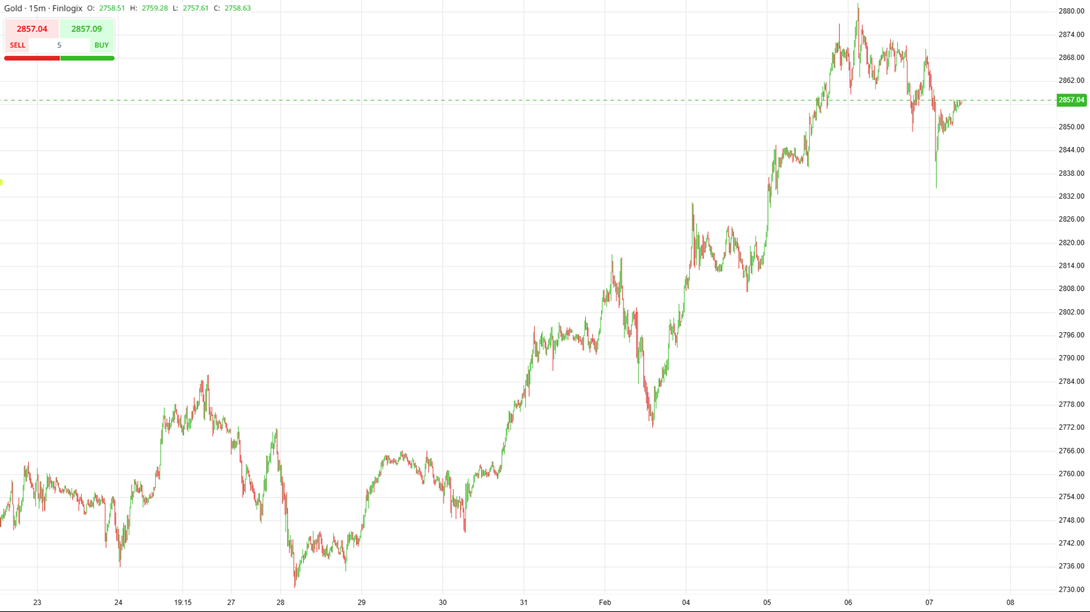
Gold has kicked off 2025 with an explosive start, consistently reaching new record highs as investors seek safety amidst a volatile economic and geopolitical landscape. With escalating trade tensions, shifting central bank strategies, and uncertainty surrounding U.S. monetary policy, gold’s appeal as a safe haven asset remains stronger than ever.
Trade disputes continue to weigh on global markets. The U.S. has pushed forward with 10% tariffs on Chinese imports, prompting immediate retaliation from Beijing. While tariffs on Canada and Mexico have been postponed, the uncertainty surrounding these policies is fuelling demand for gold. If trade negotiations deteriorate further, gold’s role as a hedge against economic instability will only be reinforced.
Beyond trade, political unpredictability is another key driver. President Donald Trump’s recent statements on U.S. involvement in Gaza reconstruction have added a new layer of uncertainty, amplifying demand for gold. With a highly volatile geopolitical environment, investors are turning to assets that offer protection against systemic risks, and gold remains at the top of that list.
A significant pillar of gold’s rally has been continued central bank purchases. In 2024, central banks acquired over 1,000 tonnes of gold for the third consecutive year, with China leading the charge. The National Bank of Poland also made aggressive moves, increasing its reserves by 90 tonnes.
This accumulation is largely driven by concerns over economic sanctions. The freezing of Russian assets by Western nations has prompted other countries to reconsider their reserve allocations, leading to increased diversification into gold. This trend is expected to persist in 2025, providing steady support for prices as central banks hedge against potential financial restrictions.
Following Trump’s re-election, gold stockpiles in the U.S. have surged. Comex inventories are at their highest levels since 2022, as tariff concerns and arbitrage opportunities have fuelled inflows. Imports from Switzerland, a key refining hub, have risen sharply, mirroring levels seen after Russia’s 2022 invasion of Ukraine.
While gold itself has not been directly targeted by U.S. tariffs, speculation remains that it could be included in broader trade restrictions. Should that occur, gold prices in the U.S. would likely experience heightened volatility and a restructuring of trade flows. With Mexico and Canada collectively accounting for nearly half of U.S. gold imports, any disruption to these supply chains would have significant market implications.
Exchange-traded funds (ETFs) tracking gold have also seen renewed interest. Despite a relatively flat performance in late 2024, ETF holdings have started to climb in recent weeks. If this trend continues, driven by geopolitical risks and expectations of U.S. rate cuts, it could provide another tailwind for gold prices.
Perhaps the most critical factor influencing gold’s outlook is the Federal Reserve’s interest rate policy. Following 100 basis points of rate cuts in late 2024, the Fed has opted to hold rates steady in early 2025. While rate cuts are still expected later in the year, a slower-than-anticipated pace of easing could temper some of gold’s momentum.
Nonetheless, declining interest rates remain a bullish factor for gold. With expectations of two rate cuts in the second half of 2025 and another possible cut in early 2026, lower borrowing costs will enhance gold’s attractiveness as a non-yielding asset. The market consensus suggests that as monetary policy loosens, gold will continue to find support from investors seeking stability.
Given the current macroeconomic backdrop, gold appears poised to break further records. The combination of falling interest rates, sustained central bank purchases, and geopolitical tensions provides a strong foundation for further gains. Current projections indicate an average price of $2,800/oz in the first quarter of 2025, with gold likely testing the $3,000/oz threshold before mid-year.
While a strong U.S. dollar and potential monetary tightening could introduce headwinds, increasing trade frictions and continued demand from institutional investors may offset these pressures. If uncertainty remains high, gold will maintain its status as the go-to asset for stability.
The year has just started, but gold is already proving its resilience in an era of uncertainty. Whether driven by trade wars, shifting central bank policies, or monetary easing, the precious metal remains a core asset for investors navigating volatile markets. With the right conditions in place, 2025 could very well be another historic year for gold.
This content may have been written by a third party. ACY makes no representation or warranty and assumes no liability as to the accuracy or completeness of the information provided, nor any loss arising from any investment based on a recommendation, forecast or other information supplies by any third-party. This content is information only, and does not constitute financial, investment or other advice on which you can rely.
ACY Securities is one of Australia's fastest growing multi-asset online trading providers, offering ultra-low-cost trading, rock-solid execution, technologically superior account management and premium market analysis.

Select the categories and companies you wish to follow directly to your person rss feed.
Create Custom RSS FeedSign up and join over 5,000 professional members who receive personalized news alerts, curated professional connections, and more for free!
Americans vote on November 3 for all 435 seats in the House of Representatives and a third of the Senate. The presidency is not on the ballot, which means any new Congress will still need the President's signature to turn bills into law. Markets care about the midterms less for the laws that follow and more for what changes in oversight, budgets and the regulatory mood of Washington.
The Australian Securities and Investments Commission has said it is not currently convinced that prediction markets for retail clients are in the public interest. ASIC Chair Sarah Court said prediction market contracts have all the features of a bet, likening them to binary options, which are banned for retail clients.
Binance has confirmed a security incident with an estimated total impact of around $6.3 billion, linked by its initial investigation to a compromised DevOps engineer's laptop. Around $3 billion has been frozen on-chain, and the exchange says it will cover all losses from its SAFU fund and company funds.
US crypto exchange Coinbase has reported net income of $719 million for the third quarter of 2026, up 66% from $432.6 million a year earlier. Prediction markets passed $200 million in annualised revenue, and paid Coinbase One subscribers reached an all-time high.
Webull Securities Co., Ltd., the Japanese subsidiary of Webull Corporation, has started handling US Treasury bonds, giving customers access to about 20,000 bonds as of 30 October 2026. The service lets users trade market-traded bonds like stocks, with real-time prices and yields, from $100.
Intercontinental Exchange and Trade[XYZ] have agreed to bring Trade[XYZ]’s perpetual markets onshore in the US through a new regulated market and clearing structure for round-the-clock retail trading built on Hyperliquid, operated separately from ICE’s institutional futures franchise, subject to regulatory approvals.
The Utah Attorney General's Office has filed 14 criminal charges against KalshiEX, LLC, the operator of US prediction market Kalshi, in a case that names co-founders Tarek Mansour, Chief Executive Officer, and Luana Lopes Lara, Chief Operating Officer, as co-defendants.
US blockchain payments company Ripple and US crypto exchange Coinbase have partnered to make Ripple's US dollar stablecoin, Ripple USD (RLUSD), available across Coinbase's platforms
The UK Financial Conduct Authority (FCA) has secured High Court undertakings to ensure that global crypto exchange HTX, formerly known as Huobi, will not knowingly promote cryptoasset services unlawfully to UK consumers.
US post-trade market infrastructure provider DTCC has launched its DTCC Tokenization Service (DTS) through its subsidiary The Depository Trust Company.