
just now


Liquidity Finder Ltd is incorporated in England and Wales, company number 10610740, registered address 167-169 Great Portland Street, Fifth Floor, London W1W 5PF, United Kingdom.
Published: just now


USD: Fed signals higher rates for longer & softer landing for US economy.
During the Asian trading session, the US dollar has maintained its strength following the recent FOMC meeting. This resulted in the dollar index reaching an intraday high of 105.69. The surge in the US dollar's value has been driven by the upward adjustment in US yields overnight. Specifically, the 2-year US Treasury yield saw a notable increase of approximately 12 basis points since just before the FOMC meeting, reaching an overnight intraday high of 5.18%. This represents a new cyclical high, surpassing the previous high of 5.12% from July.
The rise in short-term yields also had a mild effect on longer-term yields. The 10-year US Treasury yield increased by around 10 basis points, reaching a new cyclical high of 4.45%. This shift in yields was primarily triggered by the Federal Reserve's decision to adopt a more hawkish stance yesterday morning at 4am on Sydney time. While the Fed opted to keep the policy rate unchanged, the updated guidance provided a clear indication that the Fed intends to maintain higher interest rates for an extended period (hawkish stance). Consequently, the US rate market has scaled back its expectations for rate cuts by the Fed in the upcoming year, with approximately 58 basis points of cuts now being priced in by the end of the next year. This month alone, nearly 50 basis points of cuts have been removed from the US yield curve, lending further support to the US dollar.
The Fed's "higher for longer" message was articulated through revisions to economic and policy rate projections. The updated dot plot revealed that a majority of FOMC participants still plan to implement one final rate hike later this year. Out of the 19 participants, 12 favour increasing the policy rate to 5.625% by year-end, mirroring projections from June. The most significant alteration to the forecasts is that FOMC participants now anticipate fewer rate cuts in the coming years. The median projection for the Fed's policy rate by the end of the next year and the end of 2025 has both been raised by 0.50 point to 5.1% and 3.9%, respectively. Additionally, the Fed released projections for 2026 for the first time, showing a policy rate closer to their neutral estimate of 2.5%, with a projection of 2.9% by the end of 2026.
The primary reason behind the Fed's indication of a prolonged period of higher rates is its increased confidence in a softer landing for the US economy. There were notable upward revisions to GDP forecasts for this year and the next, now standing at 2.1% and 1.5%, respectively. This suggests a more modest slowdown in growth in the coming year. Consequently, the Fed no longer anticipates a significant rise in the unemployment rate from its current level of 3.8%, which is slightly above the cyclical low of 3.4% set in January. The unemployment rate forecasts for this year and the next were both revised downward by 0.4 percentage points to 4.1%. With less expected slack in the US labor market, the Fed does not foresee continued undershooting of their inflation projections in the years ahead. While the core PCE forecast for this year was lowered by 0.2 percentage points to 3.7%, core inflation forecasts for the next year and 2025 remained largely unchanged at 2.6% and 2.3%, respectively, with a slight increase of 0.1 point.
Overall, the Fed's updated guidance is expected to reinforce the upward momentum of the US dollar in the short term. There is a higher risk of one final rate hike in November or December, although weaker economic activity and core inflation data in Q4 could dissuade the Fed from following through with these plans. Similarly, we anticipate a more significant negative impact on the US economy in the coming year due to the delayed effects of previous aggressive tightening, which may encourage the Fed to implement more than the planned 50 basis points in rate cuts by the end of 2024.
USD VS. SHORT-TERM YIELD SPREADS
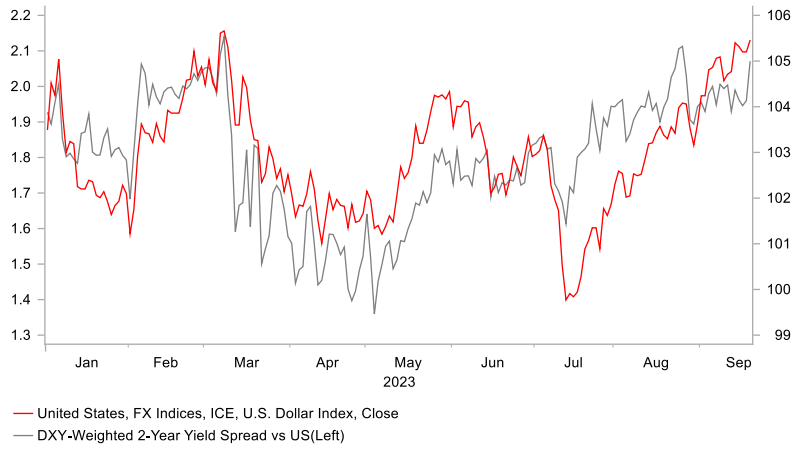
Source: Bloomberg, Macrobond & MUFG Research
This content may have been written by a third party. ACY makes no representation or warranty and assumes no liability as to the accuracy or completeness of the information provided, nor any loss arising from any investment based on a recommendation, forecast or other information supplied by any third-party. This content is information only, and does not constitute financial, investment or other advice on which you can rely.
ACY Securities is one of Australia's fastest growing multi-asset online trading providers, offering ultra-low-cost trading, rock-solid execution, technologically superior account management and premium market analysis.

Select the categories and companies you wish to follow directly to your person rss feed.
Create Custom RSS FeedSign up and join over 5,000 professional members who receive personalized news alerts, curated professional connections, and more for free!
The AI trade has always been a supply chain story. For the past two years, the narrative has been simple: insatiable demand for compute infrastructure, constrained supply at every choke point, and the companies that own the bottlenecks collect the toll. NVIDIA on GPUs. ASML on lithography. Samsung, SK Hynix, and Micron on memory. The entire semiconductor complex has traded on scarcity, and scarcity has delivered historic margins.
Interactive Brokers reported customer equity of USD 964.7 billion at the end of the third quarter, up 27% year on year, as customer accounts increased 35% to 5.58 million.
Crypto exchange BingX has secured a Markets in Crypto-Assets Regulation (MiCA) licence for its European arm from Austria's Financial Market Authority (FMA).
CXM Group has agreed to acquire TD Markets (Pty) Ltd, a Johannesburg-headquartered broker authorised by South Africa’s FSCA. TD Markets keeps its brand, team and licence, and Amar Ramith stays as CEO. Financial terms were not disclosed. The deal gives CXM a regulated base in South Africa. Clients need take no action.
Global equities under pressure: Hotter than expected US inflation and rising yields weighed on stocks, particularly technology and semiconductor shares.
Understand trading psychology and learn how a clear strategy, risk management and a trading journal help build discipline and day trading consistency.
Ripple Prime has launched support for real-world asset perpetual swaps, giving institutional clients including Virtu exposure to more than 100 reference markets across equities, indices, ETFs, metals, energy and FX. The swaps reference Trade.xyz perpetual futures on Hyperliquid and trade and settle around the clock.
iSAM Securities Apex has integrated with Crossover Markets, connecting brokers to CROSSx, its institutional digital asset ECN, through Apex’s ultra-low-latency technology stack.
Your Bourse and 4XPORTAL highlight their existing partnership, combining client onboarding, CRM and payment solutions with liquidity, execution and risk-management infrastructure for brokers.
The partnership brings together 4XPORTAL’s brokerage technology capabilities with Your Bourse’s connectivity, liquidity aggregation, and risk-management infrastructure.