just now


Liquidity Finder Ltd is incorporated in England and Wales, company number 10610740, registered address 167-169 Great Portland Street, Fifth Floor, London W1W 5PF, United Kingdom.
Published: just now

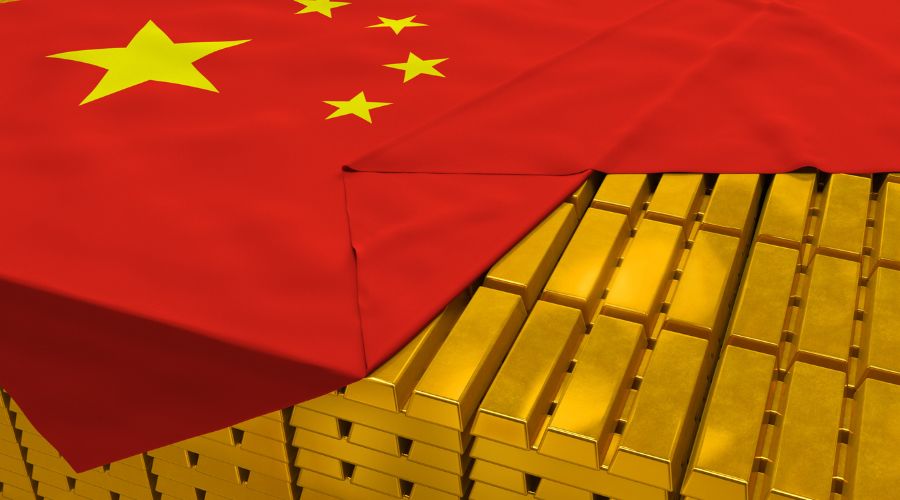
Gold’s rise in 2025 hasn’t been subtle. It’s loud, persistent, and hard to ignore XAU/USD has repeatedly made new all-time highs, pushing well beyond $2,400 and threatening to go even higher. On the surface, much of this move seems tied to global conflict the war in Ukraine, tensions in the South China Sea, and instability across parts of the Middle East. But dig deeper, and you'll find a powerful structural force behind the scenes: central banks, with China at the forefront.
One of the most important, yet underdiscussed, stories of this gold bull cycle is China’s systematic accumulation of physical gold a strategy that has profound implications for XAU/USD traders. And at the heart of it all lies a piece of post-2008 financial regulation that changed the game: Basel III.
Most traders know that central banks hold gold, but fewer understand the mechanics behind why they're buying more now and why it's likely to continue. Basel III, a regulatory framework developed by the Basel Committee on Banking Supervision, was introduced in the aftermath of the global financial crisis. While its primary aim was to strengthen the banking sector, one quiet consequence was a shift in how gold is treated on balance sheets.
Under previous rules, gold was considered a Tier 3 asset essentially risky and discounted in value. But Basel III changed that. Today, fully allocated physical gold is classified as a Tier 1 asset, putting it in the same league as cash and sovereign bonds. That means banks and central banks can now hold gold without penalizing their capital ratios a critical change that has quietly incentivized gold accumulation across the world.
For China, this couldn’t come at a better time. Amid increasing geopolitical and trade tensions with the U.S., and with a long-term goal of reducing its reliance on the dollar, Beijing has turned to gold as both a strategic reserve asset and a silent geopolitical message.
Since late 2022, the People’s Bank of China (PBoC) has been steadily increasing its gold reserves not in massive single purchases, but in consistent, quiet acquisitions. Just in the last six months, China added over 30 tonnes of gold to its reserves. These aren’t panic buys they’re part of a long-term positioning strategy.
So why does this matter for XAU/USD traders?
First, central bank demand isn’t speculative. It’s sticky. When China or other nations accumulate gold, they’re not flipping it next month. They’re removing supply from the market for years even decades tightening the float and supporting higher prices.
Second, central banks don’t chase. They buy on dips, and their accumulation often coincides with periods of market fear, corrections, or consolidation. This creates a floor effect where every pullback in XAU/USD becomes a potential opportunity for long positioning, not panic selling.
What we’re seeing now is a convergence of regulation (Basel III), strategy (China’s de-dollarization and diversification), and macro risk (inflation, war, and currency volatility). Together, they’re creating a backdrop where gold isn’t just a hedge it’s becoming a core reserve asset once again.
This creates ongoing pressure on price to scale higher, even during temporary dips. Investment banks like Goldman Sachs have echoed this sentiment, with recent projections placing gold at $3,600 per ounce in the not-so-distant future. They're not just guessing they're reading the same macro map many of us are watching declining trust in fiat systems, currency debasement, and a return to hard assets.
For you as a trader, that means a few things. Yes, gold will still move with daily flows, CPI releases, and risk sentiment. But its long-term direction is being underwritten by institutional actors. The same institutions that helped drive the price in past cycles are now holding it and that shifts the entire supply/demand curve.
If you’re watching XAU/USD in 2025, you’ve seen it pull back sharply at times. Gold doesn’t rise in a straight line, and every move higher tends to be followed by some retracement. But here’s the perspective that matters most of those pullbacks are noise short-term repositioning, profit-taking, or speculative shakeouts.
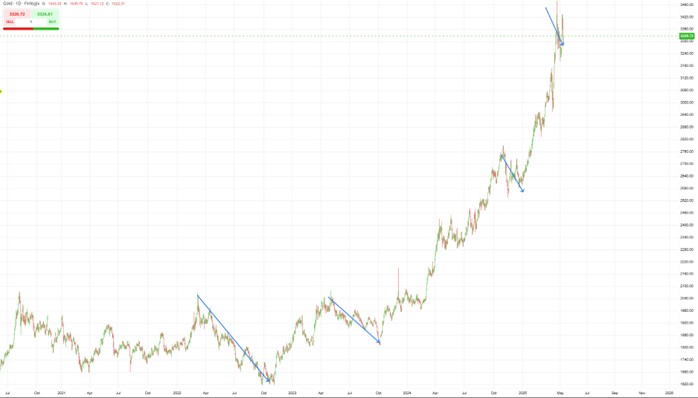
From a macro perspective, these pullbacks are often buying opportunities, especially if your thesis is anchored in fundamentals like central bank demand, inflation hedging, and global reserve diversification.
In fact, my own bias is to look for longs on dips, especially when pullbacks coincide with oversold technical and no shift in macro drivers. That’s not to say gold won’t have volatility it always does. But in an environment where the biggest buyers aren’t flinching, you shouldn’t either.
It’s also worth noting that China’s gold accumulation isn’t just a financial strategy it’s a geopolitical one. Gold is outside of the SWIFT system, immune to sanctions, and completely sovereign. For a country that has seen what happened to Russia’s dollar reserves post-Ukraine invasion, this is not lost on Beijing.
That’s why each ton of gold China adds to its reserves sends a message not just to the market, but to the global financial system. It's preparing for a world where currency power is more contested, and where gold may once again act as a pillar of financial influence.
And for XAU/USD traders, this context is crucial. You're not just trading metal. You're trading policy, strategy, and global positioning all of which are currently aligned in gold’s favour.
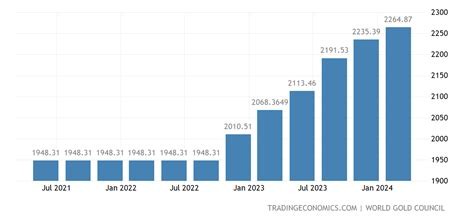
If you take one thing from this article, let it be this: gold in 2025 isn’t just reacting it’s being revalued.
It’s being revalued by central banks who now see it as a Tier 1 asset thanks to Basel III. It’s being revalued by countries like China, who are preparing for a future with less U.S. dollar dominance. And it’s being revalued by investors who are looking for real assets in a world of rising debt, inflation, and instability.
For traders, that means keeping your eye on the bigger picture. Gold may dip, it may consolidate, but the structural support is real and that’s where the long-term opportunity lies.
If you're interested in the broader macro forces driving gold and other major markets, check out these related reads:
This content may have been written by a third party. ACY makes no representation or warranty and assumes no liability as to the accuracy or completeness of the information provided, nor any loss arising from any investment based on a recommendation, forecast or other information supplies by any third-party. This content is information only, and does not constitute financial, investment or other advice on which you can rely.
ACY Securities is one of Australia's fastest growing multi-asset online trading providers, offering ultra-low-cost trading, rock-solid execution, technologically superior account management and premium market analysis.

Select the categories and companies you wish to follow directly to your person rss feed.
Create Custom RSS FeedSign up and join over 5,000 professional members who receive personalized news alerts, curated professional connections, and more for free!
Multi-asset trading broker AvaTrade has agreed to acquire the majority of FXCM Group’s business and brand, in a transaction that would bring a longstanding retail FX franchise into the AvaTrade Group.
LSEG and CMC Markets have signed a multi-year strategic data agreement expanding CMC's access to LSEG's real-time and delayed pricing, reference and corporate actions data, news and analytics, plus AI-ready content, to support new products, entry into new markets and the growth of CMC's institutional and B2B partnerships.
The Tel Aviv Stock Exchange is considering a bid for the Cyprus Stock Exchange, with Israeli media citing its EU licence, trading platform and clearing house. Euronext’s Athens exchange and India’s National Stock Exchange are also seen as contenders, and Cyprus aims to sign a sale agreement by the end of this year.
CME Group will launch baseball futures on 12 October, pending regulatory review, tracking CME FutureSports Performance Indexes built on Official League Data. Standard and micro contracts will start with the 2026 Postseason and the four clubs in the League Championship Series, trading around the clock.
ESMA has published an opinion stating that MiCA-authorised crypto-asset service providers should cease services tied to non-MiCA-compliant stablecoins for EU clients across MiCA crypto-asset services. National authorities should require remediation of existing exposures within three months, by early January 2027.
Nasdaq Ventures has made a strategic investment in Amsterdam-based derivatives and crypto exchange One Trading, with both firms to explore 24/7 trading of equity futures. The undisclosed investment follows Nasdaq's US$100 million investment in Payward, the parent of Kraken, and CME Group's move to 24/7 trading.
cTrader has opened multi-platform plugins to brokers and prop firms, which can pre-install their own tools for clients or list them in cTrader Store. The plugins run across Mobile, Web, Windows and Mac, and can be built and launched independently of core-platform releases, including trading journals and calculators.
Institutional brokerage and financial infrastructure provider Clear Street has joined TradingView’s broker network, allowing its clients to trade US stocks, exchange-traded funds and options directly through the charting and analysis platform.
Learn how to improve trading psychology, manage fear and greed, avoid revenge trading, and follow your trading strategy with discipline and a trading journal.
GTC Prime has announced a strategic partnership with Centroid Solutions to manage and distribute its liquidity through CS 360 Bridge, Centroid's multi-asset connectivity and execution engine, giving brokers and institutional clients access to tailor-made pricing, low-latency execution and real-time risk management.