just now

Liquidity Finder Ltd is incorporated in England and Wales, company number 10610740, registered address 167-169 Great Portland Street, Fifth Floor, London W1W 5PF, United Kingdom.
Published: just now


Let’s be honest trading can feel overwhelming, especially when you're just starting out. You see people talking about scalping and day trading, flipping trades in seconds or minutes, glued to their screens all day. Maybe you tried that route too. Maybe you sat at your computer for hours, eyes burning, chasing the charts, missing entries, exiting too early, and wondering if you’re even cut out for this.
If that’s you, I get it. And you’re not alone.
Here’s the truth most people don’t talk about: you don’t need to be a full-time screen warrior to succeed in trading. You can trade smartly and still have a life. That’s where Forex swing trading comes in.
Whether you're juggling a job, a family, or just want more freedom, swing trading offers a path that works with your life, not against it.
If you’ve ever tried scalping, you know how intense it is. You must be sharp, focused, and practically live in front of the charts. You’re reacting to every little price movement, making lightning-fast decisions, and the stress adds up quickly. Same goes for day trading you're still spending hours monitoring the markets, waiting for setups, managing trades in real time.
But here’s the thing: most people don’t have that kind of time. You might be working a 9-to-5, raising kids, studying, or just trying to make trading work as a side hustle before going full-time. And that’s exactly why medium-term Forex trading, better known as swing trading, is such a powerful option.
You're trading smarter, not harder. And you're giving yourself the chance to grow your skills without giving up your entire life.
In simple terms, Forex swing trading is a strategy where you aim to catch price "swings" in the market that happen over several days to a few weeks. You’re not trying to grab every little move like scalpers. Instead, you wait for high quality setups, enter when the timing is right, and give the trade space to breathe.
Swing traders typically use higher timeframes 4 hour, daily, or even weekly charts to identify trends and key levels. You might only place a few trades a week, but each one is carefully planned, with clear entries, stop-losses, and profit targets.
And the best part? You don’t have to babysit your trades. You can go to work, enjoy time with family, or even sleep while your trade is running because you’re trading with a plan.
Let’s say you’re analysing EUR/USD and notice the pair has been in a downtrend but just bounced off a key support level around 1.0500. You see a bullish candlestick pattern forming on the 4Hour chart, supported by a rising RSI and crossover on the MACD.
You decide to enter long at 1.0550, placing your stop-loss at 1.0450 (risk: 100 pips) and setting a target at 1.0750 (reward: 200 pips). That gives you a 1:2 risk/reward ratio a healthy, professional-grade setup.
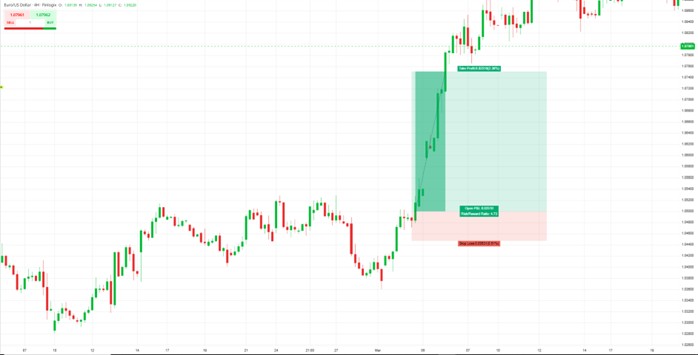
You place the trade on a Monday morning when the market opens. By Tuesday evening, price has moved in your favour. You’re not glued to the charts all day. You check it once or twice, and by Thursday, you hit your target. One trade, managed around your schedule and you didn’t sacrifice your sanity to get there.
That’s the beauty of swing trading.
There are dozens of strategies out there, but here are two reliable, beginner-friendly approaches:
This strategy looks for established trends and waits for small retracements (pullbacks) to join the move. You can use moving averages (like the 50 EMA) or Fibonacci levels to identify ideal entry zones.
Example: USD/JPY is trending upward. Price pulls back to the 50 EMA. You see a bullish engulfing candle and enter long. You’re not chasing you’re calmly entering when the market gives you a chance.
Wait for price to break a key level (support/resistance), then retest it before entering.
Example: GBP/USD breaks above 1.3000, then pulls back and retests that level. You enter long, targeting the next resistance. It's clean, visual, and effective perfect for swing trading timeframes in Forex.
One of the most overlooked but critical parts of swing trading is managing your risk/reward ratio.
Let’s say you’re willing to risk 1% of your account on a trade. If your trade setup offers a 1:2 ratio, that means you stand to gain 2% if you’re right and lose just 1% if you’re wrong. That’s the kind of math that keeps traders in the game long-term.
Even if you’re only right 50% of the time, a 1:2 ratio means you’re still growing your account.
Swing trading gives you the space to plan these trades, set them up properly, and manage them without emotional panic. You don’t need to “win every trade” you just need to protect your downside and let your winners run.
If you're tired of trading feeling like a full-time job, if you're trying to break into the world of Forex while working a day job or building your skills, swing trading might be the answer you’ve been searching for.
It lets you step away from the noise. You’re not reacting to every candle. You’re thinking clearly, making informed decisions, and building confidence over time.
Forex swing trading is not about speed it’s about rhythm. It’s about creating a trading lifestyle that fits around your life, not one that takes it over.
So, if you’ve been burning out chasing pips all day, give swing trading a real shot. It could be the shift that turns your stress into structure, your frustration into growth—and your dream of becoming a successful trader into a real, achievable path.
ACY Securities is one of Australia's fastest growing multi-asset online trading providers, offering ultra-low-cost trading, rock-solid execution, technologically superior account management and premium market analysis.

Select the categories and companies you wish to follow directly to your person rss feed.
Create Custom RSS FeedSign up and join over 5,000 professional members who receive personalized news alerts, curated professional connections, and more for free!
US institutional crypto trading venue EDX Markets has announced a strategic partnership with blockchain infrastructure platform Paxos.
An Italian court has placed Revolut Bank UAB under judicial administration for one year over failings in its anti-money laundering (AML) controls in Italy
US prediction market operator Kalshi has acquired New York broker-dealer FB Securities and plans to offer trading in stocks and exchange-traded funds within the next two months.
dxFeed has warned that outdated trading technology models are threatening broker competitiveness. Stepan Bolshakov, Managing Director, dxFeed, says firms risk wasting millions on platform redevelopment, and argues modular architectures let brokers add scripting to the platforms they already operate.
The Monetary Authority of Singapore (MAS), Singapore’s central bank and financial regulator, and Germany’s central bank, the Deutsche Bundesbank, have tested connecting their digital asset settlement systems
iSAM Securities has appointed James Laidlaw as Sales Director, joining from FalconX and previously BCB Group. His background covers OTC market making in spot FX and cryptoassets, DeFi investment strategies and electronic trading systems. He will focus on developing relationships across new markets.
Talos, Marex (NASDAQ: MRX) and Broadridge (NYSE: BR) are connecting execution, prime brokerage and post-trade processing in one workflow for trading and financing DTCC-tokenised securities beyond market hours. Marex provides prime brokerage, Talos execution, and Broadridge DLX atomic on-chain settlement.
CMC Markets, a FTSE 250 multi-asset financial services firm, has named two-time heavyweight world champion Anthony Joshua a global ambassador in a 12-month partnership. CMC branding will appear on Joshua’s fight-night clothing for his 11 December bout with Tyson Fury at Cardiff’s Principality Stadium.
One company is setting the tone for the whole market. Nvidia reports on Tuesday, its first results since Jensen Huang resigned as CEO and left the board on November 12, after 33 years in charge. Two days later, Anthropic begins trading on Nasdaq in one of the largest listings ever. In between, the Fed's minutes and a 10-year Treasury yield back above 5% will remind investors that the cost of capital has not gone away.
Nasdaq is showing a clearly bearish short-term structure on the 1-hour chart. The recent low at 27,133 is the immediate support, while the broader decline from 28,535 confirms that sellers remain in control. The moving averages MA5, MA10 and MA20, with price trading below all three.