just now


Liquidity Finder Ltd is incorporated in England and Wales, company number 10610740, registered address 167-169 Great Portland Street, Fifth Floor, London W1W 5PF, United Kingdom.
Published: just now
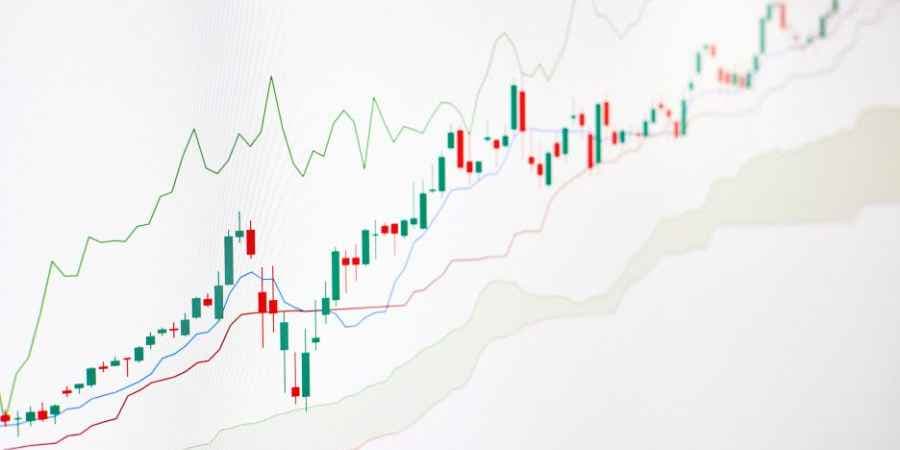
The US dollar has entered the week struggling to recover from last week’s sharp decline, with the DXY index falling below the 104.00 level. This move erases all gains the dollar had accumulated since Donald Trump’s election victory. The sell-off coincided with a shift in market sentiment following softer US economic data and renewed uncertainty around the administration’s economic policies. Over the weekend, President Trump acknowledged that the economy is in a “period of transition,” downplaying concerns over tariffs while insisting that any adjustments would be minor. However, the broader market remains sceptical about the impact of potential trade policies on growth and inflation.
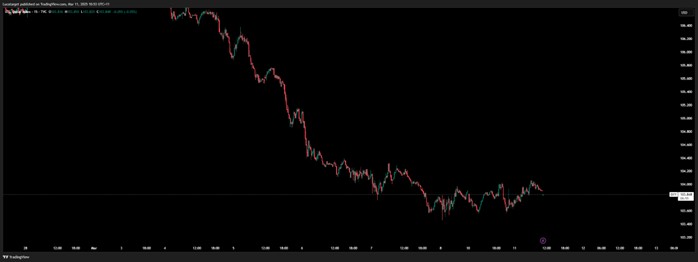
Equity markets have followed a similar trajectory. The S&P 500 has erased its post-election gains, retreating to its 200-day moving average near 5,730. Investors are speculating whether the weakness in both economic indicators and risk assets could pressure Trump into scaling back his tariff plans. So far, the administration has shown limited concern, with only minor rollbacks on Canadian and Mexican tariffs implemented last week.
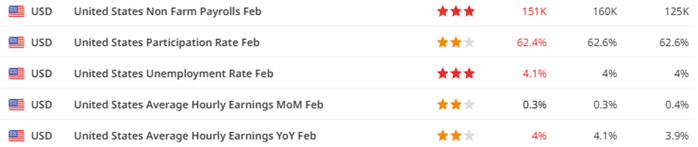
The latest nonfarm payrolls report revealed a 151,000 job increase in February, an improvement from January’s downwardly revised 125,000 figures. However, after factoring in revisions, net job growth fell short of expectations by 11,000. While employment trends remain solid—averaging 191,000 jobs per month over the last six months—recent data suggests a loss of momentum compared to the post-election hiring surge. Notably, the federal government shed 10,000 jobs in February, marking the sharpest decline since mid-2022, potentially reflecting the administration’s push to reduce public sector employment.
Federal Reserve Chair Jerome Powell remains cautious but not overly alarmed by the latest economic developments. He reaffirmed that while uncertainties persist, the economy remains "in a good place," emphasizing that the Fed is not in a rush to adjust policy. Despite this stance, markets have priced in a more dovish outlook, with expectations now leaning toward a June rate cut and a total of 75 basis points in easing by year-end. This divergence between market pricing and Fed rhetoric has contributed to the dollar’s recent slide.
Another major driver of recent USD weakness has been the sharp rise in yields outside the US. The 10-year Japanese Government Bond (JGB) yield climbed to a new year-to-date high of 1.58%, reflecting growing expectations that the Bank of Japan (BoJ) will tighten policy further. January’s labour cash earnings report showed a 3.0% rise in base salaries, reinforcing speculation that the BoJ could raise rates as early as June or July, with some pricing in a smaller hike even in May. If this trajectory continues, Japanese rates could climb toward 1.00% by year-end, further narrowing the yield differential with the US and pressuring USD/JPY lower.
Meanwhile, German bond yields also saw a significant jump last week, with 10-year Bund yields rising 40 basis points to 2.84%, approaching their October 2023 highs. Markets reacted strongly to expectations that Friedrich Merz, the incoming German Chancellor, will pursue expansionary fiscal policies. Plans for increased defence and infrastructure spending have pushed up government borrowing costs while simultaneously providing a tailwind for European assets, strengthening the euro in the process.
Markets will closely watch upcoming macroeconomic releases, including the Sentix Investor Confidence Index in the Eurozone and US Consumer Inflation Expectations. Additionally, remarks from key policymakers such as Bundesbank President Joachim Nagel could influence rate expectations in Europe. In Japan, GDP data and household spending figures could further shape market views on the BoJ’s policy trajectory.
With the USD facing headwinds from softening economic data, shifting Fed expectations, and rising global yields, the next few weeks will be critical in determining whether the dollar finds stability or extends its decline.
This content may have been written by a third party. ACY makes no representation or warranty and assumes no liability as to the accuracy or completeness of the information provided, nor any loss arising from any investment based on a recommendation, forecast or other information supplies by any third-party. This content is information only, and does not constitute financial, investment or other advice on which you can rely.
ACY Securities is one of Australia's fastest growing multi-asset online trading providers, offering ultra-low-cost trading, rock-solid execution, technologically superior account management and premium market analysis.

Select the categories and companies you wish to follow directly to your person rss feed.
Create Custom RSS Feed
just now
Sign up and join over 5,000 professional members who receive personalized news alerts, curated professional connections, and more for free!
Exinity has appointed FXTM alum Constantina Georgiadou as Associate VP of Public Relations, based in Limassol. It is the second FXTM executive to return to the Group in three months, following Antonia Droussiotou's appointment as VP of Corporate Communications & CSR. Georgiadou brings fifteen years of industry experience, including nine years at Exness.
Sucden Financial has appointed James Wheaton as Deputy Head of Softs. Wheaton joins from Amius Limited and previously served as Assistant Vice President of Softs at StoneX, bringing over ten years of front-office experience in agricultural derivatives across cleared and OTC markets and multiple trading platforms.
Bruce Markets LLC has agreed a weekend trading expansion, backed by new investment from PEAK6 and Robinhood, to bring continuous U.S. equity access to global investors pending regulatory review. Nasdaq supplies the trading technology, with Apex Clearing Corporation handling clearing, carrying and custody.
X Securities has partnered with Komodromos Legal to launch a Financial Business Setup & Operational Infrastructure service, combining legal and regulatory structuring with institutional liquidity, outsourced dealing desk and risk management support for brokers, proprietary trading firms and crypto businesses across multiple jurisdictions.
EURUSD tests critical support at 1.13243 after Fed and ECB rate hikes and strong US jobs data, with technical indicators signaling potential breakdown or relief bounce.
STARTRADER has raised its Lloyd's of London-backed client fund insurance from USD 1 million to USD 30 million, effective 1 October 2026. The policy covers available balances and open positions in the event of insolvency, applying only to eligible clients of the Mauritius entity, at no cost to clients.
cTrader has launched Mobile 5.10, reorganising its app with new Positions and Markets sections and a redesigned login screen. The update aims to simplify trade management and symbol browsing for traders, while giving brokers tools such as the AppsFlyer SDK to track client acquisition and engagement.
Learn why funding rates change in crypto perpetual swaps, how funding works, and what changing rates reveal about market positioning, liquidity and sentiment.
Luramic will power the SALVUS Mauritius Annual Forum 2026, taking place on 29 September 2026 in Mauritius. The event will bring together professionals from financial services, regulatory, compliance, investment, fintech and business communities for an evening of industry exchange, meaningful conversations and new connections.
Luramic will participate in Compliance in Action: Towards a More Resilient Financial Ecosystem, taking place on 25 September 2026 in Ebene, Mauritius. Organized by the Mauritius Institute of Directors (MIoD) in collaboration with SALVUS Funds, the event will bring together senior professionals from across the financial and governance sectors to discuss the evolving role of compliance, risk management and corporate governance in building resilient financial businesses.