just now


Liquidity Finder Ltd is incorporated in England and Wales, company number 10610740, registered address 167-169 Great Portland Street, Fifth Floor, London W1W 5PF, United Kingdom.
Published: just now

If you’re just starting out in Forex trading, you might be feeling a mix of excitement and fear. The idea of making money from the markets is thrilling, but at the same time, there’s a constant worry—what if I lose everything? That fear is real, and every trader, no matter how experienced, has felt it at some point. But here’s the truth: losses are part of the game. The difference between successful traders and those who quit is simple—how well they manage risk.
Forex risk management is not just about protecting your money; it’s about protecting your future in trading. If you ignore managing trading risk, even the best strategies won’t save you. The market doesn’t care about your hopes or dreams—it moves how it moves. But if you respect risk, control your losses, and think long-term, you give yourself a real chance at success.
Before placing any trade, ask yourself: How much am I willing to lose if this trade goes wrong? Because in trading, you will have losing trades. That’s a fact. The goal is to make sure no single loss is big enough to wipe out your account.
Most professional traders risk only 0.5%, 1%, or at most 2% per trade. That means if you have $1,000 in your account and you decide to risk 1% per trade, the most you’ll lose on a single trade is $10. Even if you lose five trades in a row, your account is still intact, and you can keep trading.
But imagine risking 10% per trade. Five losing trades in a row would wipe out half your account. And trust me, losing streaks happen even to the best traders. That’s why understanding Forex position sizing is critical. You’re not just placing a trade you’re deciding how much of your account you’re putting on the line. For this reason, Finlogix has elaborate a position size calculator that you can use for FREE! You just need to add the extension to your browser through the google store.
Not only a position size calculator but you still have access to the Finlogix Economic Calendar!
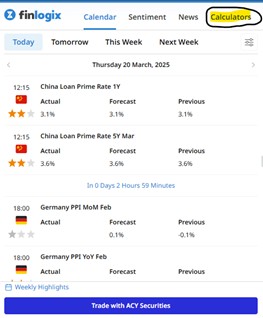
You can click on Calculator and this page will open, and then click on position size and you will have the position size calculator!
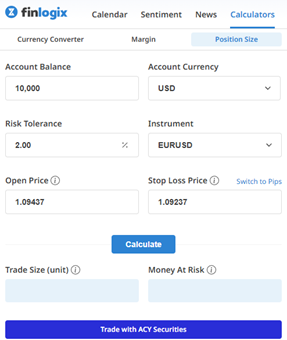
A stop-loss in Forex is your safety net. It’s the price level where your trade will automatically close to prevent further losses. Some beginners avoid using stop-losses because they don’t want to “lock in” a loss. But that’s dangerous thinking. The market doesn’t care about your emotions if price moves against you, and you don’t have a stop-loss, you could lose way more than you planned.
Think of it like this: imagine driving a car without brakes. You wouldn’t do it, right? Because at some point, you’ll need to stop before you crash. A stop-loss does the same thing it prevents your trade from turning into a disaster.
A smart trader always knows exactly where to exit a trade before they even enter. That’s what separates professionals from gamblers.
Forex position sizing is the process of deciding how big your trade should be based on your risk tolerance. If you’re risking 1% of your account per trade, that doesn’t mean every trade has the same lot size. You need to adjust your position based on how far away your stop-loss is.
Here’s a simple way to think about it:
For example, let’s say you’re trading a currency pair, and you have a $5,000 account. You decide to risk 1% per trade, which is $50. If your stop-loss is 50 pips away, you need to calculate a position size where each pip equals $1. If your stop-loss is 100 pips away, then your position should be smaller—each pip should equal $0.50 to keep your risk at $50.
This is why professional traders use position sizing calculators—they take the guesswork out of risk management. You should always adjust your position size based on the trade setup, not just randomly pick a lot size.
Managing risk isn’t just about numbers—it’s about mindset. One of the hardest things in trading is accepting losses. Every trader has taken a loss that made them feel sick. Maybe you closed a trade too early, and it later went in your favour. Maybe you moved your stop-loss further away, hoping the market would reverse, only to see an even bigger loss. These are painful lessons. But they are also necessary.
The best traders don’t just manage money—they manage emotions. They don’t let fear or greed dictate their decisions. They stick to their risk management plan no matter what.
The moment you stop respecting risk is the moment the market teaches you a hard lesson.
If you’re serious about trading, Forex risk management should be your top priority. It’s not about making money fast it’s about staying in the game long enough to succeed.
Many traders fail because they focus only on making money instead of managing trading risk. But if you focus on protecting your Forex account from losses, you’ll have something far more valuable than a lucky winning trade you’ll have a strategy that can keep you in the game for years to come.
Trading is a journey. Losses will come. Frustration will come. But if you commit to risk management strategies for Forex, you’ll build the discipline and skill to turn this into a long-term success.
And that’s what separates the winners from the rest.
ACY Securities is one of Australia's fastest growing multi-asset online trading providers, offering ultra-low-cost trading, rock-solid execution, technologically superior account management and premium market analysis.

Select the categories and companies you wish to follow directly to your person rss feed.
Create Custom RSS FeedSign up and join over 5,000 professional members who receive personalized news alerts, curated professional connections, and more for free!
Webull Corporation reported record third quarter 2026 revenue of $218.7 million, up 39% year-on-year, with customer assets reaching $32.4 billion and options contracts volume up 79%. Net income attributable to the company was $31.2 million, while margin debit balances passed $1 billion for the first time.
Anthropic, the company behind the Claude family of AI models, begins trading on the Nasdaq today under the ticker ANT. It priced its shares at $83 last night, above its marketed range of $70 to $78, and raised about $81.3 billion. That makes it the largest initial public offering on record, ahead of the roughly $75 billion SpaceX raised in June. This note covers what investors need to know: the terms, the business, how the company is governed, and what to watch.
Nvidia's first results without Jensen Huang answered the question that has hung over the AI trade since October. Revenue of $115.8 billion beat consensus by about $7 billion, fourth-quarter guidance of $130 billion came in roughly $5 billion above expectations, and the company raised its outlook for next fiscal year to around 75% growth. All of this assumes no data-centre sales to China.
Marex has entered the football financing market through a partnership with specialist sports investment and advisory firm Pinto Capital, targeting clubs in the Premier League and EFL Championship.
Around 110,000 UK retail investors have secured $300 million worth of Anthropic shares in its record-breaking $81 billion IPO. The heavily oversubscribed offer, coordinated by RetailBook, saw smaller investors prioritised, with 63% of applicants receiving their full allocation.
Clear Street has completed its acquisition of Boom Securities (H.K.) Limited, establishing its first licensed brokerage presence in Hong Kong
Sterling slips to its lowest against the dollar since October as markets trim Bank of England bets and Fed minutes point to further US rate rises, while the euro hits a fresh one-year low. Daily FX analysis from Equals.
JT Prime, the institutional Prime of Prime founded by Raj Sitlani, Jonathan Brewer and Jeff Wilkins, is set to become the new home for institutional client relationships currently serviced by FXCM Pro. Clients have been offered the same leverage, fees and connectivity, ensuring continuity of trading conditions.
The Nasdaq 100 has shifted into a short-term bullish recovery after finding strong support around 26,611. Following the sharp sell-off, price has formed a sequence of higher lows and has moved back above the 20-hour moving average at around 27,270, while the 5-hour and 10-hour averages are also turning higher.
U.S. equity futures rose in the after hours, led by Nasdaq-100 futures up 1% and S&P 500 futures up 0.6%, as investors focused on Anthropic’s Nasdaq debut. The AI company priced its IPO at $83 per share, above expectations, and expanded the offering to raise around $81.3 billion, making it the largest IPO on record.