just now


Liquidity Finder Ltd is incorporated in England and Wales, company number 10610740, registered address 167-169 Great Portland Street, Fifth Floor, London W1W 5PF, United Kingdom.
Published: just now


As evident since yesterday morning, the BoJ's policy meeting has given its approval for renewed selling of the yen, mainly due to the adjustments made to the YCC framework. These changes, however, were quite cautious and fell short of a complete abandonment of the existing policy. The commitment to continue large-scale JGB (Japanese Government Bond) purchases was seen as a signal to the markets, suggesting room for yen depreciation. The unexpected magnitude of the increase in USD/JPY was a surprise, and the BoJ's cautious approach reinforced the perception that Japanese authorities are willing to tolerate further weakening of the yen. Additionally, the Ministry of Finance (MoF) confirmed that they did not intervene in the foreign exchange market in October. Although USD/JPY has experienced a slight correction lower, renewed buying may be restrained due to the stern language used today by the Vice Finance Minister for International Affairs, who mentioned that the MoF was "on standby" following "sudden" and one-sided currency movements. Consequently, the likelihood of intervention has increased significantly.
USDJPY Chart
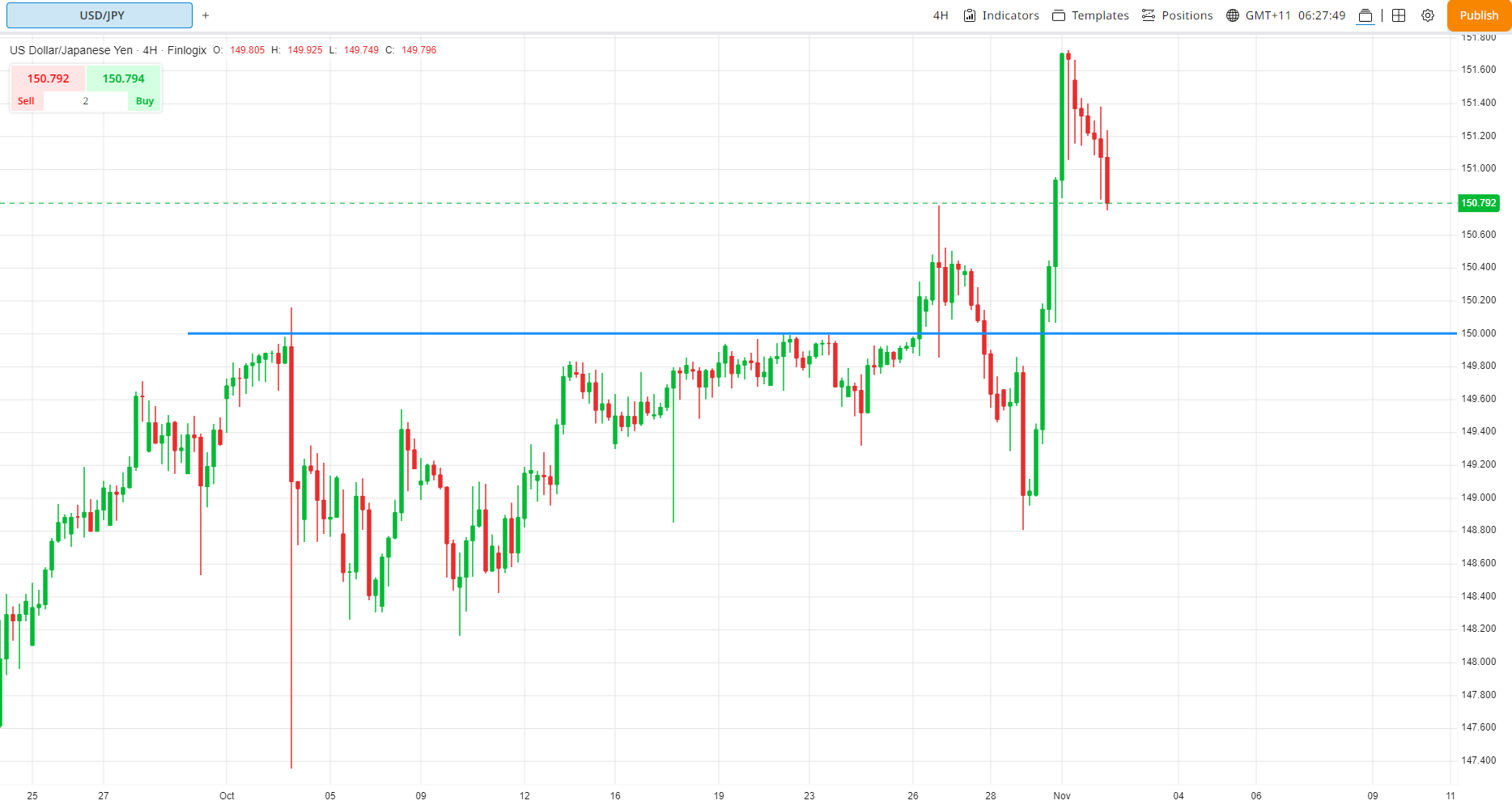
Source: Finlogix Chart
The currency movements observed yesterday appear to be linked to specific month-end flows. Despite the BoJ's announcement, the bond markets remained relatively calm, with only moderate changes in US, German, and UK 10-year yields, all of which declined by 2-5 basis points. Given the context of month-end activities, we should perhaps refrain from attaching excessive significance to the level of US dollar strength observed.
That being said, there were developments yesterday that undeniably supported the US dollar. Notably, the inflation figures in the euro-zone are worth mentioning. The European Central Bank's persistent concerns regarding inflation remaining "too high for too long," as mentioned in last week's statement, could start to appear questionable. The year-on-year advance Consumer Price Index (CPI) rate significantly dropped from 4.3% to 2.9%, marking its lowest level since July 2021. In comparison, the US equivalent stands at 3.7%. The substantial energy price shock experienced by the euro-zone, in contrast to the US, makes the current inflation comparison remarkable. The average natural gas price in 2022 increased by a factor of nine compared to 2019 in Europe, while in the US, the increase ranged between two to three times. Headline CPI in the Netherlands plummeted to -1.0% in October, and in Belgium, it is even lower at -1.7%.
The resilience of inflation in the US can be attributed to demand-related factors, as robust economic growth continues. Strong labour demand has contributed to keeping wage inflation elevated. The Employment Cost Index for the third quarter was released yesterday and slightly exceeded expectations at 1.1% on a quarterly basis. As we have previously noted, the potential for further strength in the US dollar remains in place until concrete evidence of a slowdown or more significant declines in inflation becomes apparent. The economic data released yesterday did not provide that evidence.
This content may have been written by a third party. ACY makes no representation or warranty and assumes no liability as to the accuracy or completeness of the information provided, nor any loss arising from any investment based on a recommendation, forecast or other information supplied by any third-party. This content is information only, and does not constitute financial, investment or other advice on which you can rely.
ACY Securities is one of Australia's fastest growing multi-asset online trading providers, offering ultra-low-cost trading, rock-solid execution, technologically superior account management and premium market analysis.

Select the categories and companies you wish to follow directly to your person rss feed.
Create Custom RSS FeedSign up and join over 5,000 professional members who receive personalized news alerts, curated professional connections, and more for free!
Theorem has integrated Symbiotic’s Liquid Lane RFQ network, letting holders of tokenised real-world assets trade against on-chain pool liquidity and market-maker quotes. The integration is live on Ethereum, with Midas’s yield-bearing mHYPER fund as the first supported asset. Holders can trade for the USDC stablecoin.
US equities were volatile with technology selloff erasing much of the earlier rebound.
FM Summit London 2026 returns to Old Billingsgate on 24 November for its 15th edition, with LMAX Group, Plus500 and oneZero among confirmed exhibitors. The one-day event adds Business Connect meetings and roundtables, and opens with a networking evening at The Folly on 23 November.
Finance Magnates Summit London returns to Old Billingsgate on 24 November 2026 for its 15th edition. The one-day event brings together brokers, liquidity providers, institutional firms, trading technology vendors, payments businesses and digital asset firms.
iSAM Securities Apex has integrated with Match-Prime, giving brokers access to liquidity across more than 2,000 instruments, with tailored pricing and up to 10 levels of market depth.
propfunding.com's free-entry instant funding changes the order of prop funding. Start trading first. Its free-entry instant funding model offers two qualification attempts without an upfront activation fee.
US stocks closed higher on Wednesday, with the Nasdaq gaining 1%, the S&P 500 rising 0.6%, and the Dow advancing 0.7%, as renewed enthusiasm for AI-related stocks lifted market sentiment.
SpaceX went public in June as a rocket company. On October 20 it reported as something else entirely: an AI infrastructure business, financed by a satellite broadband network, with a launch division attached. Rockets generated 12% of third quarter revenue and lost money. The AI segment generated 52% of revenue and consumed 84% of capital expenditure. Starlink generated 85% of operating profit.
Standard Chartered has signed definitive agreements to acquire 100% of Zodia Custody UK Limited, folding its regulated digital asset custody business into Securities Services. Zodia Solutions will be set up under SC Ventures with bank investors including Northern Trust, NAB Ventures, Emirates NBD and Investcorp.
Bybit Fintech FZE has secured a Virtual Asset Service Provider licence from Dubai’s Virtual Assets Regulatory Authority for Exchange Services, covering spot trading. Bybit’s Peter Loo said the firm hopes to add derivatives, subject to regulatory approvals. Its international Dubai headquarters opened in 2022.