
just now


Liquidity Finder Ltd is incorporated in England and Wales, company number 10610740, registered address 167-169 Great Portland Street, Fifth Floor, London W1W 5PF, United Kingdom.
Published: just now


Markets continue to grapple with a world that's becoming increasingly difficult to read, and the dollar is a prime reflection of that confusion. The latest data out of the U.S. paints a picture that’s hard to ignore a clear loss of economic momentum just as inflation expectations begin to creep higher. First quarter GDP tracking has been cut sharply to -0.8% QoQ annualized, a significant miss compared to even the downgraded consensus. Labour market data isn’t offering much reassurance either, with job openings falling faster than expected and consumer confidence slipping to levels last seen in the depths of 2020. At the same time, short-term inflation expectations are edging up, raising the uncomfortable possibility that we’re now drifting into stagflation territory.

The Fed remains silent for now, but the market has started to speak. Dollar demand failed to show up at month-end, and the move to fade the greenback is gaining traction across desks. Positioning has shifted in favour of liquid alternatives the euro, yen and pound all look increasingly attractive, especially with their domestic outlooks looking relatively more stable.
On the corporate side, the tech-heavy optimism that once helped hold up equities is beginning to fray. Super Micro’s earnings miss didn’t help, and concerns are now building over how U.S. chip exports might be hit by escalating controls. With Microsoft, Meta, Amazon and Apple all reporting this week, there’s a real possibility that sentiment could swing quickly if results disappoint. And yet, equities haven’t cracked possibly because we’re now past the peak of macro uncertainty for Q1. Still, in FX, the dollar is no longer feeling like the haven it used to be. The repricing we’re seeing isn’t just about interest rate expectations anymore it’s about a broader loss of confidence in the U.S. growth story.
Looking across the Pacific, the Australian dollar had a moment of strength following this morning’s CPI release, which came in a touch firmer than expected. The rebound was largely driven by food and energy categories, in part due to the expiry of certain government subsidies. But despite the headline beat, the broader picture remains unchanged. Inflation is still within the RBA’s target band, and core measures continue to show signs of easing.
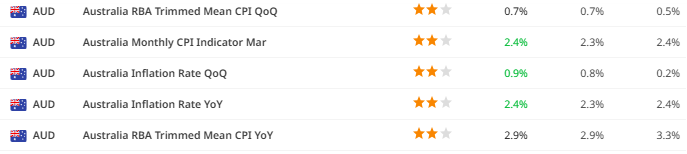
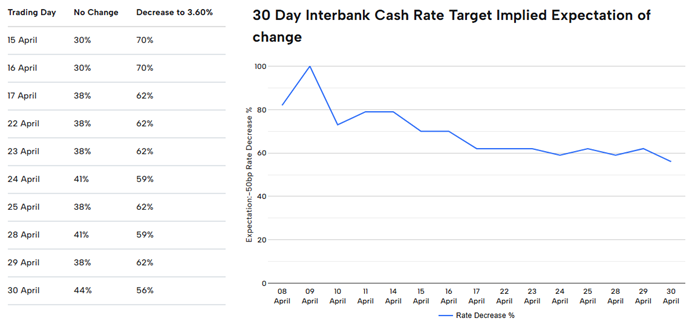
Some of the hawkish pricing in local rates has been unwound, but not completely and that might be a stretch. Goldman Sachs is sticking with their call that the RBA will resume cutting in May, with more easing to follow in the months ahead. The labour market is still tight, but it’s not overheating, and the inflation pulse simply isn’t strong enough to warrant a shift in tone. Given this, the Aussie’s recent strength feels more tactical than structural especially when risk sentiment is still fragile and global equities are mixed.
Meanwhile, China is back in focus after the latest round of PMI data showed a clear loss of momentum in the manufacturing sector. Both official and Caixin surveys dropped more than expected, with new export orders taking a particularly hard hit. That subcomponent tends to lead actual export volumes by a few months, which means China’s trade performance could deteriorate further into Q2.
Despite this, the Chinese yuan reversed initial losses, and it wasn’t just about technical flows. Beijing surprised markets by signalling it would exempt a list of U.S. goods from its 125% retaliatory tariffs. The so-called “whitelist” reportedly includes items like pharmaceuticals, aircraft engines, and semiconductors all of which are critical to China’s economy. This move suggests a more calculated approach from Beijing: standing firm on rhetoric while quietly carving out space for economic pragmatism.
There’s also a broader financial shift underway, with China’s sovereign wealth fund reportedly pulling back from U.S. private equity exposure. That’s more symbolic than systemic, but it fits into the broader trend of strategic decoupling. For now, soft CNY fixings continue, but the currency remains relatively stable even with the risks stacking up.
In short, we’re heading into May with markets that are re-evaluating old assumptions. The dollar is no longer a one-way bet, the Aussie looks overbought on shaky ground, and the yuan is being quietly supported by policy finesse. This is not a market for bold directional trades it’s one that rewards nuance, patience, and an eye on shifting fundamentals.
This content may have been written by a third party. ACY makes no representation or warranty and assumes no liability as to the accuracy or completeness of the information provided, nor any loss arising from any investment based on a recommendation, forecast or other information supplies by any third-party. This content is information only, and does not constitute financial, investment or other advice on which you can rely.
ACY Securities is one of Australia's fastest growing multi-asset online trading providers, offering ultra-low-cost trading, rock-solid execution, technologically superior account management and premium market analysis.

Select the categories and companies you wish to follow directly to your person rss feed.
Create Custom RSS FeedSign up and join over 5,000 professional members who receive personalized news alerts, curated professional connections, and more for free!
Theorem has integrated Symbiotic’s Liquid Lane RFQ network, letting holders of tokenised real-world assets trade against on-chain pool liquidity and market-maker quotes. The integration is live on Ethereum, with Midas’s yield-bearing mHYPER fund as the first supported asset. Holders can trade for the USDC stablecoin.
US equities were volatile with technology selloff erasing much of the earlier rebound.
FM Summit London 2026 returns to Old Billingsgate on 24 November for its 15th edition, with LMAX Group, Plus500 and oneZero among confirmed exhibitors. The one-day event adds Business Connect meetings and roundtables, and opens with a networking evening at The Folly on 23 November.
Finance Magnates Summit London returns to Old Billingsgate on 24 November 2026 for its 15th edition. The one-day event brings together brokers, liquidity providers, institutional firms, trading technology vendors, payments businesses and digital asset firms.
iSAM Securities Apex has integrated with Match-Prime, giving brokers access to liquidity across more than 2,000 instruments, with tailored pricing and up to 10 levels of market depth.
propfunding.com's free-entry instant funding changes the order of prop funding. Start trading first. Its free-entry instant funding model offers two qualification attempts without an upfront activation fee.
US stocks closed higher on Wednesday, with the Nasdaq gaining 1%, the S&P 500 rising 0.6%, and the Dow advancing 0.7%, as renewed enthusiasm for AI-related stocks lifted market sentiment.
SpaceX went public in June as a rocket company. On October 20 it reported as something else entirely: an AI infrastructure business, financed by a satellite broadband network, with a launch division attached. Rockets generated 12% of third quarter revenue and lost money. The AI segment generated 52% of revenue and consumed 84% of capital expenditure. Starlink generated 85% of operating profit.
Standard Chartered has signed definitive agreements to acquire 100% of Zodia Custody UK Limited, folding its regulated digital asset custody business into Securities Services. Zodia Solutions will be set up under SC Ventures with bank investors including Northern Trust, NAB Ventures, Emirates NBD and Investcorp.
Bybit Fintech FZE has secured a Virtual Asset Service Provider licence from Dubai’s Virtual Assets Regulatory Authority for Exchange Services, covering spot trading. Bybit’s Peter Loo said the firm hopes to add derivatives, subject to regulatory approvals. Its international Dubai headquarters opened in 2022.