just now


Liquidity Finder Ltd is incorporated in England and Wales, company number 10610740, registered address 167-169 Great Portland Street, Fifth Floor, London W1W 5PF, United Kingdom.
Published: just now

Every trader begins with excitement: charts, candles, setups, market predictions. But eventually, the market humbles everyone. You realize it is not about finding the perfect strategy or catching the perfect move. It is about becoming the kind of trader who can execute consistently. And that is impossible without a Trading Journal.

A trading journal is not just a notebook or a diary where you rant after a bad loss. It is what I call the trader’s mirror in Trading Journal & Reflection - The Trader’s Mirror. It is your personal data engine that reveals what memory hides and emotion distorts. It shows the truth about your performance, your behavior, your timing, and your discipline.
If you have ever wondered why you are not improving fast enough, why you repeat the same mistakes, or why your confidence disappears after a losing streak, the answer is simple:
You are not tracking your data deeply enough.
This is why a Trading Journal sits at the foundation of long term success. It converts chaos into clarity, turns guessing into evidence, and transforms hope into measurable progress.

There is a reason most traders skip journaling even though they know it matters. A proper trading journal feels confronting. It forces you to face uncomfortable truth.
Without a journal, you can keep telling yourself:
But when you start logging trades the way we do in Trading Mindset Mastery: Building Confidence Through Data, those stories fall apart. Your numbers speak clearly, objectively, and without bias.
Sometimes, what they say stings:
A trading journal removes the fantasy version of you and reveals the statistical version of you. One is emotional. The other is measurable. Only one can be improved.
You might think you remember your trades well. You do not.
The human brain is a storyteller, not a statistician.
It tends to:
None of this makes you a bad trader. It makes you human.
But in trading, these blind spots are expensive.
A Trading Journal bypasses the brain and replaces subjective memory with objective trading data. That is when real improvement begins. Over time, journaling supports everything else you learn, from Beginner Trading Strategy: How to Choose One Setup and Commit to more advanced work like Measuring Your Edge: Metrics That Matter.
When you use a trading journal consistently, you start to uncover patterns you could never see by memory alone.
You realize things like:
These insights turn into a compass for your development. You stop trading from feelings and start trading from evidence.
In Backtesting for Traders: How to Build Skill Fast, I talk about using historical data to build belief. Your trading journal is the live version of that same process. Backtesting proves your edge in history. Journaling proves your edge in real time.
This is how confidence is built. Not from hype or motivation, but from proof.
Imagine an Olympic sprinter saying:
“I think I am getting faster. I feel like it.”
It sounds ridiculous.
Elite athletes measure everything:
They do not trust feelings.
They trust metrics.
Your Trading Journal is your scoreboard. Your equity curve is your performance graph. Your metrics are your coaching feedback.
Even outside retail trading, guides from places like Investopedia consistently point to structured journaling, performance metrics, and risk control as essential habits in long term trading success. The pattern is clear: professionals track what they do.
Without these measurements, you are guessing your way through the markets.

To extract the full power of a trading journal, you need to track across three layers: technical, behavioral, and emotional. This is the same structure used when we talk about edge in Trading Edge: Definition, Misconceptions & Casino Analogy.
This covers the pure mechanics of your trades:
Technical data answers:
“Does my strategy actually work under real market conditions?”
This reveals how you function as an operator:
Behavioral data answers:
“Did I trade my plan, or did I trade my mood?”
This is the hidden dimension most traders never log:
These are the same emotional drivers we unpack in Why Most Traders Fail - Trading Psychology & The Hidden Mental Game.
Emotional data answers:
“Am I mentally ready to trade, or am I carrying emotional baggage into the chart?”
When you log all three layers, your Trading Journal becomes a complete performance lab, not just a list of random notes.

Confidence does not come from winning.
Winning without understanding why is just disguised luck.
True confidence comes from knowing your numbers.
When you can say,
“My main setup wins 48 percent of the time, averages 2.3R, and stays within my planned drawdown,”
your confidence is rooted in reality.
Confidence built on emotion collapses under pressure.
Confidence built on data survives losing streaks.
This is the same logic we apply when we discuss proving and refining edge across Proving Your Edge: Backtesting Without Bias and Forward Testing in Trading: How to Prove Your Edge Live. Your trading journal is the bridge between research and execution.
Imagine driving through a new city without a map. You might eventually get somewhere, but you would waste fuel, time, and energy. That is what trading without a journal feels like.
Your trading journal becomes your GPS:
Every professional trader I know uses some form of journaling, reflection, or review cycle. This is exactly what we formalize in The Disciplined Trader: The Complete Blueprint for Consistency. They do not use journals because it feels nice. They use them because trading without measurement is trading blind.
Start with this principle:
Track everything. No exceptions.
Every trade becomes a data point:
You do not need a complex template on day one. A simple structure is enough to start. Over time, you can evolve it using ideas from The Ultimate Guide to Risk Management in Trading and How to Think Like a Price Action Trader.
The important part is not perfection.
It is consistency.
For the next 7 days:
Journal every trade.
Log entry, exit, R result, rule adherence, and your emotional state before and after the trade.
At the end of the week, ask yourself two questions:
Circle both.
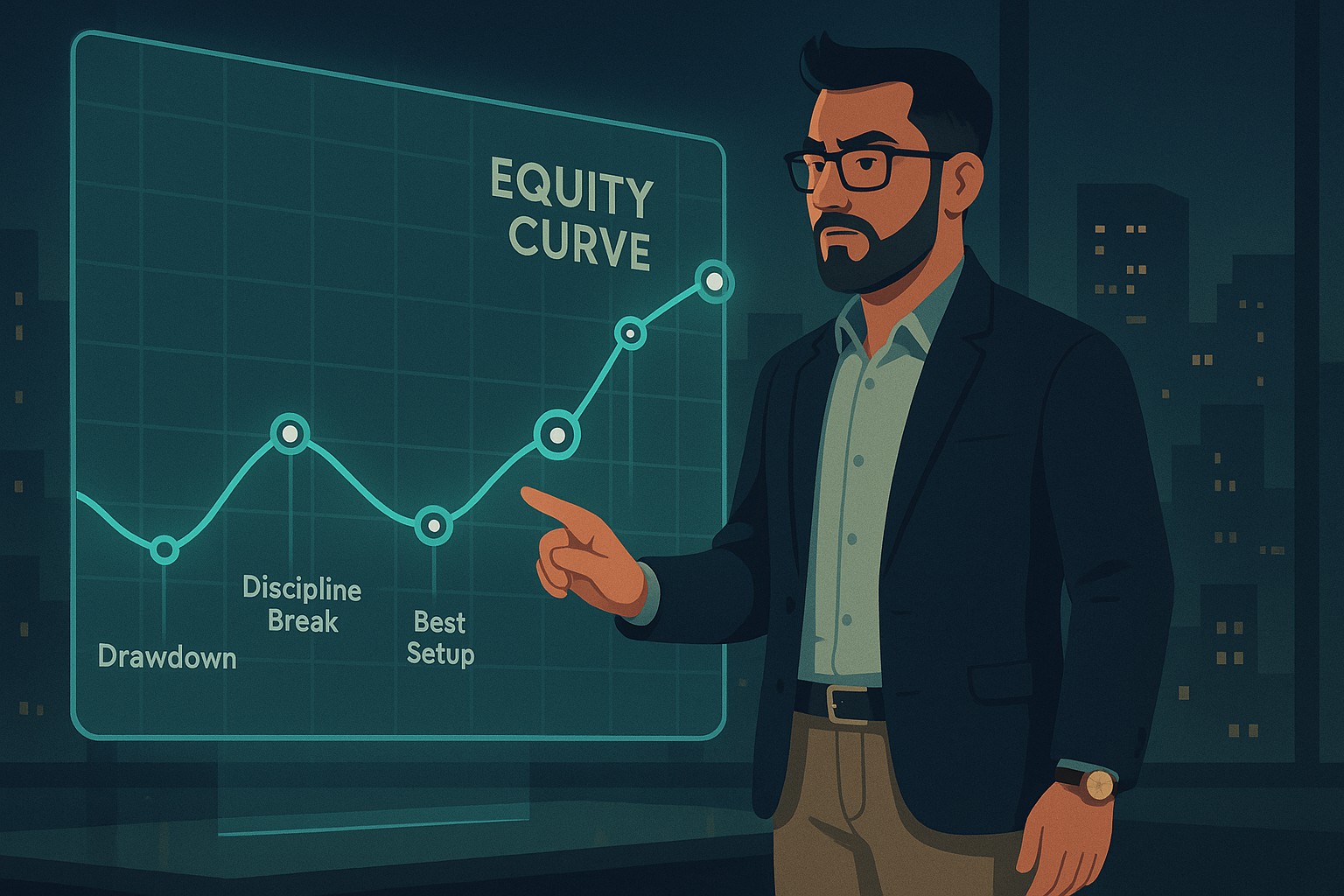
Next week, commit to aggressively removing the first and deliberately repeating the second. That single change can start to bend your equity curve in a better direction.

If you remember only one thing, let it be this:
Your Trading Journal is your most powerful trading tool.
It is more powerful than any indicator, indicator combo, or secret strategy.
Your ability to track, measure, and review your own performance is the skill that turns traders into professionals. What gets measured gets improved. What gets reviewed gets refined. What gets tracked becomes predictable.
Your consistency starts with your journal.
Your edge is hiding in your data.
Now it is your turn to uncover it.
Yes. Beginners actually benefit the most because journaling prevents years of blind repetition. Combine it with a structured path like Beginner Trading Master Guide 2025: The Complete Roadmap to Consistency and your learning curve accelerates.
No. Google Sheets, Notion, or Excel are more than enough. You can always upgrade tools later as your style matures.
Absolutely. Incomplete data leads to misleading conclusions. If you skip trades in your journal, your stats will lie to you.
That feeling is normal at first. It simply means you are finally seeing what needs to change. Over time, your journal becomes a source of clarity and motivation, not shame.
It’s time to go from theory to execution!
Create an Account. Start Your Live Trading Now!
Looking for step-by-step approaches you can plug straight into the charts? Start here:
Sharpen your edge with proven tools and frameworks:
News moves markets fast. Learn how to keep pace with SMC-based playbooks:
From NASDAQ opens to DAX trends, here’s how to approach indices like a pro:
Gold remains one of the most traded assets - here’s how to approach it with confidence:
Candlesticks are the building blocks of price action. Master the most powerful ones:
Ready to go intraday? Here’s how to build consistency step by step:
Markets swing between calm and chaos. Learn to read risk-on vs risk-off like a pro:
Step inside the playbook of institutional traders with SMC concepts explained:
Forex pairs aren’t created equal - some are stable, some are volatile, others tied to commodities or sessions.
If you’ve ever been stopped out right before the market reverses - this is why:
Mindset is the deciding factor between growth and blowups. Explore these essentials:
The real edge in trading isn’t strategy - it’s how you protect your capital:
If you’re not sure where to start, follow this roadmap:
This way, you’ll grow from foundation → application → mastery, instead of jumping around randomly.
Follow me for more daily market insights!
Jasper Osita - LinkedIn - FXStreet - YouTube
This content may have been written by a third party. ACY makes no representation or warranty and assumes no liability as to the accuracy or completeness of the information provided, nor any loss arising from any investment based on a recommendation, forecast or other information supplies by any third-party. This content is information only, and does not constitute financial, investment or other advice on which you can rely.
ACY Securities is one of Australia's fastest growing multi-asset online trading providers, offering ultra-low-cost trading, rock-solid execution, technologically superior account management and premium market analysis.

Select the categories and companies you wish to follow directly to your person rss feed.
Create Custom RSS FeedSign up and join over 5,000 professional members who receive personalized news alerts, curated professional connections, and more for free!
Multi-asset trading broker AvaTrade has agreed to acquire the majority of FXCM Group’s business and brand, in a transaction that would bring a longstanding retail FX franchise into the AvaTrade Group.
LSEG and CMC Markets have signed a multi-year strategic data agreement expanding CMC's access to LSEG's real-time and delayed pricing, reference and corporate actions data, news and analytics, plus AI-ready content, to support new products, entry into new markets and the growth of CMC's institutional and B2B partnerships.
The Tel Aviv Stock Exchange is considering a bid for the Cyprus Stock Exchange, with Israeli media citing its EU licence, trading platform and clearing house. Euronext’s Athens exchange and India’s National Stock Exchange are also seen as contenders, and Cyprus aims to sign a sale agreement by the end of this year.
CME Group will launch baseball futures on 12 October, pending regulatory review, tracking CME FutureSports Performance Indexes built on Official League Data. Standard and micro contracts will start with the 2026 Postseason and the four clubs in the League Championship Series, trading around the clock.
ESMA has published an opinion stating that MiCA-authorised crypto-asset service providers should cease services tied to non-MiCA-compliant stablecoins for EU clients across MiCA crypto-asset services. National authorities should require remediation of existing exposures within three months, by early January 2027.
Nasdaq Ventures has made a strategic investment in Amsterdam-based derivatives and crypto exchange One Trading, with both firms to explore 24/7 trading of equity futures. The undisclosed investment follows Nasdaq's US$100 million investment in Payward, the parent of Kraken, and CME Group's move to 24/7 trading.
cTrader has opened multi-platform plugins to brokers and prop firms, which can pre-install their own tools for clients or list them in cTrader Store. The plugins run across Mobile, Web, Windows and Mac, and can be built and launched independently of core-platform releases, including trading journals and calculators.
Institutional brokerage and financial infrastructure provider Clear Street has joined TradingView’s broker network, allowing its clients to trade US stocks, exchange-traded funds and options directly through the charting and analysis platform.
Learn how to improve trading psychology, manage fear and greed, avoid revenge trading, and follow your trading strategy with discipline and a trading journal.
GTC Prime has announced a strategic partnership with Centroid Solutions to manage and distribute its liquidity through CS 360 Bridge, Centroid's multi-asset connectivity and execution engine, giving brokers and institutional clients access to tailor-made pricing, low-latency execution and real-time risk management.