just now


Liquidity Finder Ltd is incorporated in England and Wales, company number 10610740, registered address 167-169 Great Portland Street, Fifth Floor, London W1W 5PF, United Kingdom.
Published: just now

As we head into the third week of May, market participants are weighing a mix of bullish price action against stubborn economic risks. Next week’s US economic calendar is headlined by two pivotal updates: fresh housing data amid ongoing affordability concerns, and April’s inflation report—a release known for surprising markets.
While stocks, particularly the S&P 500, have powered through resistance levels in recent weeks, there’s a growing disconnect between market optimism and underlying fundamentals. This week’s data could be a wake-up call.
Let’s break it all down…
The upcoming housing report will provide the latest snapshot of a sector still struggling under the weight of high financing costs. With the 30-year mortgage rate lingering just below 7%, the average new mortgage taken out for home purchases—about $450,000—equates to monthly payments nearing $3,000. That’s simply unaffordable for most Americans.
This affordability squeeze explains why mortgage applications remain historically low, despite a modest bump in new purchase applications. More importantly, sentiment among builders is collapsing. The National Association of Home Builders (NAHB) index fell sharply in May, underscoring a gloomy outlook among those closest to the action. Builders are reacting not only to pricing pressure but also to buyer hesitation triggered by recent volatility across financial markets.
With the housing market showing little sign of revival, even marginally weaker data could reinforce a broader economic slowdown narrative.
April inflation data—especially on the services side—has historically been a market-mover. That’s because April often sees annual increases in service-sector costs like healthcare, travel, insurance, and other stickier inflation categories.
In both 2023 and 2024, April’s CPI report came in hotter than expected, causing notable reactions in rates and equities. This time, there’s cautious optimism that services inflation could come in cooler—below the Bank of England’s 5% forecast.
If that’s the case, it won’t necessarily trigger a rate cut at the Fed’s June meeting, but it would help solidify expectations for policy easing later in the summer, potentially in August. For rate-sensitive sectors like housing, a more dovish tilt could offer some badly needed relief.
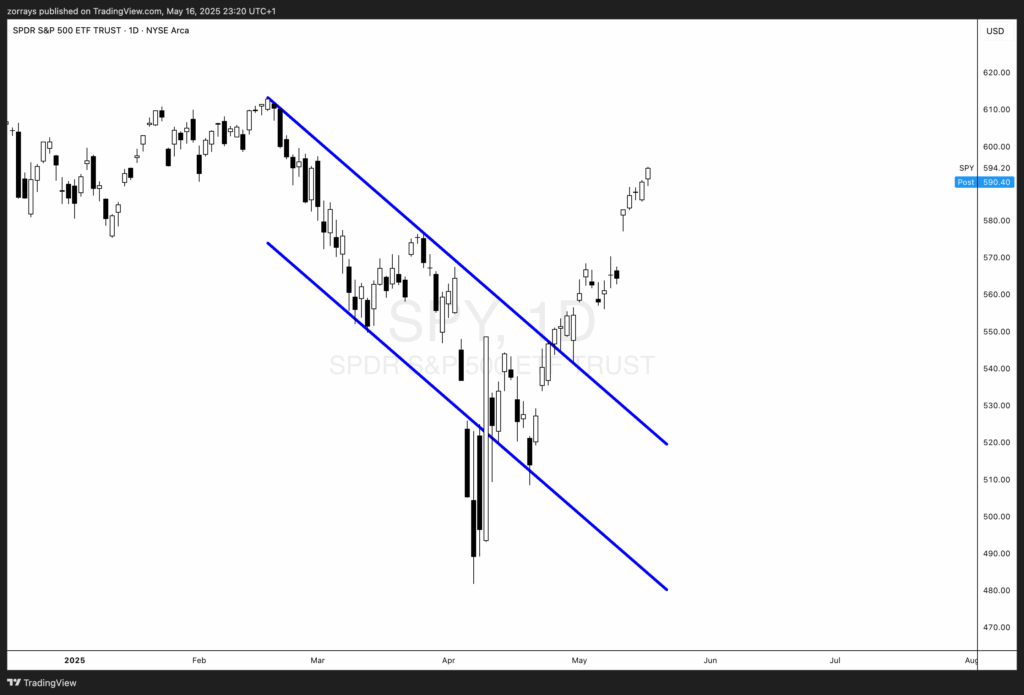
From a technical standpoint, the S&P 500’s recent performance has been stunning. After bottoming out in April, the index has broken out of a descending channel in dramatic fashion—posting one of its fastest rallies ever over such a short period.
Momentum remains strong, and short-term breadth indicators suggest little resistance up to all-time highs. But is this momentum sustainable?
Not everyone thinks so. And a look beneath the surface reveals that some market participants may be mispricing risk.
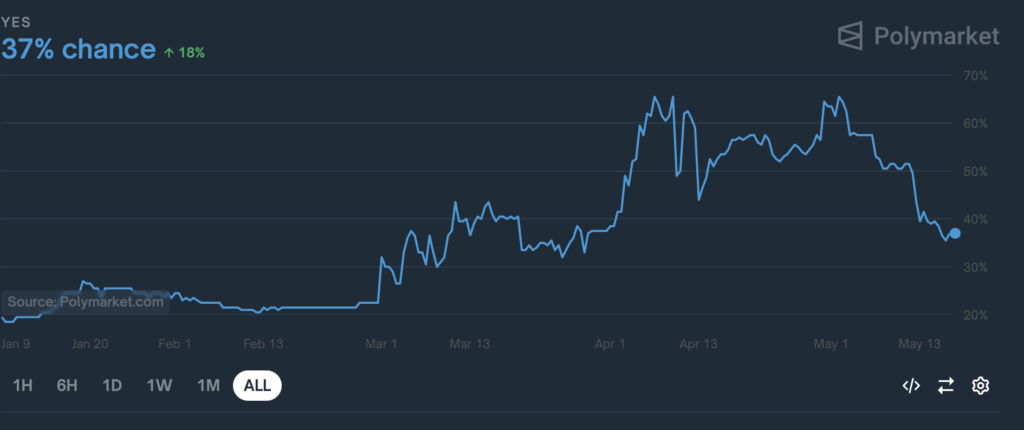
Source: Polymarket.com
While equity markets seem euphoric, prediction markets are still pricing in a 37% chance of a US recession before year-end. That number has dropped significantly since the recent 90-day pause on new tariffs, which initially spooked investors earlier this year.
However, it’s crucial to note that this pause is just that—a temporary deferral, not a resolution. The structural trade issues between the US and China remain unresolved, and any flare-up could reintroduce significant downside risks for growth.
In short, while the immediate threat has eased, the underlying fragility of the macro backdrop hasn’t gone away. The divergence between rising stock prices and sustained recession probabilities suggests either optimism is warranted—or investors are being lulled into a false sense of security.
Next week’s data on housing and inflation will offer timely insights into the real economy—beyond the headlines of new stock market highs. The S&P 500’s record-breaking rally may seem unstoppable, but with affordability collapsing in the housing sector and recession risks still elevated, caution is warranted.
For traders, investors, and policymakers alike, this week presents a reality check: the economy and the market may not be singing the same tune. Stay vigilant, stay informed.
Alchemy Markets is a multi-asset brokerage providing retail traders with the same elite trading conditions, tools, and transparency typically reserved for institutions.

Select the categories and companies you wish to follow directly to your person rss feed.
Create Custom RSS Feedjust now
Sign up and join over 5,000 professional members who receive personalized news alerts, curated professional connections, and more for free!
Marex has entered the football financing market through a partnership with specialist sports investment and advisory firm Pinto Capital, targeting clubs in the Premier League and EFL Championship.
Around 110,000 UK retail investors have secured $300 million worth of Anthropic shares in its record-breaking $81 billion IPO. The heavily oversubscribed offer, coordinated by RetailBook, saw smaller investors prioritised, with 63% of applicants receiving their full allocation.
Clear Street has completed its acquisition of Boom Securities (H.K.) Limited, establishing its first licensed brokerage presence in Hong Kong
Sterling slips to its lowest against the dollar since October as markets trim Bank of England bets and Fed minutes point to further US rate rises, while the euro hits a fresh one-year low. Daily FX analysis from Equals.
JT Prime, the institutional Prime of Prime founded by Raj Sitlani, Jonathan Brewer and Jeff Wilkins, is set to become the new home for institutional client relationships currently serviced by FXCM Pro. Clients have been offered the same leverage, fees and connectivity, ensuring continuity of trading conditions.
The Nasdaq 100 has shifted into a short-term bullish recovery after finding strong support around 26,611. Following the sharp sell-off, price has formed a sequence of higher lows and has moved back above the 20-hour moving average at around 27,270, while the 5-hour and 10-hour averages are also turning higher.
U.S. equity futures rose in the after hours, led by Nasdaq-100 futures up 1% and S&P 500 futures up 0.6%, as investors focused on Anthropic’s Nasdaq debut. The AI company priced its IPO at $83 per share, above expectations, and expanded the offering to raise around $81.3 billion, making it the largest IPO on record.
Brokers can offer LMAX perpetual futures alongside FX and CFDs through a single trading account. LMAX says brokers with existing credentials can go live in under five days.
24X National Exchange has filed a proposed rule change with the SEC to launch 24X Options, a general options market trading from 9:30 a.m. to 4:00 p.m. ET. The filing also covers binary KPI options on quarterly revenue, earnings per share and other metrics for 23 of the most actively traded U.S. companies.
cTrader Mobile 5.11 introduces Signals, a new app where traders can browse signals from leading providers and act on them directly in the platform.