
just now


Liquidity Finder Ltd is incorporated in England and Wales, company number 10610740, registered address 167-169 Great Portland Street, Fifth Floor, London W1W 5PF, United Kingdom.
Published: just now

The coming week is set to be a pivotal one for global markets as the United States, United Kingdom, and Canada all feature crucial monetary policy decisions and economic data releases. With inflationary pressures still lingering but labor markets showing signs of fatigue, central banks are carefully recalibrating their strategies. Investors and policymakers alike will be watching closely for signs of how the Fed, BoE, and BoC intend to navigate the tricky balance between inflation control and economic stability.
The Federal Reserve takes center stage this week, with expectations leaning toward a 25 basis point (bp) rate cut. Inflation remains stubbornly high, but the real story lies in the labor market.
Over the past four months, jobs growth has been tepid, and concerningly, recent revisions revealed that over half of the jobs reportedly added in the 12 months to March never actually existed. This softer jobs backdrop, combined with signs of a cooling economy, suggests the Fed now has room to ease policy.
Markets expect the Fed to lower rates from the current 4.5% ceiling toward 3.25% by March 2025, gradually moving away from “somewhat restrictive” policy toward a more neutral stance.
Consumer spending momentum is faltering. Retail sales are expected to disappoint due to weak consumer sentiment and a decline in auto sales. Industrial production, meanwhile, looks set for another contraction, supported by subdued manufacturing survey data.
Together, these releases paint a picture of an economy losing steam, reinforcing the Fed’s likely dovish tilt.
The UK labor market remains a wild card for the Bank of England (BoE). Payroll figures will be closely scrutinized for further signs of weakness. Encouragingly, business surveys have started to improve, hinting that the worst may be behind the jobs market.
However, wage growth trends remain a key focus. If pay pressures continue to ease, this will give the BoE further confidence in its rate-cutting cycle.
Food inflation remains a thorn in the BoE’s side, likely holding above 5% in the upcoming data. On the positive side, services inflation is expected to edge lower, helping to alleviate some of the pressure.
While this report is unlikely to derail the BoE’s expected path of gradual easing, a significant upside surprise could alter the timing of cuts. For now, November is still viewed as the most probable moment for the next move.
No policy change is expected at this meeting. Having already cut rates in August, the BoE tends to adjust only once per quarter. Forward guidance will likely reiterate that while cuts are coming, rates are now approaching a more neutral level.
The Bank of Canada (BoC) is widely expected to deliver a 25bp rate cut this week, responding to a weakening domestic backdrop.
Canada’s economy is highly exposed to U.S. tariff impacts, and the latest data has been troubling. Output contracted sharply in Q2, while employment fell for the second straight month in August, pushing unemployment up to 7.1%.
With inflation broadly aligned with target, the BoC has space to act. A second rate cut is likely in Q4, bringing policy closer to the bottom of its perceived neutral range.
The broader theme across the Fed, BoE, and BoC is one of monetary easing amid cooling economies. Inflation is still sticky in some sectors, but weaker labor markets and softening demand are increasingly shaping central bank decisions.
Investors should prepare for a synchronised global shift toward looser policy, which may provide temporary relief for equity markets but underscores mounting risks of a deeper slowdown.
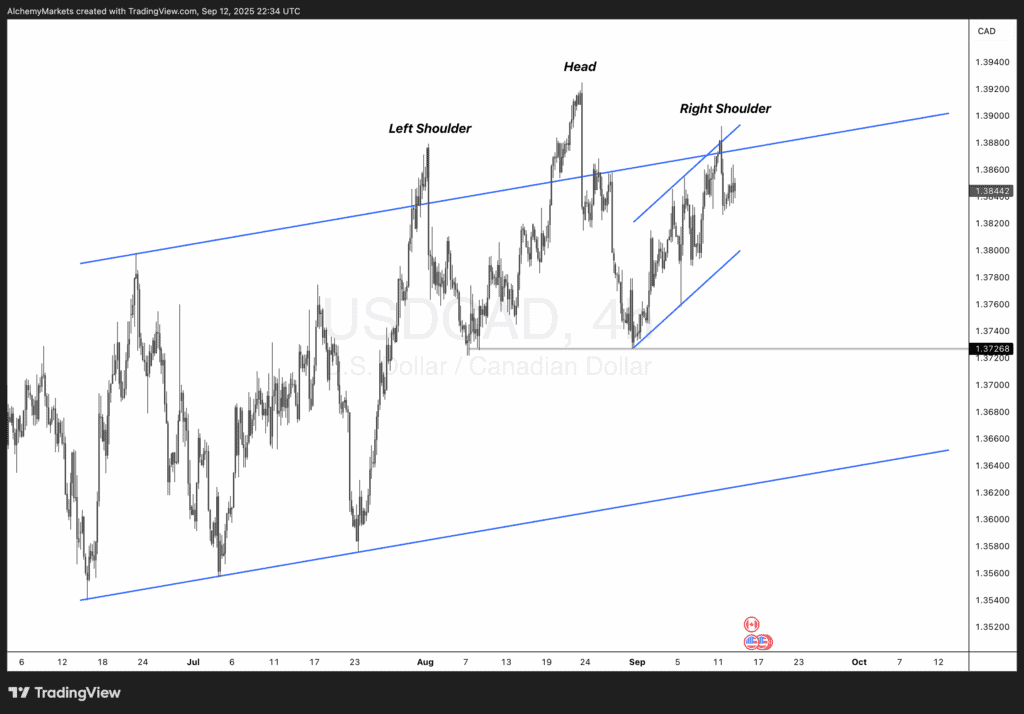
Looking at the USD/CAD 4H chart, the pair is forming a head-and-shoulders pattern, typically viewed as a bearish reversal structure.
The neckline support sits around 1.3725, which aligns closely with prior swing lows. A decisive break below this level could open the door for a deeper retracement, potentially targeting 1.3650 and 1.3550.
This technical setup ties neatly into the macro backdrop:
In other words, while rate cuts on both sides might seem offsetting at first glance, the balance of risks leans toward USD/CAD retracing lower, confirming the technical head-and-shoulders pattern.
Alchemy Markets is a multi-asset brokerage providing retail traders with the same elite trading conditions, tools, and transparency typically reserved for institutions.

Select the categories and companies you wish to follow directly to your person rss feed.
Create Custom RSS FeedSign up and join over 5,000 professional members who receive personalized news alerts, curated professional connections, and more for free!
ATARIA CRM is a centralized platform designed for fintech teams to manage account operations, verification, fund management, and support in one place. With desktop and mobile access, it helps businesses stay connected, organized, and efficient.
EUR/AUD hits the 1.60500 target after rejecting 1.61715–1.62300 resistance. Review the bearish price action setup and why trade confirmation mattered.
Get an inside look at how rising Treasury yields and sector shifts into healthcare are impacting S&P 500 market dynamics, technical levels, and key economic drivers.
Understand XAUUSD support and resistance with simple gold chart examples. Learn to identify key zones, assess price reactions, and avoid beginner mistakes.
CMC Markets, a FTSE 250 multi-asset financial services firm, has launched a read-only ChatGPT integration for UK CFD clients, giving access to balances, positions, orders, pricing and historical market data through conversational prompts, as part of its ongoing investment in AI and cloud technology.
DXtrade, the multi-asset trading platform from Devexperts, has integrated Notofin's trading performance intelligence solution, adding behaviour-first analysis, structured journaling and pattern recognition tools. Brokers licensing DXtrade can now offer Notofin's services to clients as part of the platform's open integration framework.
KYC is essential for building trust, preventing fraud, and meeting regulatory requirements. A centralized system like ATARIA CRM helps compliance teams manage KYC requests, track pending documents, monitor approvals and rejections, and keep the entire verification process organized. By quickly identifying pending issues, businesses can reduce delays and provide customers with a smoother path from “Pending” to “Approved.”
Build better trading habits with a trading journal. Learn how a trading memory bank helps you review mistakes, manage emotions, and develop confidence.
GBP/USD has fallen to 3-month lows near 1.3200 due to strong US economic data and weakening UK consumer demand, though technical indicators like an RSI of 25.18 suggest the pair is now in oversold territory near key support at 1.3150.