just now


Liquidity Finder Ltd is incorporated in England and Wales, company number 10610740, registered address 167-169 Great Portland Street, Fifth Floor, London W1W 5PF, United Kingdom.
Published: just now


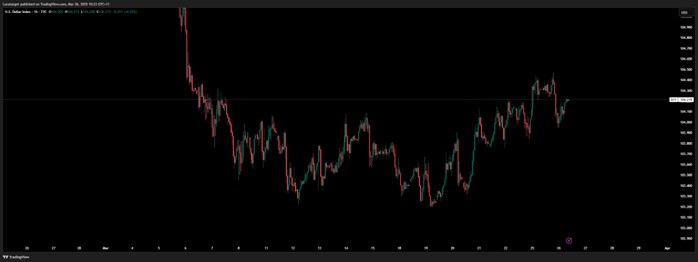
The US dollar has extended it rebound this week, with the dollar index marking its fourth consecutive day of gains. A combination of rising US Treasury yields and a robust rally in equity markets has fuelled this resurgence. The Nasdaq Composite surged 2.3% yesterday, surpassing the 18,000 marks for the first time since early March, bolstering investor sentiment and reinforcing confidence that the recent market downturn has found a floor.
A notable driver behind this renewed optimism is the evolving stance of former President Donald Trump on tariffs. His indication that upcoming tariff measures will be more selective potentially offering exemptions to certain countries has tempered fears of widespread economic disruption. However, he maintains that substantial tariff increases will be announced on April 2, with particular focus on pharmaceuticals, autos, and sector-specific policies for semiconductors and lumber. Additionally, a proposed 25% "secondary tariff" on nations purchasing oil from Venezuela has been introduced, though its overall market impact is expected to be limited given Venezuela's relatively small crude export volume.
Further supporting the dollar's momentum, fresh economic data suggests the US economy remains resilient. March's services PMI jumped 3.3 points to 54.3, driving the composite PMI to 53.5 a stark contrast to the 2.9-point decline in the manufacturing sector, which slipped to 49.8. While manufacturing struggles persist, the rebound in services has helped mitigate concerns of a prolonged economic slowdown. Compared to last year’s average PMI of 53.7 when GDP growth reached 2.8% the latest figures suggest underlying economic strength remains intact.
Across the Atlantic, business confidence has also improved, with the eurozone composite PMI edging up to 50.4, its highest level since August, while the UK’s PMI climbed to 52.0. These developments indicate that despite global uncertainties, growth momentum remains steady, providing a boost to higher-beta currencies.

Emerging market currencies have broadly lost ground against the dollar this past week, with the Turkish lira (TRY), Russian rubble (RUB), Hungarian forint (HUF), and Brazilian real (BRL) among the weakest performers. The Indian rupee (INR) has been a notable exception, strengthening 0.9% against the USD, alongside modest gains in the Malaysian ringgit (MYR).
Turkey’s financial markets have been particularly volatile, exacerbated by the political turmoil surrounding Istanbul Mayor Ekrem İmamoğlu, who was arrested on corruption charges just as he was poised to be declared the opposition’s presidential candidate. The move has heightened concerns about political interference and market stability, leading to a rapid depreciation of the lira. The Central Bank of Turkey has responded by raising the overnight lending rate by 200 basis points to 46.00%, aiming to stabilize the currency. Meanwhile, Finance Minister Mehmet Şimşek and CBRT Governor Fatih Karahan are set to address foreign investors to calm market nerves.
Looking ahead, market participants will be closely monitoring upcoming economic releases, including US building permits data and consumer confidence indicators. Additionally, remarks from Federal Reserve officials could provide further insight into the Fed’s stance on inflation and interest rates, which remain crucial to shaping USD direction. While the Fed has signalled its intent to cut rates by 50 basis points this year, expectations for inflationary pressures from tariffs could complicate the policy outlook.
With heightened geopolitical and economic uncertainty on the horizon, investors should remain vigilant as the US dollar continues to assert its strength in the global currency landscape.
This content may have been written by a third party. ACY makes no representation or warranty and assumes no liability as to the accuracy or completeness of the information provided, nor any loss arising from any investment based on a recommendation, forecast or other information supplies by any third-party. This content is information only, and does not constitute financial, investment or other advice on which you can rely.
ACY Securities is one of Australia's fastest growing multi-asset online trading providers, offering ultra-low-cost trading, rock-solid execution, technologically superior account management and premium market analysis.

Select the categories and companies you wish to follow directly to your person rss feed.
Create Custom RSS FeedSign up and join over 5,000 professional members who receive personalized news alerts, curated professional connections, and more for free!
CMC Markets has retired the CMC Connect name and will now present its institutional business as CMC Markets Institutional.
The SEC has approved Cboe's binary options tied to key performance indicators reported by 23 companies, covering more than 100 metrics such as iPhone revenue. The cash-settled contracts pay a fixed $1, Robinhood plans to be the first retail broker to offer them, and trading awaits clearing registration.
Gold is trading around $4,150, recovering sharply after falling to a recent low of $4,073.

Global semiconductor and technology stocks sold off sharply on Thursday, with South Korea’s SK Hynix plunging over 10% and Samsung Electronics falling more than 8%.
Learn gold market structure to identify bullish, bearish and ranging XAUUSD trends using higher highs, higher lows, lower highs and lower lows, support and resistance.
Axi has launched an MCP integration connecting eligible MT5 accounts to Claude, allowing clients to access live market data, track positions, execute trades and update risk parameters through the AI assistant developed by Anthropic. Available to eligible Axi clients with an active MT5 account. Setup runs via Claude.ai.
Movantis has selected Integral to extend its FX liquidity offering for institutional clients including banks, payment networks and digital asset operators, adding an institutional trading platform, direct-to-client API trading and API connectivity into a third-party multi-dealer venue, supporting regional expansion.
Running a venue around the clock is the easy part. Pricing risk when the market underneath it is shut is not. Lars Holst, CEO of GCEX explains how to manage risk in 24/7 markets.
ATFX has released its Q4 2026 Trader Magazine, offering a closer look at the macroeconomic and market forces that could shape trading conditions in the final quarter of the year.
LSEG has announced a collaboration with NVIDIA that lets financial institutions analyse years of LSEG Tick History data in seconds using NVIDIA cuDF on GPUs, without creating another full copy of the dataset. Tick History holds 110 trillion rows across 100 million instruments and more than 580 venues and contributors.