
just now


Liquidity Finder Ltd is incorporated in England and Wales, company number 10610740, registered address 167-169 Great Portland Street, Fifth Floor, London W1W 5PF, United Kingdom.
Published: just now


The U.S. dollar is cautiously finding its footing after a turbulent month, edging higher as markets digest improving sentiment around U.S. trade policy and await critical economic data. After four straight weeks of losses, the dollar index has climbed back toward the 100 marks, rebounding from its April low of 97.921. Optimism is growing that President Trump could walk back some of the most disruptive tariffs imposed during his second term a move that, if confirmed, would mark a significant easing of recent trade tensions with China.
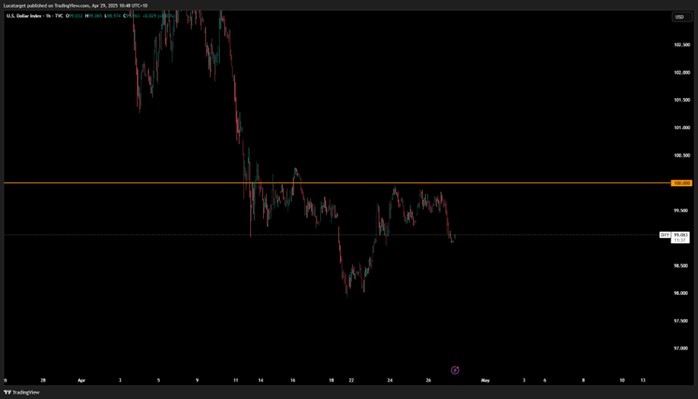
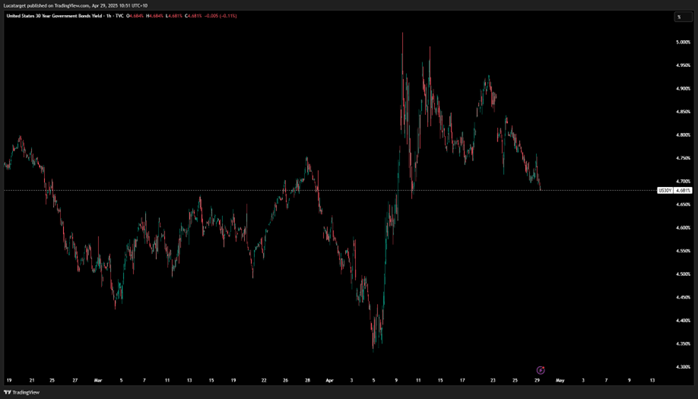
Adding to market stability, Trump also reassured investors last week that he has no intention of removing Fed Chair Jerome Powell, a signal that has helped to patch up damaged confidence in U.S. policy management following the shockwave triggered by the “Liberation Day” tariffs in early April. Equity and bond markets responded positively: the S&P 500 has nearly erased the heavy losses it suffered earlier in the month, while long-dated U.S. Treasury yields have retreated from recent highs, with the 30-year yield now closer to 4.70%.
However, despite these glimmers of hope, risks remain firmly in place. Consumer sentiment continues to crumble under the weight of policy uncertainty and elevated import costs. The University of Michigan's consumer confidence index plummeted in April, falling by an eye-watering 21.8 points to 52.2 among the lowest readings since the 1970s.
Attention now shifts to Friday’s highly anticipated U.S. nonfarm payrolls report, which could be a decisive moment for the Federal Reserve's next move. With Fed officials, including Governor Waller, signalling readiness to cut rates if labour market cracks widen, any signs of softness in hiring could fuel expectations for rate cuts as early as the September FOMC meeting. Job growth has already slowed noticeably in the first quarter, averaging 152,000 new jobs per month, and unemployment has been hovering stubbornly around 4.0%-4.2%. Rate futures are pricing in one or two cuts by July, but for that to materialize, Friday’s report will need to reveal tangible signs of economic cooling.
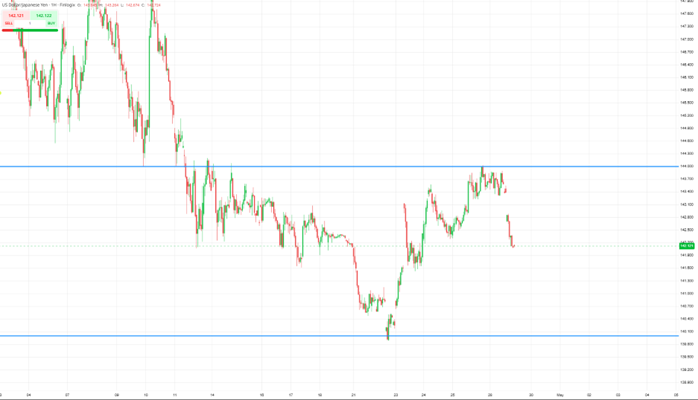
Meanwhile, the yen has come under pressure, losing ground against the dollar as global risk appetite staged a modest rebound. USD/JPY is now flirting with the 144.00 level after dipping below 140.00 earlier last week. Japanese equities have also bounced back sharply, erasing their prior "Liberation Day" losses.
The key event for the yen this week is the Bank of Japan’s policy meeting its first since the U.S.-Japan tariff hikes were introduced. Governor Ueda and his team face a tricky task: balancing the headwinds from trade disruptions with the ongoing recovery in domestic inflation. Tokyo’s April CPI surprised to the upside, reinforcing the view that Japan’s path toward policy normalization is still intact, albeit under a heavy cloud of external uncertainty.
Markets widely expect the BoJ to trim its GDP growth forecast for the current fiscal year, possibly cutting it by around half a percentage point from the current 1.1% estimate. Core inflation projections could also see a slight downward revision, reflecting both weaker energy prices and dampened domestic demand. Nevertheless, inflation is likely to stay close to the 2% target, keeping the door open for eventual rate hikes although markets have now pushed out expectations for the next BoJ move to later in the year, between September and December.
Unless the BoJ takes a surprisingly dovish turn and completely scraps its normalization plans — which seems unlikely the downside for the yen should remain contained. Broader global trends, including potential rate cuts from the Fed, ECB, and BoE later this year, could continue to narrow yield spreads and provide the yen with structural support over the medium term.
While some signs of stability are emerging, the global economy remains finely balanced. Last week, fresh inflation data from Europe suggested easing pressures, adding to speculation that the ECB may join the Fed in cutting rates before year-end. Meanwhile, U.S. political risk remains a potent wildcard with Congress debating a bill to fast-track tariff relief measures ahead of the summer session.
All eyes are now firmly on Friday's jobs report, BoJ signals, and any headlines out of Washington regarding trade negotiations. For now, markets are willing to cautiously believe that the worst of the trade policy shocks might be behind us. But with uncertainty still high, it's wise to remain nimble.
This content may have been written by a third party. ACY makes no representation or warranty and assumes no liability as to the accuracy or completeness of the information provided, nor any loss arising from any investment based on a recommendation, forecast or other information supplies by any third-party. This content is information only, and does not constitute financial, investment or other advice on which you can rely.
ACY Securities is one of Australia's fastest growing multi-asset online trading providers, offering ultra-low-cost trading, rock-solid execution, technologically superior account management and premium market analysis.

Select the categories and companies you wish to follow directly to your person rss feed.
Create Custom RSS FeedSign up and join over 5,000 professional members who receive personalized news alerts, curated professional connections, and more for free!
Bybit has launched Perp Options, described as the first options contracts built on TradFi perpetuals, giving traders round-the-clock access to US equity options. SpaceX and Nvidia are the first underlying assets, with USDT settlement and integration into Bybit's Unified Trading Account.
Use this trading preparation checklist to plan your session, define entry rules, manage risk, and build a disciplined trading routine in seven steps.
Your Bourse expands its crypto liquidity ecosystem with Caladan, giving brokers access to broader market coverage, institutional execution capacity and streamlined settlement.
Scope Markets, the retail brokerage part of Rostro Group, has appointed Ibrahim Hossny as Head of Research and Marketing for the Middle East and North Africa.
Hantec Prime, the institutional division of Hantec Markets, has reported trading volume up more than 300% year-to-date, alongside the addition of 42 new institutional clients since December, capping one of its strongest years of growth to date.
Learn how to refine XAUUSD support and resistance on the daily chart using candle bodies, market structure and weekly gold levels for swing trading. A slug alone cannot guarantee a top Google ranking. Keep it focused rather than adding every supporting keyword.
The week in Dubai will be focused on connecting directly with the industry and discussing how technology can help modern brokerages simplify operations, automate workflows, strengthen operational control, and scale efficiently.
Devexperts has launched a turnkey solution giving brokers in South Korea access to US equity markets, combining its DXtrade trading platform, dxFeed market data, and execution services. The offering targets South Korea's growing retail demand for US stocks, worth several billion USD monthly.
Assess why WTI crude oil surged past $105 per barrel amid Saudi pipeline disruptions, record tanker charter rates, and escalating geopolitical tensions.
Bitcoin price forecast: BTC/USD retests $78,460–$80,215 resistance. Watch bearish confirmation toward $72,480 or a bullish breakout toward $86,150.