just now


Liquidity Finder Ltd is incorporated in England and Wales, company number 10610740, registered address 167-169 Great Portland Street, Fifth Floor, London W1W 5PF, United Kingdom.
Published: just now


Despite fleeting moments of strength, the Japanese yen continues to struggle against the US dollar, weighed down by a confluence of bond market volatility, unclear policy direction from Tokyo, and renewed speculation surrounding US-Japan trade dynamics. This past week, the USD/JPY pair found itself trapped within a volatile range testing lows near 143 before rebounding modestly amid an absence of any decisive policy action or verbal intervention from either government.
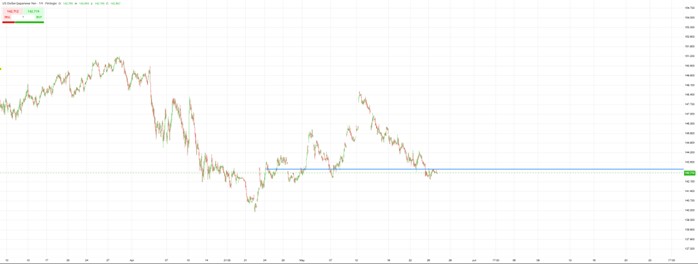
The much-anticipated finance ministers’ meeting between the US and Japan, held on the sidelines of the G7 gathering, offered little in terms of currency-specific developments. Both sides reaffirmed that there was “no discussion of exchange rate levels,” a phrase repeated from earlier communiqués. Yet markets remain unconvinced that currency diplomacy is entirely off the table. Parallel reports that the US did broach FX policy in talks with South Korea have kept traders alert to the possibility that Japan may be under subtle pressure to engineer a stronger yen through domestic policy tweaks.
The yen’s recent rebound toward the 143 handle was short-lived. It occurred after a weak 20-year Japanese government bond (JGB) auction sparked a jump in long-end yields, drawing in some speculative yen buying. However, the relief faded quickly as investor nerves returned. A similar dynamic unfolded in the US, where the Treasury's own 20-year auction was also poorly received, underscoring broader market unease with duration risk on both sides of the Pacific.
One might expect rising JGB yields to signal yen weakness, mirroring the dynamic often observed with US Treasuries. Yet this time, the relationship is decoupling. The rise in Japanese yields appears driven less by inflation expectations or hawkish Bank of Japan (BOJ) signalling and more by sheer market indigestion. The recent JGB auction posted the longest tail since 1987 an unmistakable sign that investors are demanding a higher premium to hold long-duration Japanese debt.
The BOJ, for its part, is facing calls from market participants to tread carefully as it considers its next move in tapering its bond purchases. A recent survey released by the BOJ’s Financial Markets Department revealed a split in opinion: some urge caution given the jump in superlong yields, while others advocate for accelerating tapering efforts. For now, the most likely path appears to be a continuation of the current reduction pace enough to maintain credibility, but not enough to spark a bond market revolt or yen surge.
Japan’s latest inflation print added an unexpected twist to the narrative. Core CPI (excluding food and energy) rose to 3.5% year-over-year in April the fastest pace in about a year raising eyebrows among policymakers and investors alike. This will add weight to the upcoming BOJ-hosted conference on May 27–28, where Governor Kazuo Ueda and his deputies are expected to provide updated guidance.

The central bank is still operating in a delicate balancing act: expressing openness to future rate hikes while avoiding signalling a policy shift that could destabilize fragile domestic markets. With Fed officials, including Christopher Waller and John Williams, also attending, any hints of policy coordination or divergence will be closely parsed for signals on future USD/JPY direction.
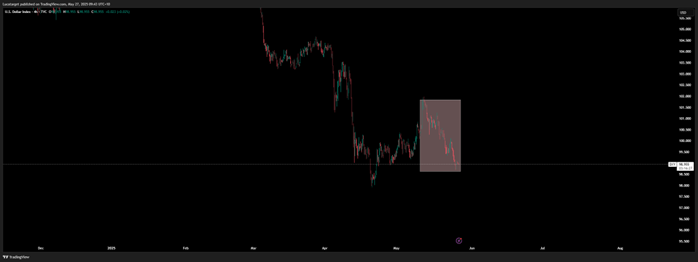
The dollar’s recent broad-based softness, with the DXY once again slipping below 100, has offered some mechanical relief to the yen, as well as to other G10 currencies. Yet the extent of USD/JPY correction remains capped by persistent uncertainty over the BOJ's policy normalization and broader macro divergence.
Investors are still digesting stronger-than-expected US economic data, including firm retail sales and labour market resilience. These figures continue to support a “higher-for-longer” narrative for Fed rates, keeping upward pressure on UST yields and the greenback. Until we see clearer signs of Fed dovishness or a BOJ shift with teeth the yen will remain at the mercy of global crosswinds.
In the near term, the USD/JPY looks set to remain stuck in the 141–145 range. However, the risks are increasingly asymmetric. If the BOJ’s messaging this week /next week leans toward policy normalization particularly considering the inflation surprise and if US-Japan trade talks yield any more hints of FX coordination, we could see the yen catch a second wind.
But the path forward is muddied by geopolitical overhangs, uncertain Fed timing, and the unresolved question of how much appetite Tokyo really has for a stronger currency. The weak-yen narrative is not dead but it is increasingly contested, and markets are starting to prepare for a shift in tone.
This content may have been written by a third party. ACY makes no representation or warranty and assumes no liability as to the accuracy or completeness of the information provided, nor any loss arising from any investment based on a recommendation, forecast or other information supplies by any third-party. This content is information only, and does not constitute financial, investment or other advice on which you can rely.
ACY Securities is one of Australia's fastest growing multi-asset online trading providers, offering ultra-low-cost trading, rock-solid execution, technologically superior account management and premium market analysis.

Select the categories and companies you wish to follow directly to your person rss feed.
Create Custom RSS FeedSign up and join over 5,000 professional members who receive personalized news alerts, curated professional connections, and more for free!
Multi-asset trading broker AvaTrade has agreed to acquire the majority of FXCM Group’s business and brand, in a transaction that would bring a longstanding retail FX franchise into the AvaTrade Group.
LSEG and CMC Markets have signed a multi-year strategic data agreement expanding CMC's access to LSEG's real-time and delayed pricing, reference and corporate actions data, news and analytics, plus AI-ready content, to support new products, entry into new markets and the growth of CMC's institutional and B2B partnerships.
The Tel Aviv Stock Exchange is considering a bid for the Cyprus Stock Exchange, with Israeli media citing its EU licence, trading platform and clearing house. Euronext’s Athens exchange and India’s National Stock Exchange are also seen as contenders, and Cyprus aims to sign a sale agreement by the end of this year.
CME Group will launch baseball futures on 12 October, pending regulatory review, tracking CME FutureSports Performance Indexes built on Official League Data. Standard and micro contracts will start with the 2026 Postseason and the four clubs in the League Championship Series, trading around the clock.
ESMA has published an opinion stating that MiCA-authorised crypto-asset service providers should cease services tied to non-MiCA-compliant stablecoins for EU clients across MiCA crypto-asset services. National authorities should require remediation of existing exposures within three months, by early January 2027.
Nasdaq Ventures has made a strategic investment in Amsterdam-based derivatives and crypto exchange One Trading, with both firms to explore 24/7 trading of equity futures. The undisclosed investment follows Nasdaq's US$100 million investment in Payward, the parent of Kraken, and CME Group's move to 24/7 trading.
cTrader has opened multi-platform plugins to brokers and prop firms, which can pre-install their own tools for clients or list them in cTrader Store. The plugins run across Mobile, Web, Windows and Mac, and can be built and launched independently of core-platform releases, including trading journals and calculators.
Institutional brokerage and financial infrastructure provider Clear Street has joined TradingView’s broker network, allowing its clients to trade US stocks, exchange-traded funds and options directly through the charting and analysis platform.
Learn how to improve trading psychology, manage fear and greed, avoid revenge trading, and follow your trading strategy with discipline and a trading journal.
GTC Prime has announced a strategic partnership with Centroid Solutions to manage and distribute its liquidity through CS 360 Bridge, Centroid's multi-asset connectivity and execution engine, giving brokers and institutional clients access to tailor-made pricing, low-latency execution and real-time risk management.