
Search Companies, News, Members & more
Terms of ServicePrivacy PolicySecurity PolicyLegal InformationCommunity GuidelinesSitemapsCookie Settings
2026 Copyright © Liquidity Finder Ltd. All rights reserved.
Liquidity Finder Ltd is incorporated in England and Wales, company number 10610740, registered address 167-169 Great Portland Street, Fifth Floor, London W1W 5PF, United Kingdom.
A Comprehensive Guide to Trading on Decentralized Exchanges

Published on Jan 2, 2026
Updated on Jun 29, 2026
Insight
Decentralised Exchanges (DEXs): How They Work, Costs, Risks And Best Practices
Author: Navneet Giri
Executive Summary
A decentralised exchange (DEX) lets users swap crypto directly from their own wallets, without a central intermediary holding funds. The trade-off is self-custody responsibility, smart contract risk, and sometimes unpredictable network fees.
- On this pageWhat Is A Decentralised Exchange?
- How DEXs Work
- Why People Use DEXs
- Main Types Of DEXs
- How Trading Works On A DEX
- Common Usage Scenarios
- Popular DEX Platforms
- Real Trading Costs (2025 Numbers)
- Advanced Strategies And Professional Tools
- Main Risks
- How To Avoid Common Mistakes
- Best Practices
- Future Of DEX Trading
What Is A Decentralised Exchange?
A decentralised exchange (DEX) is a venue where people trade cryptocurrency directly with each other. There is no bank or company in the middle holding customer funds. Trades are executed via blockchain-based smart contracts, and you keep assets in your own wallet rather than depositing them with an exchange.
Typical advantages
🔹 No account registration or extensive paperwork.
🔹 Markets can operate 24/7, including weekends.
🔹 Self-custody: you keep control of your assets.
What changes in practice
🔹 You are responsible for security and access.
🔹 Transactions are generally irreversible.
🔹 Smart contract and network fee risks matter.
ImportantWith self-custody, mistakes can be final. If you lose a seed phrase or send funds to the wrong address, there is typically no support desk that can recover assets.
How DEXs Work
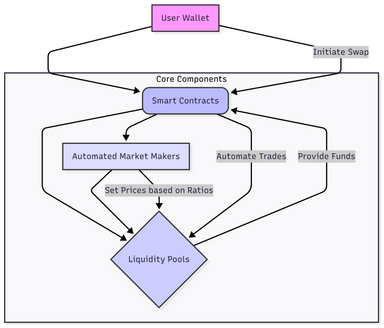
Image: Anatomy of a decentralized exchange, Source: www.liquidityfinder.com
DEX designs vary, but the goal is the same: enable users to swap tokens directly.
Core execution models
🔹 On-chain order books: Every order and trade is recorded on-chain. This is transparent but can be slower and more expensive.
🔹 Off-chain order books: Orders are matched off-chain, with final settlement on-chain. This can improve speed and reduce costs.
🔹 Automated market makers (AMMs): AMMs (for example Uniswap and PancakeSwap) use liquidity pools and smart contracts. Liquidity providers deposit tokens into pools; traders swap against the pool; prices shift based on pool balances.
Why People Use DEXs
Users typically choose DEXs for a small number of consistent reasons:
🔹 Direct control: funds remain in your wallet.
🔹 Privacy: no personal data submission or account creation.
🔹 Open access: anyone with a compatible wallet and internet can participate.
🔹 Token discovery: newer or less well-known tokens may list on DEXs early.
These benefits come with responsibility: understanding smart contract risk, token quality, and network fees is essential before trading.
Main Types Of DEXs
Order Book DEXs
These resemble traditional exchanges: orders are placed, recorded, and matched based on supply and demand. Examples include Binance DEX and Stellar-based venues.
🔹 On-chain order books maximise transparency but can introduce higher fees and slower confirmations.
🔹 Off-chain order books aim to improve performance by matching orders off-chain and settling on-chain.
An on-chain order book process:

Image: Understanding On-Chain Order Books, Source: www.liquidityfinder.com
An off-chain order book process:
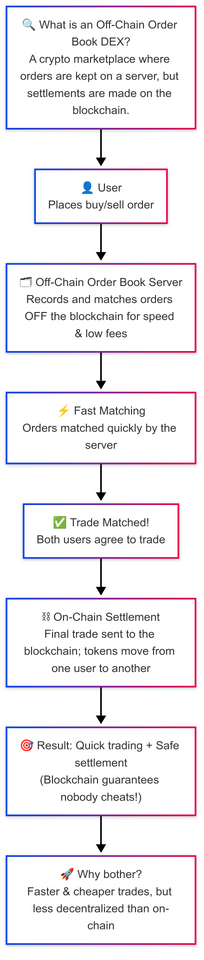
Image: Understanding Off-Chain Order Books, Source: www.liquidityfinder.com
Automated Market Makers (AMMs)
AMMs use smart contracts that hold liquidity pools. Rather than waiting for a counterparty, trades execute against the pool.
🔹 Examples: Uniswap, PancakeSwap, SushiSwap.
🔹 Liquidity provision: users can deposit tokens and earn a share of trading fees.
🔹 Pricing: adjusts automatically based on pool balances.
What Are Liquidity Pools?
Liquidity pools are collections of tokens locked in smart contracts. They allow trading to take place even when no direct counterparty is available. Users who add tokens are “liquidity providers” (LPs) and can earn a share of trading fees, but this can involve risks such as impermanent loss.
If you contribute two tokens (for example ETH and USDT), traders can swap between them by trading against the pool instead of another user. In general, deeper pools can support smoother execution.
How Prices Are Set On AMM DEXs
AMM DEXs use formulas rather than human market makers. A common approach is the constant product formula:
x × y = k
Where x and y are the quantities of each token in the pool and k is a constant. Large buys reduce one side of the pool and increase the implied price, and vice versa. This keeps the pool balanced after every trade.
If lots of one token get bought, its price goes up, and sellers of that token now get a better deal.
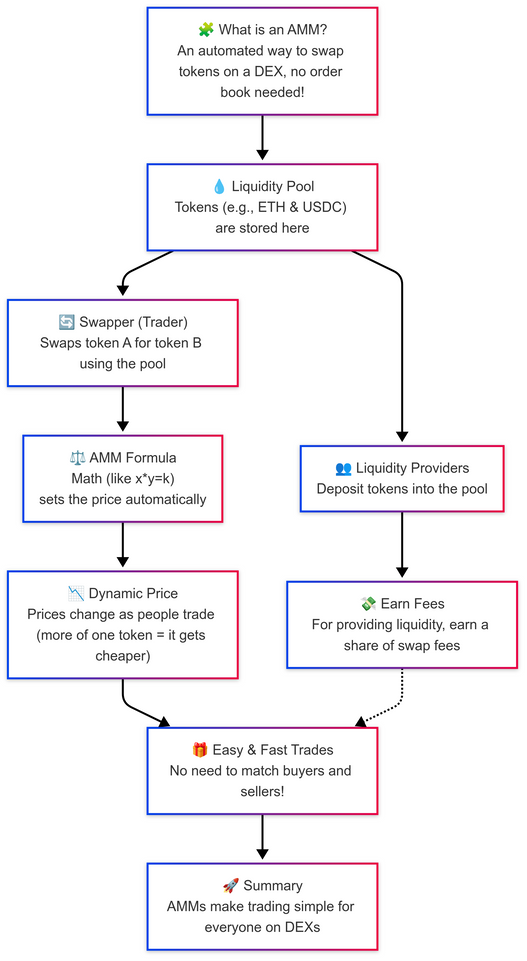
Image: Understanding the Automated Market Maker, Source: www.liquidityfinder.com
How Trading Works On A DEX
The trading flow is usually straightforward, but it is worth understanding each step before committing size.
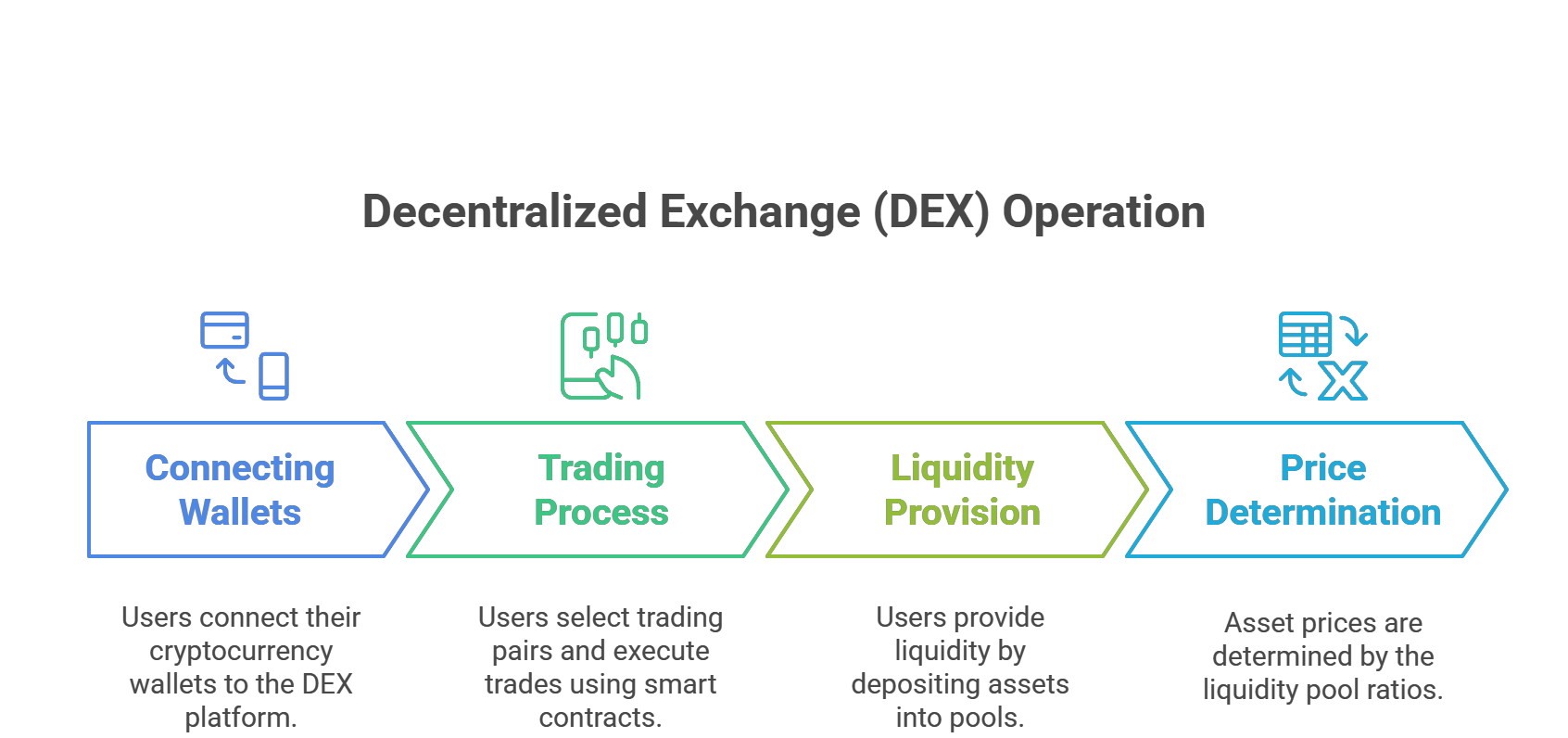
1) Get a cryptocurrency wallet. This is your access point. MetaMask is popular, but many options exist. Store your recovery phrase securely and never share it.
2) Add funds. Purchase crypto elsewhere and send it to your wallet address.
3) Connect your wallet to the DEX. Visit the DEX website and connect your wallet—typically no account is required.
4) Select the trading pair. For example, ETH/USDC.
5) Set trade size and review pricing. The interface will show an estimated rate, fees, and slippage settings.
6) Approve in-wallet. You will sign the transaction and pay network fees.
7) Wait for confirmation. Settlement may take seconds or minutes depending on the network.
8) Verify your balance. Confirm the received token appears in your wallet.
Practical tipIf you are new to DEX trading, start with a small amount to understand wallet prompts, approvals, and fee behaviour.
How To Use A DEX: Common Scenarios
Scenario 1: Swapping tokens
🔹 Connect your wallet to a DEX (for example Uniswap).
🔹 Select the token you are selling and the token you want to receive.
🔹 Enter the amount.
🔹 Review estimated price impact and fees.
🔹 Approve and confirm in your wallet.
Scenario 2: Providing liquidity
🔹 Choose a pool (for example ETH/USDC).
🔹 Deposit equal value of both tokens.
🔹 Confirm the transaction.
🔹 Receive pool tokens representing your share, earning fees from trades in that pool.
Scenario 3: Staking or farming
🔹 Some protocols offer “farming” rewards for providing liquidity or staking LP tokens.
🔹 Reward programmes can be complex and may add additional risk. Review terms, lock-ups, and token emissions before participating.
Popular DEX Platforms
Commonly used DEXs and aggregators include:
 Uniswap: a widely used AMM for Ethereum-based token swaps.
 PancakeSwap: an AMM on BNB Chain, often associated with lower fees.
 SushiSwap: AMM with additional features such as borrowing and lending integrations.
 Curve Finance: optimised for stablecoin and correlated-asset swaps.
 Balancer: supports multi-asset pools and flexible weighting.
 1inch: a DEX aggregator that routes across venues to seek best execution.
 Orca: a popular option within the Solana ecosystem, focused on usability.
Each platform differs by chain, liquidity depth, fees, and interface. Most publish step-by-step guides for first-time users.
Real Trading Costs (2025 Numbers)
Every DEX trade typically involves two categories of fees: platform fees and network fees.
Platform fees
| Platform Indicative fee Notes | ||
| Uniswap | 0.30% on most pairs | Fee tiers can vary by pool. |
| PancakeSwap | 0.25% per trade | Commonly used on BNB Chain. |
| SushiSwap | 0.30% standard rate | Fees can vary by deployment and pool. |
Network fees (gas)
| Network Typical fee range Considerations | ||
| Ethereum | $1–3 average; can spike to $20+ | Congestion and complex contract calls can increase costs. |
| BNB Chain | Usually under $0.10 | Lower fees, but token-quality diligence still matters. |
| Solana | Often less than $0.01 | Low fees can encourage higher-frequency strategies. |
Worked exampleTrade $1,000 on Uniswap = $3 platform fee + $2 gas fee = $5 total cost (illustrative).
For professional traders handling larger volumes, fees can add up quickly. Execution quality, liquidity depth, and access to institutional-grade tools and partners can materially affect outcomes.
Advanced Strategies And Professional Tools
Arbitrage trading advanced
Price differences between DEXs can create profit opportunities: buy on one venue, sell on another. In practice, this often requires:
🔹 Fast execution tooling
🔹 Multi-venue monitoring
🔹 Sufficient capital to withstand fee volatility
🔹 Risk controls and automated checks
Yield farming advanced
Yield farming typically involves moving capital across protocols to maximise returns. This can introduce additional complexity and requires:
🔹 Strong understanding of protocol and smart contract risks
🔹 Active portfolio monitoring (often automated)
🔹 Tax and accounting discipline for complex transaction flows
MEV (Maximal Extractable Value) specialist
Some advanced traders use MEV strategies to profit from transaction ordering and block mechanics. This is technical, competitive, and often relies on specialised software and partnerships.
ReminderAdvanced strategies can amplify risk. Fees, slippage, and execution uncertainty can turn expected profit into realised loss.
Main Risks In Trading DEXs
DEX trading is not risk-free. Common risk factors include:
🔹 No safety net: transaction errors are typically irreversible; lost credentials can mean lost assets.
🔹 Smart contract bugs: vulnerabilities can be exploited, sometimes leading to loss of funds.
🔹 Impermanent loss: LPs can underperform simply holding tokens when prices diverge.
🔹 Scam tokens: anyone can deploy a token; fake contracts and impersonations are common.
🔹 Network fee spikes: especially relevant on Ethereum during busy periods.
🔹 Regulatory change: what is permitted today may change across jurisdictions.
How To Avoid Common Mistakes
🔹 Only commit capital you can afford to lose.
🔹 Verify token contract addresses; do not rely on names or logos.
🔹 Use platforms with established track records and published audits.
🔹 Test workflows with small amounts before scaling up.
🔹 Use official documentation and channels for updates.
🔹 Store wallet backups securely and offline.
Simple ruleIf it sounds “too good to be true”, it probably is.
Best Practices For Trading On DEXs
1) Protect your wallet. Hardware wallets can reduce attack surface.
2) Understand liquidity pools before becoming an LP, including impermanent loss mechanics.
3) Track activity. Maintain records of swaps, fees, and LP positions.
4) Avoid hype trading. Speed can compound mistakes.
5) Prefer audited protocols. Look for credible security reviews and community scrutiny.
6) Harden your setup. Avoid public Wi-Fi and unknown devices for sensitive activity.
Future Of DEX Trading
The DEX landscape continues to evolve across technology, market structure, and regulation.
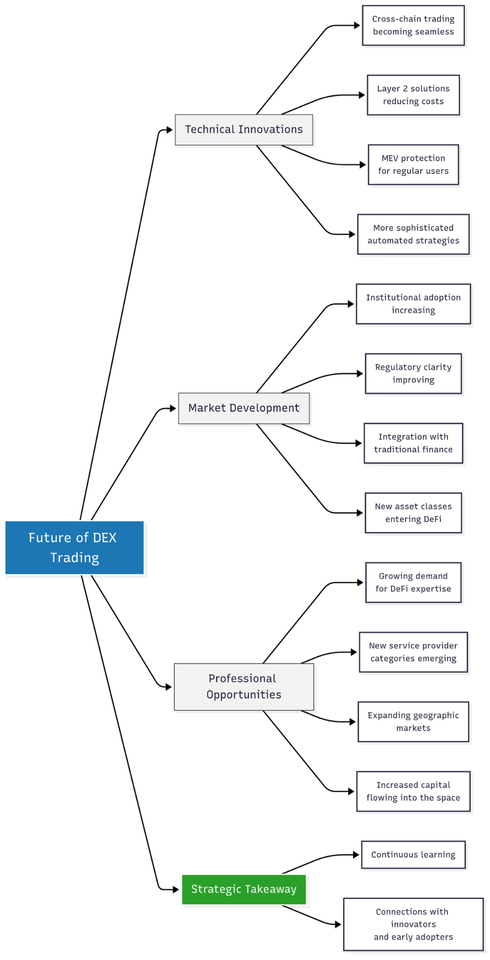
Technical innovation
🔹 Cross-chain trading becoming more seamless
🔹 Layer 2 solutions reducing cost and improving throughput
🔹 More user-facing MEV protection
🔹 More sophisticated automation and strategy tooling
Market development
🔹 Institutional adoption increasing
🔹 Incremental improvement in regulatory clarity
🔹 Broader integration with traditional finance workflows
🔹 New asset classes expanding DeFi activity
Professional opportunities
🔹 Rising demand for DeFi expertise across trading, risk, and operations
🔹 New service provider categories and tooling ecosystems
🔹 Growth across additional geographies and user segments
🔹 More capital and competition driving faster iteration
Staying competitive often means continuous learning and maintaining relationships with builders, liquidity sources, and early adopters.
Final thoughtsDecentralised exchanges give users more control over how they trade crypto, but that control comes with more responsibility. For many participants, success starts with the basics: small sizing, careful verification, and disciplined security.
DEX trading is not magic. It can be rewarding, but it can also be unforgiving. Keep it simple, stick to verifiable information, and prioritise protection of funds and access.
Disclaimer: This article is for informational purposes only and does not constitute investment, legal, tax, or trading advice.
Found this interesting? Become a member of LiquidityFinder and get daily industry news direct to your inbox — join here.
 | Author: Navneet Giri - Navneet is a professional quantitative trader with extensive experience in derivatives trading across major global exchanges and financial markets, including cryptocurrencies. | He employs market-making strategies and participates in liquidity enhancement programs to achieve optimal trading results. |
What is a decentralised exchange (DEX)? +A decentralised exchange (DEX) is a crypto trading venue that lets users swap tokens directly from their own wallets using blockchain technology and smart contracts. Unlike a centralised exchange, a DEX typically does not hold customer funds or require you to open an account. You remain in control of your assets, and trades generally settle on-chain.
What is an AMM and how does it work on a DEX? +An AMM (automated market maker) is a DEX model that uses smart contracts and liquidity pools to price and execute trades instead of matching buyers and sellers on an order book. Liquidity providers (LPs) deposit token pairs into a pool (for example ETH/USDC). Traders swap against that pool, and the price adjusts automatically based on pool balances—often using a formula such as x × y = k. AMMs enable 24/7 trading without needing a direct counterparty, but can involve slippage and impermanent loss for LPs.
What is the difference between on-chain and off-chain order book DEXs? +Order book DEXs work more like traditional exchanges: users place bids and offers, and trades clear based on supply and demand. In an on-chain order book, orders and trades are recorded directly on the blockchain—highly transparent, but potentially slower and more expensive. In an off-chain order book, orders can be matched elsewhere, while final settlement happens on-chain—often improving speed and reducing costs while still using blockchain for settlement.
How do you trade on a DEX step-by-step? +A typical DEX trade flow is:
(1) set up a crypto wallet,
(2) fund the wallet with crypto,
(3) connect the wallet to the DEX,
(4) choose the token pair (e.g., ETH/USDC),
(5) enter the amount and review the quoted price, fees, and slippage settings,
(6) confirm and sign the transaction in your wallet,
(7) pay the network (gas) fee, and (8) wait for on-chain confirmation before checking your updated balance.
If you are new, start with a small amount to learn how approvals and confirmations work.
What fees do you pay when using a DEX? +Most DEX trades involve two types of fees: platform fees and network fees (gas). Platform fees are charged by the protocol or pool (commonly quoted around 0.25%–0.30% depending on the venue and pool). Network fees are paid to the blockchain validators for processing the transaction, and can vary widely by chain and network congestion—often higher on Ethereum during busy periods and typically lower on chains like BNB Chain or Solana.
What are liquidity pools and how do liquidity providers make money? +Liquidity pools are collections of tokens locked in smart contracts that make swapping possible without needing a direct buyer or seller. Liquidity providers (LPs) deposit tokens into a pool and, in return, receive pool tokens representing their share. LPs can earn a portion of the trading fees generated when other users swap through that pool. However, LP returns are not guaranteed and can be affected by risks such as impermanent loss and smart contract vulnerabilities.
What are the main risks of using a decentralised exchange? +Key DEX risks include:
(a) no safety net—mistakes and lost keys are usually irreversible;
(b) smart contract risk—bugs or exploits can lead to losses;
(c) impermanent loss for liquidity providers when token prices diverge;
(d) scam tokens and fake contract addresses;
(e) variable network fees, particularly during congestion; and
(f) regulation changes that can affect what is permitted across jurisdictions. Risk awareness and careful verification are essential.
How can traders reduce mistakes and trade more safely on DEXs? +Good practice includes: only risking what you can afford to lose; verifying token contract addresses (not just names or logos); using established DEXs with credible audits and strong community scrutiny; testing workflows with small amounts; setting sensible slippage limits; keeping recovery phrases offline and secure; avoiding public Wi-Fi or unknown devices; and keeping detailed records of swaps, fees, and LP activity. If an offer looks “too good to be true”, treat it as a warning sign and do deeper research before committing capital.
Share this article

Comments
Most Recent
Find The Right Partners for
Your Trading Business
Sign up and join over 5,000 professional members who receive personalized news alerts, curated professional connections, and more for free!
BitMart announced on July 26, 2026 that it is winding down its trading platform: new registrations and deposits stopped immediately, spot and futures trading ends August 26, 2026, and operations fully close by January 31, 2027. Anyone still holding funds on BitMart needs a reliable replacement exchange immediately.
A new stablecoin backed by 140+ firms, from Visa to BlackRock. Can Open USD challenge USDT and USDC, and will it clear MiCA? Olaf Ransome weighs in.

Discover whether KuCoin is still “The People’s Exchange” in 2026. This in-depth KuCoin review breaks down fees, KYC, security, Proof of Reserves, supported coins, deposits/withdrawals, futures, margin, Earn and the platform’s standout free trading bots — plus who it’s best for (and who should avoid it).
Gas fees can be the most confusing part of using Ethereum and other blockchains. This guide explains what gas fees are, why they exist, how costs are calculated (including EIP-1559’s base fee and priority tip), and the key factors that drive price spikes. You’ll also learn practical ways to reduce fees using gas trackers, smarter timing, batching, and Layer 2 networks like Arbitrum, Optimism, Polygon and zkSync.

Generating and sustaining liquidity requires a strategic approach across centralized exchanges, decentralized pools, and market-making relationships. This guide covers every stage of the process for crypto projects.
This guide covers how proof-of-stake works, the best assets to stake, liquid staking protocols, and the risks you need to understand before committing funds.

S&P Global Ratings gave Tether (USDT) the weakest Stablecoin Stability Assessment. Olaf Ransome breaks down what drives stablecoin risk—asset backing, custody/correspondent chains, transparency and reporting.

Gold-i CEO Tom Higgins explains why most crypto exchanges are still retail-first and what must change to win institutional flow — including FIX support, independent custody, predictable liquidity, and pricing models that reward aggregator-driven volume.
Create Your FREE Account
Get access to latest news, updates, real-time data, brokerage and trading firm insights and customized information feeds.

Multi-asset trading broker AvaTrade has agreed to acquire the majority of FXCM Group’s business and brand, in a transaction that would bring a longstanding retail FX franchise into the AvaTrade Group.

LSEG and CMC Markets have signed a multi-year strategic data agreement expanding CMC's access to LSEG's real-time and delayed pricing, reference and corporate actions data, news and analytics, plus AI-ready content, to support new products, entry into new markets and the growth of CMC's institutional and B2B partnerships.

The Tel Aviv Stock Exchange is considering a bid for the Cyprus Stock Exchange, with Israeli media citing its EU licence, trading platform and clearing house. Euronext’s Athens exchange and India’s National Stock Exchange are also seen as contenders, and Cyprus aims to sign a sale agreement by the end of this year.
CME Group will launch baseball futures on 12 October, pending regulatory review, tracking CME FutureSports Performance Indexes built on Official League Data. Standard and micro contracts will start with the 2026 Postseason and the four clubs in the League Championship Series, trading around the clock.

ESMA has published an opinion stating that MiCA-authorised crypto-asset service providers should cease services tied to non-MiCA-compliant stablecoins for EU clients across MiCA crypto-asset services. National authorities should require remediation of existing exposures within three months, by early January 2027.
Nasdaq Ventures has made a strategic investment in Amsterdam-based derivatives and crypto exchange One Trading, with both firms to explore 24/7 trading of equity futures. The undisclosed investment follows Nasdaq's US$100 million investment in Payward, the parent of Kraken, and CME Group's move to 24/7 trading.

cTrader has opened multi-platform plugins to brokers and prop firms, which can pre-install their own tools for clients or list them in cTrader Store. The plugins run across Mobile, Web, Windows and Mac, and can be built and launched independently of core-platform releases, including trading journals and calculators.
Institutional brokerage and financial infrastructure provider Clear Street has joined TradingView’s broker network, allowing its clients to trade US stocks, exchange-traded funds and options directly through the charting and analysis platform.


Learn how to improve trading psychology, manage fear and greed, avoid revenge trading, and follow your trading strategy with discipline and a trading journal.
GTC Prime has announced a strategic partnership with Centroid Solutions to manage and distribute its liquidity through CS 360 Bridge, Centroid's multi-asset connectivity and execution engine, giving brokers and institutional clients access to tailor-made pricing, low-latency execution and real-time risk management.
Feed