
Search Companies, News, Members & more
Terms of ServicePrivacy PolicySecurity PolicyLegal InformationCommunity GuidelinesSitemapsCookie Settings
2026 Copyright © Liquidity Finder Ltd. All rights reserved.
Liquidity Finder Ltd is incorporated in England and Wales, company number 10610740, registered address 167-169 Great Portland Street, Fifth Floor, London W1W 5PF, United Kingdom.
A Detailed Guide to Cryptocurrency Staking

Published on Jan 9, 2026
Updated on Jun 20, 2026
A Detailed Guide to Cryptocurrency Staking
Putting your crypto to work for you is a smart move. Staking is one way to do that. It lets you earn rewards on the crypto you already hold, just by helping to run the network.
This guide explains what staking is, how it works, and where you can do it. We’ll cover the good and the bad, so you can decide if it’s right for you. No hype, just the information you need.
1. Understanding Staking
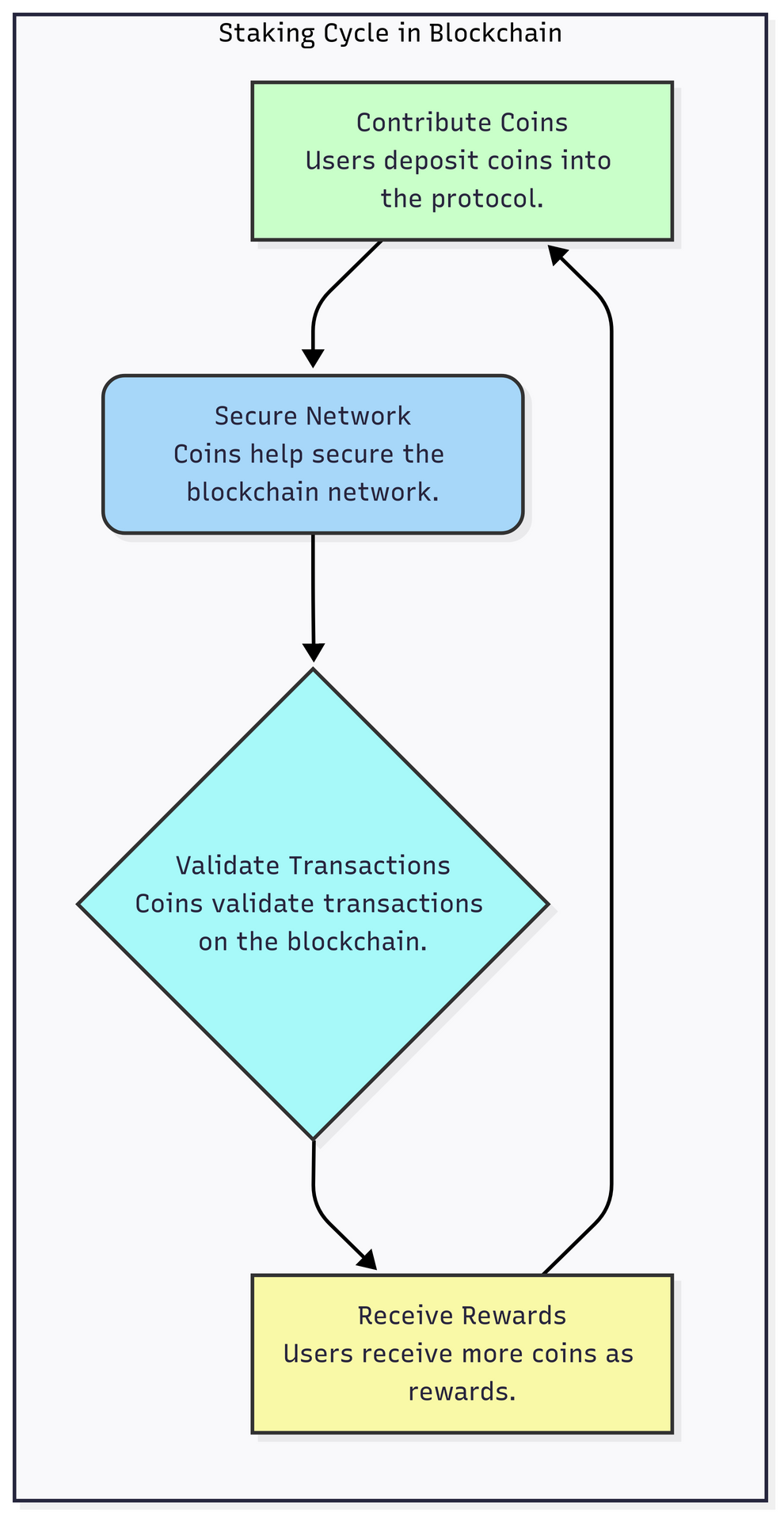
Image: Staking cycle in blockchain, source: www.liquidityfinder.com
What is Staking?
Think of it like earning interest in a savings account. You lock up your money (in this case, crypto) for a period of time, and in return, the bank (the blockchain network) pays you interest.
With staking, you lock up your crypto to help secure a blockchain network and confirm transactions. The network rewards you for doing this, usually with more of the same crypto. For example, if you stake 100 ATOM tokens, you might earn 10 extra ATOM over a year, just for holding them and participating.
Staking vs. Traditional Finance
It’s similar to a certificate of deposit (CD) or a savings account, but with a few key differences. Your funds are used to secure a decentralized network, not to be lent out by a bank. The rewards are often higher than traditional interest rates, but the risks are different, too.
How Blockchains Agree: Proof-of-Stake
To understand staking, you need to know about "consensus mechanisms." This is just how a blockchain agrees on which transactions are valid.
Proof-of-Work (PoW): This is the old way. Used by Bitcoin, it involves "miners" using powerful computers to solve complex math problems. It works well but uses a massive amount of electricity.
Proof-of-Stake (PoS): This is the newer, more efficient method that makes staking possible. Instead of miners, you have "validators." These validators are chosen to create new blocks and confirm transactions based on how many coins they have locked up, or "staked." If they act dishonestly, they can lose some of their staked coins. This economic incentive keeps everyone honest.
PoS is much more energy-efficient and lets more people participate in securing the network.
2. How Staking Works
The process isn't as complicated as it sounds. You’re essentially putting your coins up as a security deposit to show you’re committed to the network's health.
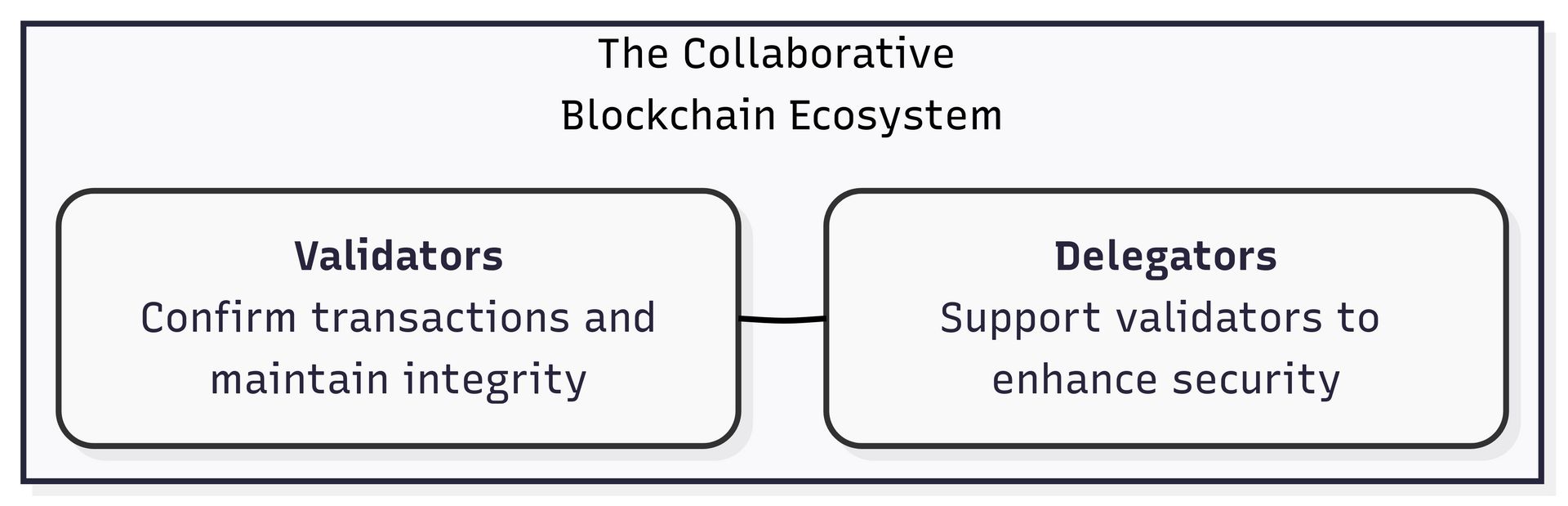
Image: Collaborative blockchain ecosystem for staking, source: www.liquidityfinder.com
Validators and Delegators
There are two main ways to get involved:
1) Being a Validator: Validators run the computer nodes that keep the network running 24/7. They are responsible for creating new blocks and verifying transactions. This requires technical knowledge, a powerful computer that’s always online, and often a large number of coins to stake. The rewards are higher, but so are the responsibilities.
2) Being a Delegator: This is what most people do. If you don't want to run your own node, you can "delegate" your coins to a validator you trust. You’re basically lending them your voting power. The validator does all the technical work, and you share in the rewards they earn. They take a small commission for their service. This is a much simpler way to get started.
Staking Wallets and Smart Contracts
When you stake your crypto, your coins are usually held in a specific wallet or locked in a smart contract on the blockchain. This prevents you from spending them while they are staked. This lock-up period is what provides security to the network.
How Rewards Are Paid Out
Staking rewards come from a few places, like network inflation (new coins being created) or transaction fees. The amount you earn, often shown as an Annual Percentage Yield (APY), depends on a few things:
・The total number of coins being staked on the network.
・The specific validator's commission rate.
・How long you stake your coins.
・The network's own rules for reward distribution.
3. Types of Staking
You have a few options for how and where to stake your crypto.
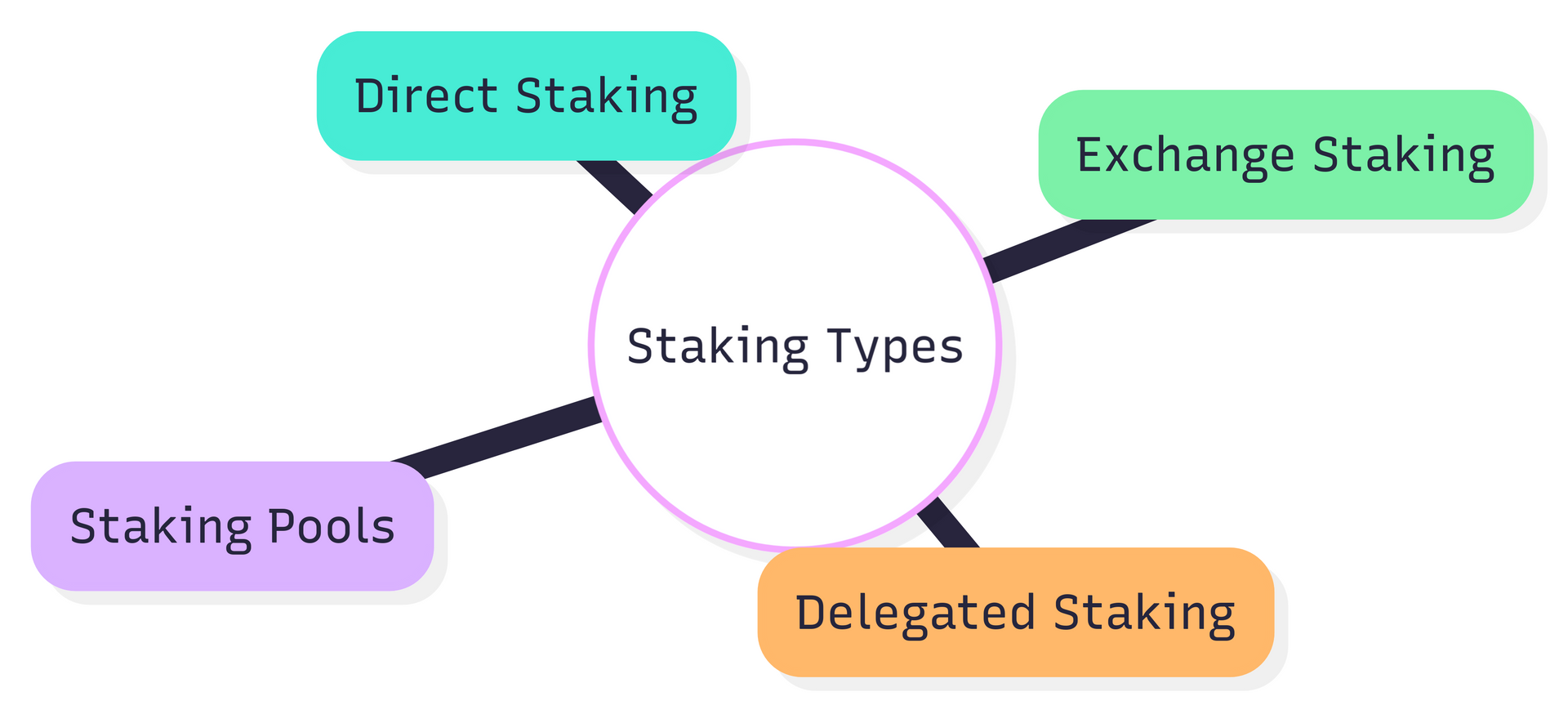
Image: Types of staking, source: www.liquidityfinder.com
Direct Staking (Running a Validator Node)
This is for the pros. You set up your own hardware and software to become a full validator on the network.
Pros: Highest possible rewards, direct control.
Cons: Technically complex, requires a large investment, and your stake can be "slashed" (taken away) if your node goes offline or misbehaves.
Delegated Staking (The Most Common Method)
You choose a validator and delegate your coins to them using a compatible wallet.
Pros: Easy to do, non-custodial (you keep control of your keys), and you can choose your validator.
Cons: You need to research and pick a reliable validator.
Staking Pools
Staking pools are a form of delegated staking where many users pool their funds together. This can sometimes lead to more frequent rewards. Lido and Rocket Pool are well-known examples of "liquid staking" pools for Ethereum. When you stake with them, you get a token back (like stETH) that represents your staked crypto, which you can use in other DeFi applications.
Pros: Can offer added flexibility (liquid staking).
Cons: Adds another layer of smart contract risk.
Exchange Staking
Many large cryptocurrency exchanges offer staking as a service. You just buy or deposit a PoS coin and click a button to stake it. The exchange handles all the technical parts.
Pros: Extremely easy, low minimums, convenient.
Cons: Custodial (the exchange holds your keys), you have no say in which validator is used, and fees can sometimes be higher or less transparent.
4. A Closer Look at Top Staking Platforms
This is where most people interact with staking. Choosing the right platform depends on your technical comfort level and how much control you want.
Centralized Exchanges (Easiest for Beginners)
These platforms are the simplest entry point. You trust the exchange to manage the staking process for you.
1) Coinbase
URL: https://www.coinbase.com/staking
Description: A major, publicly-traded U.S. exchange known for its user-friendly interface.
Features: Simple one-click staking from your main account. They provide clear information on rewards and lock-up periods.
Supported Assets: Ethereum (ETH), Cardano (ADA), Solana (SOL), Polkadot (DOT), Cosmos (ATOM), Tezos (XTZ), and more.
Pros: Very easy to use, trusted brand, good for small amounts.
Cons: Custodial (they control your keys), they take a significant commission on rewards (around 25%), and you don't control your validator choice.
2) Kraken
URL: https://www.kraken.com/features/staking-coins
Description: One of the oldest and most respected exchanges, offering a wide range of staking options.
Features: Offers both flexible and locked staking terms. Their on-chain staking service is transparent about rewards.
Supported Assets: Over 15 assets, including Ethereum (ETH), Cardano (ADA), Solana (SOL), Polkadot (DOT), and Kusama (KSM).
Pros: Competitive reward rates, strong security reputation, wide selection of assets.
Cons: Custodial, interface can be less intuitive than Coinbase for absolute beginners.
3) Binance
URL: https://www.binance.com/en/staking
Description: The world's largest crypto exchange by volume, offering a massive suite of products, including flexible and "DeFi" staking.
Features: Offers "Locked Staking" for higher yields and "DeFi Staking," which connects you to third-party protocols.
Supported Assets: A huge list of over 100 PoS tokens.
Pros: Very wide selection of assets, often has high promotional APYs.
Cons: Custodial, can be overwhelming for new users, has faced regulatory scrutiny in some countries.
4) Kucoin
URL: https://www.kucoin.com/earn/staking
Description: A global crypto exchange known for a broad range of altcoins and an “Earn” hub that bundles staking and yield products in one place.
Features: KuCoin Earn offers on-chain staking plus flexible and fixed-term options (flexible products can be redeemed anytime; fixed-term products redeem at maturity and often offer higher returns). It also supports KCS staking and ETH staking via “ETH Staking 2.0”, which issues ksETH as proof of stake; KuCoin’s ETH staking page shows a reference APR and a redemption period (e.g., 5 days) for withdrawals.
Supported Assets: A wide selection of PoS assets via KuCoin Earn Staking (varies by product), including dedicated options highlighted for ETH staking and KCS staking; KuCoin also adds new staking assets periodically (e.g., TON via Earn Staking).
Pros: Very easy for beginners; lots of staking choices in one hub; mix of flexible and fixed terms; clear product pages for key offerings like ETH staking and KCS staking.
Cons: Custodial (the exchange holds your assets/keys); terms, APR and redemption rules differ by product and can be adjusted based on on-chain rates; some staking products may require KYC to subscribe.
Staking-as-a-Service (SaaS) Platforms
These platforms specialize in running validator nodes for users. They are a middle ground between exchanges and running your own node.
1) Figment
Description: An institutional-grade staking provider that offers robust and secure validator services.
Features: Focuses on security and reliability. Provides detailed reporting and support for institutions and large token holders.
Supported Assets: Supports over 50 networks, including Ethereum, Solana, Polkadot, and Avalanche.
Pros: High-quality infrastructure, excellent for serious investors, non-custodial options available.
Cons: Geared more towards large-scale investors and institutions than small retail users.
2) Staked
URL: https://staked.us/ (Acquired by Kraken)
Description: Offers secure and reliable staking infrastructure for institutional investors.
Features: Provides yield-generating products across staking and DeFi. Known for its strong security and focus on institutional clients.
Supported Assets: Major PoS networks like Ethereum, Polkadot, Cosmos, and Solana.
Pros: High security, reliable service for large sums.
Cons: Not designed for the average retail user.
Liquid Staking Protocols (Advanced Flexibility)
These are decentralized protocols that give you a "liquid" token back when you stake.
1) Lido Finance
URL: https://lido.fi/
Description: The largest liquid staking protocol, especially for Ethereum.
Features: When you stake ETH, you receive stETH in return. This stETH token earns rewards and can be traded or used in other DeFi apps, so your capital isn't fully locked up.
Supported Assets: Ethereum (ETH), Solana (SOL), Polygon (MATIC), Polkadot (DOT), Kusama (KSM).
Pros: Provides liquidity for staked assets, fully decentralized, easy to use through their web app.
Cons: Smart contract risk (a bug in the code could lead to loss of funds), there's a risk of stETH "de-pegging" from the price of ETH.
2) Rocket Pool
Description: A decentralized Ethereum staking protocol focused on being more decentralized than Lido.
Features: You can stake as little as 0.01 ETH and receive the rETH liquid token. It also allows people to run their own mini-nodes with only 16 ETH instead of the usual 32.
Supported Assets: Ethereum (ETH).
Pros: Highly decentralized, lowers the barrier to running a node, non-custodial.
Cons: Smart contract risk, rETH liquidity is lower than stETH.
| Feature Centralized Exchange | (e.g., Coinbase, Kraken) Liquid Staking | (e.g., Lido) Self-Staking | (Your own Validator) |
| Ease of Use | Very Easy | Easy | Very Hard |
| Custody | Custodial (They hold keys) | Non-Custodial (You hold keys) | Non-Custodial |
| Control | None | Full | Full |
| Rewards | Lower (after commission) | High | Highest |
| Flexibility | Low (Assets are locked) | High (Receive liquid token) | Low (Assets are locked) |
| Risk | Platform Risk, Centralization | Smart Contract Risk | Slashing Risk, Technical Failure |
| Best For | Beginners, small amounts | DeFi users, those wanting liquidity | Experts, large holders |
Table: Different types of staking platforms and their ease of access, source: www.liquidityfinder.com
5. Top Staking Cryptocurrencies
Not all PoS coins are the same. They have different reward rates, lock-up periods, and risks.
1) Ethereum (ETH)
Description: The largest blockchain for smart contracts and dApps. It moved to Proof-of-Stake in 2022.
Staking Mechanism: Validators lock 32 ETH to run a node. Most users delegate through pools like Lido or exchanges like Coinbase.
Typical APY: 3-5%. Varies based on network activity.
Lock-up Period: Staked ETH cannot be fully withdrawn until a future network upgrade, but liquid staking tokens (stETH, rETH) can be traded.
Pros: Staking the second-largest cryptocurrency, proven security.
Cons: Lower APY compared to other chains, complex withdrawal mechanics for now.
2) Cardano (ADA)
Description: A blockchain platform focused on a research-driven approach to security and sustainability.
Staking Mechanism: Ouroboros PoS. Very easy to delegate from official wallets like Yoroi or Daedalus.
Typical APY: ~3-5%.
Lock-up Period: None. Your ADA is never locked and can be spent at any time, even when delegated.
Pros: No lock-up period, very decentralized, easy to get started.
Cons: APY is modest, development can be slow.
3) Solana (SOL)
Description: A high-performance blockchain designed for fast and low-cost transactions.
Staking Mechanism: Delegated PoS. Stake through supported wallets like Phantom or Solflare.
Typical APY: ~5-7%.
Lock-up Period: Staked SOL must be "un-staked," which takes one "epoch" (typically 2-3 days) before it becomes liquid again.
Pros: Higher APY, thriving ecosystem.
Cons: Un-staking delay, the network has experienced outages in the past.
4) Polkadot (DOT)
Description: A "blockchain of blockchains" that allows different chains to communicate with each other.
Staking Mechanism: Nominated Proof-of-Stake (NPoS). Nominators (delegators) choose up to 16 validators.
Typical APY: ~13-15%.
Lock-up Period: 28 days. This is a long un-bonding period you should be aware of.
Pros: Very high APY.
Cons: The 28-day lock-up is a major risk if you need your funds quickly. Staking can be complex.
5) Cosmos (ATOM)
Description: An ecosystem of interconnected blockchains, called the "internet of blockchains."
Staking Mechanism: Delegated PoS via the Keplr wallet is the most popular method.
Typical APY: ~15-20%. Often higher than many other major chains.
Lock-up Period: 21 days.
Pros: Very high APY, potential for airdrops from new projects in the Cosmos ecosystem.
Cons: 21-day un-bonding period, ecosystem can be complex to navigate
Staking Overview of Popular Cryptocurrencies
| Cryptocurrency Consensus Mechanism Typical APY (Variable) Lock-up / Un-bonding Period | |||
| Ethereum (ETH) | PoS | 3–5% | N/A (Liquid staking is common) |
| Cardano (ADA) | Ouroboros PoS | 3–5% | None |
| Solana (SOL) | PoS | 5–7% | ~2–3 days |
| Polkadot (DOT) | Nominated PoS | 13–15% | 28 days |
| Cosmos (ATOM) | PoS | 15–20% | 21 days |
| Avalanche (AVAX) | PoS | 7–9% | Minimum 2 weeks |
| Polygon (MATIC) | PoS | 4–6% | ~3–4 days |
Table: Popular cryptocurrencies for staking, source: www.liquidityfinder.com
Note: APYs are estimates and may fluctuate based on network conditions.
6. The Good and The Bad of Staking
Advantages
Earn Passive Income: It's a straightforward way to make your crypto holdings productive.
Support the Network: By staking, you are actively participating in the security and governance of a project you believe in.
Energy Efficient: It's a much greener alternative to Proof-of-Work mining.
Low Barrier to Entry: Delegating makes it accessible to almost anyone, unlike mining, which requires expensive hardware.
Risks and Challenges
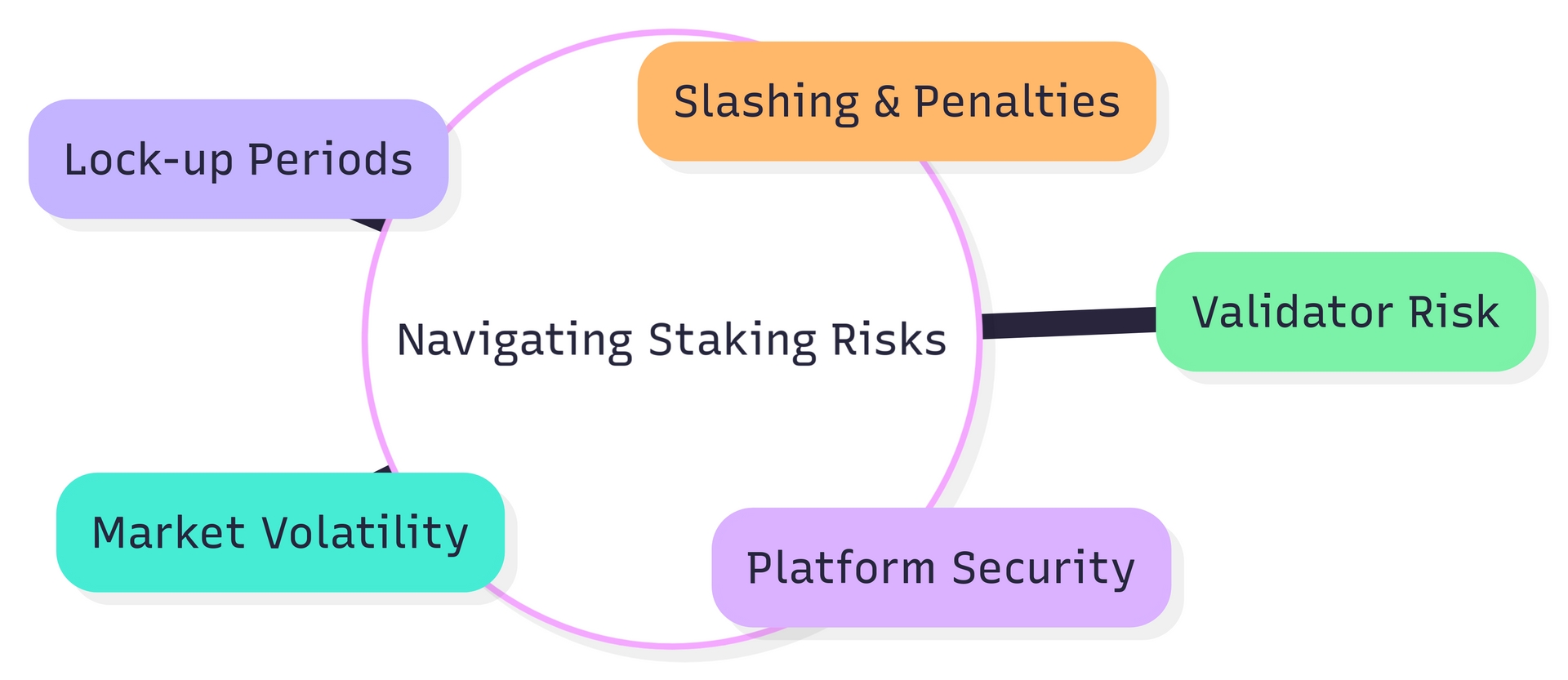
Market Volatility: This is the biggest risk. If the price of your staked crypto drops by 50%, a 10% APY won't cover your losses. You're still exposed to price risk.
Lock-up Periods: Many networks require you to lock your funds for days or weeks. If the market crashes, you can't sell until the un-bonding period is over.
Slashing: If you are a validator and you go offline or act maliciously, the network can destroy a portion of your staked tokens as a penalty. As a delegator, you could also lose a small amount if your chosen validator gets slashed.
Platform Risk: If you stake on a centralized exchange, you are trusting them with your funds. The exchange could get hacked, go bankrupt, or mismanage your assets. This is the "not your keys, not your crypto" problem.
Validator Risk: When delegating, you need to choose a good validator. A validator that is unreliable or charges a high commission will reduce your rewards.
7. How to Get Started Staking: A Simple Walkthrough
Let's walk through a common example: staking Solana (SOL) using the Phantom wallet.
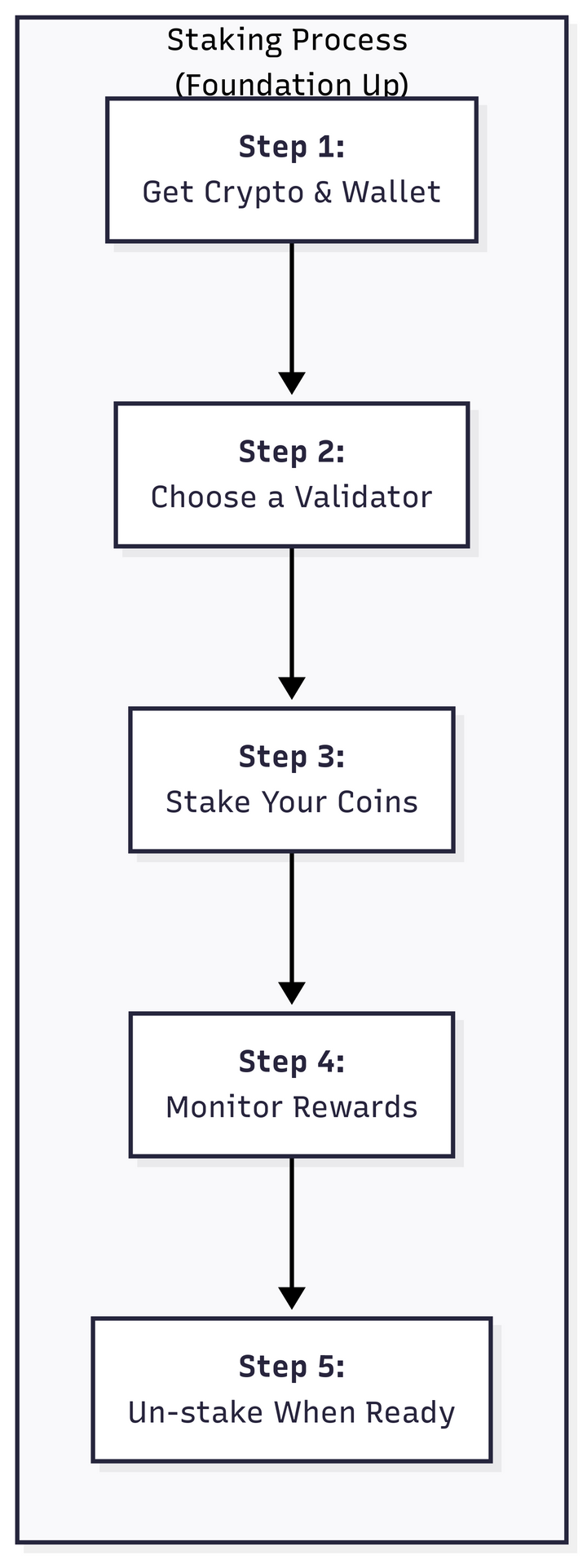
Image: Staking process, source: www.liquidityfinder.com
Step 1: Get the Right Cryptocurrency and Wallet
Buy SOL from an exchange like Coinbase or Kraken.
Download a self-custody wallet that supports staking SOL. Phantom (https://phantom.app/) is the most popular choice.
Create your wallet and be sure to back up your secret recovery phrase somewhere safe and offline. Never share it with anyone.
Withdraw your SOL from the exchange to your new Phantom wallet address.
Step 2: Choose a Validator
Inside your Phantom wallet, click on your Solana balance and then click "Start earning SOL."
You will see a list of validators. Don't just pick the one at the top. Look for validators with a good performance record (uptime) and a reasonable commission (usually 5-10%). Websites like StakeView.app and Validators.app provide detailed stats on all Solana validators.
Step 3: Stake Your Coins
Once you've chosen a validator, just enter the amount of SOL you want to stake and confirm the transaction.
Leave a small amount of SOL (e.g., 0.05 SOL) un-staked in your wallet to pay for future transaction fees (like for un-staking).
Step 4: Monitor Your Rewards
Your stake will become active in the next epoch (2-3 days). After that, you'll start earning rewards. You can monitor your growing stake directly in your wallet.
Step 5: How to Un-stake
When you want your SOL back, you can go through the un-staking process in your wallet.
Your stake will become "deactivating" and will be returned to you after the current epoch ends.
8. Best Practices and Staking Strategies
Do Your Own Research: Don't just chase the highest APY. Understand the project, its tokenomics, and the risks involved. A high APY can sometimes signal higher risk.
Diversify: Don't put all your money into one coin or one validator. Spreading your stake across different assets and validators can reduce your risk.
Choose a Good Validator: Look for validators who are active in the community, have a good performance history, and charge a fair commission. Avoid validators with 0% commission, as this is often a temporary promotional rate that will rise later. Also avoid validators that hold a huge percentage of the network's stake, as this contributes to centralization.
Understand the Taxes: In many countries, staking rewards are considered taxable income at the moment you receive them. Keep good records and consider talking to a tax professional.
Stay Informed: Keep up with updates for the networks you're staking on. Protocol changes can affect reward rates or staking rules.
9. The Future of Staking
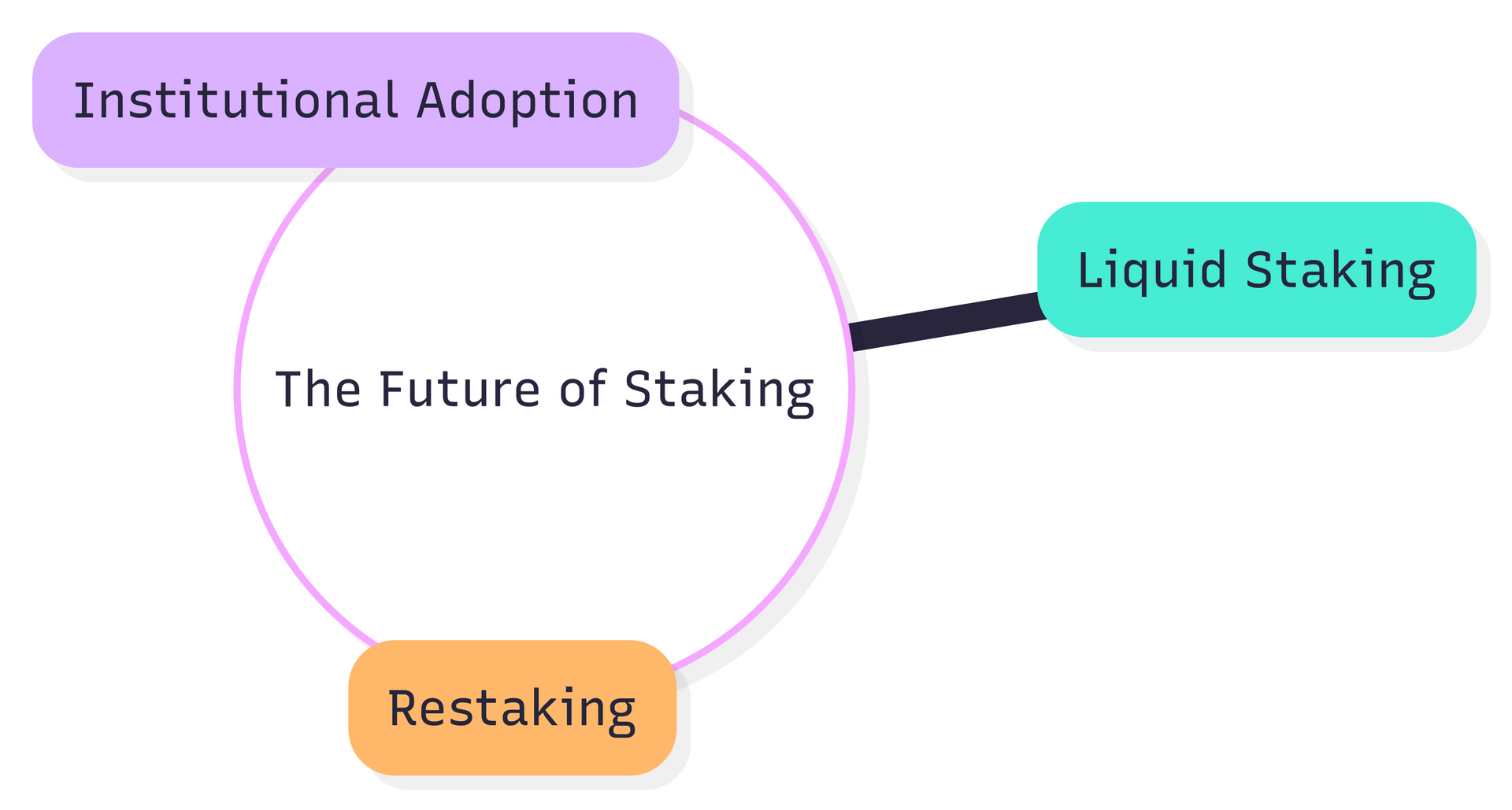
Staking is evolving. Here are a few things to watch for:
Liquid Staking: This is the biggest trend. It solves the problem of locked liquidity and will likely become the default way people stake.
Restaking: A new idea pioneered by EigenLayer. It allows you to use your staked ETH to secure other protocols, potentially earning you extra rewards. It's complex and adds risk, but it shows how staking is becoming a foundational layer for crypto.
・nstitutional Adoption: As more big players get into crypto, they are drawn to staking as a way to generate a relatively predictable yield on their assets. This will likely bring more maturity and stability to the space.
Conclusion
Staking has become a core part of the cryptocurrency world. It offers a way to earn rewards on your holdings while actively helping to secure the networks you support. It's a productive way to hold crypto for the long term.
It's not risk-free. You need to be aware of market volatility and the specific rules of each network, like lock-up periods. For most people, delegating through a self-custody wallet offers the best balance of simplicity, security, and rewards. Exchanges are easier but require you to give up control of your assets.
By starting small, doing your research, and choosing reliable platforms and validators, you can make staking a valuable part of your crypto strategy.
Author
 | Navneet Giri - Navneet is a professional quantitative trader with extensive experience in derivatives trading across major global exchanges and financial markets, including cryptocurrencies. | He employs market-making strategies and participates in liquidity enhancement programs to achieve optimal trading results. |
FAQs: Cryptocurrency Staking
▸ What is cryptocurrency staking in simple terms?Staking is committing Proof-of-Stake crypto to help secure a blockchain and validate transactions. In return, the network pays rewards, typically in the same token you stake.
▸ How are staking rewards (APY) calculated?APY varies by network and changes with factors like total staked supply, validator commission, and protocol reward rules. Rewards often come from transaction fees and token issuance, so rates can move over time.
▸ Is staking safe or risk-free?No. You still face token price volatility, and the staking method you choose can add custody risk (exchanges), smart-contract risk (liquid staking), or validator risk (delegation).
▸ What is slashing and can delegators be affected?Slashing is a penalty applied if a validator violates rules or goes offline on networks that enforce it. Depending on the chain, delegators may see reduced rewards or small losses if their chosen validator is slashed.
▸ What do lock-up and unbonding periods mean?A lock-up means you can’t immediately move or sell staked tokens. Unbonding is the time it takes to unstake and regain liquidity, which can range from days to weeks depending on the network.
▸ What’s the difference between delegated, exchange and liquid staking?Delegated staking: non-custodial via a wallet; you delegate to a validator.
Exchange staking: easiest, but custodial and fee/terms depend on the exchange.
Liquid staking: receive a liquid token representing your stake, adding smart-contract and de-peg risks.
▸ How do I choose a good validator?Prioritise uptime/performance, reasonable commission, and a strong track record. Don’t pick purely on headline APY—validator reliability and decentralisation can matter just as much as fees.
▸ Are staking rewards taxable?In many countries, staking rewards may be taxed as income when received, and further gains/losses may apply when you sell. Rules vary by jurisdiction—keep records and take advice where needed.
Share this article

Comments
Most Recent
Find The Right Partners for
Your Trading Business
Sign up and join over 5,000 professional members who receive personalized news alerts, curated professional connections, and more for free!
BitMart announced on July 26, 2026 that it is winding down its trading platform: new registrations and deposits stopped immediately, spot and futures trading ends August 26, 2026, and operations fully close by January 31, 2027. Anyone still holding funds on BitMart needs a reliable replacement exchange immediately.
A new stablecoin backed by 140+ firms, from Visa to BlackRock. Can Open USD challenge USDT and USDC, and will it clear MiCA? Olaf Ransome weighs in.

Discover whether KuCoin is still “The People’s Exchange” in 2026. This in-depth KuCoin review breaks down fees, KYC, security, Proof of Reserves, supported coins, deposits/withdrawals, futures, margin, Earn and the platform’s standout free trading bots — plus who it’s best for (and who should avoid it).
Gas fees can be the most confusing part of using Ethereum and other blockchains. This guide explains what gas fees are, why they exist, how costs are calculated (including EIP-1559’s base fee and priority tip), and the key factors that drive price spikes. You’ll also learn practical ways to reduce fees using gas trackers, smarter timing, batching, and Layer 2 networks like Arbitrum, Optimism, Polygon and zkSync.

Generating and sustaining liquidity requires a strategic approach across centralized exchanges, decentralized pools, and market-making relationships. This guide covers every stage of the process for crypto projects.

S&P Global Ratings gave Tether (USDT) the weakest Stablecoin Stability Assessment. Olaf Ransome breaks down what drives stablecoin risk—asset backing, custody/correspondent chains, transparency and reporting.
Decentralized exchanges (DEXs) allow peer-to-peer trading without intermediaries. This guide covers how AMMs work, how to connect a wallet, understand liquidity pools, manage slippage, and trade safely across Ethereum, BNB Chain, and Solana.

Gold-i CEO Tom Higgins explains why most crypto exchanges are still retail-first and what must change to win institutional flow — including FIX support, independent custody, predictable liquidity, and pricing models that reward aggregator-driven volume.
Create Your FREE Account
Get access to latest news, updates, real-time data, brokerage and trading firm insights and customized information feeds.


US stocks closed higher on Wednesday, with the Nasdaq gaining 1%, the S&P 500 rising 0.6%, and the Dow advancing 0.7%, as renewed enthusiasm for AI-related stocks lifted market sentiment.


SpaceX went public in June as a rocket company. On October 20 it reported as something else entirely: an AI infrastructure business, financed by a satellite broadband network, with a launch division attached. Rockets generated 12% of third quarter revenue and lost money. The AI segment generated 52% of revenue and consumed 84% of capital expenditure. Starlink generated 85% of operating profit.


Standard Chartered has signed definitive agreements to acquire 100% of Zodia Custody UK Limited, folding its regulated digital asset custody business into Securities Services. Zodia Solutions will be set up under SC Ventures with bank investors including Northern Trust, NAB Ventures, Emirates NBD and Investcorp.

Bybit Fintech FZE has secured a Virtual Asset Service Provider licence from Dubai’s Virtual Assets Regulatory Authority for Exchange Services, covering spot trading. Bybit’s Peter Loo said the firm hopes to add derivatives, subject to regulatory approvals. Its international Dubai headquarters opened in 2022.

ATFX Connect has released its Q4 2026 Institutional Edge, examining the geopolitical, monetary policy and fiscal pressures shaping global financial markets in the final quarter of the year.

The Nasdaq 100 is trading at 29,382. After reaching a recent high of 29,957, the index reversed sharply and has been recording a series of lower highs and lower lows.

FM Summit London returns to Old Billingsgate on 24 November 2026 for its 15th edition, with a curated one-day format aimed at senior executives. LMAX Group, Plus500, oneZero and MetaQuotes are among confirmed exhibitors, with Business Connect meetings, roundtables and an opening event at The Folly on 23 November.

GCEX has launched European-style, fiat-settled options on Bitcoin and Ethereum with monthly expiries for eligible professional and institutional clients. The service runs through the GCEX OTC desk, with pricing from Tier 1 liquidity providers and reporting on XplorPortal. GC Exchange Limited is authorised by the UK FCA

Wall Street closed mostly higher on Tuesday, led by a nearly 1% gain in the Dow. In Asia, South Korea’s Kospi rebounded 2.7% and Japan’s Nikkei gained 0.8%.

Brent crude is trading at $111.70. The latest price action show the recovery continuing toward $111.70, suggesting that demand has returned after the sharp correction.
Feed