
Search Companies, News, Members & more
Terms of ServicePrivacy PolicySecurity PolicyLegal InformationCommunity GuidelinesSitemapsCookie Settings
2026 Copyright © Liquidity Finder Ltd. All rights reserved.
Liquidity Finder Ltd is incorporated in England and Wales, company number 10610740, registered address 167-169 Great Portland Street, Fifth Floor, London W1W 5PF, United Kingdom.

April 07, 2024
Soft fork vs hard fork
In the blockchain space, a ‘fork’ is a representation of a change to the blockchain. As blockchains need to be updated to accommodate new technology, they often need to add in changes to the protocol – in simple terms, alter how the blockchain works.
A protocol is a set of predefined rules within the network that determines how users interact with each other. Essentially, it’s like the rulebook for a cryptocurrency.
When updating this protocol, there are two types of fork that can occur: a soft fork and a hard fork. In this article, we will explain what a soft fork is, what a hard fork is, the difference between the two, and notable hard forks in the cryptocurrency space.
How does blockchain work
In order to understand forks and how they work, we must first understand how a blockchain network functions.
Cryptocurrencies, such as Bitcoin, work via a blockchain, which is a database or ledger maintained by all the users together instead of one central authority. Bitcoin farming is essentially the process of maintaining the ledger and receiving Bitcoin as a reward.
Computers participating in the network are referred to as nodes. Any transaction or deal made using a cryptocurrency, Bitcoin, for example, is recorded and grouped together into what is known as a ‘block’.
These blocks are then verified by the network, and once verified, they are added to the chain, hence ‘blockchain’. The analogy of a train track works well here, as once a block has been added to the chain, it cannot be reversed, as the entire network has been updated and essentially ‘agreed’ upon the current ledger. This means the blockchain, in a sense, is travelling forward, which explains changes to the network being described as forks.
What is a soft fork?
A soft fork is a change to the blockchain protocol which doesn’t affect the previous blocks in the chain. Users can still operate with the old system, but any new users will be added to the new system.
A soft fork means that for a while both old and new versions of the software are running at the same time. Eventually, the ‘original’ chain will be phased out, as all nodes are eventually upgraded to the new protocol.
Soft forks usually occur when a new rule is added to the blockchain, or tightens existing rules. For the soft fork to happen, a majority of the network must adopt the new blockchain protocol, but not everyone.
What is a hard fork?
A hard fork is a change to the blockchain protocol which requires all users to change. Nodes must upgrade to the latest version to continue participation. A hard fork is often simply referred to as a fork, as it is much more significant.
A hard fork creates an entirely new blockchain, starting a new chain with a new set of requirements. This is often done to implement significant changes or repair security breaches. However, with a hard fork, the original blockchain continues to run, so this can often create two entirely distinct blockchains, some of which thrive in their own way.
Hard forks have historically produced new variants of cryptocurrencies, and in some cases, entirely new cryptocurrencies in themselves. For example, Sushi and PancakeSwap are both hard forks of Uniswap.
Notable hard forks
Hard forks have often produced entirely new spaces in the cryptocurrency economy, and in many cases, these hard forks become entirely separate communities with their own unique ecosystems.
Here are some of the most notable hard forks in the cryptocurrency space.
Ethereum & Ethereum Classic (2016)
The DAO was a decentralised autonomous organisation (DAO) project which was designed to organise business enterprises with a decentralised model. The project was based on Ethereum. Unfortunately, a vulnerability in the code meant that attackers attempted to steal a third of The DAO’s funds, which was approximately $70 million.
However, as the attack type meant time passing before the funds could be withdrawn, the Ethereum community, alongside founder Vitalik Buterin, decided to execute a hard fork to the blockchain to essentially block the transaction.
This meant that all Ethereum transactions were now on a new blockchain, preventing the digital heist. The original Ethereum continued as Ethereum Classic.
Bitcoin & Bitcoin Cash (2017)
Bitcoin Cash was a hard fork of Bitcoin created in 2017 from a disagreement in the Bitcoin community about the block size. Some users wanted to keep the block size smaller, which would mean nodes could be operated with fewer resources, but others wanted a cheaper and faster solution, and therefore to increase the block size.
Many in the community disagreed with this change as larger blocks also require more computational power to verify, and would therefore lead to more centralisation of the cryptocurrency, as fewer people would have the computational capacity to run full nodes. There would also be an increased security risk.
As a solution, the community agreed on a hard fork to create Bitcoin Cash, a version of Bitcoin with a larger block size.
Bitcoin Cash & Bitcoin SV (2018)
Bitcoin SV (Satoshi Vision) was created as a hard fork from Bitcoin Cash – a fork of a fork.
This was created for a similar reason to Bitcoin Cash. A disagreement within the Bitcoin Cash community about further increasing the block size (which was at 32MB) led to the creation of Bitcoin SV, which would have a block size of 128MB.
What is an accidental fork?
In some cases, a hard fork can be unintentional. As miners are operating all over the world and in great quantities, in some cases they can verify a block at almost exactly the same time.
This creates a situation where one group of the network identifies one block as verified, and continues adding to this chain, whereas another group does the same for another.
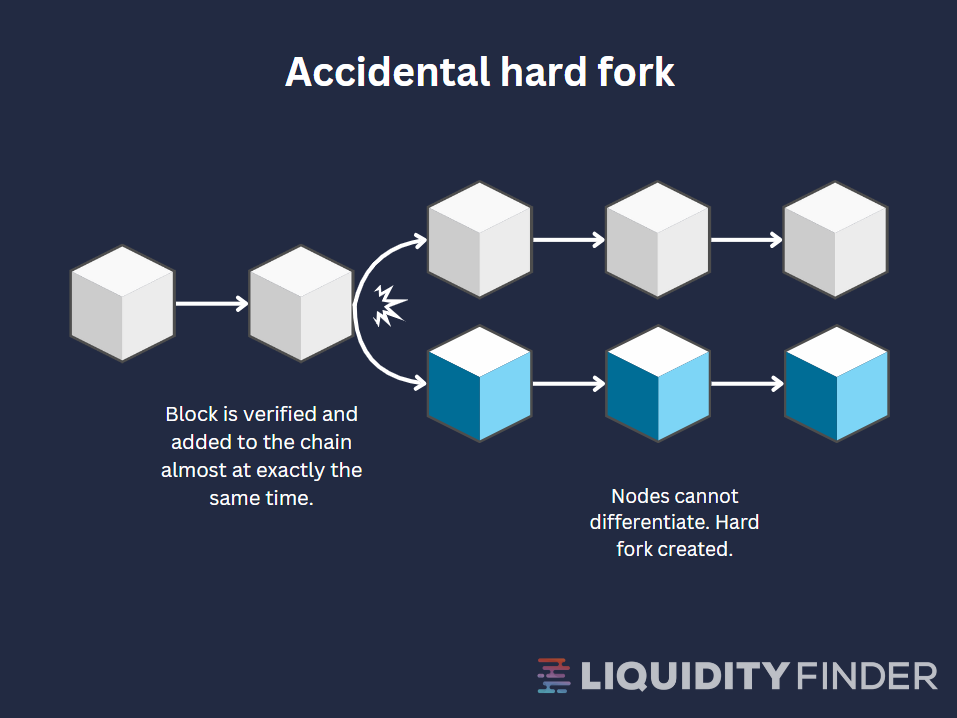
Accidental forks occur relatively frequently and can be quickly fixed. One chain eventually becomes longer than another, and then is eventually determined as the ‘correct’ chain by the network. Once this happens, the nodes will start adding blocks solely to the original chain. Blocks of the old network are referred to as ‘orphaned blocks’ and will be phased out in a similar way to a soft fork.
Conclusion
Soft forks and hard forks are frequent, and a key part of cryptocurrency history. The model of blockchain produces frequent forks, that in some cases are simple tweaks to the protocol, and in other cases are huge shifts that create entirely new cryptocurrencies and communities.
For more articles like this, make sure to stay up to date with our crypto insights.
Remember to register with LiquidityFinder and make a free account. We are a network of industry professionals, traders and providers, providing access to companies looking to accelerate their business.
You can use our crypto exchange provider as well as our Match Matrix to find the liquidity provider that is right for you.
Author
 | Caleb is a financial copywriter with a specialisation in fintech and forex. Former copywriter at Barclays and Paysafe. Contributing writer for LiquidityFinder. You can message Caleb here. |
Share this article
Comments
Most Recent
Find The Right Partners for
Your Trading Business
Sign up and join over 5,000 professional members who receive personalized news alerts, curated professional connections, and more for free!
BitMart announced on July 26, 2026 that it is winding down its trading platform: new registrations and deposits stopped immediately, spot and futures trading ends August 26, 2026, and operations fully close by January 31, 2027. Anyone still holding funds on BitMart needs a reliable replacement exchange immediately.
A new stablecoin backed by 140+ firms, from Visa to BlackRock. Can Open USD challenge USDT and USDC, and will it clear MiCA? Olaf Ransome weighs in.
Brent Xu left Wall Street for blockchain in Ethereum's earliest days. Now his Franklin Templeton and Galaxy Digital backed platform Dora is bringing fractionalised bond trading to retail brokers. He speaks to Sam Low.

As tokenisation and digital assets move from niche curiosity to mainstream expectation, banks and financial institutions face an uncomfortable truth: their legacy core banking systems were never built for this. From order execution and pre-funding to custody, portfolio management and gas fees, Olaf Ransome explores the key infrastructure challenges FIs must navigate and asks whether to re-use, buy or build their way to a solution that actually scales.

LiquidityFinder's Sam Low sits down with Nathan Sage, founder and CEO of Sage Capital Management, to trace his journey from FX fund manager to running a Bitcoin fund doing $1BN a day in 2016 — and how that experience of pain built one of the most connected prime brokerages in the digital assets market today.

Discover whether KuCoin is still “The People’s Exchange” in 2026. This in-depth KuCoin review breaks down fees, KYC, security, Proof of Reserves, supported coins, deposits/withdrawals, futures, margin, Earn and the platform’s standout free trading bots — plus who it’s best for (and who should avoid it).
Gas fees can be the most confusing part of using Ethereum and other blockchains. This guide explains what gas fees are, why they exist, how costs are calculated (including EIP-1559’s base fee and priority tip), and the key factors that drive price spikes. You’ll also learn practical ways to reduce fees using gas trackers, smarter timing, batching, and Layer 2 networks like Arbitrum, Optimism, Polygon and zkSync.

Generating and sustaining liquidity requires a strategic approach across centralized exchanges, decentralized pools, and market-making relationships. This guide covers every stage of the process for crypto projects.
Create Your FREE Account
Get access to latest news, updates, real-time data, brokerage and trading firm insights and customized information feeds.

Bybit has launched Perp Options, described as the first options contracts built on TradFi perpetuals, giving traders round-the-clock access to US equity options. SpaceX and Nvidia are the first underlying assets, with USDT settlement and integration into Bybit's Unified Trading Account.


Use this trading preparation checklist to plan your session, define entry rules, manage risk, and build a disciplined trading routine in seven steps.


Your Bourse expands its crypto liquidity ecosystem with Caladan, giving brokers access to broader market coverage, institutional execution capacity and streamlined settlement.

Scope Markets, the retail brokerage part of Rostro Group, has appointed Ibrahim Hossny as Head of Research and Marketing for the Middle East and North Africa.

Hantec Prime, the institutional division of Hantec Markets, has reported trading volume up more than 300% year-to-date, alongside the addition of 42 new institutional clients since December, capping one of its strongest years of growth to date.

Learn how to refine XAUUSD support and resistance on the daily chart using candle bodies, market structure and weekly gold levels for swing trading. A slug alone cannot guarantee a top Google ranking. Keep it focused rather than adding every supporting keyword.


The week in Dubai will be focused on connecting directly with the industry and discussing how technology can help modern brokerages simplify operations, automate workflows, strengthen operational control, and scale efficiently.

Devexperts has launched a turnkey solution giving brokers in South Korea access to US equity markets, combining its DXtrade trading platform, dxFeed market data, and execution services. The offering targets South Korea's growing retail demand for US stocks, worth several billion USD monthly.

Assess why WTI crude oil surged past $105 per barrel amid Saudi pipeline disruptions, record tanker charter rates, and escalating geopolitical tensions.

Bitcoin price forecast: BTC/USD retests $78,460–$80,215 resistance. Watch bearish confirmation toward $72,480 or a bullish breakout toward $86,150.
Feed