
Search Companies, News, Members & more
Terms of ServicePrivacy PolicySecurity PolicyLegal InformationCommunity GuidelinesSitemapsCookie Settings
2026 Copyright © Liquidity Finder Ltd. All rights reserved.
Liquidity Finder Ltd is incorporated in England and Wales, company number 10610740, registered address 167-169 Great Portland Street, Fifth Floor, London W1W 5PF, United Kingdom.
The Ultimate Guide to Gas Fees: Explained Simply

Published on Jan 27, 2026
Updated on Jun 29, 2026
If you've ever moved money or used an application on a blockchain like Ethereum, you've paid a "gas fee." It’s often the most confusing part of the process, especially when the price jumps from a few dollars to hundreds in minutes.
Simply put, the gas fee is the cost of doing business on a decentralized network.
It’s like paying for the electricity and labor required to execute your instruction on a massive, global, shared computer. You pay for computing power, storage, and the permanent recording of your transaction.
But the process is far more complex than just paying a utility bill. The cost constantly changes based on how busy the network is, what you’re trying to do, and the underlying economic rules of the blockchain itself.
This guide breaks down gas fees: why they exist, how they are calculated, and what you can do to manage them.
1. Why Gas Fees Exist
Gas fees are necessary for two main reasons: security and resource allocation.
1.1. Security: Stopping Spam and DDoS Attacks
Imagine if sending a transaction was free. Someone could flood the network with millions of useless requests—spam transactions—to slow it down or stop it entirely (a Denial of Service, or DDoS attack).
By requiring a fee for every operation, the network creates an economic barrier against malicious actors. If you want to spam the network, you have to pay millions of dollars in gas fees to do so, which quickly becomes unaffordable.
1.2. Resource Allocation: Paying the Workers
Decentralized blockchains, especially Proof-of-Stake (PoS) ones, rely on decentralized workers (called validators or miners in older systems) to verify transactions and add them to the blockchain in structures called blocks.
These workers use powerful computers and consume resources—CPU, memory, and bandwidth. The gas fee is the payment that compensates these validators for their work and incentivizes them to secure the network. They get paid to prioritize transactions and include them in the next available block.
1.3. Analogy: The Taxi Ride
Think of the blockchain like a busy city.
- Your Transaction: A passenger who needs to get from Point A to Point B.
- The Validator/Miner: The taxi driver.
- The Gas Limit (or Complexity): The distance of the trip. A simple transfer (getting across the street) uses less gas than running a complex smart contract (a trip across town with multiple stops).
- The Gas Price (or Congestion): The current surge pricing. If it's rush hour (high network congestion), the taxi drivers can charge a lot more, and you have to pay more to get picked up quickly. If it's quiet, you pay less.
2. The Math: How Gas Cost is Calculated
The calculation for your final transaction cost is based on two main variables: how much work is involved, and how expensive that work currently is.
The original simple formula used before major updates (like Ethereum's EIP-1559) was:
Total Transaction Cost = Gas Limit × Gas Price
Let’s break down the components and then discuss how this formula has evolved on major chains like Ethereum.
2.1. Component 1: Gas Limit
The Gas Limit is the maximum amount of "gas" you are willing to spend on a transaction.
🔹 What it represents: It’s a measure of computational effort. Simple token transfers require about 21,000 units of gas. Complex smart contract interactions (like swapping tokens on Uniswap or lending assets on Aave) can require 100,000, 500,000, or even millions of gas units.
🔹 Safety Net: You must set a limit high enough to cover the work required. If you set the limit too low, the transaction will fail (run out of gas), but you will still pay for the computational work the network already did.
🔹 Refund: If the transaction is successful and uses less gas than the limit you set, the unused gas is refunded to you.
2.2. Component 2: Gas Price (Gwei)
Gas Price is the cost per unit of gas. It is usually measured in Gwei.
🔹 Gwei Definition: Gwei is a small denomination of the native currency (like ETH on Ethereum or MATIC on Polygon).
🔹 1 Gwei = 0.000000001 ETH (10−9 ETH).
🔹 1 ETH = 1,000,000,000 Gwei.
When you see a gas fee of "10 Gwei," it means that for every unit of computational work (gas), you are willing to pay 0.000000010 ETH.
2.3. Example Calculation (Pre-EIP-1559 Model)
Let’s assume:
🔹 Transaction: Simple ETH transfer.
🔹 Gas Limit: 21,000 gas units.
🔹 Gas Price: 50 Gwei.
Total Cost in Gwei = 21,000 × 50 = 1,050,000 Gwei
Total Cost in ETH = 1,050,000 × 10−9 ETH = 0.00105 ETH
If ETH is trading at 4,000 USD, the dollar cost is 0.00105 × 4,000 = $4.15.
3. The Modern Approach: EIP-1559 on Ethereum
The old gas model was confusing and inefficient, often leading to users either overpaying or having their transactions stuck (because they bid too low). In August 2021, the Ethereum network implemented EIP-1559 (Ethereum Improvement Proposal 1559), fundamentally changing how gas fees work.
EIP-1559 divides the transaction cost into two main parts: the Base Fee and the Priority Fee (Tip).
3.1. The Base Fee (Burned)
The Base Fee is the mandatory price per gas unit required for a transaction to be included in the block.
🔹 Set by the Protocol: It’s automatically adjusted by the network based on how full the previous blocks were. If blocks are over 50% full, the Base Fee increases for the next block. If they are less than 50% full, it decreases. This creates a predictable fee market.
🔹 Burning: The Base Fee is destroyed (burned), removing it from circulation. This makes the ETH token deflationary during periods of high network usage.
3.2. The Priority Fee (Tip)
The Priority Fee (or "Tip") is an optional fee you pay directly to the validator who includes your transaction in the block.
🔹 Incentive: It acts as an incentive for validators to prioritize your transaction over others. In times of high congestion, you increase your Priority Fee to jump the line.
🔹 Reward: This fee is the only part of the gas cost that the validator keeps.
3.3. EIP-1559 Calculation
The updated formula is:
Total Transaction Cost = Gas Used × (Base Fee + Priority Fee)
Users also submit a Max Fee (the highest amount they are willing to pay for both the Base and Priority Fees combined). Any difference between the Max Fee and the actual fee paid is refunded.
The process of EIP-1559 can be visualized as a cycle.
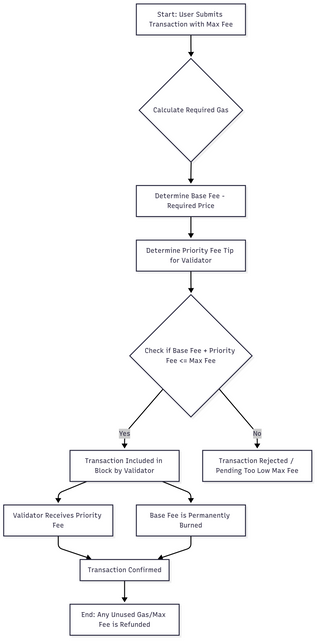
Image: EIP-1559 Gas Fee Mechanism Flowchart
Source: www.liquidityfinder.com
This new model made gas prices more stable, transparent, and predictable, but it did not eliminate high fees; it simply improved the bidding mechanism.
4. Factors That Influence Gas Prices
Gas prices are volatile. Understanding why they fluctuate so much is key to timing your transactions.
| Factor Description Impact on Price | ||
| Network Congestion | The single biggest factor. When many people try to transact at once (e.g., during a major NFT drop or a crypto market crash), demand for limited block space surges. | Highest (Prices spike 10x or more) |
| Transaction Complexity | A simple token transfer requires less computation than minting an NFT or executing a complex DeFi strategy (e.g., providing liquidity to a pool). | High (Complexity ↑, Gas Limit ↑) |
| Block Utilization | How full the current blocks are. EIP-1559's Base Fee increases or decreases based on whether the last block was over or under 50% utilization. | Medium (Constant small changes) |
| Time of Day/Week | Usage often dips during late hours in North America and Europe, leading to lower fees. Weekends are often cheaper than weekdays. | Low to Medium (Predictable dips) |
| Native Token Price | Since fees are paid in the native currency (e.g., ETH), if the dollar value of ETH doubles, the dollar cost of the same 50 Gwei transaction also doubles. | Medium (Indirectly through market volatility) |
Table: Factors affecting gas fee, Source: www.liquidityfinder.com
4.1. The Role of Smart Contracts
The complexity of a transaction is directly tied to the smart contract code it calls.
🔹 Simple Transfer: This is a basic function requiring minimal execution steps. The gas limit is fixed (around 21,000).
🔹 Complex Contract (Uniswap Swap):
1. Approve the expenditure of Token A.
2. Check the price and liquidity pool ratio.
3. Transfer Token A to the pool.
4. Calculate the output of Token B, factoring in the trading fee.
5. Transfer Token B to the user.
6. Update the pool’s state.
Each step requires specific computational effort, increasing the Gas Limit required, even if the Gas Price (Gwei) remains the same.
5. Practical Tools and Key Figures
To navigate gas fees, you need reliable tools. These tools provide real-time data to help you estimate and manage costs.
5.1. Etherscan Gas Tracker
🔹 Description: Etherscan is the leading blockchain explorer for the Ethereum network. Its Gas Tracker section provides real-time estimates of gas prices across different speed tiers.
🔹 Main Features: Real-time Gwei price for Low, Standard, and High priority; historical gas price charts; list of recent high-gas-consuming transactions and contracts.
🔹 Pros: Highly accurate, universally trusted, breaks down the current Base Fee and Priority Fee (Tip).
🔹 Cons: Only covers Ethereum Mainnet.
🔹 Official URL: https://etherscan.io/gastracker
5.2. MetaMask (Wallet)
🔹 Description: The most popular self-custody wallet for interacting with Ethereum and EVM-compatible networks.
🔹 Main Features: Automatically estimates gas fees (using EIP-1559 Max Fee and Priority Fee) and allows users to edit these estimates for faster or cheaper execution.
🔹 Pros: Integrates directly with the blockchain's fee mechanism; provides a clear user interface for fee management.
🔹 Cons: Overriding the default fee carries the risk of the transaction failing or being stuck.
🔹 Official URL: https://metamask.io/
5.3. Key Figure: Vitalik Buterin
🔹 Description: Co-founder of Ethereum. He is the principal mind behind many of Ethereum’s key innovations, including the EIP-1559 mechanism itself.
🔹 Relevance to Gas: Buterin has consistently pushed for scalability solutions (like L2s) and fee market changes (like EIP-1559) to reduce transaction costs and increase network efficiency. His work drives the roadmap for how gas fees evolve.
5.4. Data Metrics on Gas Consumption
Here is a comparison of typical gas usage for common Ethereum operations.
| Operation Typical Gas Limit Used Cost in Gwei (Example) Estimated USD Cost (at 30 Gwei, ETH=$3,000) | |||
| Simple ETH Transfer | 21,000 | 630,000 Gwei | $1.89 |
| Approve Token (ERC-20) | 45,000 | 1,350,000 Gwei | $4.05 |
| Swap Tokens on DEX (Uniswap) | 150,000−300,000 | 4,500,000−9,000,000 Gwei | $13.50−$27.00 |
| Mint Complex NFT | 300,000−800,000 | 9,000,000−24,000,000 Gwei | $27.00−$72.00 |
Table: Data Metrics on Gas Computation, Source: www.liquidityfinder.com
6. The Long-Term Solution: Layer 2 Networks
The main problem with Layer 1 (L1) blockchains like Ethereum is that they are built for security and decentralization first, which means they can only process a limited number of transactions per second (low throughput). This limited space leads to high gas fees when demand spikes.
Layer 2 (L2) networks are built on top of the L1 chain to solve this problem. They bundle hundreds or thousands of transactions off-chain and then submit a single, compressed proof of all those transactions back to the L1. This dramatically lowers the cost per user.
| L2 Platform Type of Scaling Main Features & Mechanism Typical Gas Cost vs. L1 Official URL | ||||
| Arbitrum | Optimistic Rollup | Executes transactions off-chain and assumes they are valid ("optimistic"). Uses fraud proofs where validators have a window to challenge a transaction if it was malicious. | ∼50x to 100x cheaper | https://arbitrum.io/ |
| Optimism | Optimistic Rollup | Similar to Arbitrum, focusing on simplicity and faster transaction finality (settlement on L2). Uses the same fraud proof mechanism. | ∼50x to 100x cheaper | https://www.optimism.io/ |
| zkSync | Zero-Knowledge (ZK) Rollup | Executes transactions off-chain and generates cryptographic "proofs" (ZK proofs) to instantly verify their correctness back on L1. | ∼100x to 500x cheaper | https://zksync.io/ |
| Polygon (PoS Chain) | Sidechain/L2 Hybrid | A separate Proof-of-Stake (PoS) blockchain that is EVM-compatible. It commits its state back to Ethereum, acting as a scaling solution. | Fees are usually a fraction of a cent. | https://polygon.technology/ |
Table: Typical Gas Cost of L2 Platforms as compared to L1 platforms, source: www.liquidityfinder.com
6.1. Comparison of Scaling Architectures
Understanding the trade-offs in scaling solutions helps explain why costs vary so much.
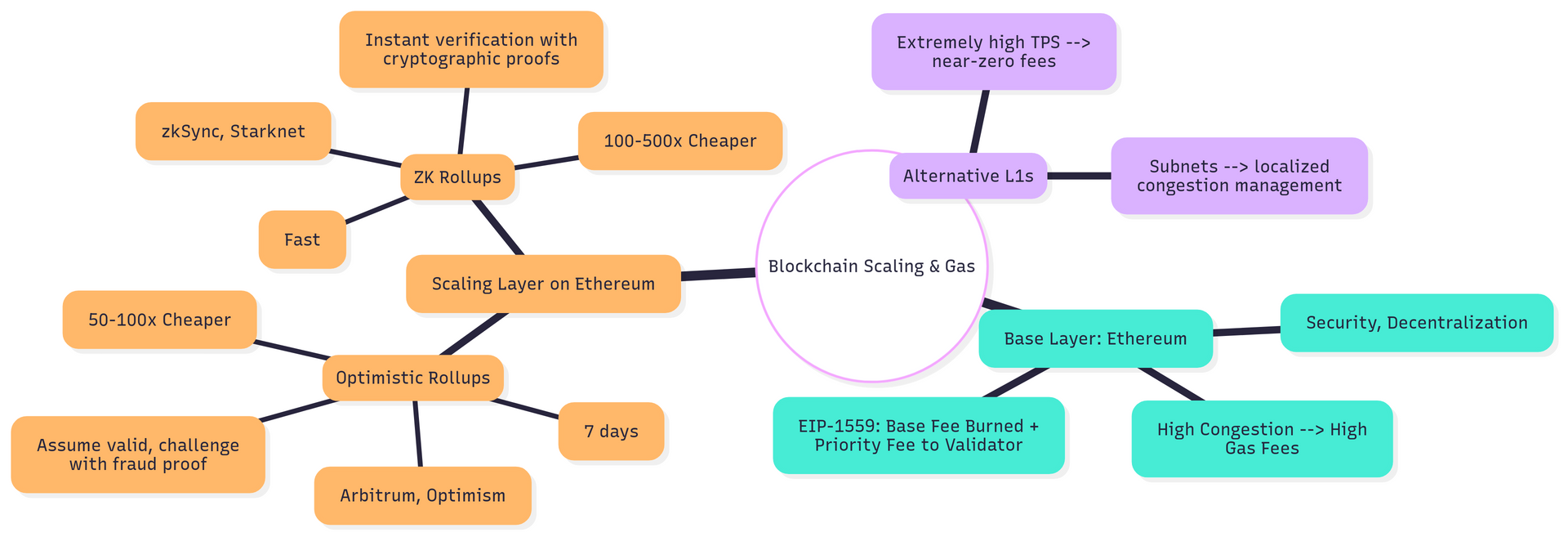
Image: Blockchain Scaling Comparison Diagrams
Source: www.liquidtyfinder.com
6.2. Alternative Layer 1 Chains (L1s)
Some users avoid high gas fees by moving to entirely different L1 blockchains. These chains have different architectural trade-offs, often prioritizing speed and low cost over the absolute decentralization and security of Ethereum.
| Chain Name Consensus Mechanism Key Feature for Low Fees Trade-Offs Official URL | ||||
| Solana | PoH (Proof-of-History) + PoS | Extremely high transaction throughput (TPS) allows fees to remain consistently low. | Periodic network outages; less validator decentralization. | https://solana.com/ |
| BNB Chain (BSC) | PoS Authority (PoSA) | Centralized structure allows for high speed and low fees. | Significantly lower decentralization than Ethereum. | https://www.bnbchain.org/en |
| Avalanche (C-Chain) | Snowman Consensus | Allows transactions to finalize quickly and cheaply through horizontal scaling (subnets). | Smaller ecosystem and less developer tool support than Ethereum. | https://www.avax.network/ |
Table: Alternative Layer 1 (L1s) Chains, Source: www.liquidityfinder.com
7. Practical Guide: Minimizing Your Gas Costs
Even with Layer 2s, you will sometimes need to transact on Layer 1. Here are actionable tips to cut down on costs.
7.1. Time Your Transactions Strategically
Gas fees follow predictable patterns related to global market activity and working hours.
🔹 Avoid US Trading Hours (9 AM - 5 PM EST): This is the busiest time for market activity, decentralized finance (DeFi), and NFTs.
🔹 Aim for Weekends/Late Nights: Saturday and Sunday, especially in the US and European night hours, often see a significant drop in demand, leading to cheaper Base Fees.
🔹 Monitor Gas Trackers: Always check Etherscan or a similar tracker before submitting a large transaction. Waiting an hour for the price to drop from 80 Gwei to 25 Gwei can save you hundreds of dollars on a complex smart contract interaction.
7.2. Consolidate Operations (Batching)
Try to bundle several actions into one complex transaction rather than executing them individually.
Example: If you need to approve a token and then swap it, some advanced protocols allow you to do this in one atomic transaction if the contract is designed for it. While this single transaction will have a higher Gas Limit than a simple transfer, it will be significantly cheaper than executing two entirely separate transactions (each requiring a separate Base Fee and Priority Fee).
7.3. Use the L2 Networks
This is the most effective cost-saving measure. Before doing anything on Ethereum L1:
1. Check if the decentralized application (dApp) you want to use is available on Arbitrum, Optimism, Polygon, or another L2.
2. Bridge your assets from L1 to the L2. This bridging process is expensive (it’s an L1 transaction), but the subsequent hundreds of transactions you make on the L2 will be nearly free, quickly recouping the bridging cost.
7.4. Understanding "Stuck" Transactions
If you set your Priority Fee too low during congestion, your transaction might not be picked up by a validator and will remain "Pending."
🔹 Cancel: In MetaMask, you can submit a new, zero-value transaction to yourself with the exact same nonce as the stuck transaction, but with a much higher Max Fee. This replaces the stuck transaction.
🔹 Speed Up: Alternatively, you can use the "Speed Up" feature in your wallet, which automatically resubmits the transaction with a higher Max Fee/Priority Fee.
8. Looking Ahead: The Future of Gas Fees
The gas fee journey is far from over. The Ethereum network and its competitors are continuously working to reduce costs and increase scalability.
8.1. Proto-Danksharding (EIP-4844)
The next major step for Ethereum is to implement a feature called Proto-Danksharding (EIP-4844). This update introduces a new type of space for data called "blobs".
🔹 How it Works: Instead of storing L2 data directly in the very expensive L1 transaction call data, L2s will store the necessary data in these cheaper "blobs." This data is temporary (only available for about 18 days) but is enough time for validators to verify the L2 transactions.
🔹 Expected Impact: This is designed to reduce L2 gas costs by another factor of 10x to 100x, making L2s the primary and almost-free place to transact.
The future of blockchain fees looks like this:
L1 Cost ≫ L2 Cost (Today) ≫ L2 Cost (Post-Danksharding)
8.2. Other L1 Innovations
Other chains are addressing the fee problem with unique models.
🔹 Avalanche Subnets: Allows developers to create entirely new, customizable blockchains ("subnets") that use their own gas tokens and rules. This removes competition for block space on the main chain.
🔹 Solana Fares: Solana’s model is heavily dependent on hardware efficiency. As hardware improves, its theoretical limit for transactions per second (TPS) increases, constantly keeping the per-transaction fee near zero.
Conclusion
Gas fees are the foundational economic mechanism that keeps a decentralized network honest, secure, and running. They are not a penalty; they are the price of censorship-resistance and global finality.
While the concept of Gwei, Base Fees, and Priority Fees might seem intimidating at first, the core idea is simple: you are bidding for limited space.
For the vast majority of users, the answer to "how do I avoid high gas fees?" is to move to Layer 2. Platforms like Arbitrum and Optimism have absorbed the bulk of network activity precisely because they make the cost barrier almost disappear.
The transition to a multi-layered blockchain world means high Layer 1 fees will become a rarity for average users, reserved only for critical events like bridging or large institutional movements.
Author
 | Navneet Giri - Navneet is a professional quantitative trader with extensive experience in derivatives trading across major global exchanges and financial markets, including cryptocurrencies. | He employs market-making strategies and participates in liquidity enhancement programs to achieve optimal trading results. |
FAQs: Ethereum Gas Fees
These FAQs answer the most searched questions about Ethereum gas fees, EIP-1559, and how to reduce costs using Layer 2 networks.
What are Ethereum gas fees (and what does “gas” mean)? +Ethereum gas fees are the transaction fees paid to process actions on the Ethereum network. In simple terms, “gas” is the unit that measures how much computational work your transaction requires (for example, sending ETH, swapping tokens, minting an NFT, or interacting with a DeFi smart contract).
Gas fees exist to keep the network secure and usable: they create a cost that discourages spam/DDoS attempts, and they compensate validators for verifying transactions and adding them to blocks.
Your total fee depends on how much gas is used (complexity) and how expensive gas is right now (congestion and fee market conditions).
Why are Ethereum gas fees so high sometimes? +Ethereum gas fees become high when the network is congested and users are competing for limited block space. Common causes include major market volatility, NFT launches, popular token airdrops, and heavy DeFi activity (liquidations, arbitrage, large swaps).
Under EIP-1559, the Base Fee automatically rises when blocks are consistently more full than the target and falls when demand drops. This makes fees more predictable than the older auction model, but it doesn’t remove the underlying supply constraint: block space is scarce.
Also note: “headline gas price” isn’t the whole story — a complex transaction (DEX swap, bridge, mint) uses far more gas than a simple ETH transfer, so it can cost much more even at the same market fee level.
Gas limit vs gas price: what’s the difference (and what is Gwei)? +Gas limit is the maximum amount of computational work your transaction is allowed to consume. Gas price is the amount you pay per unit of gas. On Ethereum, gas prices are commonly quoted in Gwei (a small unit of ETH).
In the EIP-1559 model, users typically set a Max Fee (your ceiling) and a Priority Fee (a tip), while the protocol sets the Base Fee. Your total cost is driven by gas used × (Base Fee + Priority Fee).
Put simply: gas limit = how much work, gas price/fees = how expensive that work is right now.
What happens if my gas limit is too low (out of gas)? +If your gas limit is too low, your transaction can fail with an “out of gas” error. This often happens with smart contracts when the transaction requires more computation than expected (for example, complex swaps, bridges, multi-step contract calls, or state changes).
Crucially, you may still pay fees for the work that was already performed before the transaction reverted. The network executed real computation up to the failure point, and validators must be compensated for that processing.
Most wallets (like MetaMask) estimate gas limits automatically. If you manually adjust gas, it’s typically safer to avoid underestimating — because the transaction can fail even if you’re willing to pay a high fee.
What is EIP-1559 (Base Fee vs Priority Fee) and how does it work? +EIP-1559 is Ethereum’s fee market upgrade that changed how gas fees are calculated. It introduced a protocol-set Base Fee and a user-set Priority Fee (tip), replacing the older “first-price auction” approach where users had to guess a single gas price.
The Base Fee rises or falls automatically based on block demand, while the Priority Fee incentivises validators to include your transaction sooner when the network is busy. Users also specify a Max Fee (the maximum they are willing to pay); if the actual fee is lower, the difference is refunded.
Practically, EIP-1559 makes fees more transparent and reduces overpaying, but gas can still be expensive when demand exceeds capacity.
Why does Ethereum burn the Base Fee? +Ethereum burns the Base Fee under EIP-1559, meaning it is permanently removed from circulation rather than paid to validators. This design helps separate the protocol’s “minimum market price” for block space (Base Fee) from the optional service incentive you provide (Priority Fee).
Burning can also affect ETH supply dynamics: when network usage is high, more ETH is burned, which can reduce net issuance over time (depending on staking issuance and network activity).
In short: burning is part of a cleaner fee market design and an economic mechanism that can reduce circulating ETH during busy periods.
How can I reduce Ethereum gas fees (best practical tips)? +The best way to reduce Ethereum gas fees is to use Layer 2 networks (Arbitrum, Optimism, zkSync, Polygon, etc.) for everyday transactions. After bridging once (an L1 cost), most ongoing transfers and swaps on L2 are dramatically cheaper.
If you must transact on Ethereum mainnet, timing matters. Fees often drop during off-peak hours and weekends. Use a gas tracker before executing high-cost actions like bridging, minting, or multi-step DeFi operations.
You can also reduce costs by batching actions where possible (e.g., protocols that combine “approve + swap” in a single transaction) and by avoiding unnecessary contract interactions when congestion is high.
How do I speed up or cancel a stuck MetaMask transaction? +A transaction is usually stuck in MetaMask because the effective fee is too low for current conditions (low Priority Fee or Max Fee, or the Base Fee rose after you submitted). Validators prioritise transactions that pay enough to be included quickly.
To fix it, use MetaMask’s Speed Up feature to resubmit the transaction with a higher Max Fee and Priority Fee. To cancel, use Cancel (or send a 0-value transaction to yourself) with the same nonce and a higher fee so it replaces the pending transaction.
Avoid sending many new transactions from the same wallet while one is stuck — Ethereum processes your transactions in nonce order, so a single pending transaction can block later ones.
Share this article

Comments
Most Recent
Find The Right Partners for
Your Trading Business
Sign up and join over 5,000 professional members who receive personalized news alerts, curated professional connections, and more for free!
BitMart announced on July 26, 2026 that it is winding down its trading platform: new registrations and deposits stopped immediately, spot and futures trading ends August 26, 2026, and operations fully close by January 31, 2027. Anyone still holding funds on BitMart needs a reliable replacement exchange immediately.
A new stablecoin backed by 140+ firms, from Visa to BlackRock. Can Open USD challenge USDT and USDC, and will it clear MiCA? Olaf Ransome weighs in.
Brent Xu left Wall Street for blockchain in Ethereum's earliest days. Now his Franklin Templeton and Galaxy Digital backed platform Dora is bringing fractionalised bond trading to retail brokers. He speaks to Sam Low.

Discover whether KuCoin is still “The People’s Exchange” in 2026. This in-depth KuCoin review breaks down fees, KYC, security, Proof of Reserves, supported coins, deposits/withdrawals, futures, margin, Earn and the platform’s standout free trading bots — plus who it’s best for (and who should avoid it).

Generating and sustaining liquidity requires a strategic approach across centralized exchanges, decentralized pools, and market-making relationships. This guide covers every stage of the process for crypto projects.
This guide covers how proof-of-stake works, the best assets to stake, liquid staking protocols, and the risks you need to understand before committing funds.

S&P Global Ratings gave Tether (USDT) the weakest Stablecoin Stability Assessment. Olaf Ransome breaks down what drives stablecoin risk—asset backing, custody/correspondent chains, transparency and reporting.
Decentralized exchanges (DEXs) allow peer-to-peer trading without intermediaries. This guide covers how AMMs work, how to connect a wallet, understand liquidity pools, manage slippage, and trade safely across Ethereum, BNB Chain, and Solana.
Create Your FREE Account
Get access to latest news, updates, real-time data, brokerage and trading firm insights and customized information feeds.


OANDA Japan has restricted trading on accounts that may have been affected by unauthorised access after login details stored on GMO's Onamae.com Desktop Cloud VPS leaked. The broker says its core systems were not breached and is directing affected clients to GMO's compensation process while urging password changes and 2FA.
Alpaca has received in-principle approval from ADGM's FSRA for Alpaca Clearing & Custody ME Ltd. Subject to a Financial Services Permission, the entity plans to offer brokerage services and virtual asset custody, bringing Alpaca's API-driven brokerage infrastructure closer to partners in the Middle East region.


US stock futures edged higher in early trading today as investors prepared for a week of major central bank decisions. S&P 500 futures rose 0.2%, Dow futures gained 0.3%, and Nasdaq-100 futures advanced 0.3%, following Friday’s selloff.

Brent crude is trading at $115.57 after retreating from its recent high of $118.23. The moving averages indicate a mixed short term picture.


iSAM Securities Apex is working with LMAX Group to bring perpetual futures pricing to FX and CFD brokers through the Apex platform.

ICM MENA has promoted Ahmed Kamal to Chief Executive Officer. Kamal joined the firm in March 2019 as Business Development Manager and most recently served as Regional Manager. He brings more than a decade of experience in financial markets, with expertise in foreign exchange, business development and team leadership.

Theorem has integrated Symbiotic’s Liquid Lane RFQ network, letting holders of tokenised real-world assets trade against on-chain pool liquidity and market-maker quotes. The integration is live on Ethereum, with Midas’s yield-bearing mHYPER fund as the first supported asset. Holders can trade for the USDC stablecoin.

US equities were volatile with technology selloff erasing much of the earlier rebound.

FM Summit London 2026 returns to Old Billingsgate on 24 November for its 15th edition, with LMAX Group, Plus500 and oneZero among confirmed exhibitors. The one-day event adds Business Connect meetings and roundtables, and opens with a networking evening at The Folly on 23 November.

Finance Magnates Summit London returns to Old Billingsgate on 24 November 2026 for its 15th edition. The one-day event brings together brokers, liquidity providers, institutional firms, trading technology vendors, payments businesses and digital asset firms.
Feed