
Search Companies, News, Members & more
Terms of ServicePrivacy PolicySecurity PolicyLegal InformationCommunity GuidelinesSitemapsCookie Settings
2026 Copyright © Liquidity Finder Ltd. All rights reserved.
Liquidity Finder Ltd is incorporated in England and Wales, company number 10610740, registered address 167-169 Great Portland Street, Fifth Floor, London W1W 5PF, United Kingdom.
Different Traders, Different Trading Environments

Published on Jan 27, 2026
Updated on Mar 7, 2026

LiquidityFinder Insight, January 2026
Author: Youssef Bouz, GCC Brokers
One of the most common mistakes in the trading industry is trying to design a single trading model that satisfies everyone. Markets do not work that way—and traders certainly do not behave that way.
As trading strategies diversify and automation becomes more common, it is increasingly clear that different traders require different trading environments. Not because some traders are better or worse than others, but because their objectives, risk tolerance, and execution logic are fundamentally different.
Recognizing this distinction is not exclusionary. It is practical.
Trading Priorities Are Not Universal
Traders enter the market with different goals, time horizons, and constraints. Some prioritize flexibility and short-term opportunity. Others focus on consistency, scalability, and long-term survivability.
For discretionary or newer traders, ease of access and adaptability may take priority. For professional, systematic, or algorithmic traders, priorities tend to shift toward:
🔹 Execution transparency
🔹 Predictable market behavior
🔹 Stable infrastructure
🔹 Clear rules around profitability and scaling
Neither set of priorities is inherently superior. Problems arise only when expectations are mismatched with the trading environment.
Why Suitability Matters More Than Persuasion
In many cases, brokers spend significant effort trying to convince traders why a particular model is “better.” In practice, clarity around suitability is far more valuable than persuasion.
A trading environment should not attempt to accommodate every possible style at the cost of consistency. Instead, it should be designed with a clear understanding of the type of trading behavior it supports best.
For traders running systematic or automated strategies, this clarity is especially important. Algorithms do not negotiate conditions or adapt emotionally. They rely on predictable execution and transparent market behavior. When the environment matches the strategy, performance becomes easier to evaluate and scale responsibly.
Real Market Conditions Require the Right Mindset
Trading environments that reflect real market conditions—such as variable spreads, natural slippage, and external liquidity—are not always comfortable. They require traders to accept that outcomes are shaped by market dynamics rather than structural guarantees.
Professional and algorithmic traders tend to prefer this realism because it removes uncertainty around how trades are handled. When outcomes are driven by market behavior rather than internal constraints, traders can focus on improving strategy logic rather than navigating hidden rules.
This mindset becomes increasingly important as strategies move from discretionary execution toward automation.
Clear Expectations Benefit Both Sides
Misalignment between trader expectations and broker environments often leads to frustration on both sides. Traders feel constrained or misunderstood, while brokers struggle to manage behavior that does not fit their operational model.
Clear positioning helps avoid this.
When a broker is explicit about the type of trading environment it offers:
🔹 Traders self-select more effectively
🔹 Operational friction is reduced
🔹 Long-term relationships become more viable
This is particularly relevant for traders who intend to scale capital or deploy automated strategies over time. Stability and predictability matter more than short-term optimization.
Alignment Over Accommodation
As trading becomes more advanced, the industry benefits from moving away from one-size-fits-all approaches. Alignment—between trader behavior, execution infrastructure, and broker risk models—creates healthier outcomes for everyone involved.
Different traders will continue to coexist in the market. The challenge is not choosing which group to serve, but building environments that genuinely support the traders they are designed for.
Clarity, suitability, and transparency are not limitations. They are foundations for long-term participation in increasingly automated markets.
Other articles by Youssef:
Competing In A Spoiled FX Market
Building the Right Trading Environment in the Age of Algorithmic & AI Trading
You may also be interested in:
Author
 |
Youssef Bouz is Operations Manager at GCC Brokers, focusing on execution quality, infrastructure, and long-term broker–trader alignment for professional and algorithmic traders. |
Share this article

Comments
Most Recent
Find The Right Partners for
Your Trading Business
Sign up and join over 5,000 professional members who receive personalized news alerts, curated professional connections, and more for free!
n in-depth review of TMGM (TradeMax Global Markets), the ASIC-regulated ECN broker offering raw spreads from 0.0 pips, MT4 and MT5, copy trading via HUBx and ZuluTrade, and 24/7 multilingual support across four regulated jurisdictions. Find out if TMGM belongs on your shortlist.
LiquidityFinder's Sam Low sits down with Nathan Sage, founder and CEO of Sage Capital Management, to trace his journey from FX fund manager to running a Bitcoin fund doing $1BN a day in 2016 — and how that experience of pain built one of the most connected prime brokerages in the digital assets market today.
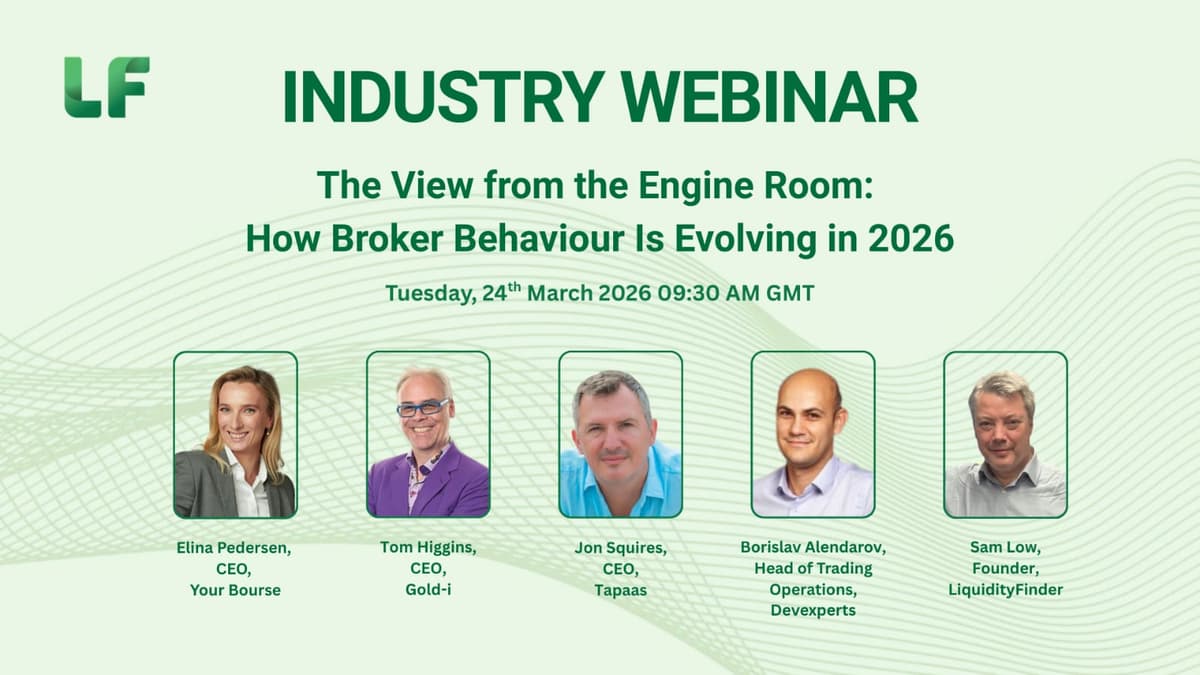
Gold at record highs, oil as a meme stock, and crypto exchanges eyeing your clients. Watch our expert panel - Gold-i, Your Bourse, Tapaas and Devexperts - discuss broker risk management, , AI trading and the MetaTrader debate.

Over a long tapas lunch in Shoreditch, London, Sam Low sits down with Peter Brooks and Jess Reed from ADMISI eFX, the dedicated electronic FX desk operating inside one of the world's largest agricultural commodities companies. What emerges is a compelling case for why this largely unknown operation deserves serious attention from brokers, payments firms, corporate treasuries, and digital asset companies alike.
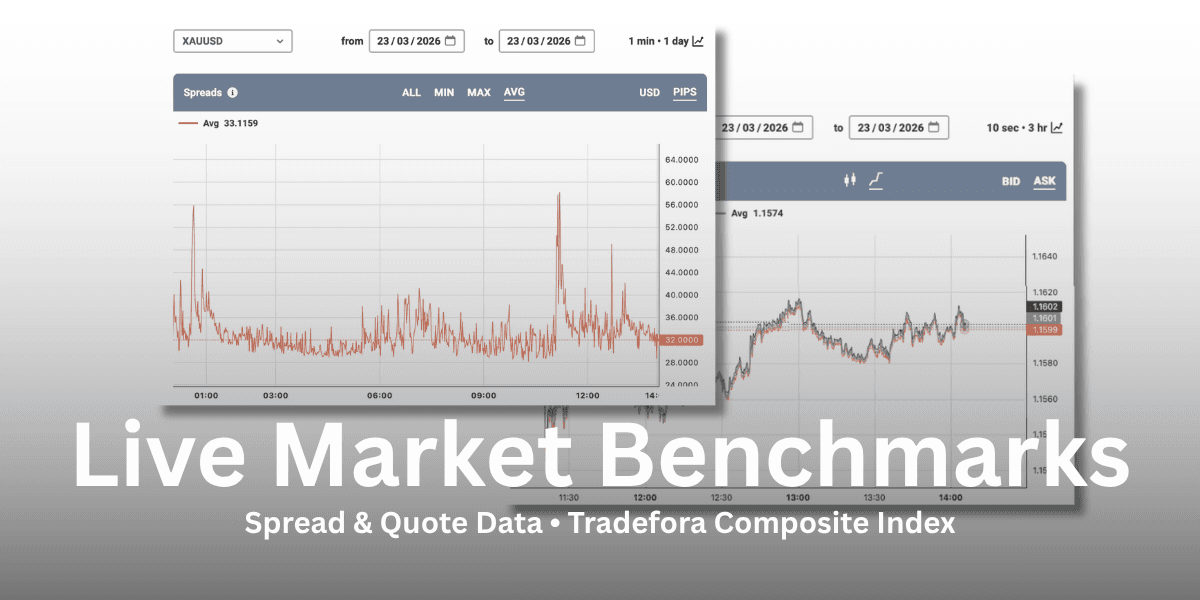
Explore live spread and quote benchmarks powered by the Tradefora Composite Index (TCI), an independent dataset aggregated from multiple FX and CFD brokers. View average, minimum and maximum spreads by instrument and timeframe, plus composite bid/ask quote data updated continuously at millisecond precision.
In Part 6 of his A-Book STP series, Youssef Bouz from GCC Brokers looks at how the rise of algorithmic and AI-assisted trading is forcing brokers to rethink risk models, revenue strategy, and long-term sustainability, and why trader longevity, not short-term extraction, is the real measure of a resilient execution business.
Fusion Capital is a specialist crypto liquidity provider offering brokers over 350 crypto CFD pairs with bespoke pricing, pure A-book execution, and access to decentralised exchange liquidity through Hyperliquid. In this broker profile, LiquidityFinder's Sam Low speaks with Head of Product Jasper Cooney about how Fusion's in-house trading bots monetise flow across centralised and decentralised venues, why crypto exchanges handle toxic flow differently to FX, and how brokers can now offer clients pre-IPO perpetual futures through their existing MT5 infrastructure.
In Part 5 of his A-Book STP series, Youssef Bouz from GCC Brokers provides a guide to distinguishing healthy algorithmic trading from latency arbitrage and structural abuse — and why behavior, not profitability, is the real risk indicator.
Create Your FREE Account
Get access to latest news, updates, real-time data, brokerage and trading firm insights and customized information feeds.


Theorem has integrated Symbiotic’s Liquid Lane RFQ network, letting holders of tokenised real-world assets trade against on-chain pool liquidity and market-maker quotes. The integration is live on Ethereum, with Midas’s yield-bearing mHYPER fund as the first supported asset. Holders can trade for the USDC stablecoin.


US equities were volatile with technology selloff erasing much of the earlier rebound.

FM Summit London 2026 returns to Old Billingsgate on 24 November for its 15th edition, with LMAX Group, Plus500 and oneZero among confirmed exhibitors. The one-day event adds Business Connect meetings and roundtables, and opens with a networking evening at The Folly on 23 November.

Finance Magnates Summit London returns to Old Billingsgate on 24 November 2026 for its 15th edition. The one-day event brings together brokers, liquidity providers, institutional firms, trading technology vendors, payments businesses and digital asset firms.


iSAM Securities Apex has integrated with Match-Prime, giving brokers access to liquidity across more than 2,000 instruments, with tailored pricing and up to 10 levels of market depth.

propfunding.com's free-entry instant funding changes the order of prop funding. Start trading first. Its free-entry instant funding model offers two qualification attempts without an upfront activation fee.

US stocks closed higher on Wednesday, with the Nasdaq gaining 1%, the S&P 500 rising 0.6%, and the Dow advancing 0.7%, as renewed enthusiasm for AI-related stocks lifted market sentiment.

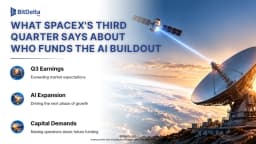
SpaceX went public in June as a rocket company. On October 20 it reported as something else entirely: an AI infrastructure business, financed by a satellite broadband network, with a launch division attached. Rockets generated 12% of third quarter revenue and lost money. The AI segment generated 52% of revenue and consumed 84% of capital expenditure. Starlink generated 85% of operating profit.

Standard Chartered has signed definitive agreements to acquire 100% of Zodia Custody UK Limited, folding its regulated digital asset custody business into Securities Services. Zodia Solutions will be set up under SC Ventures with bank investors including Northern Trust, NAB Ventures, Emirates NBD and Investcorp.

Bybit Fintech FZE has secured a Virtual Asset Service Provider licence from Dubai’s Virtual Assets Regulatory Authority for Exchange Services, covering spot trading. Bybit’s Peter Loo said the firm hopes to add derivatives, subject to regulatory approvals. Its international Dubai headquarters opened in 2022.
Feed