
Search Companies, News, Members & more
Terms of ServicePrivacy PolicySecurity PolicyLegal InformationCommunity GuidelinesSitemapsCookie Settings
2026 Copyright © Liquidity Finder Ltd. All rights reserved.
Liquidity Finder Ltd is incorporated in England and Wales, company number 10610740, registered address 167-169 Great Portland Street, Fifth Floor, London W1W 5PF, United Kingdom.
What are the best DEXs in 2024?
Published on Aug 29, 2024
Updated on Mar 7, 2026

What are the best DEXs in 2024?
Using a decentralised exchange (DEX) for crypto trading can be a great alternative to using some of the more traditional centralised exchanges (CEXs) such as Binance or Coinbase. While DEXs are generally more complicated, users are contributing to a wider, and more sustainable ecosystem, as well as benefiting from earning by participating in liquidity pools.
In this article, we outline six of the best DEXs that are available on the market in 2024, and which ones might be right for you.
What is a DEX?
A decentralised exchange (DEX) is a type of exchange that uses crypto liquidity pools to create liquidity.
In simple terms, there are two main benefits of using a DEX:
1) Earning passive income
2) Increased security and decentralisation
As the liquidity is supplied by all users, instead of one central authority, a DEX allows for the liquidity to be held in secure liquidity pools, and for the users to earn money from this.
This is the basis of most DEXs, and if you are interested in using a DEX, here are six of the best DEXs currently available.
Six of the best DEXs you can use
Each DEX has its own benefits, and you should thoroughly research any cryptocurrency platform before investing your money. Some DEXs are catered more to beginners and some more to professionals, so it’s important to pick a DEX based on your own ability.
1. Uniswap
Perhaps one of the most well-known DEXs is Uniswap, which is credited for being one of the early pioneers of the automated market maker (AMM) and the DEX, rivalling the dominant CEXs in the space at the time.
Created in 2018, Uniswap operates on the Ethereum blockchain and allows users to trade ERC-20 tokens directly from their wallets, without the need for intermediaries.
Uniswap is a user-friendly platform that aims to make exchanging cryptocurrency accessible. The platform has been through three version upgrades, with the latest Uniswap v3 offering concentrated liquidity in the form of non-fungible liquidity pools. In late 2024, Uniswap introduced Hooks, which is another novel concept by the DEX, allowing users to create their own smart contracts.
2. Sushi
Sushi (formerly known as SushiSwap), originally came about as a fork of Uniswap. Sushi values user-friendliness, and has developed into a highly accessible platform that is ideal for beginners. Sushi offers token swaps, yield farming, staking, borrowing and lending.
Sushi provides an accessible alternative to many DEXs, introducing yield farming in a way that is easy to understand with its BentoBox, and also a large focus on community development, making Sushi one of the best DEXs available today.

3. PancakeSwap
PancakeSwap was founded in 2020 by a group of anonymous developers as a fork of Uniswap at a similar time to Sushi. The DEX operates similarly to Uniswap in many ways but is instead built on the Binance Smart Chain (BSC). At the time, this meant that PancakeSwap was a lot faster than other DEXs, as Ethereum’s popularity meant that it was struggling with transaction speeds. BSC provided a cheaper and faster alternative.
PancakeSwap has a big focus on user-friendliness and gamification, introducing lotteries and NFTs into the platform. It represents a type of DEX where user participation is valued highly, as well as introducing beginners into the DEX space. It is also popular for more experienced traders looking to avoid the higher gas fees of Ethereum.
4. KyberSwap
Towards the more advanced end of the scale, KyberSwap is a multi-chain DEX aggregator, which means that it uses liquidity from various other DEXs and liquidity pools in order to facilitate trades.
KyberSwap’s algorithm will either split the trade across multiple exchanges, reduce slippage by choosing the optimal trade path, and will also be able to compare rates from various sources in real-time.
This advanced model means that KyberSwap is able to offer rapid trade execution with much lower slippage than other DEXs.
It also has a wide range of tokens and allows users to trade directly from their wallets without needing to deposit into the platform, which further increases the security. Additionally, KyberSwap integrates with various decentralised finance (DeFi) protocols, allowing users to easily access liquidity across the DeFi ecosystem.
For anyone seeking a DEX with efficient trading times and a wide range of tokens, KyberSwap is a fantastic option.
5. Balancer
Balancer is another innovative DEX that operates on the Ethereum blockchain. A unique feature of Balancer is that it uses an AMM system to simplify the management of your portfolio. Users can create customised liquidity pools of up to eight different cryptocurrencies and determine their weights in the portfolio. The AMM will then rebalance token prices as the markets change (hence the name Balancer) and will ensure that the weighting stays the same in your liquidity pool.
This allows more advanced traders to set up highly efficient portfolio management, as well as earn fees from the trades executed like a regular DEX. This unique approach to liquidity and versatility makes Balancer a popular tool for traders.
6. Bancor
Bancor is a DEX that is a little different to the others on this list and is more of an ecosystem of decentralised protocols. Rather than being one DEX where users can trade, Bancor is essentially an umbrella for several products, listed under one banner of ‘Bancor’ and all based on the BNT.
Bancor’s unique feature is that it offers single-sided liquidity provision, which means that users can enter liquidity pools with just a single token when normally a pair is required. The idea of this is to reduce exposure to impermanent loss, which can be an issue for other DEXs. Bancor also implements Impermanent Loss Insurance which works by allocating around 15% of all trading fees into a unique pool in the event of impermanent loss.
Conclusion
Choosing a DEX to either trade or stake your crypto can be a challenging decision, but we hope with our list that you have a better understanding of DEXs and how to use them.
For those interested in a smoother and more beginner-friendly experience, DEXs such as Sushi and PancakeSwap are ideal choices. More advanced traders looking for optimal trading rates and more complex tools might want to consider KyberSwap or Balancer.
For more articles like this, make sure to stay up to date with our crypto insights.
Remember to register with LiquidityFinder and make a free account. We are a network of industry professionals, traders and providers, providing access to companies looking to accelerate their business.
You can use our crypto exchange provider as well as our Match Matrix to find the liquidity provider that is right for you.
Author
 | Caleb is a financial copywriter with a specialisation in fintech and forex. Former copywriter at Barclays and Paysafe. Contributing writer for LiquidityFinder. You can message Caleb here. |
Share this article
Comments
Most Recent
Find The Right Partners for
Your Trading Business
Sign up and join over 5,000 professional members who receive personalized news alerts, curated professional connections, and more for free!
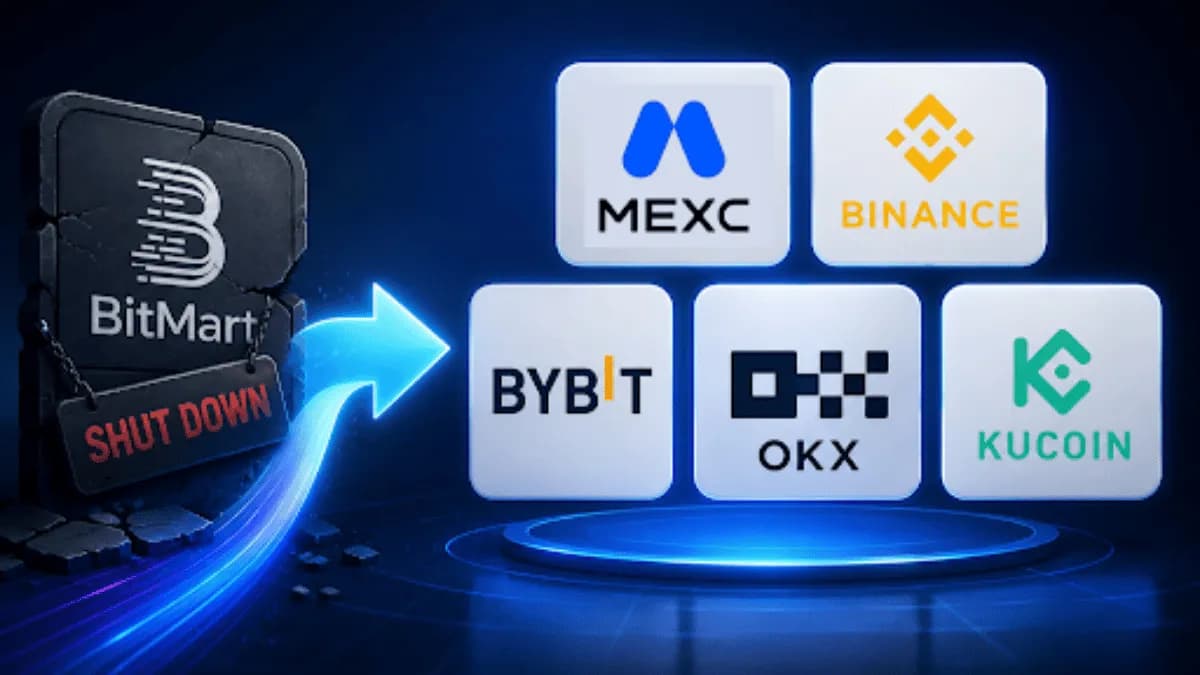
BitMart announced on July 26, 2026 that it is winding down its trading platform: new registrations and deposits stopped immediately, spot and futures trading ends August 26, 2026, and operations fully close by January 31, 2027. Anyone still holding funds on BitMart needs a reliable replacement exchange immediately.
A new stablecoin backed by 140+ firms, from Visa to BlackRock. Can Open USD challenge USDT and USDC, and will it clear MiCA? Olaf Ransome weighs in.

Discover whether KuCoin is still “The People’s Exchange” in 2026. This in-depth KuCoin review breaks down fees, KYC, security, Proof of Reserves, supported coins, deposits/withdrawals, futures, margin, Earn and the platform’s standout free trading bots — plus who it’s best for (and who should avoid it).

From machine learning-driven execution to predictive market analytics, we break down the AI tools that institutional and quantitative traders are using to gain an edge.
Gas fees can be the most confusing part of using Ethereum and other blockchains. This guide explains what gas fees are, why they exist, how costs are calculated (including EIP-1559’s base fee and priority tip), and the key factors that drive price spikes. You’ll also learn practical ways to reduce fees using gas trackers, smarter timing, batching, and Layer 2 networks like Arbitrum, Optimism, Polygon and zkSync.

Generating and sustaining liquidity requires a strategic approach across centralized exchanges, decentralized pools, and market-making relationships. This guide covers every stage of the process for crypto projects.
This guide covers how proof-of-stake works, the best assets to stake, liquid staking protocols, and the risks you need to understand before committing funds.

S&P Global Ratings gave Tether (USDT) the weakest Stablecoin Stability Assessment. Olaf Ransome breaks down what drives stablecoin risk—asset backing, custody/correspondent chains, transparency and reporting.
Create Your FREE Account
Get access to latest news, updates, real-time data, brokerage and trading firm insights and customized information feeds.


Understand trading psychology and learn how a clear strategy, risk management and a trading journal help build discipline and day trading consistency.


Ripple Prime has launched support for real-world asset perpetual swaps, giving institutional clients including Virtu exposure to more than 100 reference markets across equities, indices, ETFs, metals, energy and FX. The swaps reference Trade.xyz perpetual futures on Hyperliquid and trade and settle around the clock.


iSAM Securities Apex has integrated with Crossover Markets, connecting brokers to CROSSx, its institutional digital asset ECN, through Apex’s ultra-low-latency technology stack.


Your Bourse and 4XPORTAL highlight their existing partnership, combining client onboarding, CRM and payment solutions with liquidity, execution and risk-management infrastructure for brokers.


The partnership brings together 4XPORTAL’s brokerage technology capabilities with Your Bourse’s connectivity, liquidity aggregation, and risk-management infrastructure.

Clearstream has appointed Philippe Mueller as Head of Digital Products and Transformation for Clearstream Fund Services, succeeding Olivier Portenseigne. He will lead digital fund distribution, DLT-enabled fund processing and transfer agency innovation. He has over 25 years at Clearstream and Deutsche Börse Group.

Learn how to detach from trading outcomes by focusing on entry, exit, and risk. Build trading discipline with clear rules and a repeatable process.

CMC Markets has retired the CMC Connect name and will now present its institutional business as CMC Markets Institutional.

The SEC has approved Cboe's binary options tied to key performance indicators reported by 23 companies, covering more than 100 metrics such as iPhone revenue. The cash-settled contracts pay a fixed $1, Robinhood plans to be the first retail broker to offer them, and trading awaits clearing registration.


Gold is trading around $4,150, recovering sharply after falling to a recent low of $4,073.
Feed