just now

Liquidity Finder Ltd is incorporated in England and Wales, company number 10610740, registered address 167-169 Great Portland Street, Fifth Floor, London W1W 5PF, United Kingdom.
Published: just now
The industry conversation about AI and risk management has a problem. It is mostly being led by vendors.
That is not a criticism — vendors invest in research, build useful tools, and have genuine insight into how technology can improve brokerage operations. But it produces a particular kind of discourse: AI as transformation, AI as the next frontier, AI as the answer to challenges that have defined the dealing desk for a decade. The framing is consistently forward-looking, consistently optimistic, and — when you are actually running a risk desk — consistently incomplete.
This is not an argument against AI in brokerage operations. It is an argument for a more precise understanding of what AI does well in this environment, where it introduces new risks, and why the human dealing desk is not a transitional arrangement on the way to full automation.
Pattern recognition across large datasets is genuinely where AI outperforms human analysis. A dealing desk managing thousands of accounts across multiple servers, instruments, and time zones cannot maintain continuous attention on individual account behaviour. An AI system can. It does not get tired at 2 AM. It does not lose concentration during a quiet patch before a volatility event. It applies the same classification logic to every account, every minute, without the inconsistency that comes from shift changes or cognitive load.
Specifically, AI adds real value in three areas:
Early behavioural classification. Machine learning models trained on historical flow data can identify accounts likely to generate toxic or edge-based flow earlier than rule-based systems — often within the first 50–100 trades, before the account has generated enough P&L history to trigger traditional thresholds. This is meaningful. Getting ahead of informed flow by days rather than weeks has direct impact on B-book performance.
Correlation detection across accounts. Human analysts can track dozens of accounts simultaneously with difficulty. AI systems can monitor hundreds of thousands of account pairs for coordinated behaviour, timing correlation, and structural hedging patterns — at the network level, not just the individual account level. This is categorically beyond manual capacity.
Continuous monitoring without fatigue. The dealing desk has always had a coverage problem. Risk events do not schedule themselves around working hours. AI-powered monitoring closes the coverage gap without proportional headcount increases.
These are meaningful capabilities. They are also specific and bounded — which is the part of the conversation that tends to get lost.
An AI system is only as good as the data it was trained on and the environment it operates in. Both create failure modes that are underappreciated in current industry discussion.
The regime change problem. AI models for risk classification are trained on historical market data. When market structure changes — new instrument correlations, regulatory shifts, macro regimes that have not been seen before — models trained on prior data can misclassify flow confidently and incorrectly. The model does not know it is wrong. It produces a signal. A dealing desk that has delegated routing decisions to that signal is exposed in precisely the conditions where the signal is least reliable.
April 2026 was an example. Dollar weakness of the kind seen in that period — combined with gold at those levels, correlated with tariff shock dynamics — did not have a close historical parallel in most training datasets. Models that worked well in 2024 conditions were not necessarily calibrated for the flow patterns that emerged. Brokers who understood this maintained human oversight at the routing decision level. Brokers who did not discovered the gap in their Q2 review.
The false positive cost. AI classification that routes accounts to A-book generates LP costs on every trade. A system that over-classifies accounts as toxic — flagging more than the actual base rate of harmful flow — creates systematic hedging costs on trades that would have been better kept on the book. The P&L impact is the mirror image of what the system is supposed to prevent. False positives are not neutral; they are a real cost, and one that does not show up labelled as AI error in the monthly report.
Automation without auditability. When an AI system makes a routing decision automatically, the dealing desk needs to understand why. Not in retrospect — in real time, as conditions evolve. Many current implementations do not provide this. The system acts; the desk monitors the output; the logic is opaque. This is workable in normal conditions and dangerous when something unexpected happens. The desk cannot correct what it cannot diagnose.
Before a broker evaluates any AI risk management system, there is one question worth asking before any other: who makes the routing decision?
If the answer is "the system, automatically, based on its classification" — the broker has delegated a consequential operational decision to a model they cannot fully audit, running in market conditions the model may not have seen. That is a risk management choice, not a risk management solution.
If the answer is "the dealing desk, informed by AI analysis" — the system is being used correctly. The AI provides classification, monitoring, and pattern recognition at scale. The desk applies judgement, context, and accountability. The combination is more powerful than either alone.
This distinction is not philosophical. It determines who is responsible when the model is wrong, what the desk can do about it, and whether the AI capability makes the operation more resilient or more fragile.
There are dealing desk functions that AI cannot take over not because the technology is immature, but because they require something AI does not have: contextual judgement under uncertainty, with accountability for the outcome.
Interpreting ambiguous flow. Not all unusual trading patterns are harmful. A large position from a new account might be toxic flow, or it might be a sophisticated institutional client who signed up direct. The technical signal is the same. The correct response is different. A human with context about the account's origin, onboarding, and commercial relationship makes this call. An AI model makes it statistically.
Regulatory and counterparty decisions. A routing decision that affects a specific client relationship, a specific LP arrangement, or a specific regulatory obligation requires a human who understands those relationships. An AI system does not have a relationship with a liquidity provider. It has a classification output.
Crisis management. When markets move fast and risk events compound — a fat finger on a major pair during low liquidity, a flash crash in a correlated instrument, a connectivity failure with an LP — the dealing desk needs to act decisively on incomplete information. AI systems are not designed for crisis decision-making under novel conditions. They are designed for pattern recognition under familiar ones.
The dealing desk that understands these boundaries uses AI well. The dealing desk that does not may discover them at an inconvenient moment.
The AI transformation of brokerage risk management is real and underway. The tools that exist today — early flow classification, network-level correlation detection, continuous account monitoring — are genuinely useful and worth integrating. Brokers who ignore them are leaving capability on the table.
The framing that obscures this is the idea that AI is replacing the dealing desk, or that the human in the loop is a transitional arrangement on the way to full automation. It is not. The human is there because the decisions involve context, accountability, and judgement under uncertainty — not because the technology is not sophisticated enough yet.
The right question for a risk manager evaluating AI tools is not "will this replace my team?" It is "what does this let my team do that they cannot do today, and what does it not do that I need to stay responsible for myself?"
The answer to the second question is longer than most vendor pitches acknowledge. That is what makes it worth asking.
Brokerpilot is a SaaS risk management platform for multi-asset brokers. It helps monitor trade servers, detect fraud, and automate reporting to enhance dealing transparency and operational control.

Select the categories and companies you wish to follow directly to your person rss feed.
Create Custom RSS FeedSign up and join over 5,000 professional members who receive personalized news alerts, curated professional connections, and more for free!
The AI conversation in brokerage risk management is mostly led by vendors. Here is what a dealing desk actually needs to know — before signing anything.
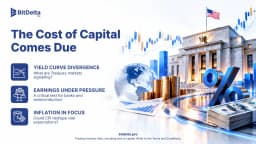
The cost of capital is becoming a defining force in global markets. But are investors pricing in the full impact? With the Fed's policy outlook under scrutiny, major bank and semiconductor earnings approaching, and key inflation data on the horizon, markets face a critical week. In this week's BitDelta Pro Weekly Outlook, we explore the signals shaping market expectations and the factors that could challenge the prevailing narrative.
September's US inflation report could be a defining moment for the Federal Reserve's next interest rate decision. With headline inflation expected to accelerate while core inflation remains steady, the growing divergence raises an important question: Is inflation pressure becoming more widespread, or is energy driving the narrative? Ahead of the October 14 CPI release, BitDelta Pro Research examines the forces shaping inflation expectations, the signals policymakers may prioritise, and what the data could mean for the Fed's next move.
BingX has launched US stock trading through an integration with Alpaca, giving eligible users access to more than 7,000 US stocks and ETFs. Trades can be funded with USDT and USDC, start from $5 and run 24 hours a day, five days a week. A $200,000 Stocks Mystery Box promotion runs from 9 to 23 October 2026.
Bybit has opened stocks trading to eligible users, offering access to more than 1,000 U.S.-listed stocks and ETFs funded in USDC. Orders are executed through Alpaca, with 24/5 trading, fractional shares and zero commission on eligible trades, plus support for dividends and stock splits. Users must complete KYC checks.
AUDCAD price forecast tracks a bullish retest of 0.99265–0.99450 toward 0.99940, with a weekly support breakdown putting 0.98740 in focus.
Visa has received approval of its Application to Prepare from the People's Bank of China, allowing it to begin formal preparations to establish a domestic bankcard clearing institution in China. The company will now work to complete the process under PBOC regulations before starting domestic clearing operations in the country.
Plus500 has conditionally agreed to acquire Hedge Capital Markets, an SEC-registered US broker-dealer, marking its entry into US securities. The cash-funded deal supports a planned US super-app in Q1 2027 combining futures, prediction markets, stocks, options and ETFs, plus a new hub in New York.
MAS Markets has appointed Simon Naish as Head of APAC to lead its plans across the Asia-Pacific region. Naish brings over 30 years of experience in institutional banking and FX, most recently as Country Head at ATFX Global and previously 33 years at National Australia Bank (NAB) across Asia-Pacific and global markets.
BTCUSD rejects $78,400–$82,175 support. Watch bullish follow-through toward $86,550 and a daily close below $80,268.75 for weakness.