just now


Liquidity Finder Ltd is incorporated in England and Wales, company number 10610740, registered address 167-169 Great Portland Street, Fifth Floor, London W1W 5PF, United Kingdom.
Published: just now

Last week was a stress test for the AI infrastructure trade. CoreWeave dropped 25% in five sessions, its CDS spreads blew past 1,000 basis points, and the contagion pulled the entire neocloud complex down with it. Oracle fell 10%. IREN and Nebius each lost more than 10%. The SOX index shed 11.4%, its worst week since the summer. The Nasdaq closed at 26,140, down 4.5%, while the Dow quietly gained 0.7%. The divergence is instructive: this was not a broad risk-off event. It was a targeted repricing of the most leveraged participants in the AI capex buildout, catalyzed by a Gartner report warning that $3.5 trillion of AI infrastructure spending could face impairment by 2030.
The question heading into this week is whether the selloff was a signal or a tantrum. CoreWeave's $50 billion debt stack and $626 million net loss are real vulnerabilities, but the market traded them as though the entire AI demand story was in question. It was not. The hyperscalers, the ones actually writing the checks for GPU compute, report this week. Meta's capex guidance is north of $125 billion for 2026. Defense primes report Tuesday into a spending environment where government commitment is a provable input, not a talking point. This is the week where earnings either confirm that the selloff was a financing scare concentrated in overleveraged neoclouds or reveal something deeper. The data starts Tuesday.
The Yield Environment
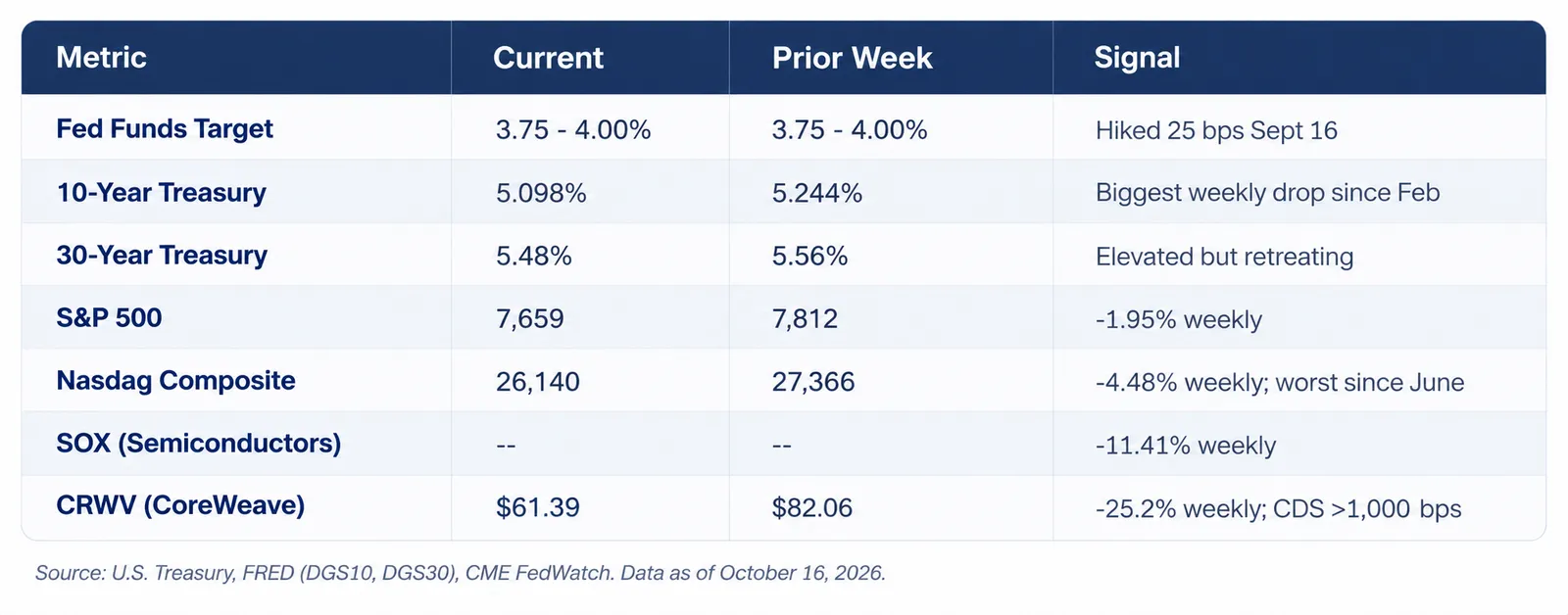
The 10-year Treasury fell to 5.098% on Friday, its biggest weekly decline since February. After touching 5.36% midweek on the back of hot CPI data, yields reversed sharply as the CoreWeave-driven risk aversion pushed capital into duration. The 30-year settled at 5.48%, still elevated but off its highs. The Fed hiked 25 basis points in September, bringing the target range to 3.75% to 4.00%, and the market is split on whether December brings another move.
The yield decline this week does not signal a dovish pivot. It signals that the market found the ceiling, at least temporarily. Institutions bought duration because the selloff in risk assets created a flight-to-quality bid, not because the inflation backdrop has improved. The CPI print came in hot. Challenger layoffs hit 153,000, the highest since 2003, which muddies the labor picture. The rate environment remains a headwind for every levered business reporting this week, but the direction of travel matters: a 10-year that is falling into earnings season is a less hostile backdrop than one that is rising.
CoreWeave: A Stress Test, Not a Crisis
CoreWeave's 25% weekly decline was the most violent repricing in the AI infrastructure sector since the buildout began. The stock hit $60.36 intraday on Wednesday, its lowest level since the March 2025 IPO range. CDS spreads above 1,000 basis points and bonds yielding north of 15% created the optics of a company approaching distress. Options volume exceeded seven times the 30-day average, with puts outnumbering calls nearly two to one. Chamath Palihapitiya flagged the bond yields publicly. Elon Musk responded with "yikes." The narrative spiral was in full motion.
But the underlying financials tell a more nuanced story. CoreWeave posted Q2 revenue of $2.575 billion, up 112% year over year. Adjusted EBITDA was $1.51 billion. The backlog stands at roughly $104 billion at quarter-end, with an additional $25 billion in commitments signed early in Q3. The problem is not demand. The problem is that CoreWeave is financing a $35 billion debt stack (over $50 billion including lease liabilities) against $679 million of operating cash flow and a $626 million net loss. Revenue is doubling. Cash flow is not covering interest expense. This is the structural fragility we have discussed at length: neoclouds without diversified revenue streams and fortress balance sheets are exposed to exactly this kind of repricing when sentiment shifts.
The contagion pattern is telling. Oracle's 10% decline, IREN's double-digit drop, and Nebius trading in lockstep with CoreWeave all week suggest the market was repricing the entire neocloud category, not just one company. Even TSMC fell 9% despite posting record Q3 revenue of $46.72 billion. Micron dropped 14.6%. The SOX index lost 11.4%. Jensen Huang stepped in Thursday to defend CoreWeave publicly, saying they did not need an Nvidia backstop. The intervention stabilized the stock briefly, with CRWV bouncing 5.9% on Thursday, before falling 11.9% again on Friday. The market heard the reassurance and did not buy it.
The critical distinction: CoreWeave's capital structure problems are real, but they are specific to CoreWeave and the handful of neoclouds that financed GPU buildouts with aggressive leverage. The hyperscalers, which generate the actual demand for AI compute, are financing their capex from operating cash flow and investment-grade balance sheets. Confusing CoreWeave's cost of capital problem with an AI demand problem is the analytical error the market made last week. Earnings this week will clarify which interpretation is correct.
Tuesday: Defense Earnings as Government Commitment Signal
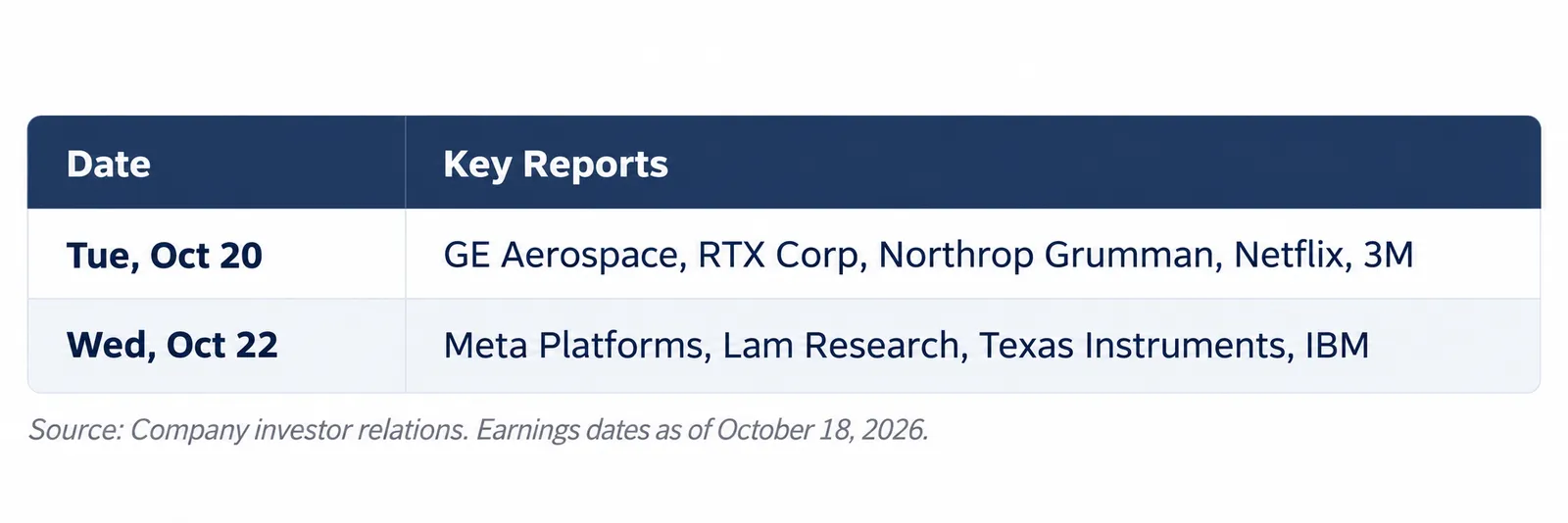
GE Aerospace, RTX Corp, and Northrop Grumman report Tuesday morning. The defense sector operates on a fundamentally different earnings dynamic than the rest of the market: revenue visibility is measured in years, not quarters, and demand is a function of government appropriations that are largely decoupled from the business cycle. In a week dominated by questions about AI demand sustainability, defense earnings serve as a different kind of signal: whether the government spending commitments that have driven the sector's rerating are flowing through to actual revenue and margins.
GE Aerospace is the cleanest read on commercial aviation and defense services demand. The aftermarket business, which drives the bulk of margins, is a direct function of flight hours and fleet utilization. A beat here confirms that the aerospace recovery cycle has further to run. RTX brings the defense backlog story. The company's Pratt & Whitney segment has been managing the geared turbofan engine recall, and the guidance trajectory is the signal. Northrop Grumman is the purest defense play, with B-21 Raider production and missile defense programs providing multi-decade revenue visibility.
If all three report beats and raise guidance, it confirms that government spending momentum is translating into earnings power. In the context of a week where markets are questioning the durability of large-scale capital commitments in AI, a clean sweep from defense would demonstrate that not all capex-heavy stories carry the same balance sheet risk. These companies finance their buildouts from contracted government revenue, not speculative debt stacks. The comparison to CoreWeave's model is not subtle.
3M: The Industrial Bellwether
3M also reports Tuesday. The spinoff of the healthcare segment has simplified the story, and 3M is now a more readable industrial bellwether. Pricing power and volume trends in the industrial segment will provide an early signal on manufacturing activity heading into Q4. In a week heavy on tech and defense, 3M is the reminder that the rest of the economy still exists.
Netflix: Execution Over Narrative
Netflix reports Q3 on Tuesday after the close. Consensus expects $12.9 billion in revenue, up roughly 12% year over year, with more than 325 million paid members. Management has guided to fiscal 2026 revenue of approximately $51 billion, about 14% growth, with a 31.5% operating margin. Ad revenue is expected to roughly double to about $3 billion. Content spend is guided at $20 billion, up 10%. These are the numbers of a company operating at genuine scale, not a growth story running on aspiration.
The stock built momentum after Q2 earnings, driven in part by the decision to walk away from the Warner Bros. Discovery content deal. That was a disciplinary signal: management chose organic execution over a dilutive acquisition that would have complicated the content strategy. The market rewarded the discipline. The subsequent pullback has been driven by fears around competitive pressure from Reels and TikTok, which are eating into attention share particularly among younger demographics. The concern is valid structurally but overstated as a near-term earnings risk. Netflix's engagement metrics remain robust, and the platform is expanding into live events, podcasts, cloud gaming, and vertical video formats that directly address the short-form competition.
Netflix is interesting this week precisely because it has nothing to do with AI capex. It is a pure execution story. Revenue growth is double-digit. Margins are expanding. The content flywheel is self-funding. In a week where the market is consumed with questions about the sustainability of AI infrastructure spending, Netflix is the reminder that some businesses generate returns by doing the work, not by promising that the work will eventually pay off. A clean beat confirms the premium. A miss reopens the mindshare debate.
Wednesday: AI Capex at the Source
Wednesday is the day that matters most for the AI narrative. Meta, Lam Research, Texas Instruments, and IBM all report, and together they cover both sides of the equation: the demand for AI compute and the supply chain that enables it.
Meta: The Hyperscaler Readthrough
Meta's Q3 report is the most consequential earnings event of the week for anyone trying to assess whether the CoreWeave selloff was a financing scare or a demand signal. Meta has guided capex in the range of $125 billion to $145 billion for 2026, a number that has been revised upward repeatedly. The question is not whether Meta is spending. The question is whether the spending is generating returns that justify the magnitude, and whether the forward guidance signals acceleration, stabilization, or the first signs of discipline.
Meta is a Magnificent Seven constituent and the largest social media company on the planet. Its AI spending is not speculative in the way CoreWeave's is. Meta is deploying models across its own advertising stack, its recommendation engine, and its content generation pipeline. The returns are visible in ad revenue per user metrics. But the sheer scale of the capex, combined with the CoreWeave-driven anxiety about AI infrastructure overbuilding, means the market will scrutinize this report with unusual intensity. If Meta raises capex guidance again and delivers strong ad revenue growth, the CoreWeave contagion thesis collapses. If it moderates spending or the ad revenue uplift from AI disappoints, the contagion thesis gains credibility.
Semicap: Lam Research, Texas Instruments, IBM
Lam Research is the semicap bellwether. The company's etch and deposition equipment is foundational to advanced chip manufacturing, and its order book is a leading indicator for the capex cycle. After the SOX index shed 11.4% last week, Lam's guidance will be closely watched for any signs that semiconductor capital spending is rolling over. The stock is priced for continued AI-driven demand, and a soft order intake would compound the damage from last week's selloff.
Texas Instruments provides the analog and embedded processing read. The analog business is more cyclical and more exposed to industrial and automotive end markets, which makes TI a useful cross-check on whether the weakness is AI-specific or broad-based. IBM rounds out Wednesday with its hybrid cloud and consulting businesses, which offer a different vantage point on enterprise IT spending.
Collectively, Wednesday's reports will answer the question the market has been circling all week: is the AI capex cycle intact, and who is actually paying for it? The distinction between hyperscaler-funded demand (Meta, Microsoft, Google, Amazon) and debt-funded neocloud demand (CoreWeave, Nebius) is the fault line. If the hyperscaler checks are still clearing and the semicap order books are holding, last week's selloff was a leverage shakeout, not a demand inflection.
Earnings Calendar
No major macro data releases this week. Post-CPI, the data calendar is light, which means earnings are the sole source of price discovery. The market absorbed the inflation print, the CoreWeave selloff, and the yield spike all in one week. Now it needs earnings to confirm or deny the damage.
What We Are Watching
Defense beats and guidance. If GE Aerospace, RTX, and Northrop Grumman all report clean numbers and raise forward guidance, it confirms that government-funded capex stories are fundamentally different from debt-funded ones. The comparison to CoreWeave writes itself.
Netflix subscriber trajectory and ad revenue. Revenue growth above 12% and any upside on the ad-supported tier would reinforce the execution premium. The WBD deal walkaway set the tone. The numbers need to validate it.
Meta capex guidance. This is the single most important data point of the week for the AI trade. If Meta raises its $125 billion to $145 billion capex range again while delivering strong ad revenue, the CoreWeave contagion thesis is dead. A moderation in guidance extends the anxiety.
Lam Research order intake. The SOX index lost 11.4% last week. Lam's forward orders are the leading indicator for whether the semicap selloff was overdone or a preview of something worse. The backlog tells the story.
CoreWeave CDS spreads. Even though CRWV does not report this week, its credit spreads are a real-time barometer of the market's confidence in the neocloud financing model. If spreads compress below 800 basis points while hyperscaler earnings hold, the stress test is over. If they remain above 1,000, the anxiety persists regardless of what Meta reports.
The CoreWeave selloff was a necessary repricing of the weakest link in the AI infrastructure chain. It was not a verdict on AI demand. The companies that are actually writing the checks for compute, the hyperscalers, report this week alongside defense primes that demonstrate what capex looks like when it is backed by contracted revenue rather than speculative leverage. The market conflated a balance sheet problem with a demand problem last week. Earnings will sort the signal from the noise. Defense on Tuesday. Netflix as the execution control case. Meta and semicap on Wednesday. The reality check starts now.
Research | BitDelta Pro
Disclaimer
This document is for informational and educational purposes only and does not constitute investment advice, a solicitation, or a recommendation to buy or sell any security or financial instrument. All data sourced from public filings, government releases, and third-party providers as cited. Forward-looking statements reflect the author's analysis as of the publication date and are subject to revision. Past performance is not indicative of future results.
BitDelta Securities Financial Services LLC, regulated by the Capital Market Authority under Category 5 (Introduction Only), acts solely as an introducer and does not provide trading, execution, dealing, advisory, portfolio management, or custody services. All trading, execution, and investment-related services are provided by BitDelta Limited, Mauritius, a licensed Investment Dealer excluding underwriting.
All trading and investments involve risk. The value of investments may fluctuate, and you may receive less than your initial investment.
Readers should seek independent professional advice and conduct their own due diligence before making any decisions. Neither the publisher nor the contributors accept liability for any loss arising from reliance on this content.
Appendix: Sources
Rates & Monetary Policy
FRED: 10-Year Treasury Constant Maturity Rate (DGS10)
FRED: 30-Year Treasury Constant Maturity Rate (DGS30)
CME FedWatch: Federal Funds Rate Probabilities
Federal Reserve: FOMC Statement, September 16, 2026
CoreWeave & AI Infrastructure
ROIC.ai: CoreWeave Shares Plunge to Lowest Since May 2025 (Oct 15, 2026)
TradingNews: CoreWeave Sinks as CDS Spreads Top 1,000bp
Gartner: AI Infrastructure Impairment Risk Forecast
CoreWeave Q2 2026 Earnings Release
Equities & Earnings
Portfolio Terminal: Stock Market Close October 16, 2026
Netflix Q3 2026 Earnings Preview (Hudson Labs)
Meta Platforms: AI Capex Guidance (Yahoo Finance)
GE Aerospace: Investor Relations
RTX Corporation: Investor Relations
Northrop Grumman: Investor Relations
Lam Research: Investor Relations
Labor Market
BLS: Employment Situation Summary
Challenger, Gray & Christmas: Layoff Announcements
Inflation
Institutional multi-asset market access across MT5 Ultency, CQG, Iress Pro and BitDelta Terminal, with transparent execution standards and global market coverage.

Select the categories and companies you wish to follow directly to your person rss feed.
Create Custom RSS Feed
just now
Sign up and join over 5,000 professional members who receive personalized news alerts, curated professional connections, and more for free!
US stock futures edged higher this morning after Wall Street rebounded on Monday, with the S&P 500 rising 0.4% and the Nasdaq Composite gaining over 1%, led by technology stocks such as Nvidia, Tesla, and Alphabet.
Gold is trading at $4,128. Following its recent high of $4,198, the precious metal has entered a clear downward move, with successive lower highs and lower lows.
Was the recent AI infrastructure sell-off a warning sign, or a market overreaction? As earnings season takes centre stage, investors are looking beyond market volatility to assess the strength of corporate spending, financial resilience and future growth. With major technology, semiconductor and defence companies set to report, this week's results could offer important clues about where market confidence stands. In this Weekly Outlook, we examine the key developments and earnings signals that could shape market sentiment. Read the full article for our latest analysis. BitDelta Securities Financial Services LLC, regulated by the Capital Market Authority under Category 5 (Introduction Only), acts solely as an introducer and does not provide trading, execution, dealing, advisory, portfolio management, or custody services. All trading, execution, and investment-related services are provided by BitDelta Limited, Mauritius, a licensed Investment Dealer. All trading and investments involve risk. The value of investments may fluctuate, and you may receive less than your initial investment.
Nasdaq 100 turns bearish after breaking weekly support. Watch 29,800–30,400 resistance for a potential rejection toward the 29,000 target.
Tradeweb Markets Inc. has agreed to acquire electronic credit trading platform Trumid Holdings, LLC for about $1.97 billion, combining credit protocols and extending its reach into new issue and grey market trading. The deal is targeted to close in the first half of 2027, subject to regulatory approvals.
The Cboe has launched pre-market and post-market trading sessions for select single stock and exchange-traded fund (ETF) options on its Cboe Options Exchange (C1). Trading began today with options on 24 single stocks and 5 ETFs.
GTCFX has appointed Charbel Raffoul as Chief Executive Officer. He joins from Equiti, where he was Chief Compliance Officer and Financial Crime, and has held roles at ADS Securities, Alpari ME and Swissquote. He will guide the firm’s strategic direction, governance and international business development.
Revolut has secured regulatory permission covering crypto trading, custody and staking for its Gibraltar subsidiary, adding to its expanding international digital assets business.
Financial markets infrastructure provider Beeks Financial Cloud Group has taken a strategic minority stake in AI trading technology business OmniPhi, with plans to offer its technology through Beeks’ infrastructure.
Gold is trading at $4,170. Following a recovery from the recent low of $4,073, the precious metal advanced toward $4,198.