
just now


Liquidity Finder Ltd is incorporated in England and Wales, company number 10610740, registered address 167-169 Great Portland Street, Fifth Floor, London W1W 5PF, United Kingdom.
Published: just now
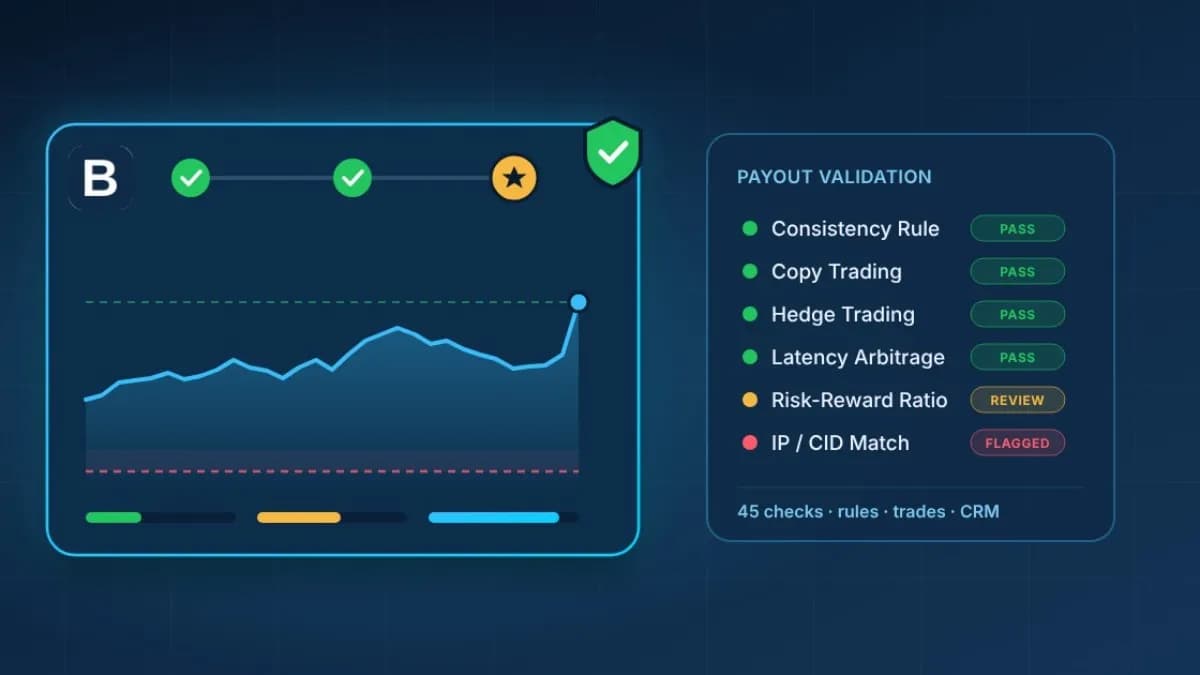
A prop firm challenge is two things at once: a product you sell to traders, and the first risk control protecting your funded capital. Every rule in your rulebook decides which trading behaviour makes it through to a payout - and every gap in the wording will eventually be found by a trader, usually before it is found by you.
We look at challenges from the dealing room: the place where rules meet live trade data, where breaches are investigated and where payout requests are approved or rejected. This guide shares what we have learned about setting challenge rules that hold up, monitoring them in real time, and validating payouts properly.
A well-run prop firm protects itself in three layers, and each one depends on the one before it:
Many firms invest heavily in the last two layers and treat the rulebook as marketing copy. That is the wrong way round. A vague rule cannot be monitored automatically, and it cannot be defended when a trader disputes a rejected payout.
Before a rule goes into your rulebook, ask one question: could a reviewer decide, using trade data alone, whether this rule was broken? If the answer depends on interpretation, traders will interpret it - in their favour. Rules that work in practice share five qualities:
Write rules for the behaviour you can measure, and make sure you can measure everything you prohibit. Copying another firm's rulebook without checking that your monitoring can detect each violation is one of the most common - and expensive - mistakes we see.
To make this concrete, here is the kind of rule set a modern two-step challenge might apply to a USD 100K funded account. The values are a realistic example taken from the market, not a recommendation - your own settings should reflect your pricing, your traders and your risk appetite.
| Rule / Example setting / Why it matters | ||
| Daily loss limit | 5%, open trades included | Caps the damage from a single bad day |
| Maximum loss | 10% static (USD 90K floor) | Simple, objective and easy to defend |
| Maximum risk per asset | 5% | Stops all-in bets on a single instrument |
| Stop-loss placement | Within 5 minutes of entry | Forces defined risk on every trade |
| Minimum trade duration | 2 minutes | Filters out latency and tick-scalping strategies |
| News trading | Directional trades allowed, within defined rules | Allows genuine trading, blocks straddles around releases |
| Weekend holding | Allowed as a paid add-on | Gap risk is priced, not ignored |
| EAs and copying | Manual trading only; no automatic copying | Stops copy rings and purchased strategies |
| Leverage | 1:100 | Limits position size relative to the account |
| Prohibited practices | Martingale, grid, hedging across accounts, HFT, latency arbitrage, exploiting errors, reckless one-sided exposure | Removes strategies that exploit the model rather than the market |
| Negative risk-reward | Breach if 60% or more of trades risk more than they make | Catches "risk big, win small" gambling |
| Account rules | No sharing or reselling, no moving risk between accounts, no churning, capped total capital per trader | Closes multi-account loopholes |
| Inactivity | 30 calendar days | Keeps dormant accounts from sitting on allocated capital |
| Qualifying profit days | 4 days | Prevents one lucky day from producing a payout |
| Payout timing | First and later payouts every 14 days | Gives time for review and limits hit-and-run withdrawals |
| Profit split | 80% to the trader, with a minimum payout amount | Commercial term - but must be stated precisely |
Notice that every line can be checked against trade data. That is the standard every rule should meet.
A static maximum loss measured from the initial balance is the easiest to enforce and explain. Trailing drawdown can be commercially attractive, but you must state exactly what it trails - closed balance, peak equity or end-of-day equity - because each version produces different behaviour and a different number of disputes.
For daily loss limits, define "the day": server midnight, a fixed UTC time or a rolling 24 hours. Then answer the edge cases in the rule text: are floating losses included, are commissions and swaps counted, and how is a position that spans the reset treated?
Consistency rules stop traders from passing on one outsized day. They only work if the calculation is published exactly - for example, "the highest profit day must be below X% of total profit in the payout period, measured in server time, including commissions and swaps". A rule that simply says the firm "may review for consistency" will lose every dispute.
"No trading around major news" is unenforceable. "No opening or closing positions within two minutes before or after listed high-impact releases on the affected instruments" is enforceable - as long as you publish the calendar source and the instruments. The same applies to EAs and latency: banning every EA is hard to police, but banning specific, observable behaviour - such as sub-minute holds clustered around price updates - is both fair and defensible.
The most costly prop firm abuse rarely happens on a single account. Copy-trading rings, hedging between accounts and groups buying many challenges to play the odds are attacks across a network of accounts, so the rules must work at that level too:
If rules are only checked when a trader asks to be paid, abusers learn that the evaluation stage is free. Continuous monitoring changes the economics: breaches are caught during the challenge, organised groups move on to softer targets, and payout reviews become shorter because most issues have already been dealt with.
On MT4 and MT5, the data is rich - deal times to the second, IP and device information, group settings and full tick history. But cross-account patterns such as copy rings and linked hedging cannot be seen in any single back office. They require trade data from all accounts to be brought together and analysed in real time, which is exactly what the Broktinger Risk Monitor does.
The payout review is where everything comes together. As part of our PROP trading management service, every payout request is validated against 45 checks, drawing on trade history, login journals, tick data, the economic calendar and the firm's CRM. The checks fall into seven groups:
| Check group / What is validated | |
| Account linking | IP Match (including impossible-travel logins), CID / device match, Email Match, Related Abuse, Cross-Account Check for the same user, Total Capital of the User |
| Coordinated trading | Copy Trading, Cluster Trading, Hedge Trading (self and cross-account), Bracketing & Layering |
| Execution edge | Latency Arbitrage, Decay, Entry Edge, HFT, Scalping (including scalping between the same user's accounts) |
| Risk discipline | Risking Over %, Using Stop Loss, Risk-Reward Ratio, Increase of Risk After Loss, Adding in Drawdown, One-Side Bets, Abnormal Profits |
| Timing and holding | News & Market Open/Close (and rollover), Weekend Holding, Overnight Holding, Open Positions at Request |
| Activity and consistency | Minimum Trading Days, Excessive Trading Then Slow Down, Inactivity Period, Consistency Rule, Expert Advisor Trading |
| Payout history and CRM | Previous Payouts, First Payout After, Next Payout After, Blacklisted Before, Account Churning |
Each check is configurable to your own rulebook, and the outcome distinguishes between a warning, a profit deduction, a delayed payout and a full breach - so the decision reflects exactly what your rules say.
Every rejected payout is a potential dispute, and the firms that resolve them quickly are the ones that can produce four things immediately: the rule, the version the trader accepted, the acceptance record and the trade evidence. A few practices make this much easier:
Broktinger helps prop firms at every stage: designing and reviewing challenge rules so they can actually be enforced, configuring them on your MT4 or MT5 servers, monitoring accounts in real time with the Risk Monitor, and validating every payout against our 45-check framework.
The work is done by senior dealers and risk managers with years of experience at regulated CFD brokers and reputable prop firms - people who know what abuse looks like in real trade data. And, as always, we work with your existing platform, CRM and infrastructure rather than asking you to replace them.
For a deeper look at the abuse patterns that reach both brokers and prop firms, see our guide to toxic flow and how to detect it.
Industry leaders in outsourced dealing desk, risk management and platform development for FX and CFD brokers. Building MT4/MT5 tools, reporting solutions and API integration, plugins.

Select the categories and companies you wish to follow directly to your person rss feed.
Create Custom RSS FeedPut your profile to work. Our Match Matrix pairs you with the liquidity providers, brokers, and technology partners that fit your exact requirements, in minutes rather than weeks.
MultiBank Group has announced the formation of a predominantly Emirati Board of Directors for MultiBank Exchange Holding, the first interbank trading platform in the BRICS and emerging countries, which achieved in October 2026 a turnover of over US$ 0.5 Trillion.
Monday saw a sharp rebound in Wall Street, with the Dow Jones rising 2.2%, the S&P 500 2.4%, and the Nasdaq 2.7%.
The Central Bank of Nigeria (CBN) has issued regulations that require issuers of foreign currency stablecoins used by Nigerians to incorporate locally.
Last week delivered the worst day for US technology stocks in six years. On Thursday, November 5, the Philadelphia Semiconductor Index fell 12%, its steepest daily drop since 2020, the Nasdaq Composite fell 5.5% into correction territory and the S&P 500 fell 4.3%. Micron and AMD each lost more than 17% in a single session. Then on Friday, the same stocks bounced, after a jobs report that came in at more than double expectations.
Toxic flow doesn’t only hit B-book brokers. In an STP model it shows up as wider spreads, more rejections and strained LP relationships. This guide explains what toxic flow really is, what it costs, the 35 patterns professional dealing desks monitor, and the practical steps to detect it and protect your brokerage.
The Monetary Authority of Singapore has launched a central bank gold vaulting service for foreign central banks, international financial institutions and sovereign entities, using a national vault that can hold up to 500 tonnes, and announced an enhanced GST framework for wholesale gold activities from April 2027.
24X Bermuda Limited has expanded its partnership with Standard Chartered to include digital assets prime brokerage, enabling Bitcoin and Ethereum trading on its multi-asset platform. Standard Chartered acts as central counterparty, with 24X running the execution-only platform for institutional crypto and FX products.
Learn how a demo trading account works, why beginners use it before live trading, and how to practice with virtual funds using a simple five-step guide.
Bitcoin faces resistance at $76,800–$80,800. Explore the BTCUSD bearish setup toward $71,000 and the bullish break-and-retest scenario targeting $86,500.
Raj Sitlani, Jonathan Brewer and Jeff Wilkins have launched JT Prime, a new institutional Prime of Prime business offering aggregated Tier 1 multi-asset liquidity to brokers, funds, family offices and proprietary trading firms, with a regulatory application pending and digital assets planned beyond FX and commodities.