just now


Liquidity Finder Ltd is incorporated in England and Wales, company number 10610740, registered address 167-169 Great Portland Street, Fifth Floor, London W1W 5PF, United Kingdom.
Published: just now
"Should we A-book, B-book or go hybrid?"
Our dealing team hears this question almost every day, from brokers preparing to launch and from brokers who have been running for years. Most of them expect a one-word answer. There isn't one, because the right model depends far less on the theory than on the broker asking.
This article doesn't explain how each model works. If you need a refresher on execution models, routing and the basic pros and cons, start with our guide A-Book vs B-Book: What Every Forex Broker Needs to Know. Here we focus on a different question: why different models suit different brokerage firms, and why a broker can lose money under any of them.
A-book is often described as the safe option and B-book as the profitable one. In practice, neither label holds up. A badly run A-book can lose money every day without anyone noticing, and a badly run B-book can wipe out months of profit in a single week. What decides the outcome is not the label on the book, but how well the model is configured, monitored and managed.
In our experience, new brokers tend to fall into one of two camps.
Starting with full A-book: "Let's play it safe"
The logic is understandable. Pass all the flow to the liquidity provider, earn the markup, and never worry about a client's winning streak. Over time, these brokers usually start identifying lower-risk clients and internalising their flow to improve margins.
The problem is that full A-book is neither cheap nor automatically safe.
It's expensive because you pay to hedge flow that, in many cases, was never a real threat to the business. Every lot routed out carries LP costs, and the markup you keep has to cover all of them.
It's not risk-free either. If spreads, commissions, swaps or execution settings are misconfigured, a "safe" A-book can quietly lose money every day. Nobody notices until the monthly numbers don't add up.
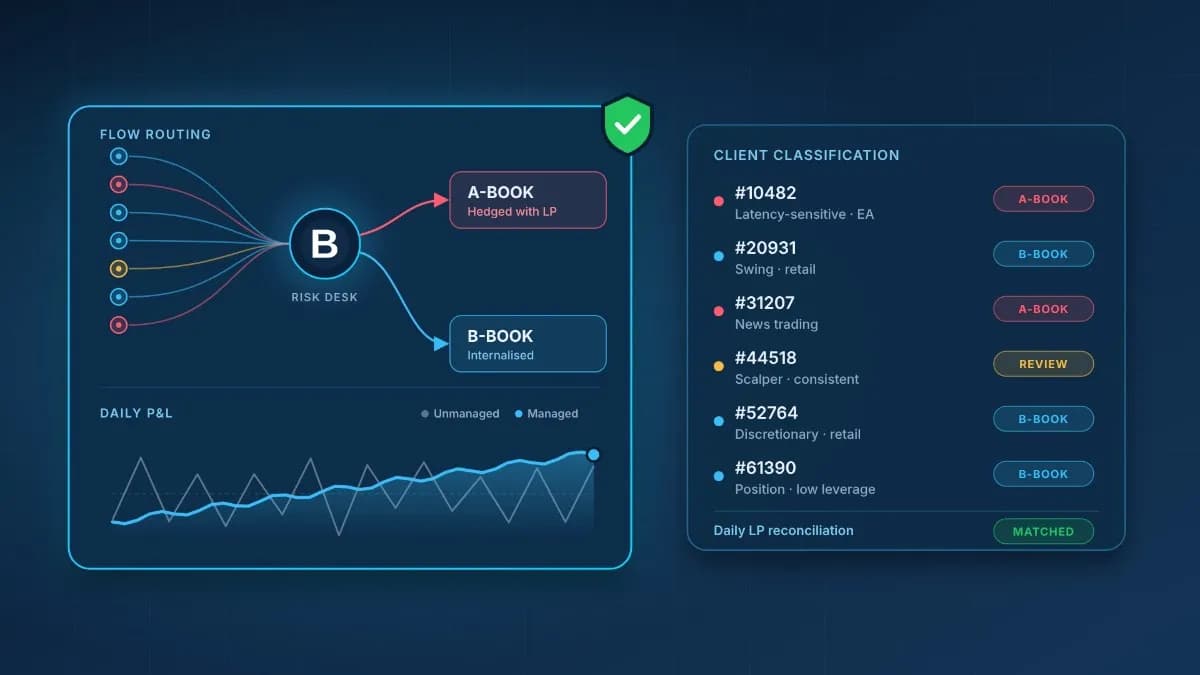
The only way to catch this is to reconcile what you actually earn from clients against what you actually pay the LP. On paper that looks like a simple calculation. In practice it's a detailed daily analysis covering:
It is one of the most important analyses a brokerage runs, and not only new brokers struggle to get it right. Many established ones do too. We cover the reporting side in more detail in Why FX Brokers Struggle with Accurate Reporting.
Starting with full B-book: "Most traders lose anyway"
The other camp starts from the commonly quoted figure that the vast majority of retail traders lose money, often put at 90% or more. Keep the flow in-house and the house wins. Over time, these brokers start identifying toxic and consistently profitable accounts and routing them out to limit their exposure.
The flaw is in the arithmetic. The remaining 10% doesn't behave like the other 90%. A handful of informed traders, latency-driven strategies, linked accounts or promotion abusers can generate losses that outgrow the profit from losing clients several times over. A B-book without proper oversight isn't a business model. It's a bet the broker doesn't fully understand. Our article on toxic flow explains what that flow looks like and what it costs.
There is no universal answer, but the starting point usually depends on where the business is today and who is running the book.
| Your situation | Where to start, and what to watch |
| Newly launched, no in-house risk team | Full A-book is the usual starting point, but only with correctly configured spreads, commissions and swaps, and a daily reconciliation against the LP. |
| Launching with an experienced dealing partner | Internalising part of the flow becomes realistic sooner, with exposure limits and client monitoring in place from day one. |
| Established, mostly A-book | Use your trading history to find lower-risk flow you are paying to hedge, and check that the markup actually covers your LP costs. |
| Established, mostly B-book | Identify and route out toxic and consistently profitable accounts before they outweigh the profit from the rest of the book. |
| Mature, with history and specialists | Hybrid, with routing decisions reviewed continuously rather than set once and forgotten. |
Hybrid is where most mature brokers end up, but very few start there, for two simple reasons.
Hybrid isn't a setting you switch on. It's a capability you build.
This is the second question we hear most, and again, the honest answer isn't simple.
Yes, it can be profitable. But only when client classification is done by risk specialists with hands-on dealing experience and a real understanding of markets and trading styles. It depends on many factors working together:
A useful book analysis takes all of this into account, and more, so that decisions are based on the full picture rather than a single metric or a monthly P&L snapshot. And it never stops. Clients change, markets change, and a classification that was right last month can be wrong today.
There's a lot of talk in our industry about getting more out of the B-book. We don't think risk management should be framed that way.
For us, the job is to protect the broker's performance:
Just as important is giving the broker a clear view of their own numbers. When a broker understands exactly where every part of their P&L comes from (client flow, LP costs, swaps, commissions), decisions get easier, confidence grows, and so does the business. That is the thinking behind our Broktinger Risk Monitor, which brings quotes, exposure, revenue and client behaviour into one view.
A-book, B-book or hybrid: a broker can bleed money under any of them. The model matters less than how well it's run.
Often, the most valuable decision a broker makes isn't which model to choose. It's who runs it. The right risk specialist can save a brokerage tens of thousands a day, and sometimes the business itself. Unfortunately, most brokers find that out the hard way.
Our senior dealers and risk managers analyse books like these every day, with the configuration checks, reconciliation and client classification each model needs to work properly. If you're weighing up your model, or you're not sure your current one is working as it should, see how our outsourced dealing desk and risk management services work, or talk to our desk.
Is A-book the safest model for a new broker?
It is the most common starting point, but it is not automatically safe. Misconfigured spreads, commissions, swaps or execution settings can make an A-book lose money every day, which is why it needs a daily reconciliation between client revenue and LP costs.
Is B-book profitable if most retail traders lose?
It can be, but the small share of profitable, informed or abusive accounts can generate losses that outweigh the rest of the book several times over. Profitability depends on accurate, continuous client classification by experienced risk specialists.
When should a broker move to a hybrid model?
When there is enough trading history to classify clients reliably, and specialists in place to make routing decisions every day. Without both, hybrid is a label rather than a working model.
Can a broker lose money under any model?
Yes. A-book, B-book and hybrid can all lose money if they are poorly configured or poorly managed. The model matters less than how well it is run and who runs it.
Industry leaders in outsourced dealing desk, risk management and platform development for FX and CFD brokers. Building MT4/MT5 tools, reporting solutions and API integration, plugins.
Select the categories and companies you wish to follow directly to your person rss feed.
Create Custom RSS FeedSign up and join over 5,000 professional members who receive personalized news alerts, curated professional connections, and more for free!
A-book, B-book or hybrid? The right model depends on the broker. Why full A-book is neither cheap nor automatically safe, why full B-book can be a losing bet, why almost nobody starts hybrid, and why a broker can lose money under any model.
The sponsorship reflected STARTRADER’s commitment to supporting platforms that connect investors, institutions and the wider financial community across the region.
A money manager using trademakers can run a strategy for multiple investors through one trading account at SGT Markets.
Gold rises back to a price where sellers stopped it last time. Traders call that area resistance. You’re watching to see whether sellers' step in there again.
CMC Markets has reported record first-half results for FY2027, with net operating income up 54% to £286.6 million and profit before tax up 115% to £106.0 million. The broker declared a record interim dividend of 10.1 pence and said it has been registered by the FCA as a cryptoasset business under UK money laundering rules.
Switzerland's first spot Bitcoin ETF, the Bitcoin Fund ETF (BBIT), has listed on SIX Swiss Exchange, issued by Pernet von Ballmoos with BIT Asset Management as sponsor and asset manager. The fund tracks the SIX Reference Rate Bitcoin Index, with coins held offline at a Swiss bank under CISA investor protection rules.
Equiti Group has been named Official Fintech Partner of the 2026 Emirates Dubai 7s, with pitchside branding, a co-branded pop-up court with Dubai Basketball and Yalla Club fan activations in the Festival Village. The festival runs at The Sevens Stadium from 27 to 29 November and opens the HSBC SVNS season.
GCEX has launched Real World Asset perpetuals for eligible professional and institutional clients, starting with contracts referencing Amazon, Nvidia, Tesla and SpaceX. The cash-settled CFDs have no expiry, carry no shareholder rights, and are offered through FCA-regulated GC Exchange Limited in London.
Italy’s regulator has ordered blocks against three investment-service websites and eight crypto-service websites, bringing its total since July 2019 to 1,894.
RepoAgent connects Tradeweb execution to automated post-trade processing and settlement instructions, initially covering euro-denominated repo at Euroclear and Clearstream ICSDs.