
just now


Liquidity Finder Ltd is incorporated in England and Wales, company number 10610740, registered address 167-169 Great Portland Street, Fifth Floor, London W1W 5PF, United Kingdom.
Published: just now

Few things feel worse in trading than being stopped out at the high or low of the day - only to watch price move exactly where you expected. That moment of frustration isn’t just bad luck. It’s a carefully engineered stop hunt, designed to exploit the predictable psychology of retail traders.
Stop hunts are more than technical tricks. They’re designed to exploit the predictable psychology of retail traders - fear, impatience, and the need to be right. To win against them, you don’t just need charts and tools; you need to rewire your mindset.
Traders are creatures of habit. We like clear rules and obvious levels. That’s why stops often pile up in the same places:
This creates a herd effect - liquidity clusters in predictable zones. Institutions see this, and like hunters tracking footprints in fresh snow, they know exactly where the herd has passed. The stop hunt is simply the ambush.
Markets know traders crave breakouts. The moment price pushes through a swing high or low, breakout traders jump in with conviction. For a few seconds, it feels like they’re ahead of the crowd. But often, that breakout is nothing more than bait - a sweep of stops before reversing.
This plays directly on FOMO (fear of missing out). Traders don’t want to be left behind, so they grab the move without confirmation. The result? They become liquidity for the real players.

A single stop-out doesn’t destroy an account - but the emotional reaction to it can. Many traders fall into this spiral:
This pain cycle is what destroys accounts, not the stop hunt itself. The trap isn’t just on the chart - it’s in your psychology.
Stop hunts also exploit overconfidence. Traders often think:
But the obvious is often the target. The market knows where the crowd is looking. The stop hunt thrives on traders who place blind faith in obvious swing highs and lows without waiting for confirmation.
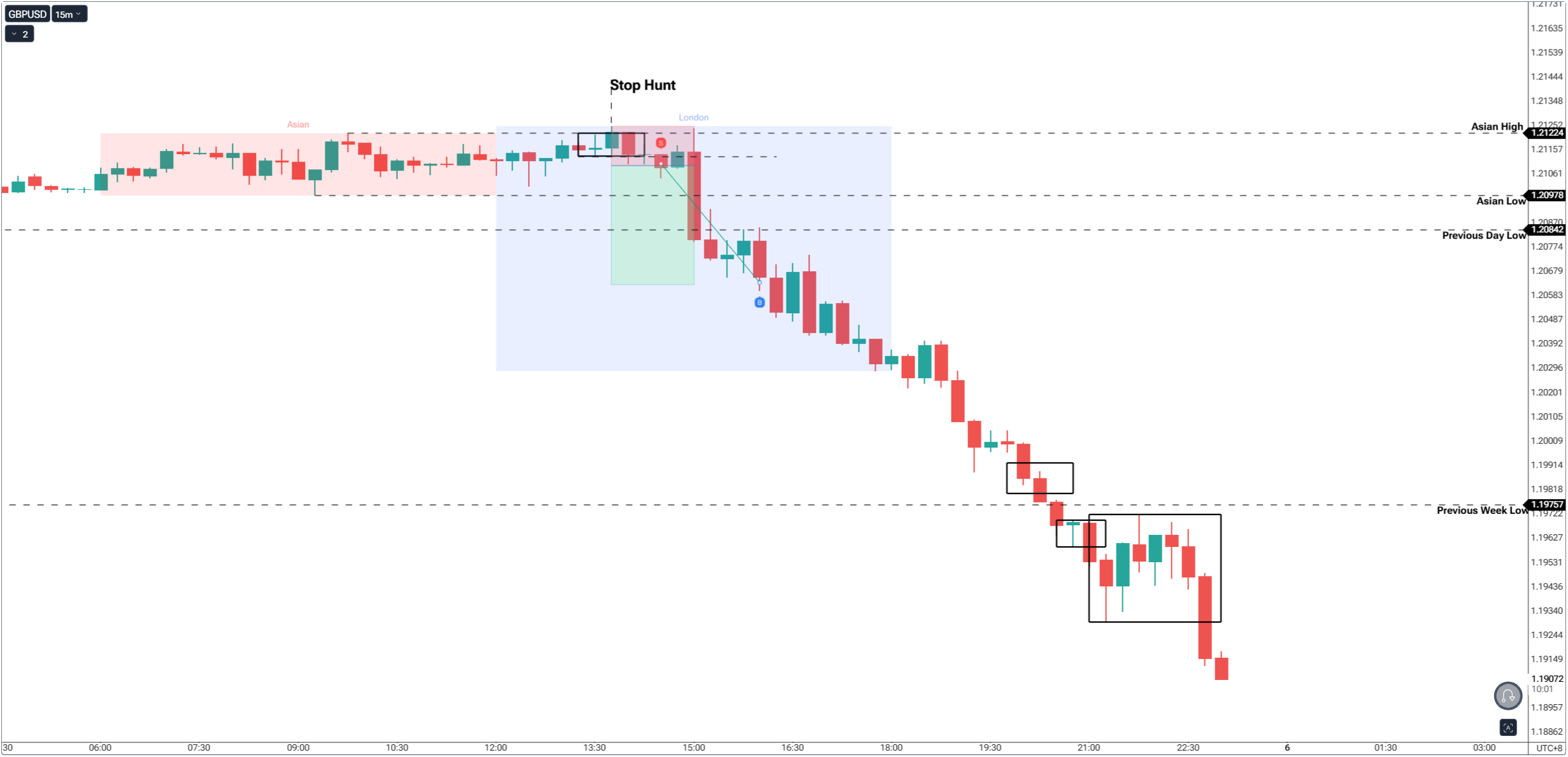
The key to surviving stop hunts isn’t just technical - it’s mental. Confirmation gives you psychological grounding. Instead of reacting emotionally, you’re waiting for the market to prove itself.
Ask yourself before entering:
By filtering your trades through confirmation, you shift from chasing traps to waiting for the market to reveal intent.
Here’s the truth: you’ll still get caught in stop hunts sometimes. But if your risk is small and your winners are bigger, one or two hunts mean nothing.
Smart traders embrace asymmetry:
Even if stop hunts hit you 40% of the time, the math still works in your favor. The key is not trying to dodge every trap, but managing your losses so that one win pays for many cuts.

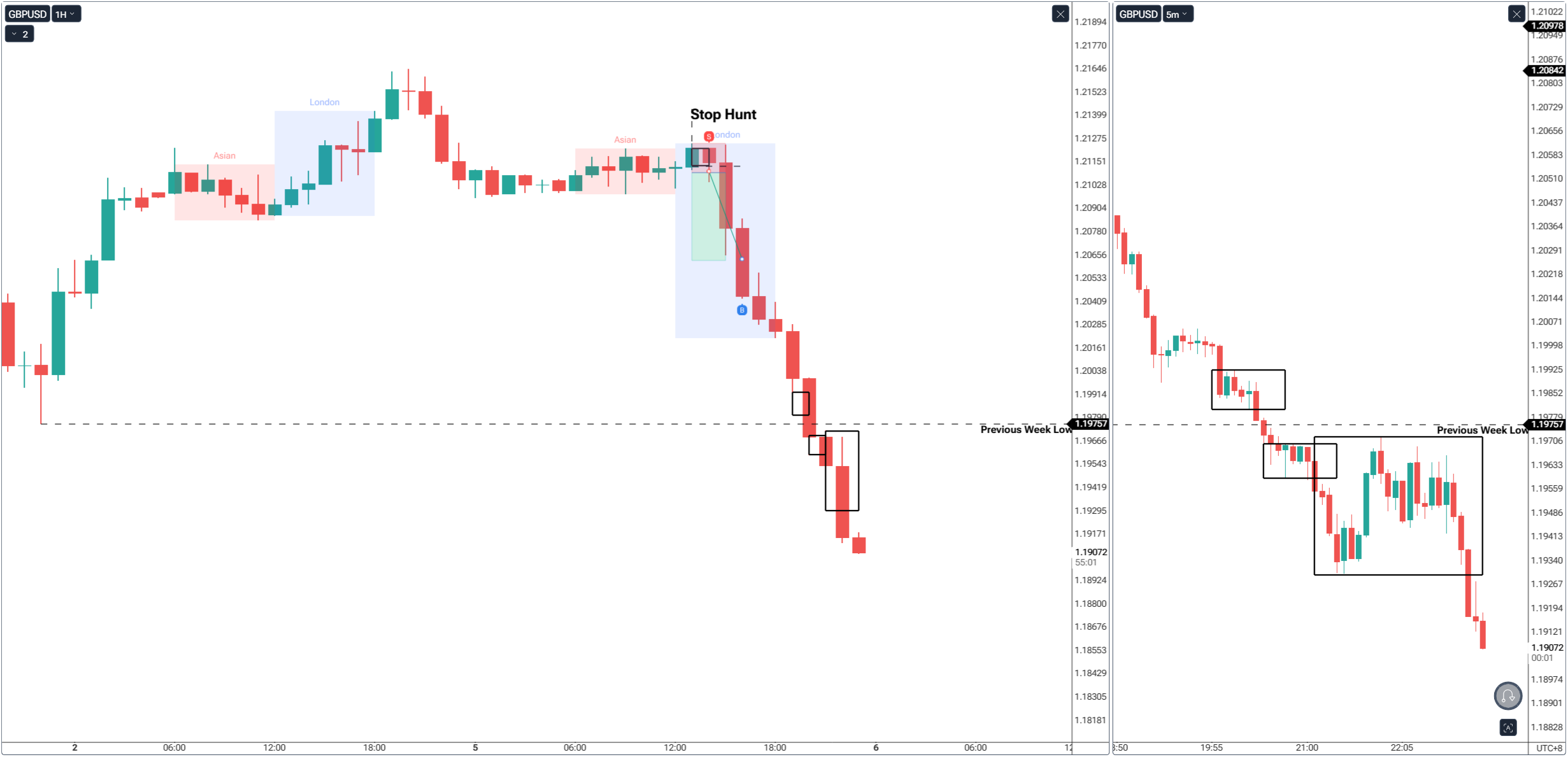
Most traders lose because they trade every swing sweep as a reversal. But not all sweeps are equal.
The higher timeframe is your filter against noise. Without it, every stop hunt looks like opportunity - when in reality, most are just continuation fuel.
The last piece of the puzzle is acceptance. Stop hunts aren’t unfair. They aren’t the market attacking you. They’re part of the design.
When you accept them as natural, the sting fades. Instead of feeling like a victim, you start to see them as signals of opportunity: the market showing its hand before the real move.

A hunter doesn’t fire the second they see movement in the bushes. They wait for confirmation - the deer stepping into the open. If they shoot too soon, they scare it off and miss the real chance.
Stop hunts are the market’s way of shaking the bushes. If you react impulsively, you waste ammo. If you wait patiently, you take the high-probability shot.
Every time you’re tempted to jump into a breakout or reversal at a swing high/low, pause and demand confirmation. Journal what happened:
After just a week, you’ll notice a shift. You’ll no longer see stop hunts as personal attacks, but as predictable traps you’re now too disciplined to fall for.
Open a free demo account today and experience institutional-grade spreads, lightning-fast execution, and all the tools you need to grow as a trader.
It’s time to go from theory to execution - risk-free.
Create an Account. Start Your Free Demo!
How To Trade & Scalp Indices at the Open Using Smart Money Concepts (SMC)
How to Trade Breakouts Effectively in Day Trading with Smart Money Concepts
Complete Step-by-Step Guide to Day Trading Gold (XAU/USD) with Smart Money Concepts (SMC)
The Power of Multi-Timeframe Analysis in Smart Money Concepts (SMC)
Forex Trading Strategy for Beginners
Mastering Candlestick Pattern Analysis with the SMC Strategy for Day Trading
Mastering Risk Management: Stop Loss, Take Profit, and Position Sizing
How to Use Fibonacci to Set Targets & Stops (Complete Guide)
RSI Divergence Trading Strategy for Gold: How to Identify and Trade Trend Reversals
Stochastics Trading Secrets: How to Time Entries in Trending Markets using Stochastics
Gold Trading Stochastics Strategy: How to Trade Gold with 2R–3R Targets
RSI Hidden Divergence Explained: How to Spot Trend Continuations Like a Pro
The Ultimate Guide to Risk Management in Trading - A Complete Compilation for 2025
Moving Averages Trading Strategy Playbook
How to Think Like a Price Action Trader
Mastering Fibonacci Trading Psychology - Trusting the Levels, Managing the Mind
Why Smart Money Concepts Work in News-Driven Markets - CPI, NFP, and More
How to Trade NFP Using Smart Money Concepts (SMC)-A Proven Strategy for Forex Traders
How to Trade CPI Like Smart Money - A Step-by-Step Guide Using SMC
How to Start Trading Indices and Get into the Stock Market with Low Capital (2025 Guide)
Best Indices to Trade for Day Traders | NASDAQ, S&P 500, DAX + Best Times to Trade Them
How To Trade & Scalp Indices at the Open Using Smart Money Concepts (SMC)
NAS100 - How to Trade the Nasdaq Like a Pro (Smart Money Edition)
How to Trade CPI Like Smart Money - A Step-by-Step Guide Using SMC
Why Smart Money Concepts Work in News-Driven Markets - CPI, NFP, and More
How to Swing Trade Gold (XAU/USD) Using Smart Money Concepts: A Simple Guide for Traders
Complete Step-by-Step Guide to Day Trading Gold (XAU/USD) with Smart Money Concepts (SMC)
The Ultimate Guide to Backtesting and Trading Gold (XAU/USD) Using Smart Money Concepts (SMC)
Why Gold Remains the Ultimate Security in a Shifting World
How to Trade Candlestick Patterns with High Probability: A Complete Guide for Beginners
The Top Japanese Candlestick Guide: What is an Engulfing Pattern and How to Trade It?
Piercing Pattern Candlestick Explained: How to Trade It - Step-By-Step Guide
Morning & Evening Star Candlestick Patterns - How to Trade Market Reversals with Confidence
5 Steps to Start Day Trading: A Strategic Guide for Beginners
8 Steps How to Start Forex Day Trading in 2025: A Beginner’s Step-by-Step Guide
3 Steps to Build a Trading Routine for Consistency and Discipline - Day Trading Edition
The Ultimate Guide to Understanding Market Trends and Price Action
Trading with Momentum: The Best Trading Session to Trade Forex, Gold and Indices
How to Identify Risk-On and Risk-Off Market Sentiment: A Complete Trader’s Guide
How to Trade Risk-On and Risk-Off Sentiment - With Technical Confirmation
The Ultimate Guide to Understanding Market Trends and Price Action
Why Smart Money Concepts Work: The Truth Behind Liquidity and Price Action
Mastering the Market with Smart Money Concepts: 5 Strategic Approaches
Mastering Candlestick Pattern Analysis with the SMC Strategy for Day Trading
Understanding Liquidity Sweep: How Smart Money Trades Liquidity Zones in Forex, Gold, US Indices
The SMC Playbook Series Part 4: How to Confirm Trend Reversal & Direction using SMC
The SMC Playbook Series Part 5: The Power of Multi-Timeframe Analysis in Smart Money Concepts (SMC)
Fair Value Gaps Explained: How Smart Money Leaves Footprints in the Market
The Best Time to Use Smart Money Concepts (SMC): Why Timing Is Everything in Trading SMC
How to Trade the London Session Using Smart Money Concepts (SMC)
The Mental Game of Execution - Debunking the Common Trading Psychology
5 Steps to Backtest a Trading Strategy with AI: A Step-by-Step Guide
Managing Trading Losses: Why You Can Be Wrong and Still Win Big in Trading
The Hidden Threat in Trading: How Performance Anxiety Sabotages Your Edge
Why You Fail in Trading: You Don’t Have Enough Capital to Survive
Why 90% of Retail Traders Fail Even with Profitable Trading Strategies
The Top 10 Best Trading Books That Changed My Mindset, Strategy & Performance
Discovering Your Trader Profile: What Kind of Trader Are You?
Follow me for more daily market insights!
Jasper Osita - LinkedIn - FXStreet - YouTube
This content may have been written by a third party. ACY makes no representation or warranty and assumes no liability as to the accuracy or completeness of the information provided, nor any loss arising from any investment based on a recommendation, forecast or other information supplies by any third-party. This content is information only, and does not constitute financial, investment or other advice on which you can rely.
ACY Securities is one of Australia's fastest growing multi-asset online trading providers, offering ultra-low-cost trading, rock-solid execution, technologically superior account management and premium market analysis.

Select the categories and companies you wish to follow directly to your person rss feed.
Create Custom RSS FeedSign up and join over 5,000 professional members who receive personalized news alerts, curated professional connections, and more for free!
Bybit has launched Perp Options, described as the first options contracts built on TradFi perpetuals, giving traders round-the-clock access to US equity options. SpaceX and Nvidia are the first underlying assets, with USDT settlement and integration into Bybit's Unified Trading Account.
Use this trading preparation checklist to plan your session, define entry rules, manage risk, and build a disciplined trading routine in seven steps.
Your Bourse expands its crypto liquidity ecosystem with Caladan, giving brokers access to broader market coverage, institutional execution capacity and streamlined settlement.
Scope Markets, the retail brokerage part of Rostro Group, has appointed Ibrahim Hossny as Head of Research and Marketing for the Middle East and North Africa.
Hantec Prime, the institutional division of Hantec Markets, has reported trading volume up more than 300% year-to-date, alongside the addition of 42 new institutional clients since December, capping one of its strongest years of growth to date.
Learn how to refine XAUUSD support and resistance on the daily chart using candle bodies, market structure and weekly gold levels for swing trading. A slug alone cannot guarantee a top Google ranking. Keep it focused rather than adding every supporting keyword.
The week in Dubai will be focused on connecting directly with the industry and discussing how technology can help modern brokerages simplify operations, automate workflows, strengthen operational control, and scale efficiently.
Devexperts has launched a turnkey solution giving brokers in South Korea access to US equity markets, combining its DXtrade trading platform, dxFeed market data, and execution services. The offering targets South Korea's growing retail demand for US stocks, worth several billion USD monthly.
Assess why WTI crude oil surged past $105 per barrel amid Saudi pipeline disruptions, record tanker charter rates, and escalating geopolitical tensions.
Bitcoin price forecast: BTC/USD retests $78,460–$80,215 resistance. Watch bearish confirmation toward $72,480 or a bullish breakout toward $86,150.