just now


Liquidity Finder Ltd is incorporated in England and Wales, company number 10610740, registered address 167-169 Great Portland Street, Fifth Floor, London W1W 5PF, United Kingdom.
Published: just now
Sports prediction market Novig has secured designation from the US Commodity Futures Trading Commission (CFTC) as a Designated Contract Market (DCM), clearing the way for the company to operate as a federally regulated exchange and roll out across all 50 states from this summer.
The designation places Novig within the same federal framework that governs derivatives exchanges, allowing it to list event contracts nationwide rather than navigating the patchwork of state sports betting and sweepstakes rules under which it previously operated. Novig described the approval as one of the fastest of its kind in CFTC history.
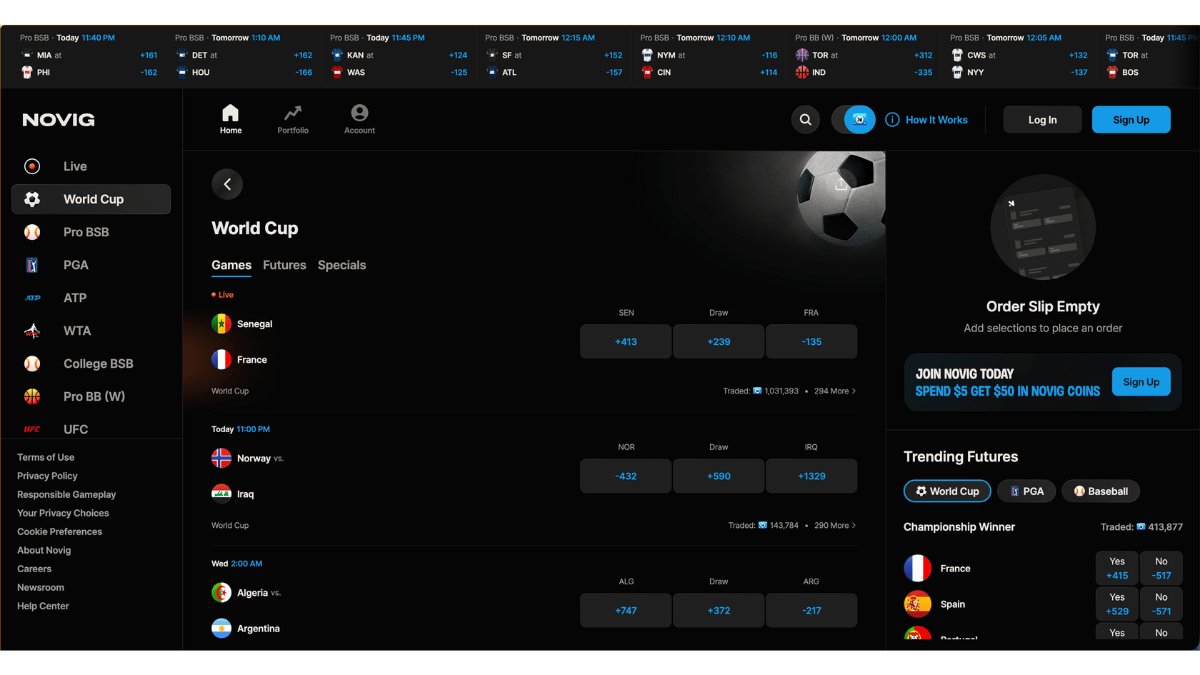
Operating as a DCM, Novig will be able to apply safeguards more commonly associated with financial markets, including market surveillance, protections against manipulation and insider activity, and broader compliance standards. The platform retains a 21-plus age requirement and says it is built around responsible participation at scale.
Novig runs an exchange-based, peer-to-peer model rather than the against-the-house structure of a traditional sportsbook. Customers trade directly with one another, with pricing set by real-time supply and demand through an order book. The company argues this removes unfair odds and the punitive limits that sportsbooks often place on consistently winning customers.
"From day one, our vision has been to operate within a single national framework that raises the standard for the entire category," said Jacob Fortinsky, Co-Founder and Chief Executive of Novig. "By aligning incentives with users and removing the structural disadvantages of legacy betting platforms, we're building a fundamentally different model where participants aren't playing against the house, but operating within a fair and transparent market."
Novig says it has surpassed USD 5 billion in cumulative trading volume, and positions itself as the most liquid and efficient sports prediction market in the country. The company has moved through several operating models since launch, beginning as a licensed betting exchange in New Jersey and Colorado before pivoting to a sweepstakes model, and now to a federally regulated exchange. Its Series B round earlier this year, led by Pantera Capital, valued the business at roughly 500 million dollars post-money.
Novig now joins a growing group of CFTC-designated exchanges competing for prediction market volume. Prediction market exchange Kalshi has held DCM status since 2020 and began offering sports event contracts in January 2025, while Crypto.com, Polymarket and Robinhood have also moved into the space. Kalshi remains a broad-market venue spanning politics, economics, weather and culture alongside sports, whereas Novig is built exclusively around sports, which makes the two direct competitors specifically in sports event trading.
That competition sits on contested legal ground. In April 2026 the Third Circuit became the first federal appeals court to hold that the Commodity Exchange Act preempts state gambling laws as applied to sports event contracts traded on a CFTC-registered DCM, a ruling that strengthens the federal model Novig is now entering. Several states continue to challenge the exchanges, and the CFTC has separately proposed rules that would bar certain sports contracts, such as those tied to player injuries or officiating outcomes.
Found this interesting? Become a member of LiquidityFinder, join the community and join the discussion - join here.
We're the largest marketplace to connect with brokers, Fintech companies & digital asset firms. Want to partner? Let's get in touch.
Select the categories and companies you wish to follow directly to your person rss feed.
Create Custom RSS FeedSign up and join over 5,000 professional members who receive personalized news alerts, curated professional connections, and more for free!
Multi-asset trading broker AvaTrade has agreed to acquire the majority of FXCM Group’s business and brand, in a transaction that would bring a longstanding retail FX franchise into the AvaTrade Group.
LSEG and CMC Markets have signed a multi-year strategic data agreement expanding CMC's access to LSEG's real-time and delayed pricing, reference and corporate actions data, news and analytics, plus AI-ready content, to support new products, entry into new markets and the growth of CMC's institutional and B2B partnerships.
The Tel Aviv Stock Exchange is considering a bid for the Cyprus Stock Exchange, with Israeli media citing its EU licence, trading platform and clearing house. Euronext’s Athens exchange and India’s National Stock Exchange are also seen as contenders, and Cyprus aims to sign a sale agreement by the end of this year.
CME Group will launch baseball futures on 12 October, pending regulatory review, tracking CME FutureSports Performance Indexes built on Official League Data. Standard and micro contracts will start with the 2026 Postseason and the four clubs in the League Championship Series, trading around the clock.
ESMA has published an opinion stating that MiCA-authorised crypto-asset service providers should cease services tied to non-MiCA-compliant stablecoins for EU clients across MiCA crypto-asset services. National authorities should require remediation of existing exposures within three months, by early January 2027.
Nasdaq Ventures has made a strategic investment in Amsterdam-based derivatives and crypto exchange One Trading, with both firms to explore 24/7 trading of equity futures. The undisclosed investment follows Nasdaq's US$100 million investment in Payward, the parent of Kraken, and CME Group's move to 24/7 trading.
cTrader has opened multi-platform plugins to brokers and prop firms, which can pre-install their own tools for clients or list them in cTrader Store. The plugins run across Mobile, Web, Windows and Mac, and can be built and launched independently of core-platform releases, including trading journals and calculators.
Institutional brokerage and financial infrastructure provider Clear Street has joined TradingView’s broker network, allowing its clients to trade US stocks, exchange-traded funds and options directly through the charting and analysis platform.
Learn how to improve trading psychology, manage fear and greed, avoid revenge trading, and follow your trading strategy with discipline and a trading journal.
GTC Prime has announced a strategic partnership with Centroid Solutions to manage and distribute its liquidity through CS 360 Bridge, Centroid's multi-asset connectivity and execution engine, giving brokers and institutional clients access to tailor-made pricing, low-latency execution and real-time risk management.