

Explore Companies BySectors & Categories
Explore Companies ByUse Cases
Explore Companies ByProducts & Services
Explore Companies ByRankings & Reviews
Featured NewsCompaniesMarketsCryptoTechRegulatoryCommentaryUKUSWorldMore

    Latest Wires

      Daily Newsletter

      LF Daily News

      Daily industry focused newsletter giving you an overview for the financial & finTech industry.

      See All Newsletters
      By clicking "Sign Up" you are agreeing to our Terms of Service and Privacy Policy

      Toxic Flow - What to Know? What It Costs? How to Detect It and Protect from It?

      Published: just now

      Toxic Flow - What to Know? What It Costs? How to Detect It and Protect from It?

      Every FX and CFD broker eventually meets toxic flow. Sometimes it is obvious - a cluster of brand-new accounts winning on every news release. More often it is quiet: a few linked accounts hedging each other, a copy-trading group moving in perfect sync, or a strategy that only ever profits from stale quotes. Left alone, it erodes your P&L, your execution quality and - just as importantly - your relationships with liquidity providers.

      This guide explains what toxic flow really is, what it costs under both B-book and STP execution, the patterns professional dealing desks look for, and the practical steps that keep it under control.


      What Is Toxic Flow?

      Toxic flow is trading activity that makes money not because the client is right about the market, but because they are exploiting a weakness - in your pricing, your execution speed, your platform settings, your promotions or your rules. Typical sources include:

      1. A speed or information edge - latency arbitrage, trading on stale prices, or entering just before quotes catch up with the market
      2. Rule gaming - hedging between accounts, abusing bonuses or exploiting negative balance protection
      3. Collusion - groups of connected accounts, sometimes with an introducer or insider, acting together to extract risk-free profit
      4. Disruptive behaviour - very high-frequency or ultra-short trading that is costly to execute and hedge


      It is important to separate toxic flow from simply profitable clients. A skilled trader who wins consistently with a genuine strategy is not toxic - they are a client who belongs in the A-book. Toxic flow is about how the profit is made, and treating the two the same way is both unfair to clients and bad for business.


      What Toxic Flow Costs a B-Book Broker

      When you internalise client risk, every dollar a toxic account wins comes straight out of your P&L. But the direct loss is usually only part of the bill:

      1. Direct trading losses - systematic, low-risk profits taken from the book, often by a small number of accounts
      2. Late and expensive hedging - by the time the exposure is noticed and hedged, the price has already moved
      3. Exposure capacity used up - risk limits are consumed by flow you never wanted to carry, leaving less room for profitable flow
      4. Bonus and credit leakage - promotional budgets converted into withdrawable profit by organised groups
      5. Negative balance write-offs - losses on one account absorbed by the broker while a linked account keeps the gains
      6. Dealer time - hours spent investigating, reversing and documenting incidents instead of managing the book


      The danger is that these costs are spread across different lines - hedging, marketing, write-offs, operations - so many brokers never see a single monthly number for what toxic flow is really costing them.


      Not Just a B-Book Problem: Toxic Flow in the STP Model

      A common belief is that toxic flow only matters if you take the other side of client trades. If you route everything straight through to your liquidity providers, the thinking goes, the risk is theirs. In practice, STP brokers feel the impact too - it simply arrives through a different door.

      Liquidity providers analyse the flow they receive from every broker. When they see a stream that consistently wins in the seconds after each fill, they react quickly - and their reaction usually applies to all of your flow, not just the toxic accounts:

      1. Wider spreads and higher mark-ups on the prices you receive, which you either pass on to clients or absorb in your margin
      2. More rejections and last-look delays, leading to requotes, slippage and frustrated genuine clients
      3. Worse fill quality - more negative slippage and lower fill ratios across your whole client base
      4. Lower credit limits, flow segregation or termination - in serious cases the LP may restrict your access to certain instruments or end the relationship entirely
      5. A harder time finding new liquidity - a reputation for sending toxic flow travels, and onboarding new LPs becomes slower and more expensive


      The relationship between a broker and its liquidity provider is built on trust and on the quality of the flow being sent. Toxic flow damages that trust, and the commercial terms that come with it. Detecting and handling it before it reaches your LPs is one of the best ways to protect your pricing, your execution quality and your long-term liquidity access.


      The Toxic Patterns a Professional Desk Monitors

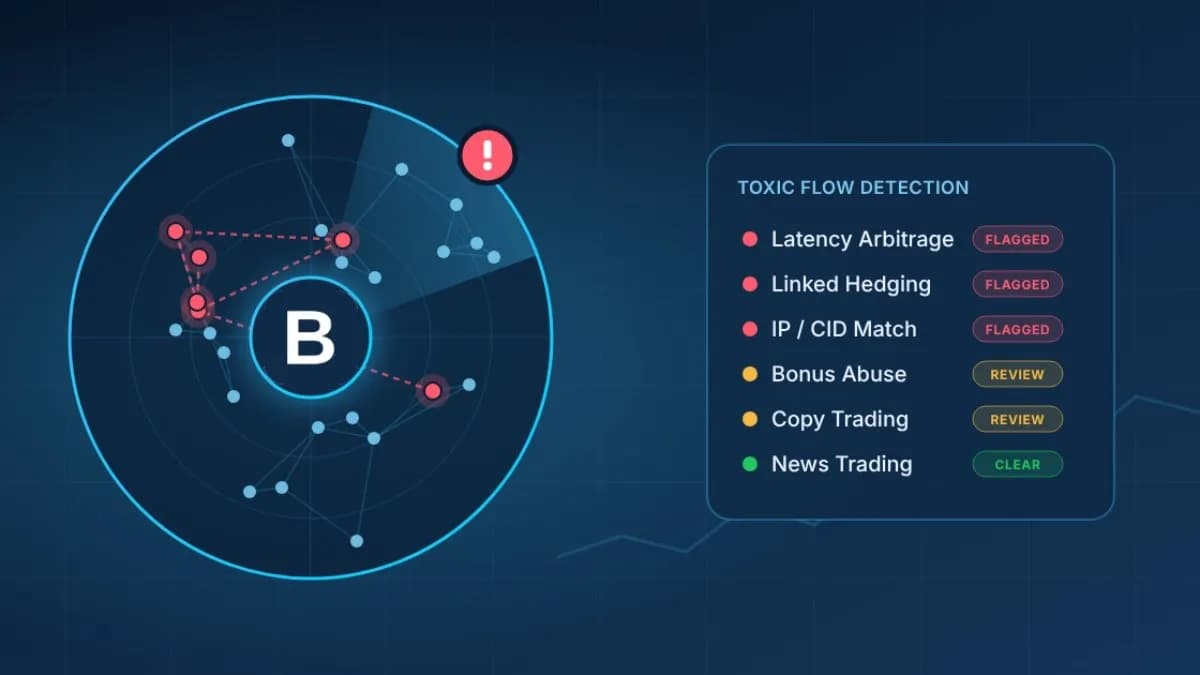
      Toxic flow comes in many forms, and checking for only one or two patterns leaves plenty of room for the rest. Below are the main pattern families our dealers and the Broktinger Risk Monitor look for, grouped by how the abuse works:

      Pattern family / What we monitor
      Connected accountsConnected Abusers, CID Match, IP Match, Email Match, Surname Match, Identical Deposits, Inside Job
      Hedging schemesHedging, Self-Hedging, Linked Hedging, Bonus Group Hedge
      BracketingBracketing, Self-Bracketing, Linked Bracketing
      Coordinated tradingCopy Trading, Linked Copy, Cluster Trading
      Speed and execution edgeLatency Arbitrage, HFT, Scalping, Entry Edge, Slippage, Trade Duration
      Event timingNews & Market Open/Close, Market Movers
      Risk behaviourAdding in Drawdown, Adding in Profit, Risk After Loss, Churning, Reason (EA / Dealer)
      Outcome signalsAbnormal Profits, Large Profit Trades, Large Volume Trades
      Promotion and balance abuseBonus Abuse, Negative Balance Abuse

      What Some of These Patterns Look Like

      1. Connected abusers and account matching - separate accounts that share a client ID, IP address, email pattern, surname or identical deposit amounts, usually a sign that one person or group is operating several accounts.
      2. Linked hedging and bonus group hedge - opposite positions held across connected accounts so that one side always wins; combined with bonuses or negative balance protection, the group locks in profit at the broker's expense.
      3. Bracketing and linked bracketing - pending orders placed either side of the price before a known event, on one account or split across several, to catch the move whichever way it goes.
      4. Copy, linked copy and cluster trading - many accounts opening the same trades at the same moment, which concentrates exposure and often hides a single strategy behind many small accounts.
      5. Latency arbitrage and entry edge - entries that consistently land at prices better than the live market, taking advantage of slow or stale quotes.
      6. HFT, scalping and trade duration - very short holding times clustered around price updates, which are expensive to hedge and often depend on execution weaknesses rather than market views.
      7. News, market open/close and market movers - trading concentrated in the seconds around releases, session opens and sharp moves, when spreads and liquidity are least stable.
      8. Risk after loss, adding in drawdown and churning - behaviour patterns that signal gambling or deliberate exploitation of credit, leverage or commission structures.
      9. Inside job - unusual links between client activity and introducers, partners or staff, which can indicate information leaks or collusion.
      10. Abnormal profits and large profit trades - results that are statistically out of line with the account's history or with the market, prompting a closer review of how they were achieved.


      How to Detect Toxic Flow

      No single report will catch every toxic account. Effective detection combines continuous, automated monitoring with experienced dealers who review the results. The key data points include:

      1. Decay analysis - how the price moves in the seconds and minutes after each client fill, analysed per account and per group
      2. Holding-time profile - concentrations of very short trades around price updates and news
      3. Simultaneous trading - entries from different accounts arriving within the same fraction of a second
      4. Account linking data - shared CIDs, IPs, emails, surnames, devices and deposit patterns
      5. Performance versus account age - new accounts that win immediately and consistently deserve a closer look
      6. Execution statistics - slippage patterns, rejections and fill quality by account, symbol and session


      The most important factor is timing. Detection that runs once a month, after a bad result, only tells you what you have already lost. Monitoring needs to run in real time, with alerts that reach a dealer while there is still time to act.


      How to Protect Your Brokerage

      Detection is only useful if it leads to consistent action. A practical protection framework includes:

      1. Classify and route deliberately - move flagged accounts or groups to the appropriate book or execution profile, rather than routing everything one way by default.
      2. Protect your LPs - in an STP or hybrid setup, identify toxic flow before it reaches your liquidity providers and agree with them how it will be handled. Being open with your LP is far better than being caught out by them.
      3. Tighten group and symbol settings - leverage, execution and trading conditions can be adjusted for specific groups to reduce the economics of an exploit, in line with your terms and applicable regulation.
      4. Close promotional loopholes - clear bonus terms, eligibility checks and monitoring of linked accounts remove most bonus and negative balance abuse.
      5. Use your KYC data - match onboarding and payment information against trading behaviour to spot connected accounts early.
      6. Keep a documented review process - every flag, decision and action should be recorded, so treatment is consistent between dealers and shifts and you have evidence if a client disputes it.
      7. Act fairly - always act within your client agreement, and do not penalise genuinely successful traders. The goal is to stop abuse, not to punish winners.


      How Broktinger Helps

      Broktinger combines technology and people to keep toxic flow under control. The Broktinger Risk Monitor runs more than 30 abuse checks - including every pattern listed above - across all your MT4 and MT5 servers, alongside exposure, quotes, revenue and LP spread analysis, with alerts by email or Telegram. It runs on your own servers, so your client data stays with you.

      Our outsourced dealing desk and risk management team then turns those alerts into action. Our dealers are senior professionals with years of experience at regulated CFD brokers and prop firms, so when a toxic pattern appears, the person on shift can investigate and respond immediately - in B-book, STP or hybrid setups - and we work with your existing platform, bridge and liquidity providers rather than asking you to change them.


      Key Takeaways

      1. Toxic flow is about how profit is made - not whether a client wins.
      2. In a B-book it costs you directly; in an STP model it costs you through wider spreads, worse fills and damaged LP relationships.
      3. Many different patterns exist, from connected accounts and hedging schemes to latency arbitrage and bonus abuse - monitoring only a few leaves gaps.
      4. Real-time monitoring plus experienced dealers and a documented process is what keeps it under control.


      Want to know how much toxic flow is costing your brokerage today? Book a free consultation and our team will show you what the Risk Monitor finds on your own data.

      Industry leaders in outsourced dealing desk, risk management and platform development for FX and CFD brokers. Building MT4/MT5 tools, reporting solutions and API integration, plugins.

      This content may have been written by a third party. LiquidityFinder makes no representation or warranty and assumes no liability as to the accuracy or completeness of the information provided, nor any loss arising from any investment based on a recommendation, forecast or other information supplies by any third-party. This content is information only, and does not constitute financial, investment or other advice on which you can rely.
      Comments
      Most Recent
      Daily Newsletter

      LF Daily News

      Daily industry focused newsletter giving you an overview for the financial & finTech industry.

      See All Newsletters
      By clicking "Sign Up" you are agreeing to our Terms of Service and Privacy Policy
      RSS Feeds

      Create a custom RSS Feed

      Select the categories and companies you wish to follow directly to your person rss feed.

      Create Custom RSS Feed

      Related Categories:

      Related Tags:

      #Outsourced Dealing#DealingDesks#RiskManagement#BrokerRiskManagement#ToxicFlow#ToxicTradeDetection#ToolsForBrokers#MT5#MarketAbuse#Latency Arbitrage

      Related Articles:

      Find The Right Partners for
      Your Trading Business

      Sign up and join over 5,000 professional members who receive personalized news alerts, curated professional connections, and more for free!

      Create Your FREE Account
      Get access to latest news, updates, real-time data, brokerage and trading firm insights and customized information feeds.

      Toxic flow doesn’t only hit B-book brokers. In an STP model it shows up as wider spreads, more rejections and strained LP relationships. This guide explains what toxic flow really is, what it costs, the 35 patterns professional dealing desks monitor, and the practical steps to detect it and protect your brokerage.

      just now

      The Monetary Authority of Singapore has launched a central bank gold vaulting service for foreign central banks, international financial institutions and sovereign entities, using a national vault that can hold up to 500 tonnes, and announced an enhanced GST framework for wholesale gold activities from April 2027.

      just now

      24X Bermuda Limited has expanded its partnership with Standard Chartered to include digital assets prime brokerage, enabling Bitcoin and Ethereum trading on its multi-asset platform. Standard Chartered acts as central counterparty, with 24X running the execution-only platform for institutional crypto and FX products.

      just now

      Learn how a demo trading account works, why beginners use it before live trading, and how to practice with virtual funds using a simple five-step guide.

      just now

      Bitcoin faces resistance at $76,800–$80,800. Explore the BTCUSD bearish setup toward $71,000 and the bullish break-and-retest scenario targeting $86,500.

      just now

      Raj Sitlani, Jonathan Brewer and Jeff Wilkins have launched JT Prime, a new institutional Prime of Prime business offering aggregated Tier 1 multi-asset liquidity to brokers, funds, family offices and proprietary trading firms, with a regulatory application pending and digital assets planned beyond FX and commodities.

      just now

      The update adds strategy promotion, cross-platform sharing and guest browsing to STAR Copy.

      just now

      GTN has appointed former Gemini and Kraken executive Mark Jennings as global head of digital assets, a new role leading its tokenisation strategy as more platforms bring traditional assets on-chain. Jennings previously led Gemini Europe and Crypto Facilities, Kraken’s FCA-regulated institutional derivatives venue.

      just now

      The Central Bank of Nigeria (CBN) has issued regulations that require issuers of foreign currency stablecoins used by Nigerians to incorporate locally.

      just now

      US crypto exchange Coinbase has received full approval from the Office of the Comptroller of the Currency (OCC) for its national trust bank, Coinbase National Trust Company.


      just now
      Feed