just now


Liquidity Finder Ltd is incorporated in England and Wales, company number 10610740, registered address 167-169 Great Portland Street, Fifth Floor, London W1W 5PF, United Kingdom.
Published: just now

USD/CHF has been trending lower, and this move is not random. Both fundamental forces and technical structure are aligned to the downside. When macro drivers and chart patterns point in the same direction, trends often persist longer than many traders expect.
In simple terms, USD/CHF is falling because US monetary policy is turning more accommodative, the Swiss franc is benefiting from safe-haven demand, and the chart has rolled over from a key resistance level. Below, we break this down step by step—starting with fundamentals and finishing with a clear technical roadmap.
The primary driver behind the USD/CHF decline is a broad weakening of the US dollar.
Currencies are heavily influenced by yield differentials. When US yields fall, global investors have less incentive to hold USD, particularly against traditionally stable currencies like the Swiss franc.
Result: When the dollar weakens broadly, USD/CHF typically comes under pressure.
The Swiss franc (CHF) remains one of the world’s most trusted safe-haven currencies.
As investors seek safety:
This dynamic has been quietly supporting CHF in recent weeks.
For much of the previous cycle, the US dollar enjoyed a clear yield advantage over Switzerland.
As the US rate premium fades, holding USD versus CHF becomes less attractive, removing a key support for USD/CHF.
Fundamentals provide the backdrop—but price action confirms the narrative.
Once a major level fails, it often flips from support into resistance—and that is exactly what the chart is showing.
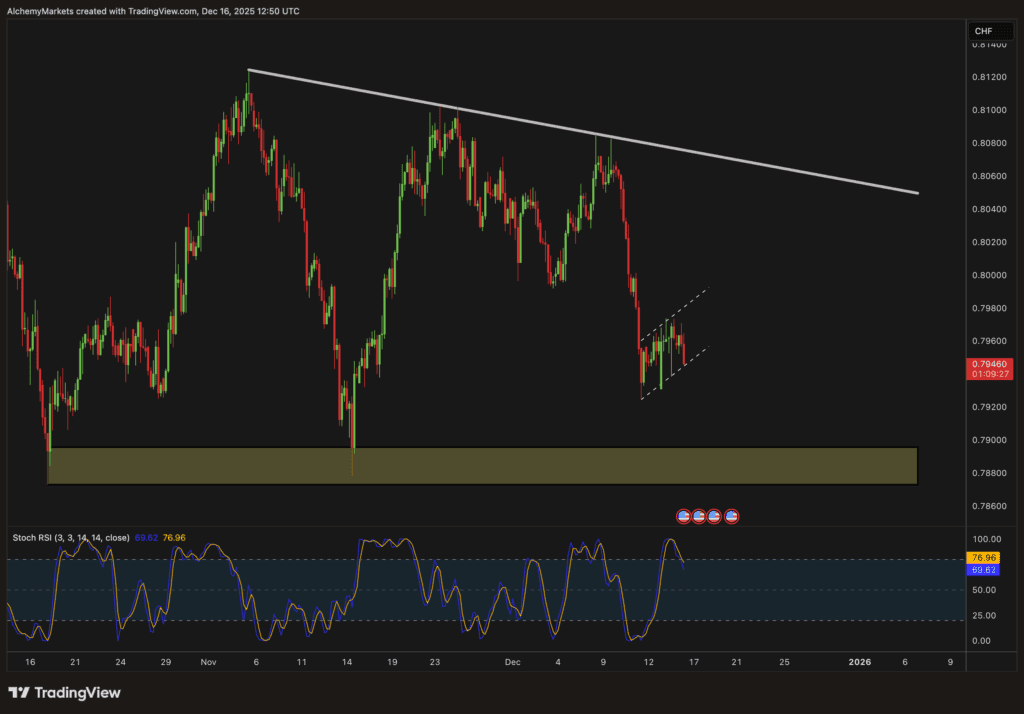
From a technical perspective, USD/CHF is forming a classic bear flag pattern.
In trending markets, bear flags most often break in the direction of the prevailing trend—which, in this case, is lower.
Momentum indicators continue to support the bearish bias.
When price consolidates while momentum resets from overbought conditions, it often prepares the market for another leg down.
Below current price, the chart highlights a well-defined demand zone from previous reactions.
If the bear flag resolves lower, this support region becomes the logical downside target before any meaningful rebound can develop.
USD/CHF is falling because US interest rates are declining, the dollar is weakening, investors are seeking safety, and the chart has rolled over into a bearish continuation pattern.
No trend lasts forever. A sustained reversal would likely require more than one catalyst.
Absent these developments, rallies in USD/CHF are more likely to remain corrective pullbacks rather than trend reversals.
Yes. Both the fundamental backdrop and technical structure point towards further downside.
A bear flag, which typically signals continuation of the prevailing downtrend.
Switzerland is viewed as financially and politically stable, making CHF a safe-haven currency.
Yes. Momentum is not oversold, suggesting room for another decline.
The failure to hold above the 0.80 psychological level.
Stronger US data, renewed Fed hawkishness, or broad-based US dollar strength.
USD/CHF currently offers a textbook example of macro fundamentals and technical structure aligning. Falling US interest rates, a softer dollar, increased demand for CHF, and a clean bearish chart pattern are all pointing in the same direction. Until those conditions change, downside pressure remains the path of least resistance.
Markets do not need dramatic headlines to trend—sometimes, steady fundamentals and clear technicals are more than enough.
Alchemy Markets is a multi-asset brokerage providing retail traders with the same elite trading conditions, tools, and transparency typically reserved for institutions.

Select the categories and companies you wish to follow directly to your person rss feed.
Create Custom RSS FeedSign up and join over 5,000 professional members who receive personalized news alerts, curated professional connections, and more for free!
The AI trade has always been a supply chain story. For the past two years, the narrative has been simple: insatiable demand for compute infrastructure, constrained supply at every choke point, and the companies that own the bottlenecks collect the toll. NVIDIA on GPUs. ASML on lithography. Samsung, SK Hynix, and Micron on memory. The entire semiconductor complex has traded on scarcity, and scarcity has delivered historic margins.
Interactive Brokers reported customer equity of USD 964.7 billion at the end of the third quarter, up 27% year on year, as customer accounts increased 35% to 5.58 million.
Crypto exchange BingX has secured a Markets in Crypto-Assets Regulation (MiCA) licence for its European arm from Austria's Financial Market Authority (FMA).
CXM Group has agreed to acquire TD Markets (Pty) Ltd, a Johannesburg-headquartered broker authorised by South Africa’s FSCA. TD Markets keeps its brand, team and licence, and Amar Ramith stays as CEO. Financial terms were not disclosed. The deal gives CXM a regulated base in South Africa. Clients need take no action.
Global equities under pressure: Hotter than expected US inflation and rising yields weighed on stocks, particularly technology and semiconductor shares.
Understand trading psychology and learn how a clear strategy, risk management and a trading journal help build discipline and day trading consistency.
Ripple Prime has launched support for real-world asset perpetual swaps, giving institutional clients including Virtu exposure to more than 100 reference markets across equities, indices, ETFs, metals, energy and FX. The swaps reference Trade.xyz perpetual futures on Hyperliquid and trade and settle around the clock.
iSAM Securities Apex has integrated with Crossover Markets, connecting brokers to CROSSx, its institutional digital asset ECN, through Apex’s ultra-low-latency technology stack.
Your Bourse and 4XPORTAL highlight their existing partnership, combining client onboarding, CRM and payment solutions with liquidity, execution and risk-management infrastructure for brokers.
The partnership brings together 4XPORTAL’s brokerage technology capabilities with Your Bourse’s connectivity, liquidity aggregation, and risk-management infrastructure.