just now

Liquidity Finder Ltd is incorporated in England and Wales, company number 10610740, registered address 167-169 Great Portland Street, Fifth Floor, London W1W 5PF, United Kingdom.
Published: just now
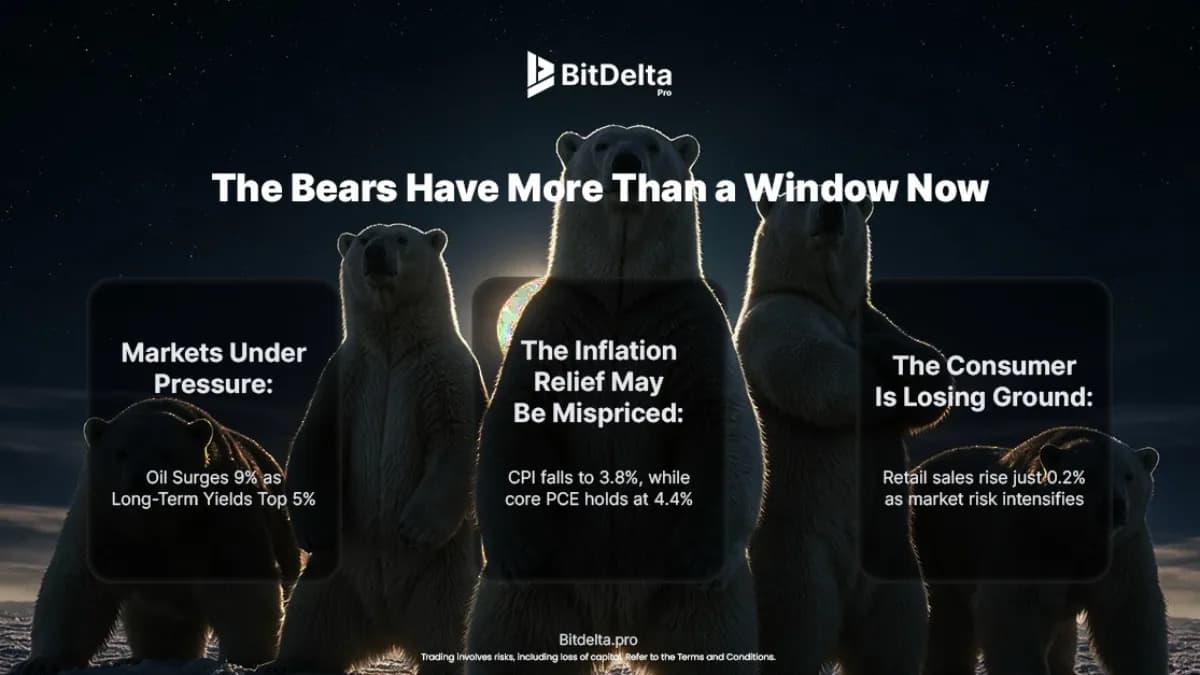
BitDelta Pro | Weekly Outlook | July 20, 2026
Last week we identified five bearish catalysts converging into a single week and argued that the bears had a window but not the narrative. The data came in largely as expected. CPI fell to 3.8%. PPI confirmed the same backward-looking story. Retail sales badly missed, growing 0.2% against a 1.0% forecast. Chair Warsh was guarded in his congressional testimony. Markets had a difficult session before stabilizing after hours on the CPI print.
Then the situation got materially worse.
Two US service members were killed in an Iranian attack on a US base in Jordan. The US reinstated its naval blockade on Iranian ports and launched a third consecutive night of strikes across a broad swath of Iran, hitting infrastructure targets in Bandar Abbas, Kish, Qeshm, and Abu Musa*. Iran struck two UAE tankers in Omani territorial waters in the Strait of Hormuz, killing an Indian crew member**. The Saudi-Houthi de facto truce has collapsed, with fresh strikes exchanged between the two sides***. Oil surged more than 9% on the blockade announcement.
The ceasefire has not merely frayed. It has collapsed. The preliminary deal signed in late June survived less than a month before an Iranian drone strike on a cargo vessel set off the chain of escalation that has now produced American casualties. Red lines set by both sides have been crossed. The US has expanded strikes into northern Iran. Iran has attacked US regional allies. The path back to all-out war appears increasingly likely.
This changes the calculus for the week ahead. The bearish catalysts are no longer compressed into a single week of data releases. They are compounding across geopolitical, macro, and market dimensions simultaneously.
The Data Recap: What Last Week Actually Told Us
The economic data released last week painted a consistent picture of an economy that is cooling on the consumer side while running hot on the investment side.
CPI (3.8% YoY, down from 4.2%): The decline was driven almost entirely by energy. Fuel oil fell 9.2% month-over-month. Gasoline dropped 9.7%. Electricity fell 1.0%. Strip energy out and the picture is stickier. Core inflation remains above the Fed's comfort zone. More importantly, the Personal Consumption Expenditures price index, the measure the Fed actually targets, ran at 4.5% annualized in Q1 with core PCE at 4.4%. The gap between what the market celebrated (CPI at 3.8%) and what the Fed is watching (core PCE at 4.4%) is a mispricing that has not been resolved.
PPI: Came in cold, confirming the same backward-looking story. Wholesale energy costs declined during the ceasefire period in June. The producer-level data reflects that. Neither the CPI nor the PPI capture the re-escalation that began in early July. The next prints will tell a very different story as oil flows back above $78.
Retail sales (0.2% vs 1.0% forecast): This is the data point that deserves the most attention. Consumer spending is weakening in real terms. Q1 GDP showed personal consumption growing at just 1.4%, the weakest since 2014. Goods consumption was 0.4%. The retail sales miss confirms that the consumer is not participating in the growth story being told by the investment side of the economy. Real disposable income grew 0.8% in Q1. That is not a consumer who can sustain the current pace of economic expansion.
Truflation (1.923%, 30-day average 1.850%): Real-time inflation indicators are running well below the official CPI, suggesting that price pressures were easing faster than the lagging government data captured. Whether this trend survives the oil re-acceleration is the open question.
| Indicator | Reading | Signal |
| CPI YoY | 3.8% (from 4.2%) | Energy-driven decline, core sticky |
| PPI | Cool | Same backward-looking energy story |
| Retail Sales MoM | 0.2% (vs 1.0% est.) | Consumer weakening confirmed |
| Core PCE (Q1 annualized) | 4.4% | Fed's actual target measure, still hot |
| Truflation CPI | 1.923% | Real-time cooling, pre-escalation |
| Sticky CPI ex Food/Energy | 2.8% | Down from 3.3% (12-month trend) |
The War Is Back
The economic data is now secondary to the geopolitical situation. American service members are dead. The naval blockade is reinstated. Iran is striking US allies. This is no longer a risk to monitor. It is an active military escalation with real consequences for markets.
Oil has surged 9% on the blockade reinstatement. Brent is back above $85. If the Strait of Hormuz becomes functionally impassable again, the physical supply disruption that drove oil to $120 in March returns to the table. The ceasefire period that drove the June CPI decline is over. The July and August inflation prints will re-accelerate as higher energy costs flow through to gasoline, transport, and goods.
Trump has committed $95 billion to fight Iran. The Treasury General Account sits at $822 billion, an enormous war chest that has not yet been deployed into the economy. When that spending hits, it adds fiscal stimulus on top of an already expansionary budget posture. This is the fiscal equivalent of giving the economy another shot of adrenaline when its heart rate is already elevated.
The 30-year Treasury yield has breached 5%. The 20-year has done the same. The yield curve remains steep, with the term premium that established itself last year continuing to climb. Long-end yields at these levels reflect two forces: the war driving inflation expectations higher, and the market demanding more compensation for holding long-duration government debt at a time when the deficit is expanding to fund military operations.
The Consumption Problem
The data is increasingly pointing to a K-shaped economy where two separate growth regimes coexist under a single GDP print.
Q1 real GDP grew 1.6%. Equipment investment grew 17.2%. Intellectual property investment grew 11.6%. Federal nondefense spending grew 20.7%. These are the numbers driving the investment economy: AI infrastructure, defense, software, and government procurement. They are exceptional by any historical standard.
Personal consumption grew 1.4%. Goods consumption grew 0.4%. Residential investment contracted 6.2%. Disposable income grew 0.8%. These are the numbers describing the consumer economy. They are anemic.
Retail sales growing at 0.2% against a 1.0% forecast is not noise. It is confirmation that the consumer side of the economy is struggling under the weight of persistent inflation, elevated borrowing costs, and real wage growth that is not keeping pace with the cost of living. The investment economy generates corporate earnings and drives the stock market higher. The consumer economy determines whether the expansion is sustainable. These two economies are diverging, and the retail sales data suggests the divergence is accelerating.
The Chinese AI Wrinkle
Moonshot AI released Kimi K3 last week, claiming performance approaching Anthropic's frontier models. There is significant chatter in the developer community that K3 is a distilled version of Claude, not an independently developed model. Separately, reports emerged that major AI labs are running low on available compute, which should be a bullish signal for infrastructure providers.
Markets traded futures lower despite the compute scarcity signal. The reaction suggests that investor sentiment is fragile enough that even constructive data points are being interpreted through a bearish lens. When good news cannot push prices higher, it indicates that positioning is defensive and the path of least resistance is lower in the near term.
The broader implication of Chinese AI model releases is worth tracking but not overreacting to. Model commoditization has been a theme throughout 2026. Each new model release from any lab compresses the perceived moat of every other lab. This is structurally negative for model builders and structurally positive for infrastructure providers (compute, storage, packaging) who get paid regardless of which model wins. The stack stratification thesis remains intact.
The Week Ahead
The setup for this week is worse than last week. The bearish catalysts are no longer forward-looking risks. They are active realities.
The war has re-escalated with American casualties, which changes the political dynamics. Trump cannot easily de-escalate after US service members have been killed. The $95 billion commitment signals a sustained campaign, not a limited operation. Oil will remain elevated and volatile. The June CPI decline that the market celebrated is being erased in real time.
The TGA at $822 billion is a loaded weapon. That money will eventually enter the economy, whether through war spending, infrastructure disbursements, or other fiscal channels. When it does, it adds demand-pull inflation to the supply-shock inflation already being driven by oil. The combination is stagflationary: prices rising while consumer spending stalls.
Yields at 5% on the long end create a gravitational pull on equity valuations. At some point, a risk-free 5% return competes with the equity risk premium. That point may not be today, but the yield curve is closer to it than at any time since the financial crisis.
Consumer staples, healthcare, and the dollar are the natural beneficiaries of a risk-off environment. Gold is likely to face downward pressure as dollar strength is expected. Tech, semis, and the Mag7 are fundamentally strong, with earnings power that has not deteriorated. But fundamentals do not prevent short-term drawdowns driven by sentiment and positioning. Strong fundamentals with weak headlines produce the kind of dislocation that creates opportunity for investors with a longer time horizon, and pain for investors who are over-leveraged or over-concentrated.
The Bottom Line
Last week, the bears had a window. This week, they have more than that. The re-escalation of the Iran war, the reinstatement of the naval blockade, American casualties, the consumption weakness confirmed by retail sales, and long-end yields breaching 5% collectively represent a risk environment that is materially worse than seven days ago.
The structural bull case has not changed. Earnings are growing. The AI capex supercycle is intact. Corporate balance sheets are strong. The investment economy is booming. But the structural bull case operates on a different time horizon than the tactical risk environment. This week, the headlines dominate. The fundamentals will reassert themselves when the geopolitical situation stabilizes.
The question is when, not whether. And the honest answer is that "when" just got harder to predict.
Investments may fluctuate in value and you may receive less than your original investment. Past performance is not indicative of future results. Please remove This content is for informational purposes only.
*Ref: https://www.bbc.com/news/articles/cgk417jp83po
***Ref: https://edition.cnn.com/2026/07/13/world/live-news/iran-war-trump
Institutional multi-asset market access across MT5 Ultency, CQG, Iress Pro and BitDelta Terminal, with transparent execution standards and global market coverage.

Select the categories and companies you wish to follow directly to your person rss feed.
Create Custom RSS FeedSign up and join over 5,000 professional members who receive personalized news alerts, curated professional connections, and more for free!
Learn gold market structure to identify bullish, bearish and ranging XAUUSD trends using higher highs, higher lows, lower highs and lower lows, support and resistance.
Axi has launched an MCP integration connecting eligible MT5 accounts to Claude, allowing clients to access live market data, track positions, execute trades and update risk parameters through the AI assistant developed by Anthropic. Available to eligible Axi clients with an active MT5 account. Setup runs via Claude.ai.
Movantis has selected Integral to extend its FX liquidity offering for institutional clients including banks, payment networks and digital asset operators, adding an institutional trading platform, direct-to-client API trading and API connectivity into a third-party multi-dealer venue, supporting regional expansion.
Running a venue around the clock is the easy part. Pricing risk when the market underneath it is shut is not. Lars Holst, CEO of GCEX explains how to manage risk in 24/7 markets.
ATFX has released its Q4 2026 Trader Magazine, offering a closer look at the macroeconomic and market forces that could shape trading conditions in the final quarter of the year.
LSEG has announced a collaboration with NVIDIA that lets financial institutions analyse years of LSEG Tick History data in seconds using NVIDIA cuDF on GPUs, without creating another full copy of the dataset. Tick History holds 110 trillion rows across 100 million instruments and more than 580 venues and contributors.
Standard Chartered has launched a cryptocurrency trading solution letting eligible affluent clients buy and sell Bitcoin and Ether through existing bank accounts. Built with Zodia Markets and regulated by VARA, it launches first for Professional Investor clients in the UAE, with other markets to follow over time.
WTI crude oil breaks above daily resistance after rejecting weekly support. Explore key price levels, breakout confirmation, and the potential 100.305 target.
IG Prime has confirmed Investec Prime Services as a new partner for its institutional white label solution, giving institutional clients in South Africa access to IG’s multi-asset global trading platform under the Investec Prime Services brand. The offering spans equities, indices, FX, commodities and fixed income.
PLUGIT announcing a new YOONIT UX/UI experience coming across all six modules.