just now


Liquidity Finder Ltd is incorporated in England and Wales, company number 10610740, registered address 167-169 Great Portland Street, Fifth Floor, London W1W 5PF, United Kingdom.
Published: just now
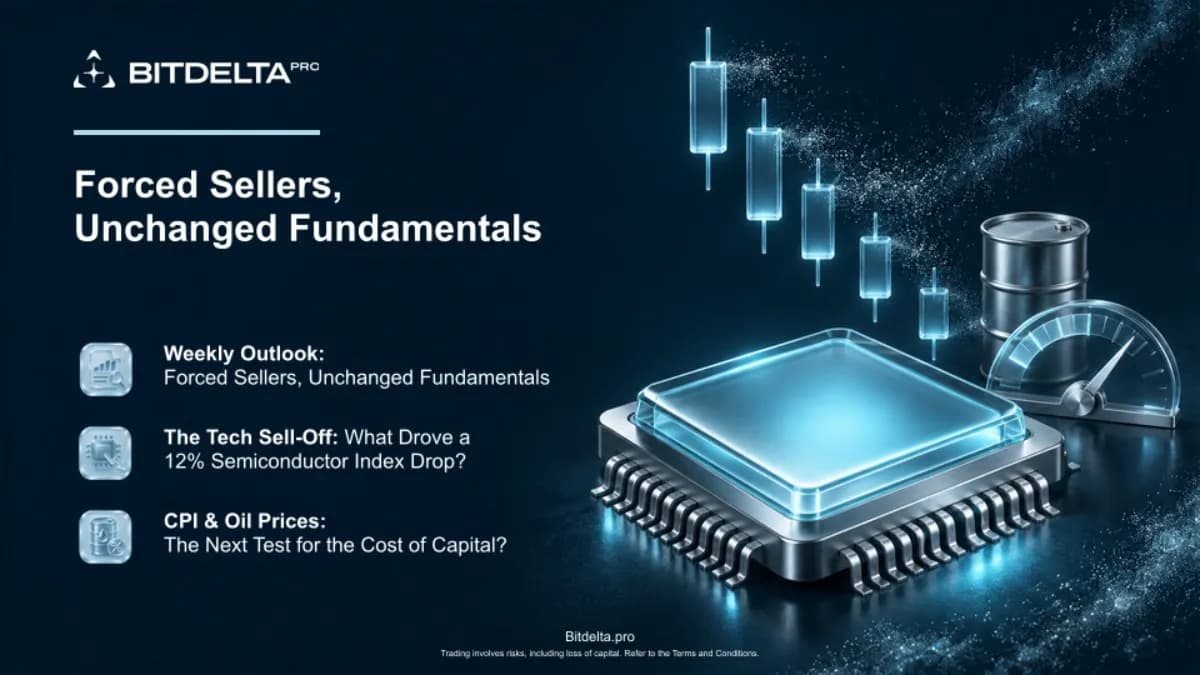
Last week delivered the worst day for US technology stocks in six years. On Thursday, November 5, the Philadelphia Semiconductor Index fell 12%, its steepest daily drop since 2020, the Nasdaq Composite fell 5.5% into correction territory and the S&P 500 fell 4.3%. Micron and AMD each lost more than 17% in a single session. Then on Friday, the same stocks bounced, after a jobs report that came in at more than double expectations.
Our read is that last week was about who was selling, not what changed. A sentiment shift after the hyperscaler results and the midterms met a wave of deleveraging from leveraged funds that owned the same crowded AI winners. The fundamentals we track, from cloud backlogs to Nvidia's guidance, did not move. What did move is the cost of capital question, and this week's inflation data and the Iran talks will both shape it.
The Yield Environment
| Metric | Current | Prior Week | Signal |
| Fed Funds Target | 3.75 - 4.00% | 3.75 - 4.00% | Next meeting December 9 |
| December Hike Odds | ~77% | ~66% pre-payrolls | Repriced on the jobs beat |
| 2-Year Treasury | 4.52% | 4.56% | -4 bps |
| 10-Year Treasury | 4.87% | 4.94% | -7 bps |
| 30-Year Treasury | 5.27% | 5.31% | -4 bps |
| 10-Year Real Yield (TIPS) | 2.63% | 2.66%* | Barely moved |
| 10-Year Breakeven | 2.23% | 2.34%* | Driving the rally |
| S&P 500 | 7,377 | 7,580 | -2.68% weekly |
| Nasdaq Composite | 24,579 | 25,437 | -3.37% weekly |
| Brent Crude | $98.32 | ~$118 | -16.4% weekly |
| Gold | $4,075 | ~$3,899 | +4.5% weekly |
Source: AP market closes (November 6, 2026), Treasury yields via Yahoo Finance, TIPS and breakeven data from U.S. Treasury via TIPSyield.com, CME FedWatch via Mitrade, commodity closes via Mitrade. *Real yield and breakeven prior values as of October 26. Prior-week Brent and gold approximate.
The bond market rallied, but look at why. From October 26 to November 6, the 10-year yield fell 14 basis points, and 11 of those came from lower inflation expectations as oil collapsed. The real yield, which is what matters for the cost of capital, fell only 3 basis points and still sits at 2.63%. Money did not get much cheaper for the companies spending the most on AI. That keeps the question of returns on capital versus the cost of capital squarely in front of investors.
Who Was Selling
The pattern in Thursday's sell-off points to forced selling rather than a change in the outlook. The stocks that fell hardest were the year's biggest winners and the most widely held by leveraged funds. Walleye Capital's June filing showed Micron, AMD and KLA among its largest positions; on November 5 those three fell 17.5%, 17.3% and 13.4%. Nomura's Charlie McElligott described the move as “shooting the generals”: funds selling their best performers to lock in the year and cut risk.
The pressure had been building through October, when the average hedge fund lost about 3%. Several large multi-manager firms are now cutting the stock-picking teams that owned these names.
| Fund | October | Action |
| Walleye Capital | -5.9% | Worst month since March 2020; restructuring its equity long-short unit and returning capital |
| Engineers Gate | -5.5% | Cut most of its Synthesis stock team; kept five fundamental managers |
| Marshall Wace (Eureka) | -5.4% | Not disclosed |
| Balyasny | -3.4% | Removed its equity long-short chief |
| Millennium (flagship) | -2.3% | Not disclosed |
| Citadel (Wellington) | +1.7% | Up 15.3% for the year |
Source: 24/7 Wall St (November 6, 2026), TokenPost (November 7, 2026), citing investor letters and media reports.
Retail investors added to it. Vanda Research estimates individuals sold a net $358 million of US stocks on Thursday, their biggest selling day since 2020, which it called “total capitulation.” When leveraged funds and retail investors sell the same stocks on the same day, prices can fall far further than any change in the business would justify. That also means the selling can stop as abruptly as it started, which is what Friday's 1.1% Nasdaq bounce began to show.
What Did Not Change
The hyperscaler results that started the slide did not show weak demand. Google Cloud reported a backlog of $561 billion and AWS one of $578 billion. Azure grew 48%. The market was disappointed that capex guidance was not raised again, but after the increases announced earlier in the year, spending is already at levels few expected 12 months ago. Not raising it a third time is not the same as cutting it.
Nvidia's guidance is the clearest example. In August it guided third-quarter revenue to $108 billion, well above the roughly $104 billion consensus, and that guide assumes no data-centre revenue from China at all. Nothing in last week's sell-off changed that number. With backlogs of this size, a large part of the next two years of AI revenue is already contracted. The debate is about the returns on that spending, not whether the demand exists.
Memory: Mix Matters More Than Ever
Memory took the heaviest hit, and it is where the debate is loudest. The skeptics' case centres on Micron's long-term agreements with customers. A widely shared post last week argued these contracts are “basically meaningless” once prices fall, because customers broke similar agreements in past downturns. That history is real: in the 2022-23 downturn, Micron's gross margin fell from 45% to roughly zero.
This cycle has more protection than the last. The agreements include take-or-pay volumes, minimum prices and, in some cases, letters of credit Micron can draw on. Customers paid $12.75 billion in prepayments in fiscal 2026. Micron discloses about $134 billion of remaining performance obligations, though only about $34 billion of that falls due in the next 12 months, so the contracted floor is smaller than the headline. Revenue is recognised as Micron delivers, which is why new fabs coming online matter as much as the contracts themselves.
Our view is that the trough for this memory cycle is structurally higher than in past cycles, whether or not every agreement holds. AI models are getting more capable on better chips, and better chips need more and faster memory. The longer-term demand from robotics and autonomous vehicles adds to that, though it is a story for the next decade rather than next year's prices. A higher floor for demand does not guarantee today's margins, since supply will respond, but it changes how deep the next downturn can go.
In the near term, product mix is what separates the winners. The suppliers with the largest share of the newest high-bandwidth memory carry the best pricing, and the shift of capacity toward those products is also what tightened supply of older memory. If hyperscaler capex has plateaued, the way to win a larger share of it is to offer the best technology first. The test comes with Micron's next report in mid-December: if contracted revenue due within 12 months grows from $34 billion, the agreements become much harder to dismiss.
CPI, Iran and the Cost of Capital
Tuesday's October CPI carries more weight than usual. Because prices were not collected during last year's government shutdown, this release will show only monthly changes, with no official year-on-year figure. Consensus expects headline CPI to rise 0.3% and core 0.2%, down from 0.6% and 0.3% in September. Forecasts range from 0.19% (Morgan Stanley) to 0.3% (ING). We expect a print in line with consensus.
The core number decides December. A core reading of 0.2% or below would likely pull hike odds under 70%. A reading of 0.3% or above would all but lock in a hike, and a hot headline alongside it would raise the risk that December is not the last. The Fed is not alone: the Bank of England raised rates to 4% last week, its first hike since 2023, and the Reserve Bank of Australia lifted its cash rate to 4.85%.
Inflation expectations are where Iran comes in. Brent fell 16.4% last week to $98.32, its biggest weekly drop since 2020, as markets priced a deal after the midterms. Qatar says US-Iran talks are alive and President Trump meets the Qatari prime minister on Monday to discuss a ceasefire and nuclear talks. But Secretary of State Rubio called the talks unproductive, and disruption in the Strait of Hormuz continues. We do not see the underlying situation as changed. Markets remain headline-driven, and the new Congress's appetite for funding or curbing the war is unknown until it takes its seats in January.
This matters for equities through the cost of capital. If oil rebounds on a failed deal, breakevens rise again and the bond rally unwinds. For the hyperscalers, which are making the largest capital commitments in corporate history, a higher cost of capital raises the return their AI spending must earn. That calculation, returns on invested capital against the cost of capital, is one the market has only started to price.
Nvidia: Governance Risk, Unchanged Numbers
Over the weekend, Nvidia CEO Jensen Huang been embroiled in a personal courtesy. Nvidia's board has opened an independent investigation with outside counsel, following reports that Huang was targeted by a Chinese intelligence operation. Those reports rest on a memo circulated among US policymakers alleging she was recruited by China's Ministry of State Security, which has not been verified. The board said it has “no reason to believe” national security or company secrets were compromised.
This is a real governance risk and will make the stock volatile until the investigation reports. Huang is unusually central to Nvidia, and any finding that touches national security would carry regulatory consequences. But the business has not changed. Nvidia has sold almost nothing to China since export controls tightened, its guidance already excludes China, and it continues to beat estimates. Investors will get the numbers when Nvidia reports its third quarter next week.
The Week Ahead
| Day | Data and Events | Earnings |
| Mon Nov 9 | Trump meets Qatari PM on Iran | Rocket Lab, Take-Two (after close) |
| Tue Nov 10 | October CPI (no year-on-year figure) | CoreWeave (after close) |
| Wed Nov 11 | Veterans Day: bond market closed, stocks open | Franco-Nevada |
| Thu Nov 12 | Nebius (before open); Cisco, Applied Materials, Cerebras (after close) | |
| Fri Nov 13 | October PPI | SMFG, MUFG (before open) |
Source: TradingKey, Mitrade, Investinglive. Report dates subject to change.
CoreWeave and Nebius report on the neocloud layer that rents AI capacity to the hyperscalers, and Applied Materials on demand for chip-making equipment. After last week, the market will judge all three on guidance and on how much capital their plans require.
What We Are Watching
Whether the forced selling is over. Friday's bounce in the most crowded names is a start. Further fund restructurings could bring more selling, but crowded positions that have already been cut cannot be sold twice.
Core CPI versus 0.2%. The swing factor for December. At or below 0.2%, hike odds fall; at 0.3% or above, a hike is close to certain.
Real yields, not just nominal. A bond rally driven by breakevens does not lower the cost of capital. A fall in the 2.63% real yield would.
Iran headlines and Brent near $100. A deal could push oil lower and support bonds; a breakdown would reverse last week's 16% drop quickly.
The Nvidia investigation. Any finding on national security matters more than the personal story. Third-quarter results next week will show whether the numbers still lead.
Micron in December. Growth in contracted revenue due within 12 months is the cleanest test of the long-term agreements.
Last week the market was driven by who had to sell. This week it will be driven by what inflation and Iran do to the cost of capital. The AI build-out has not slowed; what has changed is how much investors will pay for it while that cost stays high.
Research | BitDelta Pro
Dubai, UAE
Disclaimer
BitDelta Securities Financial Services LLC, regulated by the Capital Market Authority under Category 5 (Introduction Only), acts solely as an introducer and does not provide trading, execution, dealing, advisory, portfolio management services. All trading, execution, and investment-related services are provided by BitDelta Limited, Mauritius, a licensed Investment Dealer excluding underwriting.
All trading and investments involve risk. The value of investments may fluctuate, and you may receive less than your initial investment.
Information has been obtained from publicly available sources believed to be reliable; however, accuracy and completeness are not guaranteed. Any forecasts, estimates, or forward-looking statements are based on current assumptions and are subject to change without notice.
This publication is prepared and distributed by BitDelta Limited, Mauritius. This publication constitutes general market commentary only and does not constitute investment research, investment advice, financial promotion, personal recommendation, or a solicitation to transact in any financial instruments.
Appendix: Sources
Markets and Hedge Funds
AP via Yahoo Finance: How Major US Stock Indexes Fared, Friday 11/6/2026
Yahoo Finance: Stock Market Today, November 5 Chip Stock Meltdown
24/7 Wall St: A $17 Billion Hedge Fund Is Handing Back Cash
TokenPost: Hedge Funds Cut Stock Teams After October Losses
Rates, Inflation and Central Banks
Yahoo Finance: Strong October Jobs Report Sends Yields Higher
TIPSyield: 10-Year TIPS Real Yield and Breakeven
Mitrade: The CPI That Has No Year-Over-Year Number
Continuum Economics: Preview, US October CPI
Investment Week: Bank of England Hikes Rates to 4%
Savings.com.au: RBA Lifts Cash Rate to 4.85%
Commodities and Iran
Mitrade: Weekly Commodity Report, Gold Up 4.5%, Brent Down 16.4%
Globe and Mail: Brent Set for Biggest Weekly Drop Since 2020
Investinglive: Qatar Says US-Iran Talks Alive as Trump Meets Qatari PM
Companies
TIKR: Why Micron’s Supply Deals Are “Basically Meaningless” Once Prices Fall
SentiSense: NVIDIA Guides to $108 Billion With Zero China Revenue Assumed
TechCrunch: Nvidia Investigating CEO’s Relationship With Possible Chinese Spy
Washington Post: Nvidia Board to Investigate CEO
TradingKey: Week Ahead, October CPI, PPI, CoreWeave, Cisco and Applied Materials
Institutional multi-asset market access across MT5 Ultency, CQG, Iress Pro and BitDelta Terminal, with transparent execution standards and global market coverage.

Select the categories and companies you wish to follow directly to your person rss feed.
Create Custom RSS FeedSign up and join over 5,000 professional members who receive personalized news alerts, curated professional connections, and more for free!
Last week delivered the worst day for US technology stocks in six years. On Thursday, November 5, the Philadelphia Semiconductor Index fell 12%, its steepest daily drop since 2020, the Nasdaq Composite fell 5.5% into correction territory and the S&P 500 fell 4.3%. Micron and AMD each lost more than 17% in a single session. Then on Friday, the same stocks bounced, after a jobs report that came in at more than double expectations.
Toxic flow doesn’t only hit B-book brokers. In an STP model it shows up as wider spreads, more rejections and strained LP relationships. This guide explains what toxic flow really is, what it costs, the 35 patterns professional dealing desks monitor, and the practical steps to detect it and protect your brokerage.
The Monetary Authority of Singapore has launched a central bank gold vaulting service for foreign central banks, international financial institutions and sovereign entities, using a national vault that can hold up to 500 tonnes, and announced an enhanced GST framework for wholesale gold activities from April 2027.
24X Bermuda Limited has expanded its partnership with Standard Chartered to include digital assets prime brokerage, enabling Bitcoin and Ethereum trading on its multi-asset platform. Standard Chartered acts as central counterparty, with 24X running the execution-only platform for institutional crypto and FX products.
Learn how a demo trading account works, why beginners use it before live trading, and how to practice with virtual funds using a simple five-step guide.
Bitcoin faces resistance at $76,800–$80,800. Explore the BTCUSD bearish setup toward $71,000 and the bullish break-and-retest scenario targeting $86,500.
Raj Sitlani, Jonathan Brewer and Jeff Wilkins have launched JT Prime, a new institutional Prime of Prime business offering aggregated Tier 1 multi-asset liquidity to brokers, funds, family offices and proprietary trading firms, with a regulatory application pending and digital assets planned beyond FX and commodities.
The update adds strategy promotion, cross-platform sharing and guest browsing to STAR Copy.
GTN has appointed former Gemini and Kraken executive Mark Jennings as global head of digital assets, a new role leading its tokenisation strategy as more platforms bring traditional assets on-chain. Jennings previously led Gemini Europe and Crypto Facilities, Kraken’s FCA-regulated institutional derivatives venue.
The Central Bank of Nigeria (CBN) has issued regulations that require issuers of foreign currency stablecoins used by Nigerians to incorporate locally.