On Saturday, August 15, Iranian Foreign Minister Abbas Araqchi said Washington would have to meet Tehran's conditions before normal shipping through the Strait of Hormuz could resume.
One day later (that would be Sunday), Kpler registered zero commodity-vessel transits through the strait after tracking only five on Saturday, versus 31 across the previous weekend.
Yet on Monday, August 17, Brent was still trading around $89 and U.S. equity futures were higher. That is the contradiction behind the markets: the physical energy picture has worsened faster than the equity market has reacted.
The story moved from rhetoric to physical evidence
On Thursday, August 13, U.S. Defense Secretary Pete Hegseth said the Navy could maintain its blockade of Iran "indefinitely", rotating ships as needed.
Treasury Secretary Scott Bessent said Washington was preparing further measures against Tehran.
The UAE also reported attacks on ADNOC vessels transiting Hormuz.
Araqchi's Saturday condition then gave the shipping slowdown a political constraint: the Oman-Iran navigation work may provide a technical mechanism for traffic, but Tehran is still linking a normal reopening to wider U.S. concessions.
In other words, a shipping-lane framework is not the same thing as a political settlement.
Despite that, the market may still be right to avoid pricing a full supply choke. ADNOC said on Monday that it had sold at least 14 million barrels of spot crude to Asian refiners, and analysts argued that crude may struggle to move materially higher unless the remaining flows through Hormuz stop more completely or Bab el-Mandeb deteriorates further.
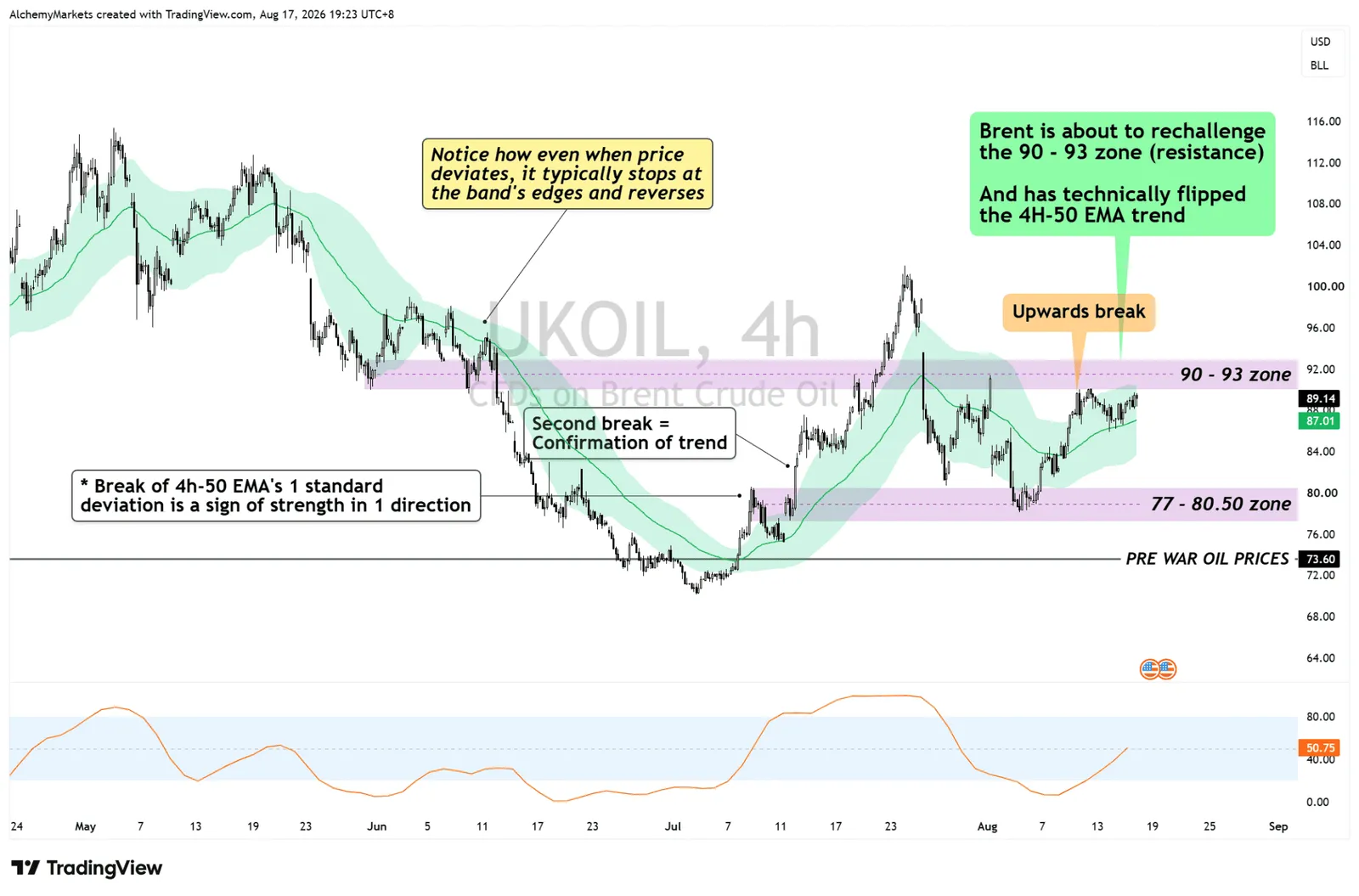
| Chart 1. Brent crude (UKOIL), 4-hour. Price has moved back above the 4H 50-EMA trend and is approaching the 90-93 resistance zone. The 77-80.50 area remains the nearer support reference. |
That is also what the Brent chart is saying. Price has reclaimed its 4 hour 50-EMA bollinger bands and is moving back toward the 90-93 resistance zone.
However, that move admittingly is looking weak, and without a clean breakout in the picture, crude oil remains suppressed.
A break above would be a stronger sign that the physical disruption is finally overcoming the market's managed-disr...