

August PPI rose 0.4% month-on-month, right in line with expectations. On the surface, that sounds fairly harmless.
So was it a relief? Not really.
If you look at the fine print, final-demand goods rose 1.1%, energy jumped 4.2%, while transportation and warehousing services rose 2.3%.
These are exactly the kinds of costs that can eventually work their way into consumer prices through fuel, freight and distribution costs.
Markets did not exactly treat PPI as an all-clear either. The S&P 500 fell 0.76%, the Nasdaq 100 fell 1.14%, while the Dow slipped 0.93%.
So what should we expect from CPI?
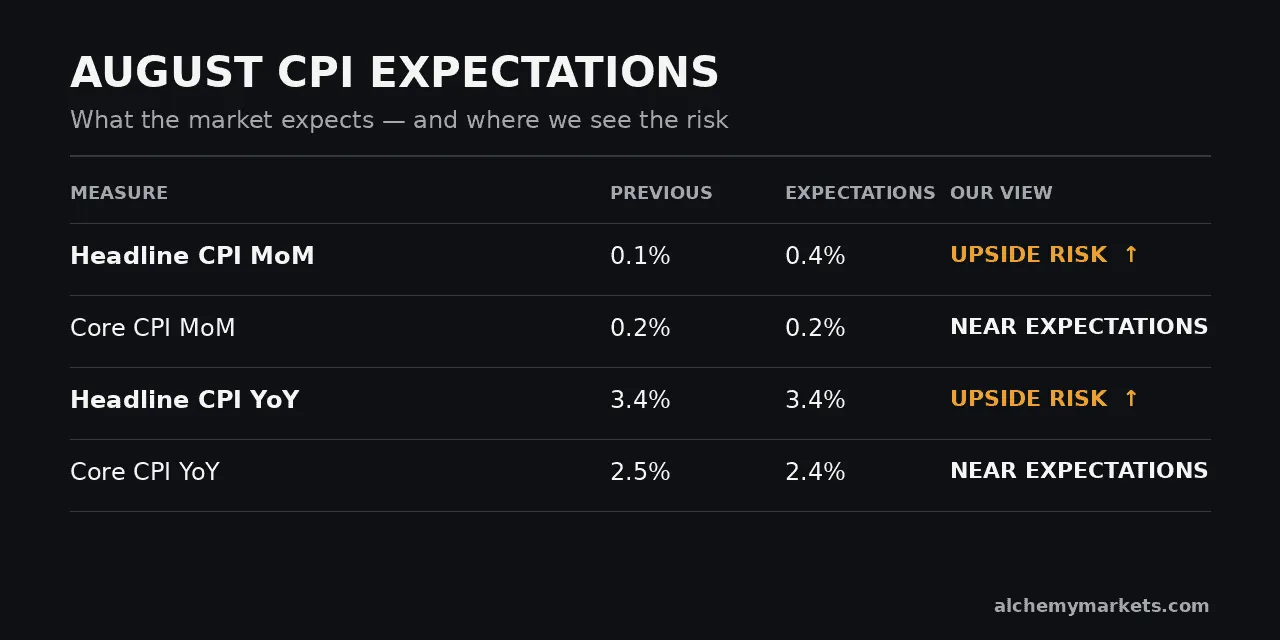
Energy’s 4.2% jump gives us a reason to lean slightly higher on headline CPI inflation, which is currently expected to come in at 0.4% month-on-month and 3.4% year-on-year.
Core CPI is a little less obvious. Expectations are for 0.2% month-on-month and 2.4% year-on-year.
For now, our base case is still close to that.
Nick Timiraos from The Wall Street Journal points out the median core CPI estimate from various American financial institutions is actually 0.22%.
All 17 forecasts range from 0.16% to 0.24%, yet every one of them still rounds to 0.2%.

So if core CPI lands at 0.2%, it is worth looking one layer deeper. A reading near 0.24% is a different inflation signal from 0.16%, even if both show up as the same number on the calendar.
He also notes that the PPI components feeding into core PCE were firm.
More in-depth analysis on alchemymarkets.com.