just now


Liquidity Finder Ltd is incorporated in England and Wales, company number 10610740, registered address 167-169 Great Portland Street, Fifth Floor, London W1W 5PF, United Kingdom.
Published: just now


There’s something brewing beneath the surface, something bigger than just short-term noise. Over the past couple of weeks, we’ve witnessed a rare alignment: the US dollar falling sharply, equities retreating, and Treasury yields rising. That trifecta signals more than volatility it suggests we may be staring into the early phases of a confidence crisis in US assets.
To be clear, this isn’t just about currency moves or speculative trading. It’s about global investors starting to question the very underpinnings of the US macroeconomic and policy environment. And that could reshape the FX landscape for months ahead.
Let’s start with what triggered the market tremors: the Trump administration’s aggressive tariff hike on Chinese imports 145%, to be exact. Beijing didn’t hesitate to respond, raising its own to 125%. These aren’t just numbers; they represent a tectonic shift in global trade dynamics. The risk here isn’t just about bilateral tensions it’s about systemic shock to supply chains, corporate margins, and inflation expectations worldwide.
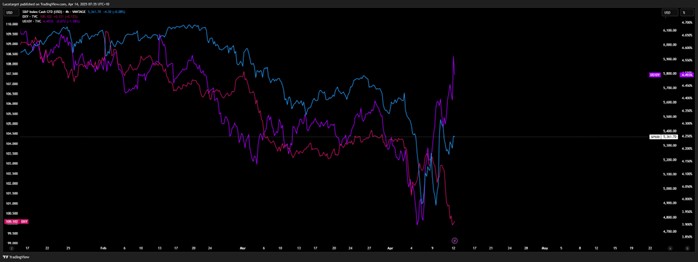
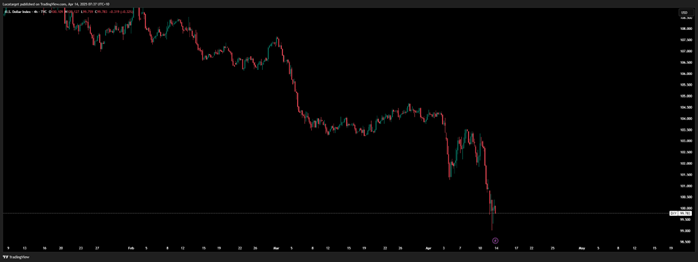
The S&P 500 fell over 7% since early April, and the DXY dollar index has dropped to levels not seen since the early days of the Russia-Ukraine war. This time, however, yields have moved higher, not lower further cementing the notion that confidence is cracking, not just in the currency, but in the broader US macro framework.
While some are asking whether the Fed will step in to calm bond markets, the reality is more sobering. This is not your classic exogenous shock. The current disarray has been largely self-inflicted. The Fed has already slowed the pace of quantitative tightening, and while ending QT entirely might be on the table, a return to QE feels like a stretch especially with inflation risks still lingering.
In fact, it’s becoming clear that monetary policy alone won’t restore order. Until there’s a shift in fiscal posture be it a walk-back on tariffs, or clarity on US debt sustainability—any Fed action would likely have limited impact.
There’s a growing narrative that this dollar weakness might not be accidental. The recent buzz around Stephen Miran’s “Mar-a-Lago Accord” proposal has drawn attention. While not official policy, the idea of realigning the global trade system through a weaker dollar lens seems to be gaining traction within Trump’s orbit. The question is whether markets are now pricing in the possibility that a softer dollar is part of the plan.
If that perception grows, we could see extended dollar declines, especially in a context where policymakers refuse to send a clear “strong dollar” message.
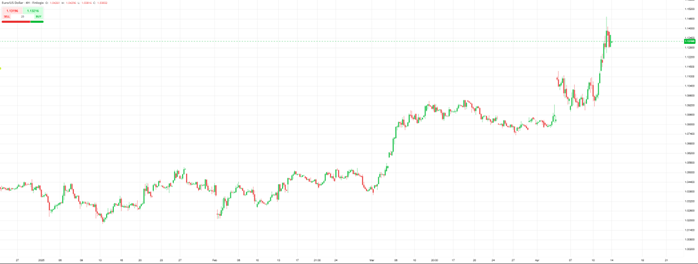
With capital flowing out of US assets, where is it going? The euro and the Swiss franc are clearly in demand. EUR/USD has blasted through prior resistance and could soon test levels not seen since early 2022. Even with the European Central Bank expected to cut rates again this week, the EUR remains well supported proof that yield spreads are no longer the dominant driver.
As for the CHF, the story is even more striking. USD/CHF has fallen to its lowest level since 2011. The Swiss National Bank now finds itself in a corner, with inflation still subdued and the currency surging. Intervention might be their next step negative rates are on the table again, though still seen as a last resort.
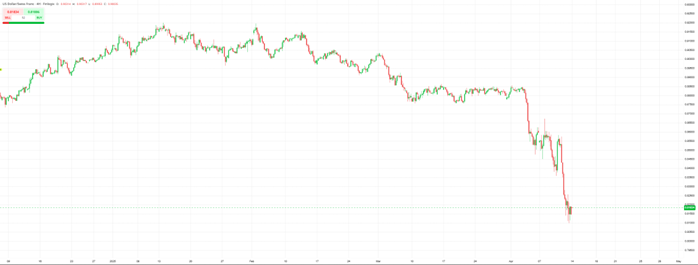
Japan is also attracting safe-haven flows, with the yen benefiting from both risk aversion and improving domestic yields. Japanese investors may have been net sellers of foreign bonds recently, but foreign buyers have returned to the JGB market in size—a sign that capital preservation is taking priority.
While the USD sell-off has extended to the broader G10, not every currency is reaping the same benefits. The AUD, NZD, NOK, and SEK continue to show more erratic patterns, caught in the tug-of-war between commodity volatility and global growth anxiety.
The RBA, for instance, held rates steady at 4.10% in its latest meeting, signalling caution despite moderating inflation. Yet with Trump’s tariff bombshell raising new recession risks globally, Australia’s interest rate path remains uncertain. Markets are already pricing in a cut by May, and all eyes will be on the next CPI report to see if that dovish turn materializes.
CFTC data reveals a notable trend: leveraged funds have cut back on long USD positions for nine straight weeks the longest streak in over a decade. Instead, we’re seeing renewed appetite for EUR, JPY, and even GBP, albeit cautiously. This kind of shift in positioning often precedes a sustained move not just a blip.

In portfolio terms, safe-haven demand is showing up clearly in trades like short NOK/JPY. The trade war narrative, paired with falling oil prices and increased OPEC+ supply, has put the NOK under pressure, while the JPY rides the wave of de-risking. Expect this theme to continue unless we see a meaningful shift in tone from Washington or signs of de-escalation from Beijing.
The key takeaway is this: we are entering a phase where the dollar is no longer benefiting from its traditional safe-haven role. The market is repricing not just risks, but fundamentals. Fiscal uncertainty, trade aggression, and political gridlock are now the dominant themes—overshadowing yield differentials or rate path assumptions.
Unless the US makes a clear policy, pivot be it on tariffs, fiscal discipline, or dollar communication the path of least resistance for the greenback remains lower. In this context, the EUR, CHF, and JPY are likely to remain in favour.
For traders and strategists, this is no time to rely on outdated playbooks. We’re in a macro environment where capital allocation decisions are being reshaped by geopolitical noise, fiscal dysfunction, and the erosion of US policy credibility. Navigate it wisely.
This content may have been written by a third party. ACY makes no representation or warranty and assumes no liability as to the accuracy or completeness of the information provided, nor any loss arising from any investment based on a recommendation, forecast or other information supplies by any third-party. This content is information only, and does not constitute financial, investment or other advice on which you can rely.
ACY Securities is one of Australia's fastest growing multi-asset online trading providers, offering ultra-low-cost trading, rock-solid execution, technologically superior account management and premium market analysis.

Select the categories and companies you wish to follow directly to your person rss feed.
Create Custom RSS FeedSign up and join over 5,000 professional members who receive personalized news alerts, curated professional connections, and more for free!
Multi-asset trading broker AvaTrade has agreed to acquire the majority of FXCM Group’s business and brand, in a transaction that would bring a longstanding retail FX franchise into the AvaTrade Group.
LSEG and CMC Markets have signed a multi-year strategic data agreement expanding CMC's access to LSEG's real-time and delayed pricing, reference and corporate actions data, news and analytics, plus AI-ready content, to support new products, entry into new markets and the growth of CMC's institutional and B2B partnerships.
The Tel Aviv Stock Exchange is considering a bid for the Cyprus Stock Exchange, with Israeli media citing its EU licence, trading platform and clearing house. Euronext’s Athens exchange and India’s National Stock Exchange are also seen as contenders, and Cyprus aims to sign a sale agreement by the end of this year.
CME Group will launch baseball futures on 12 October, pending regulatory review, tracking CME FutureSports Performance Indexes built on Official League Data. Standard and micro contracts will start with the 2026 Postseason and the four clubs in the League Championship Series, trading around the clock.
ESMA has published an opinion stating that MiCA-authorised crypto-asset service providers should cease services tied to non-MiCA-compliant stablecoins for EU clients across MiCA crypto-asset services. National authorities should require remediation of existing exposures within three months, by early January 2027.
Nasdaq Ventures has made a strategic investment in Amsterdam-based derivatives and crypto exchange One Trading, with both firms to explore 24/7 trading of equity futures. The undisclosed investment follows Nasdaq's US$100 million investment in Payward, the parent of Kraken, and CME Group's move to 24/7 trading.
cTrader has opened multi-platform plugins to brokers and prop firms, which can pre-install their own tools for clients or list them in cTrader Store. The plugins run across Mobile, Web, Windows and Mac, and can be built and launched independently of core-platform releases, including trading journals and calculators.
Institutional brokerage and financial infrastructure provider Clear Street has joined TradingView’s broker network, allowing its clients to trade US stocks, exchange-traded funds and options directly through the charting and analysis platform.
Learn how to improve trading psychology, manage fear and greed, avoid revenge trading, and follow your trading strategy with discipline and a trading journal.
GTC Prime has announced a strategic partnership with Centroid Solutions to manage and distribute its liquidity through CS 360 Bridge, Centroid's multi-asset connectivity and execution engine, giving brokers and institutional clients access to tailor-made pricing, low-latency execution and real-time risk management.