just now

Liquidity Finder Ltd is incorporated in England and Wales, company number 10610740, registered address 167-169 Great Portland Street, Fifth Floor, London W1W 5PF, United Kingdom.
Published: just now

As global trade tensions tense up again, the question arises: do tariffs still carry the same economic weight? With threats of duties ranging from 10% to 70% on numerous trading partners—and Vietnam already facing doubled tariffs—the spotlight is squarely back on the effectiveness and consequences of protectionist trade policy.
Recent spikes in tariff rhetoric seem to attract less shock than they used to. Markets have grown accustomed to last-minute threats ahead of negotiation deadlines. As a result, some volatility (for instance in FX risk premiums) has surfaced—but the expectation remains that upcoming tariff renegotiation deadlines will likely pass without major incident.
The average U.S. tariff rate, currently hovering around 14%, appears to be seen more as a ceiling than the start of a new round. The general consensus? Another gradual escalation is unlikely unless talks completely stall.
From a fiscal lens, the short-term situation looks deceptively positive:
At the same time, many companies have front-loaded imports and filled warehouses under the assumption of future tariffs—giving them a window to absorb cost increases without passing them on to consumers, for now.
Don’t be lulled by calm consumer-price data—it could be deceptive. History shows it takes months for tariff-induced cost shocks to fully appear in inflation reports.
Now that inventory buffers are running low, a significant price impact seems imminent. Analysts expect inflation to pick up noticeably over the next few months—potentially reshaping expectations around monetary policy and pushing back anticipated rate cuts.
Tariff policy hasn’t just affected prices—it’s also subtly slowed growth. While headline indicators (like employment) may still look solid, indicators such as business sentiment and investment show growing caution.
Meanwhile, rising fiscal deficits—bolstered by recent government spending—risk raising financing costs. While bond markets have remained calm for now, any surge in inflation or heavy summer debt issuance could quickly unsettle investors.
Europe faces a double bind. A rising euro makes exports pricier and complicates the ECB’s efforts to maintain its inflation target. Any unexpected U.S. tariffs on EU goods would further reduce inflationary pressure, possibly prompting additional monetary easing.
With ECB commentary hinting at discomfort over currency strength, the euro’s trajectory has become more relevant to both trade and monetary strategy.
Here are the critical economic and policy events next week that may shift perspectives around tariffs, inflation, and central bank strategy:
| Date | Event | Why It Matters |
|---|---|---|
| Monday–Wednesday | FOMC Meeting Minutes | Insights into how open the Fed is to delaying easing due to rising cost pressures. |
| Tues–Thurs | U.S. Export-Import & Inventory Reports | Hard data on whether companies still have stockpiles or begin passing on costs. |
| Wednesday | Durable Goods Orders | Signals on business investment and manufacturers’ pricing outlook. |
| Thursday | Eurozone Retail Sales + Sentiment Surveys | Helps assess the eurozone economy’s resilience under uncertainty. |
| Friday | U.S. Core PCE Deflator (June) | Official inflation gauge—potential early sign of upward tariff-driven pressures. |
| Ongoing | Market Reaction to Currency Moves | Fluctuations in EUR/USD and USD dynamics will test central bank communications. |
Tariffs may have lost some of their headline punch, but their economic effects remain growing under the surface. As inventory buffers deplete and inflation begins to heat up, both central banks and traders will recalibrate, potentially shifting the outlook on rate policy and growth.
Watch next week’s data closely—especially manufacturing, inventory, and inflation releases—they could be the trigger points that set the tone for the next phase of global economic policy.
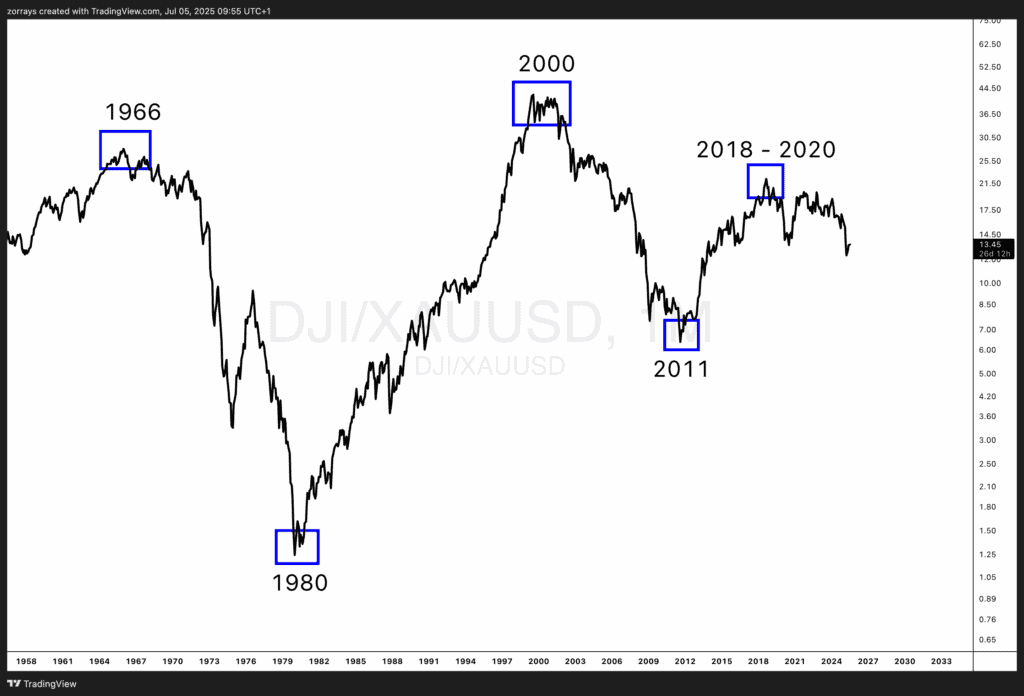
The Dow/Gold (DJI/XAUUSD) ratio chart reveals critical cyclical turning points where equities relative to gold either peaked or bottomed, often around major macroeconomic inflection points. Let’s break down the boxed areas:
These turning points underline how the Dow/Gold ratio is highly sensitive to monetary policy, inflation expectations, and macro confidence cycles. Each reversal often marks a broader capital rotation—from risk assets to safety, or vice versa.
The Dow-to-Gold ratio continues to be a powerful macro signal for assessing long-term shifts in investor preference between equities and hard assets. Historical turning points—highlighted on the chart—have consistently coincided with major economic regime changes, from stagflation and monetary tightening to tech bubbles and systemic crises. These inflection zones show how capital moves in cycles between risk-on and risk-off assets depending on inflation trends, policy shifts, and macroeconomic sentiment.
Looking ahead, the base case suggests the ratio is poised to climb further. With equity markets regaining strength, gold losing short-term momentum, and the U.S. economy showing surprising resilience, conditions increasingly favor stocks over gold. While geopolitical and debt-related risks remain, the recent easing of trade tensions and fading inflation concerns are encouraging capital to rotate back into growth assets—setting the stage for a continued rise in the Dow-to-Gold ratio.
Alchemy Markets is a multi-asset brokerage providing retail traders with the same elite trading conditions, tools, and transparency typically reserved for institutions.

Select the categories and companies you wish to follow directly to your person rss feed.
Create Custom RSS FeedSign up and join over 5,000 professional members who receive personalized news alerts, curated professional connections, and more for free!
Multi-asset trading broker AvaTrade has agreed to acquire the majority of FXCM Group’s business and brand, in a transaction that would bring a longstanding retail FX franchise into the AvaTrade Group.
LSEG and CMC Markets have signed a multi-year strategic data agreement expanding CMC's access to LSEG's real-time and delayed pricing, reference and corporate actions data, news and analytics, plus AI-ready content, to support new products, entry into new markets and the growth of CMC's institutional and B2B partnerships.
The Tel Aviv Stock Exchange is considering a bid for the Cyprus Stock Exchange, with Israeli media citing its EU licence, trading platform and clearing house. Euronext’s Athens exchange and India’s National Stock Exchange are also seen as contenders, and Cyprus aims to sign a sale agreement by the end of this year.
CME Group will launch baseball futures on 12 October, pending regulatory review, tracking CME FutureSports Performance Indexes built on Official League Data. Standard and micro contracts will start with the 2026 Postseason and the four clubs in the League Championship Series, trading around the clock.
ESMA has published an opinion stating that MiCA-authorised crypto-asset service providers should cease services tied to non-MiCA-compliant stablecoins for EU clients across MiCA crypto-asset services. National authorities should require remediation of existing exposures within three months, by early January 2027.
Nasdaq Ventures has made a strategic investment in Amsterdam-based derivatives and crypto exchange One Trading, with both firms to explore 24/7 trading of equity futures. The undisclosed investment follows Nasdaq's US$100 million investment in Payward, the parent of Kraken, and CME Group's move to 24/7 trading.
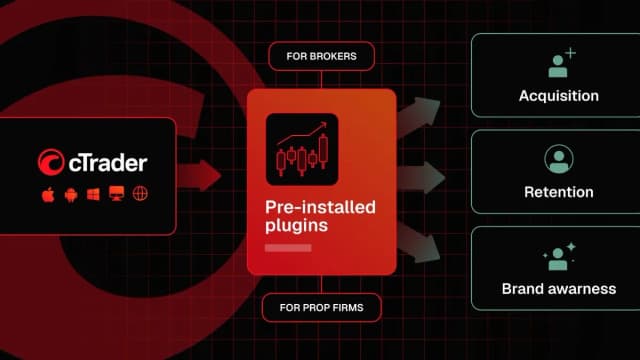
cTrader has opened multi-platform plugins to brokers and prop firms, which can pre-install their own tools for clients or list them in cTrader Store. The plugins run across Mobile, Web, Windows and Mac, and can be built and launched independently of core-platform releases, including trading journals and calculators.
Institutional brokerage and financial infrastructure provider Clear Street has joined TradingView’s broker network, allowing its clients to trade US stocks, exchange-traded funds and options directly through the charting and analysis platform.
Learn how to improve trading psychology, manage fear and greed, avoid revenge trading, and follow your trading strategy with discipline and a trading journal.
GTC Prime has announced a strategic partnership with Centroid Solutions to manage and distribute its liquidity through CS 360 Bridge, Centroid's multi-asset connectivity and execution engine, giving brokers and institutional clients access to tailor-made pricing, low-latency execution and real-time risk management.