just now


Liquidity Finder Ltd is incorporated in England and Wales, company number 10610740, registered address 167-169 Great Portland Street, Fifth Floor, London W1W 5PF, United Kingdom.
Published: just now

The week the market stopped paying any price for a perfect story.
For the better part of a year, the S&P 500 has run on a single engine: artificial intelligence, and the belief that the spending behind it has no ceiling. Every quarter the numbers got bigger, every dip got bought, and the index climbed a clean channel from the April low near 6,300 all the way to a record print above 7,600. Then, in the space of 48 hours, the market was handed two of the things it had been quietly counting on — and sold them both.
That is the story worth telling this week. Not that stocks fell, but why they fell, and what it says about the year ahead.
The first crack came from Broadcom. On the surface the quarter was a triumph: second-quarter revenue of $22.19 billion, up 48% from a year earlier, with AI chip sales reaching $10.8 billion, a 143% increase. By any normal standard, that is a blowout. And yet the stock fell roughly 14% in after-hours trading. The reason is the tell. Management guided next-quarter AI chip sales to about $16 billion versus the roughly $17.2 billion some analysts expected, and crucially kept its full-year AI target unchanged rather than raising it. The number was extraordinary. The problem was that the market had already priced more than extraordinary. When the full-year math landed at $56 billion rather than higher, traders read it as a ceiling rather than a floor.
The second crack came from the labour market — but in reverse. On Friday, nonfarm payrolls jumped a seasonally adjusted 172,000 in May, far above the consensus estimate for 80,000, with the unemployment rate holding at 4.3%. A strong economy should be good news. The catch is what it does to the Fed. A labour market this resilient reduces the urgency for near-term rate cuts, suggesting a prolonged period of stable rates — and high-valuation stocks faced downward pressure as a result. Good news for Main Street, bad news for a market that had been leaning on cheaper money to justify rich multiples.
Put them together and you get the real theme: the market is no longer being rewarded for good. It needs perfect, and it needs it cheap. Broadcom proved that even a 143% growth print can disappoint when expectations run ahead of reality. The jobs report proved that the rate-cut cushion stocks were resting on is thinner than hoped. Two different sources, one message — the margin for error has gone.
Step back and this looks less like a single bad week and more like the first real test of the move off the April low. The entire rally from 6,300 has been a story of expanding belief: belief that AI capex compounds forever, belief that the Fed rides to the rescue at the first sign of trouble, belief that any pullback is a dip to be bought. Channels like the one SPX has traced don't break because the story turns false — they break when the story stops getting better. Broadcom's "unchanged" guidance and Friday's "too strong" payrolls are both, in their own way, the story failing to improve.
That doesn't make this a top. The bull case is still intact — AI bookings are contracted, not hoped for, and a resilient economy is a strange thing to be bearish about. But the easy phase, where price simply tracked the upper rail and nobody had to think, looks finished. From here the index has to earn its level rather than assume it. The question for the back half of 2026 is no longer "how high," it's "what price is fair" — and that is a far more two-sided conversation.
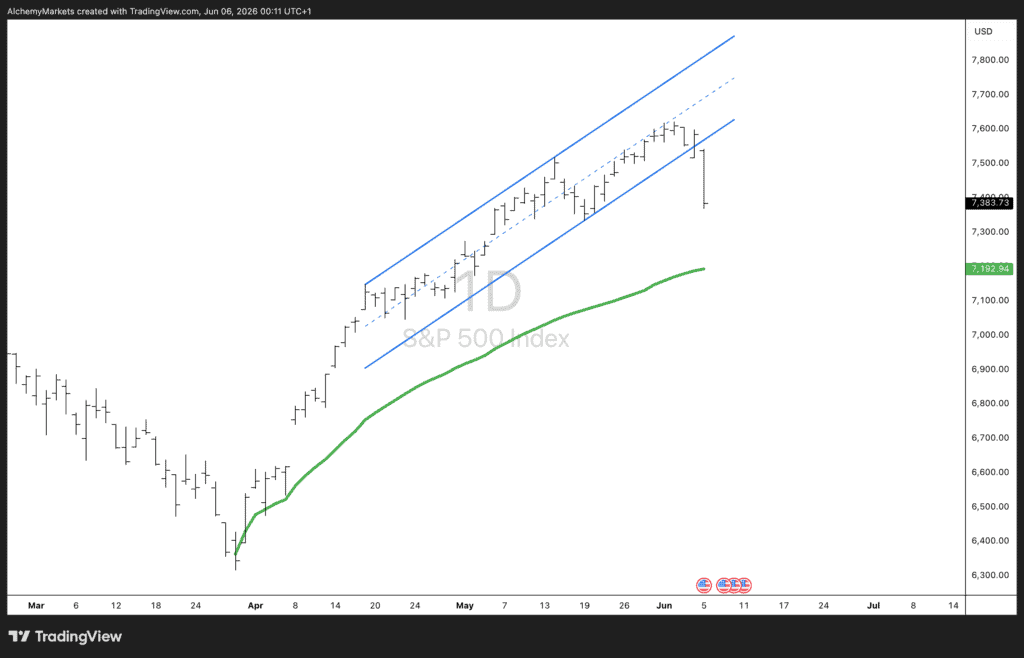
Price has just slipped out of the lower boundary of the rising channel that has guided the entire move since April, closing the week around 7,383. That break is the technical echo of the fundamental shift above — the trend isn't broken, but it's no longer effortless.
The level to watch is 7,400. It was support on the way up; it now sits just overhead as the first test of whether buyers step back in or sellers defend the breakdown. A clean rejection below 7,400 opens the door toward the anchored VWAP from the April low (the green line), which has tracked beneath this entire advance and currently sits near 7,200. That is the line the rally has never seriously challenged — and the most logical magnet if this turns into a genuine mean-reversion rather than a one-week wobble. Reclaim 7,400 convincingly and the breakdown reads as a shakeout; lose it and the VWAP becomes the conversation.
Chart: S&P 500 Index, Daily timeframe. Rising channel off the April low, anchored VWAP in green.
After the Broadcom-and-payrolls double-header, the calendar front-loads the quiet and back-loads the fireworks. Monday and Tuesday are bare. Then everything lands at once.
| DayEventWhy it matters | ||
| Mon 9 Jun | — | No major scheduled releases. |
| Tue 10 Jun | — | No major scheduled releases. |
| Wed 11 Jun | US CPI | The headline US event. After a hot payrolls print, a firm CPI would cement the "no cuts soon" read and pressure rate-sensitive growth names further. |
| Wed 11 Jun | China CPI | Read on global demand and the commodity complex; matters for risk appetite broadly. |
| Wed 11 Jun | Bank of Canada decision | A second G7 central-bank data point in the same week. |
| Thu 12 Jun | ECB rate decision + staff projections | Markets price ~91% odds of a 25bp hike to 2.25%. The projections and Lagarde's tone are the real catalyst, not the near-certain hike. |
| Thu 12 Jun | US PPI | Pipeline inflation read; confirms or complicates the CPI signal. |
| Fri 13 Jun | German final CPI | Confirms the euro-area inflation picture into the ECB. |
| Fri 13 Jun | UoM Consumer Sentiment (prelim) | Closes the week on the US consumer's mood and inflation expectations. |
The thread that ties it together: Wednesday's CPI is now the single most important release for US equities. Friday's jobs report told the Fed it can wait; a hot CPI would tell it it must wait. For an S&P 500 that just lost its channel on exactly that fear, the inflation print is the data that either rescues the dip or confirms the breakdown.
Alchemy Markets is a multi-asset brokerage providing retail traders with the same elite trading conditions, tools, and transparency typically reserved for institutions.
Select the categories and companies you wish to follow directly to your person rss feed.
Create Custom RSS FeedSign up and join over 5,000 professional members who receive personalized news alerts, curated professional connections, and more for free!
Multi-asset trading broker AvaTrade has agreed to acquire the majority of FXCM Group’s business and brand, in a transaction that would bring a longstanding retail FX franchise into the AvaTrade Group.
LSEG and CMC Markets have signed a multi-year strategic data agreement expanding CMC's access to LSEG's real-time and delayed pricing, reference and corporate actions data, news and analytics, plus AI-ready content, to support new products, entry into new markets and the growth of CMC's institutional and B2B partnerships.
The Tel Aviv Stock Exchange is considering a bid for the Cyprus Stock Exchange, with Israeli media citing its EU licence, trading platform and clearing house. Euronext’s Athens exchange and India’s National Stock Exchange are also seen as contenders, and Cyprus aims to sign a sale agreement by the end of this year.
CME Group will launch baseball futures on 12 October, pending regulatory review, tracking CME FutureSports Performance Indexes built on Official League Data. Standard and micro contracts will start with the 2026 Postseason and the four clubs in the League Championship Series, trading around the clock.
ESMA has published an opinion stating that MiCA-authorised crypto-asset service providers should cease services tied to non-MiCA-compliant stablecoins for EU clients across MiCA crypto-asset services. National authorities should require remediation of existing exposures within three months, by early January 2027.
Nasdaq Ventures has made a strategic investment in Amsterdam-based derivatives and crypto exchange One Trading, with both firms to explore 24/7 trading of equity futures. The undisclosed investment follows Nasdaq's US$100 million investment in Payward, the parent of Kraken, and CME Group's move to 24/7 trading.
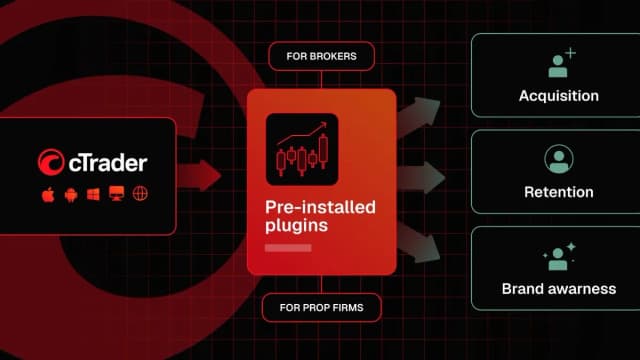
cTrader has opened multi-platform plugins to brokers and prop firms, which can pre-install their own tools for clients or list them in cTrader Store. The plugins run across Mobile, Web, Windows and Mac, and can be built and launched independently of core-platform releases, including trading journals and calculators.
Institutional brokerage and financial infrastructure provider Clear Street has joined TradingView’s broker network, allowing its clients to trade US stocks, exchange-traded funds and options directly through the charting and analysis platform.
Learn how to improve trading psychology, manage fear and greed, avoid revenge trading, and follow your trading strategy with discipline and a trading journal.
GTC Prime has announced a strategic partnership with Centroid Solutions to manage and distribute its liquidity through CS 360 Bridge, Centroid's multi-asset connectivity and execution engine, giving brokers and institutional clients access to tailor-made pricing, low-latency execution and real-time risk management.