just now


Liquidity Finder Ltd is incorporated in England and Wales, company number 10610740, registered address 167-169 Great Portland Street, Fifth Floor, London W1W 5PF, United Kingdom.
Published: just now

Friday’s session delivered the kind of volatility that defines October markets.
A single Truth Social post from Donald Trump announcing plans to impose an additional 100% tariff on Chinese imports - alongside export controls on critical U.S. software - sparked instant global panic.
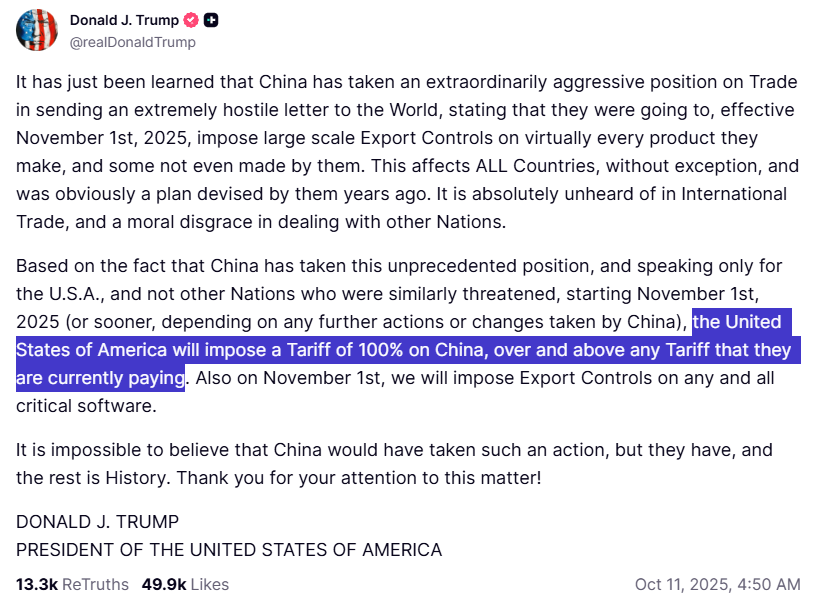
Within minutes, traders dumped risk assets. The Nasdaq 100 collapsed -3.6%, the S&P 500 slid over 2%, and Bitcoin dropped nearly 8% in sympathy. Safe-haven flows poured into gold and Treasuries, while oil sank below $74 on expectations of slower global demand.
China responded swiftly, warning of “corresponding measures” if the U.S. escalates.
The result: a Friday rout that erased nearly $700 billion in U.S. equity market capitalization, led by semiconductors, EVs, and software exporters.
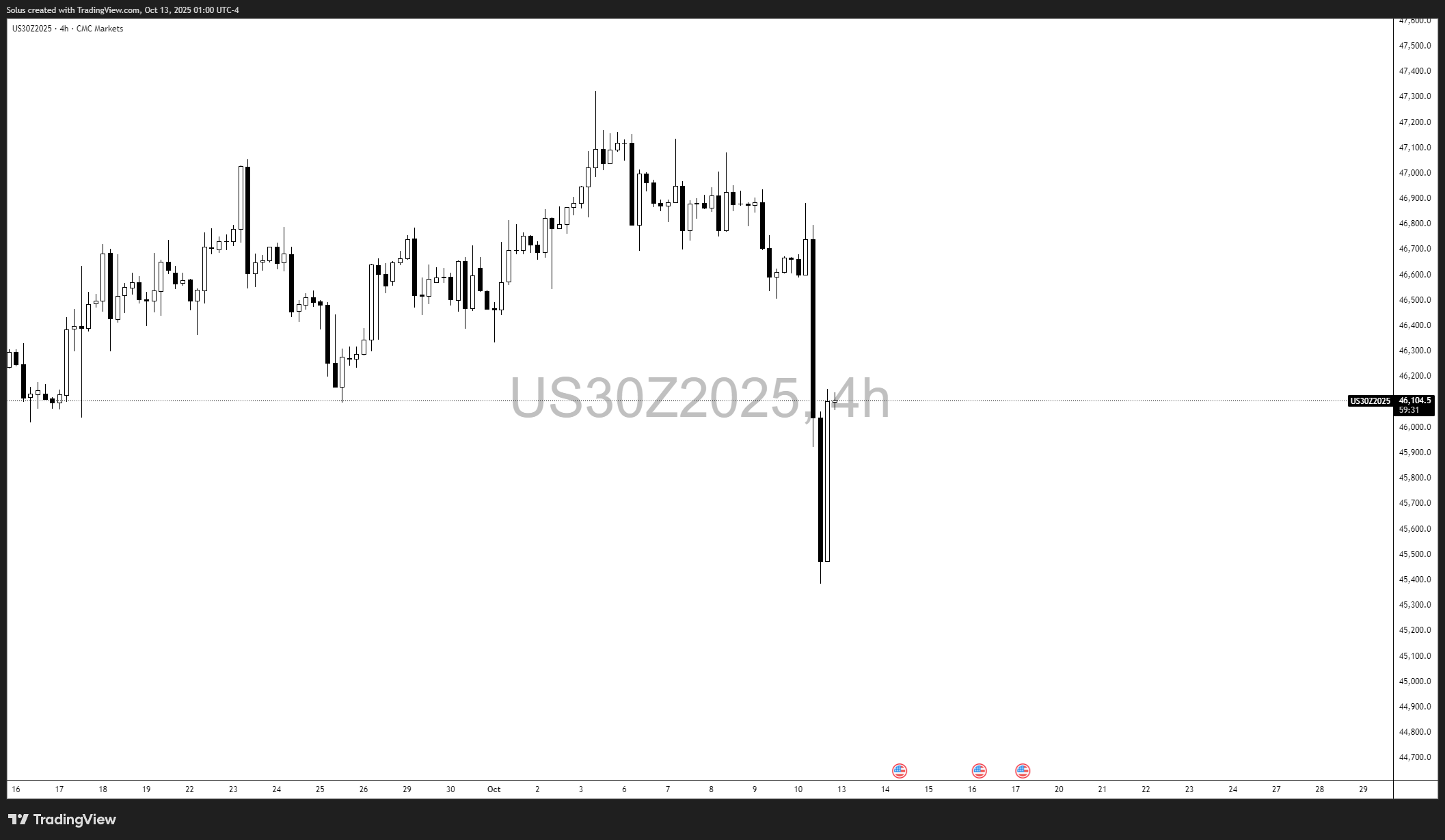
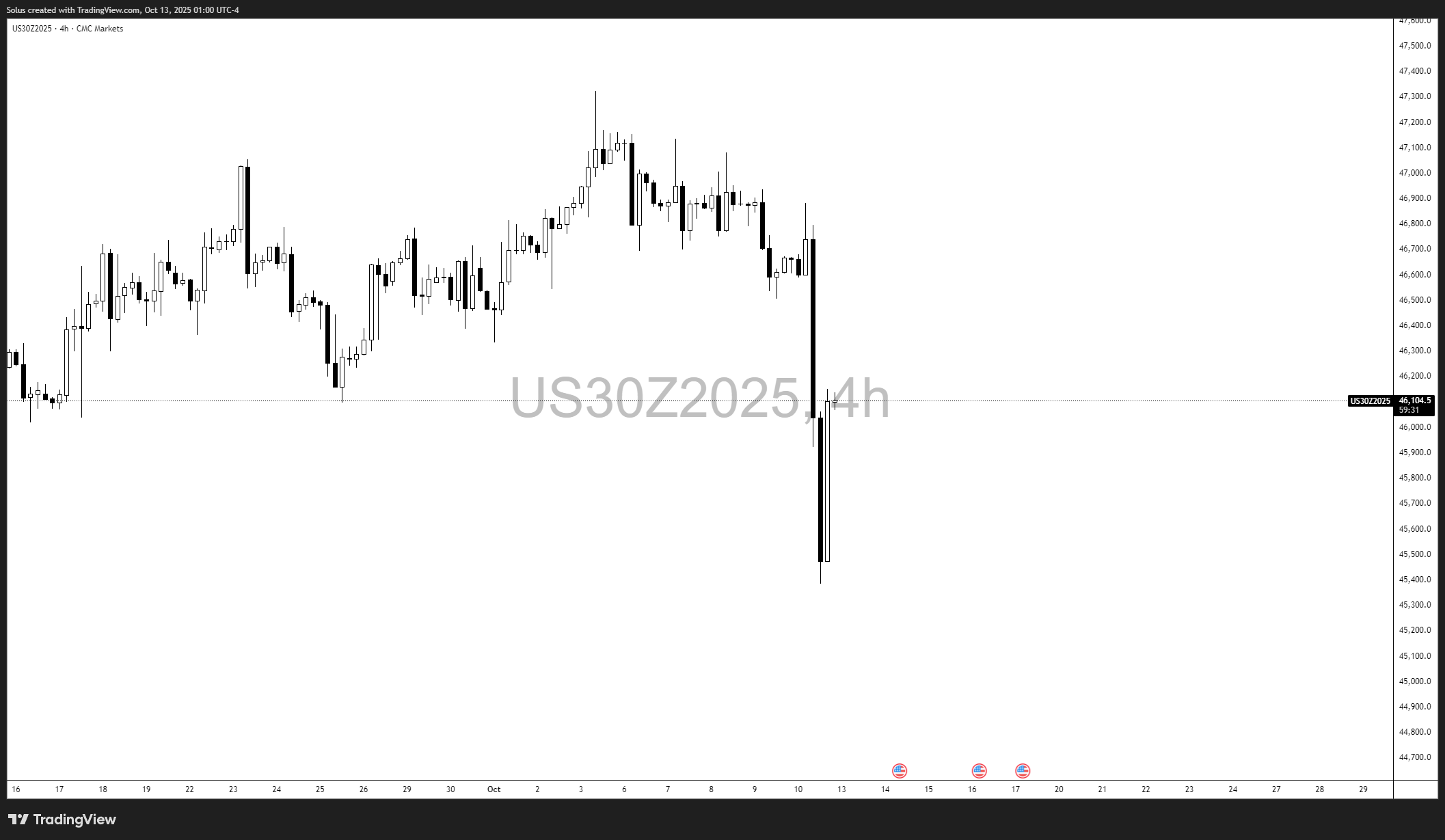
Friday’s price action across US30 (Dow Jones), SPX500 (S&P 500), and NDX100 (Nasdaq 100) reveals the violent impact of Trump’s 100% China tariff announcement.
On all three charts, we see a sharp vertical drop on the 4-hour timeframe - a textbook displacement move driven by panic liquidations and automated selling. The candles reflect near-instant momentum unwinds as liquidity thinned out following the news.
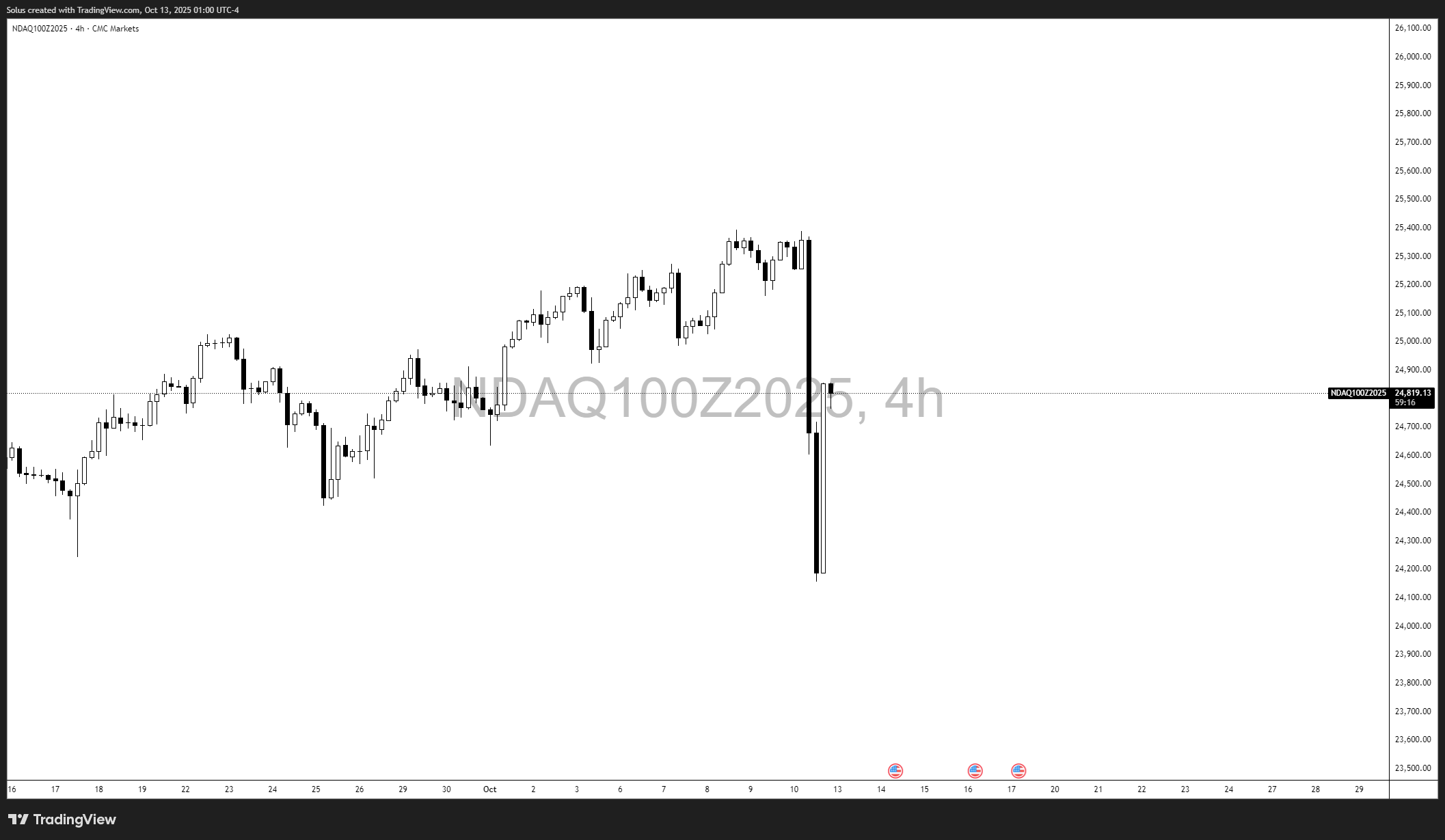
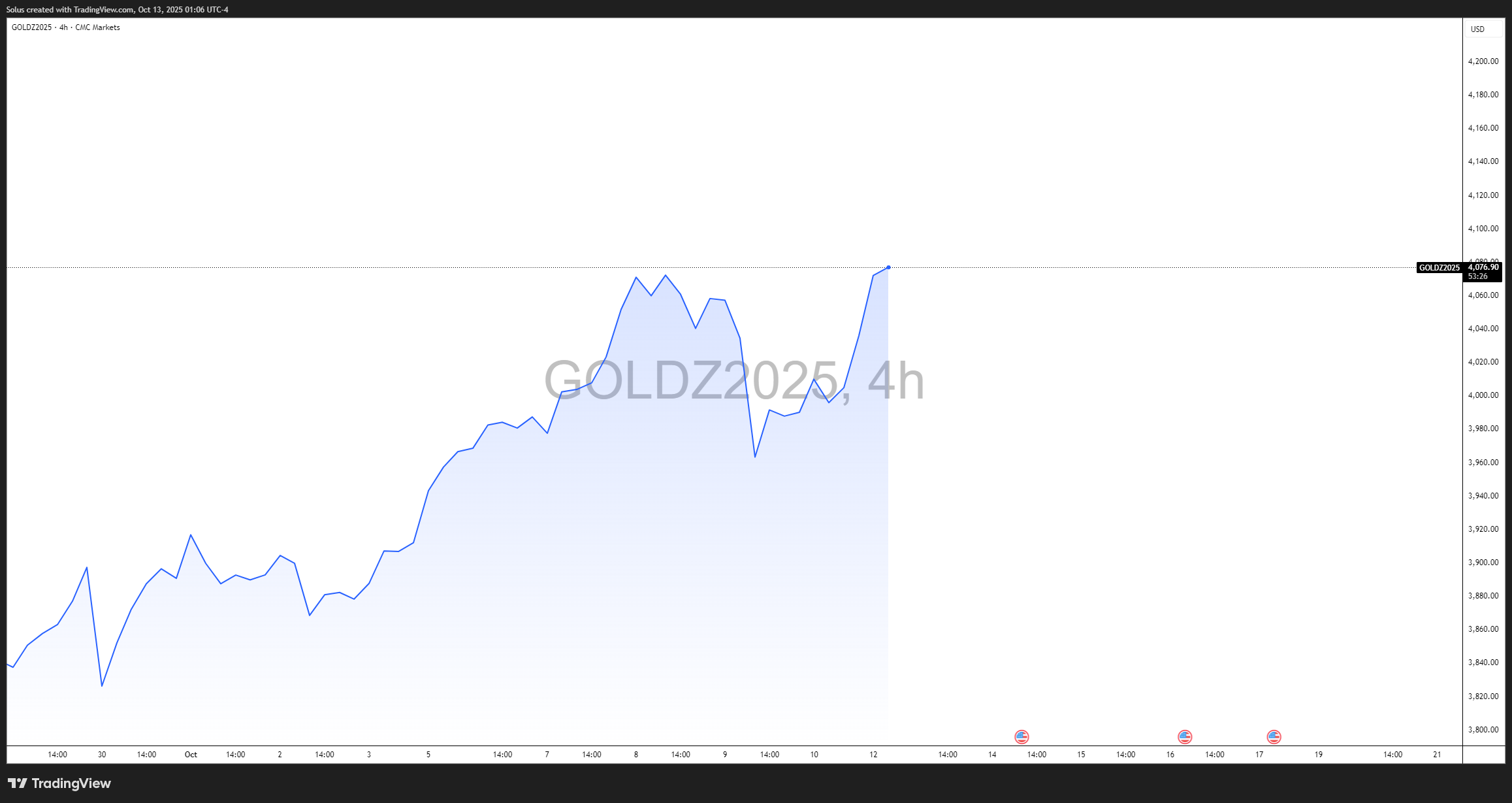
As equities and crypto plunged on Friday after Trump’s 100% China tariff threat, gold spiked sharply, reaffirming its role as the market’s go-to safe haven.
While the Dow, S&P 500, and Nasdaq collapsed, gold surged from $3,940 to above $4,070, a clear sign of capital rotation into defensive assets. The move was driven by fear of slower global growth, demand for safety, and institutional hedging as risk assets sold off.
By the weekend, gold had gained nearly 3%, reclaiming a key imbalance zone on the 4-hour chart. Even as markets rebound, gold continues to hold firm above $4,050, signaling that risk hedging remains active.
Traders are now watching whether price can push through $4,100-$4,120 for continuation toward $4,200, or if renewed optimism pulls flows back into equities.
However, after the weekend’s Trump softening tone, futures have already started to recover inside those imbalance zones, hinting at short-term relief rallies forming from the liquidity vacuum. The reaction illustrates how fast sentiment can flip - from fear-driven displacement to potential retracement once rhetoric eases.
But just as fear peaked, sentiment flipped.
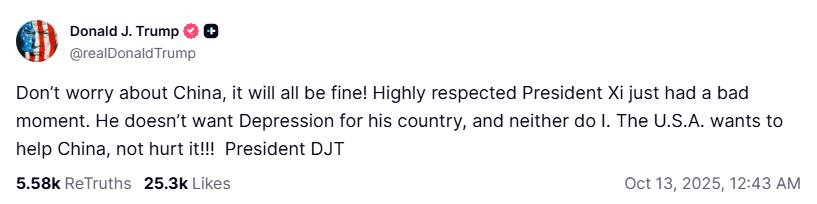
Over the weekend, Trump softened his tone, saying, “Don’t worry about China - it will all be fine.” That single phrase was enough to spark a massive relief rally as traders interpreted it as a sign that his hardline message might be negotiation pressure, not policy set in stone.
By Monday morning, futures were roaring back:
The move wiped out much of Friday’s losses in one overnight session, confirming just how headline-sensitive markets remain.
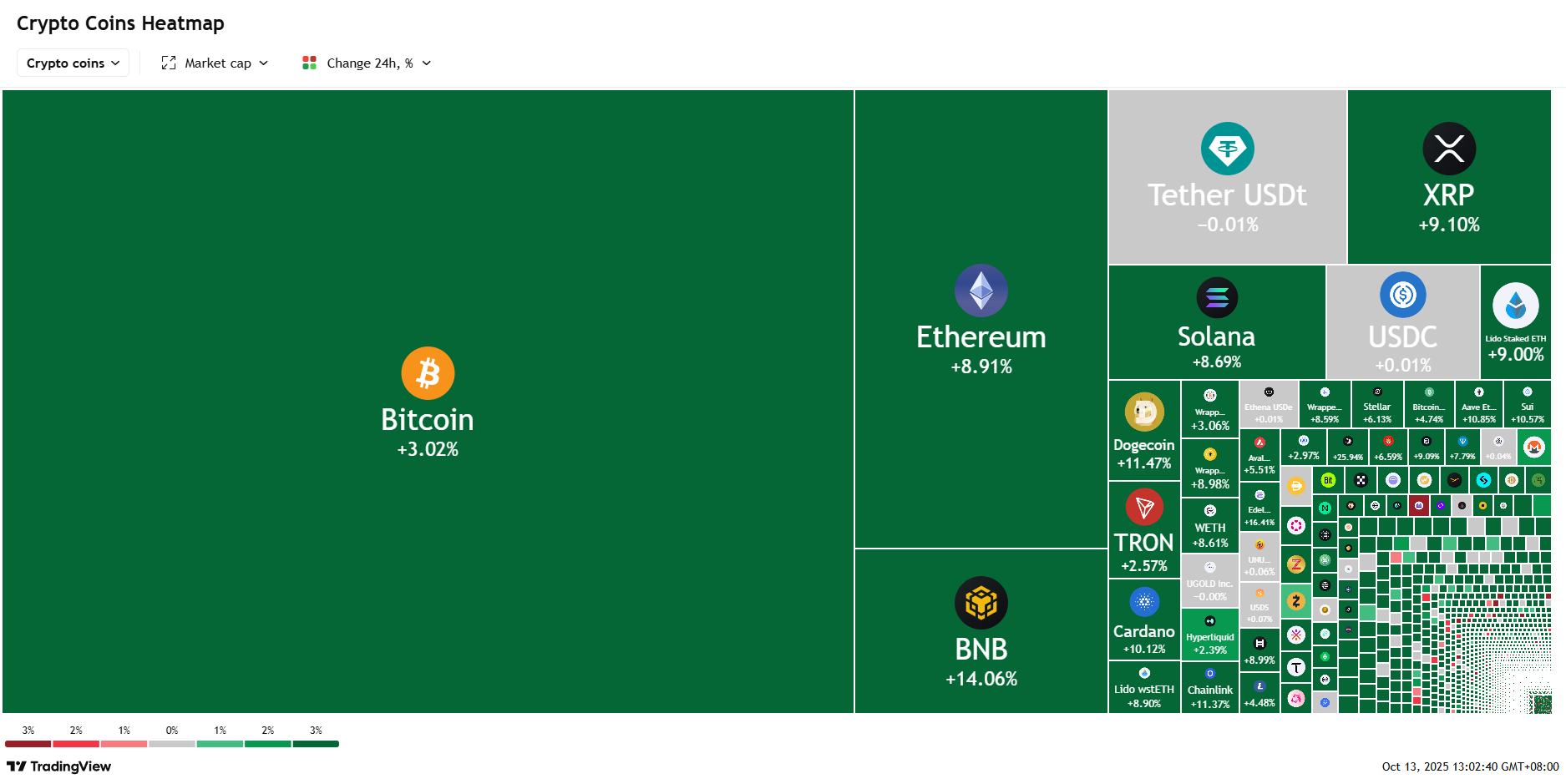
The rebound wasn’t confined to equities. As U.S. index futures bounced sharply after Trump eased his tone on the 100% China tariff threat, the crypto market followed suit, reflecting a synchronized return of global risk appetite.
The TradingView heatmap shows deep green across major tokens, signaling a broad-based recovery:
Stablecoins such as USDT and USDC remained flat, showing that capital was rotating out of safety and back into risk.
This pattern mirrors the action in S&P 500, Nasdaq, and Dow Jones futures, all of which are reclaiming their H4 imbalance zones after Friday’s massive liquidation. The synchronized rebound between crypto and equities signals that sentiment has flipped from fear to relief, driven by hopes that the tariff threat may be dialed back rather than implemented.
In short, risk markets are breathing again.
Friday’s panic liquidation gave way to Monday’s recovery - a classic case of headline-driven volatility followed by aggressive short covering and renewed speculative flows.
Last week’s tariff shock was a powerful reminder that markets can turn on a single headline. What looked like a calm October session quickly spiraled into one of the sharpest intraday selloffs of the quarter - only to recover just as fast once sentiment flipped.
These swings highlight the importance of risk management over prediction. No trader can control the news, but every trader can control exposure. When volatility spikes, your edge lies not in calling the next move, but in protecting capital and managing emotions.
Keep position sizes proportional to account equity, set stop-losses beyond emotional reach, and avoid chasing late momentum after extreme events. When headlines drive liquidity, the goal isn’t to catch every move - it’s to survive the storm and stay positioned for clarity.
The past few days have shown that fear fades, relief rallies, and structure eventually resets - but discipline is what keeps you in the game long enough to profit from both.
It’s time to go from theory to execution - risk-free.
Create an Account. Start Your Free Demo!
Looking for step-by-step approaches you can plug straight into the charts? Start here:
Sharpen your edge with proven tools and frameworks:
News moves markets fast. Learn how to keep pace with SMC-based playbooks:
From NASDAQ opens to DAX trends, here’s how to approach indices like a pro:
Gold remains one of the most traded assets - - here’s how to approach it with confidence:
Candlesticks are the building blocks of price action. Master the most powerful ones:
Ready to go intraday? Here’s how to build consistency step by step:
Markets swing between calm and chaos. Learn to read risk-on vs risk-off like a pro:
Step inside the playbook of institutional traders with SMC concepts explained:
Forex pairs aren’t created equal - - some are stable, some are volatile, others tied to commodities or sessions.
If you’ve ever been stopped out right before the market reverses - - this is why:
Mindset is the deciding factor between growth and blowups. Explore these essentials:
The real edge in trading isn’t strategy - it’s how you protect your capital:
If you’re not sure where to start, follow this roadmap:
This way, you’ll grow from foundation → application → mastery, instead of jumping around randomly.
Follow me for more daily market insights!
Jasper Osita - LinkedIn - FXStreet - YouTube
This content may have been written by a third party. ACY makes no representation or warranty and assumes no liability as to the accuracy or completeness of the information provided, nor any loss arising from any investment based on a recommendation, forecast or other information supplies by any third-party. This content is information only, and does not constitute financial, investment or other advice on which you can rely.
ACY Securities is one of Australia's fastest growing multi-asset online trading providers, offering ultra-low-cost trading, rock-solid execution, technologically superior account management and premium market analysis.

Select the categories and companies you wish to follow directly to your person rss feed.
Create Custom RSS FeedSign up and join over 5,000 professional members who receive personalized news alerts, curated professional connections, and more for free!
Why did gold keep falling after reaching $3,880? See how a failed 4-hour retest confirmed weakness in XAUUSD and why $3,400 is the next weekly support to watch.
Reality television personality Aaron Chalmers and finfluencer Jason Agbodza have been fined after pleading guilty to illegally promoting an unauthorised foreign exchange trading scheme on social media.
UK retail sales rose a stronger-than-expected 0.7% in October, giving sterling some support, while a deepening tech sell-off pushed the dollar lower overnight against all major currencies. Thanim Islam, Head of FX Analysis at Equals, says the dollar remains in charge as the week ends, with the Fed expected to raise rates more than both the Bank of England and the ECB.
Nvidia beats expectations, reporting $115.8bn in revenue and raising its long-term growth outlook, but the stock still struggled to sustain its gains. AI remains fundamentally strong, but investor expectations are becoming more demanding, particularly around capex and profitability. Wall Street suffered a major sell-off, with the S&P 500 entering a six-session losing streak as rate concerns intensified.
iSAM Securities reviews the ris of weekend gold trading
Webull Corporation reported record third quarter 2026 revenue of $218.7 million, up 39% year-on-year, with customer assets reaching $32.4 billion and options contracts volume up 79%. Net income attributable to the company was $31.2 million, while margin debit balances passed $1 billion for the first time.
Anthropic, the company behind the Claude family of AI models, begins trading on the Nasdaq today under the ticker ANT. It priced its shares at $83 last night, above its marketed range of $70 to $78, and raised about $81.3 billion. That makes it the largest initial public offering on record, ahead of the roughly $75 billion SpaceX raised in June. This note covers what investors need to know: the terms, the business, how the company is governed, and what to watch.
Nvidia's first results without Jensen Huang answered the question that has hung over the AI trade since October. Revenue of $115.8 billion beat consensus by about $7 billion, fourth-quarter guidance of $130 billion came in roughly $5 billion above expectations, and the company raised its outlook for next fiscal year to around 75% growth. All of this assumes no data-centre sales to China.
Marex has entered the football financing market through a partnership with specialist sports investment and advisory firm Pinto Capital, targeting clubs in the Premier League and EFL Championship.
Around 110,000 UK retail investors have secured $300 million worth of Anthropic shares in its record-breaking $81 billion IPO. The heavily oversubscribed offer, coordinated by RetailBook, saw smaller investors prioritised, with 63% of applicants receiving their full allocation.