just now

Liquidity Finder Ltd is incorporated in England and Wales, company number 10610740, registered address 167-169 Great Portland Street, Fifth Floor, London W1W 5PF, United Kingdom.
Published: just now

MetaTrader 4 and MetaTrader 5 are the most widely used retail trading platforms in the world – but they were not designed with external API connectivity in mind. The native MetaTrader Manager API is powerful but complex, requiring deep specialist knowledge to work with, significant development investment to integrate, and ongoing maintenance as MetaTrader versions evolve. For brokers who want to connect a third-party trading platform, build a custom client-facing front-end, or integrate MetaTrader with an existing back-office or CRM system, the native API presents a significant technical barrier.
The result is that many brokers either accept the limitations of the standard MetaTrader client terminal – missing out on the competitive advantages that a custom or third-party front-end could deliver – or invest heavily in custom development that takes months to complete, requires specialist MetaTrader API expertise, and needs continuous maintenance as the platform evolves. Neither option is ideal for a broker focused on growing their business rather than managing complex technology projects.
There is a better approach – and in this guide we explain what it is, how it works, and what it means for brokers who want to offer their clients a superior trading experience without the complexity and cost of building a custom MetaTrader integration from scratch.
Before exploring how to connect external applications to MetaTrader, it is worth understanding why brokers want to do this in the first place. The reasons vary by business model and strategic priority, but the most common motivations include:
What all of these use cases have in common is a need for reliable, real-time, programmatic access to the data and functionality of a MetaTrader server – and the challenge of achieving this without spending months on complex native API development.
The traditional approach to connecting external applications to MetaTrader is to develop a custom integration layer using the MetaTrader Manager API directly. This involves writing code that communicates with the MT Manager API using its native protocol, handling session management, real-time data streaming, order management, and error handling – all in a production-ready implementation that can withstand the demands of a live brokerage environment.
The challenges with this approach are significant. The MetaTrader Manager API – particularly the MT4 Manager API – is a legacy interface with limited documentation and numerous edge cases that require specialist knowledge to handle correctly. Building a reliable, production-ready integration typically requires three to six months of senior development time from engineers with specific MetaTrader API expertise – expertise that is genuinely rare and commands a significant premium in the employment market. Once built, the integration requires ongoing maintenance as MetaTrader versions evolve and edge cases are discovered in production.
For most brokers, the cost and complexity of this approach is disproportionate to the business benefit – particularly when the underlying need is to connect a specific application to MetaTrader rather than to build a general-purpose integration platform.
A more efficient and cost-effective approach is to use a purpose-built middleware solution that sits between your MetaTrader server and the external applications you want to connect. This middleware – an integration bridge – handles all communication with the MT Manager API and exposes a modern, well-documented API interface that any web or desktop application can connect to using standard protocols.
Broktinger’s MetaTrader API Platform Integration Bridge is exactly this kind of solution. It is a production-ready middleware that connects your MT4 or MT5 trading infrastructure to external applications through a clean REST API and WebSocket interface – eliminating the need for custom MetaTrader API development entirely and reducing the time to connect any external application from months to hours.
The Broktinger Integration Bridge consists of two components that run on dedicated secure infrastructure and connect to your MetaTrader server remotely using your existing Manager API credentials:
The REST API component handles all request-response interactions with your MetaTrader server. Through standard HTTP endpoints, connected applications can authenticate sessions, retrieve real-time account information including balance, equity, margin and leverage, open and manage orders with optional stop loss and take profit parameters, retrieve open and closed positions and deal history, access symbol and group configuration data, and query quote history for any instrument on your server.
These endpoints follow standard REST conventions and return data in JSON format – making them immediately accessible to any development team using any programming language or framework. There is no need for specialist MetaTrader API knowledge on the client side – if your developers can make HTTP requests, they can integrate with the bridge.
The WebSocket component handles all real-time streaming requirements. Connected applications can subscribe to live bid and ask price feeds for any symbol on your server, receive real-time account equity and balance updates triggered by position changes and deal execution, and receive instant push notifications when a client’s margin level approaches the stopout threshold – allowing client-facing applications to display risk warnings and prompt action before a stopout occurs.
The WebSocket infrastructure is built on a battle-tested engine capable of handling thousands of concurrent connections – making it suitable for brokers with large client bases where many clients may be connected simultaneously through external applications.
One of the most significant advantages of the Broktinger Integration Bridge is that it requires no infrastructure investment or IT effort from the broker. The bridge runs entirely on Broktinger’s dedicated, secured servers – the broker never installs, configures, or maintains any software.
Onboarding a new broker instance requires just two actions from the broker’s side:
Once these two steps are complete, Broktinger configures and deploys the dedicated bridge instance, runs end-to-end tests against your MT server, and confirms all endpoints are responding correctly. The broker’s clients can typically be live on the connected platform within the same business day.
Security is a primary consideration for any solution that involves access to MetaTrader Manager API credentials. The Broktinger Integration Bridge is built with security as a core design principle:
For brokers evaluating whether to build a custom MetaTrader integration or use a purpose-built solution like the Broktinger Integration Bridge, the economics are straightforward.
A custom MT4 or MT5 integration layer typically requires three to six months of senior development time from engineers with specific MetaTrader API expertise. This expertise is rare and commands a significant salary premium. The development cost alone – before accounting for testing, deployment, and ongoing maintenance – typically reaches a level that makes a proven, production-ready solution a significantly more cost-effective choice for most brokers.
Beyond the initial development cost, a custom integration requires ongoing maintenance as MetaTrader versions evolve, edge cases are discovered in production, and connected applications change their requirements. With the Broktinger Integration Bridge, major version updates and new platform compatibility patches are deployed by Broktinger without any action required from the broker.
The result is a proven, auditable solution running in a regulated live environment – at a fraction of the cost and time of building an equivalent custom integration from scratch.
The Broktinger MetaTrader API Platform Integration Bridge is designed for FX and CFD brokers who need programmatic access to their MetaTrader infrastructure for any purpose. It is particularly valuable for:
If you are looking to connect a third-party platform, build a custom front-end, or integrate MetaTrader with any external system, the Broktinger Integration Bridge gives your development team a production-ready foundation to build on – without the months of custom development that a native MetaTrader API integration would require.
We offer live technical demos, API documentation access, and sandboxed test environments connected to a demo MT server – so your team can evaluate the bridge against your specific requirements before making any commitment. Get in touch with our team to arrange a demo or request a commercial proposal.
You can also learn more about the bridge on our MetaTrader API Platform Integration Bridge product page.
Learn more: https://broktinger.com/
Industry leaders in outsourced dealing desk, risk management and platform development for FX and CFD brokers. Building MT4/MT5 tools, reporting solutions and API integration, plugins.
Select the categories and companies you wish to follow directly to your person rss feed.
Create Custom RSS FeedSign up and join over 5,000 professional members who receive personalized news alerts, curated professional connections, and more for free!
Multi-asset trading broker AvaTrade has agreed to acquire the majority of FXCM Group’s business and brand, in a transaction that would bring a longstanding retail FX franchise into the AvaTrade Group.
LSEG and CMC Markets have signed a multi-year strategic data agreement expanding CMC's access to LSEG's real-time and delayed pricing, reference and corporate actions data, news and analytics, plus AI-ready content, to support new products, entry into new markets and the growth of CMC's institutional and B2B partnerships.
The Tel Aviv Stock Exchange is considering a bid for the Cyprus Stock Exchange, with Israeli media citing its EU licence, trading platform and clearing house. Euronext’s Athens exchange and India’s National Stock Exchange are also seen as contenders, and Cyprus aims to sign a sale agreement by the end of this year.
CME Group will launch baseball futures on 12 October, pending regulatory review, tracking CME FutureSports Performance Indexes built on Official League Data. Standard and micro contracts will start with the 2026 Postseason and the four clubs in the League Championship Series, trading around the clock.
ESMA has published an opinion stating that MiCA-authorised crypto-asset service providers should cease services tied to non-MiCA-compliant stablecoins for EU clients across MiCA crypto-asset services. National authorities should require remediation of existing exposures within three months, by early January 2027.
Nasdaq Ventures has made a strategic investment in Amsterdam-based derivatives and crypto exchange One Trading, with both firms to explore 24/7 trading of equity futures. The undisclosed investment follows Nasdaq's US$100 million investment in Payward, the parent of Kraken, and CME Group's move to 24/7 trading.
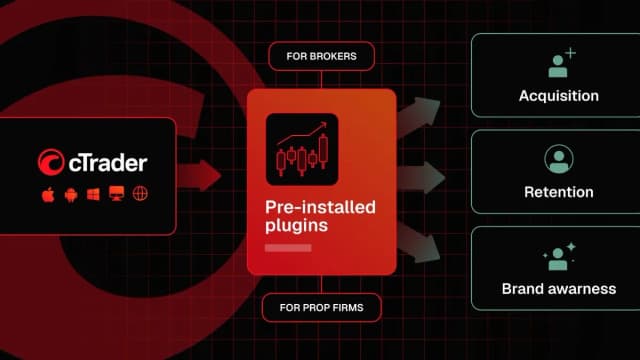
cTrader has opened multi-platform plugins to brokers and prop firms, which can pre-install their own tools for clients or list them in cTrader Store. The plugins run across Mobile, Web, Windows and Mac, and can be built and launched independently of core-platform releases, including trading journals and calculators.
Institutional brokerage and financial infrastructure provider Clear Street has joined TradingView’s broker network, allowing its clients to trade US stocks, exchange-traded funds and options directly through the charting and analysis platform.
Learn how to improve trading psychology, manage fear and greed, avoid revenge trading, and follow your trading strategy with discipline and a trading journal.
GTC Prime has announced a strategic partnership with Centroid Solutions to manage and distribute its liquidity through CS 360 Bridge, Centroid's multi-asset connectivity and execution engine, giving brokers and institutional clients access to tailor-made pricing, low-latency execution and real-time risk management.