just now

Liquidity Finder Ltd is incorporated in England and Wales, company number 10610740, registered address 167-169 Great Portland Street, Fifth Floor, London W1W 5PF, United Kingdom.
Published: just now

If you've been in the markets long enough, you already know this: some of the biggest opportunities in forex don't come from quite days they come from uncertainty.
And there’s nothing that stirs uncertainty like elections and geopolitical events.
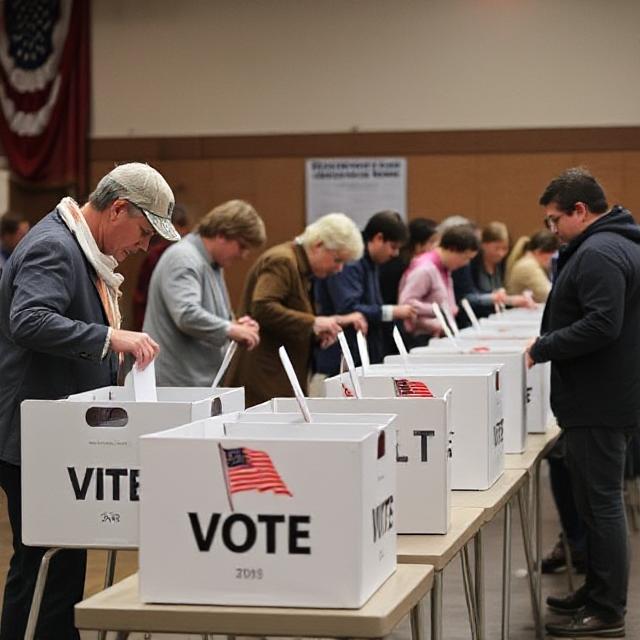
But here’s the mistake most traders make. They get caught chasing moves without understanding the mechanics behind them.
They react to headlines instead of preparing for liquidity shifts, risk repricing, and volatility surges that come in waves not all at once.
In this article, we’ll break down how to properly position, protect, and profit around these high-impact moments.
And we’ll keep it clean no empty forecasting, just structured, strategic trading logic you can rely on.
Let’s start with the basics.
Currencies represent countries. And countries run on policy, stability, and power.
So when the balance of any of those shifts as it does during national elections or global conflict the forex market responds.
Here’s how that plays out in real time:
Election outcomes reshape expectations on fiscal and monetary policy.
Geopolitical conflicts disrupt trade flows, trigger flight-to-safety behavior, and impact commodities.
Uncertainty increases volatility and volatility attracts liquidity.
This isn't just theory. We've seen it during Brexit, U.S. presidential transitions, European parliamentary shifts, Middle East escalations, and more.
The currency market becomes the front line often reacting before equities or commodities.
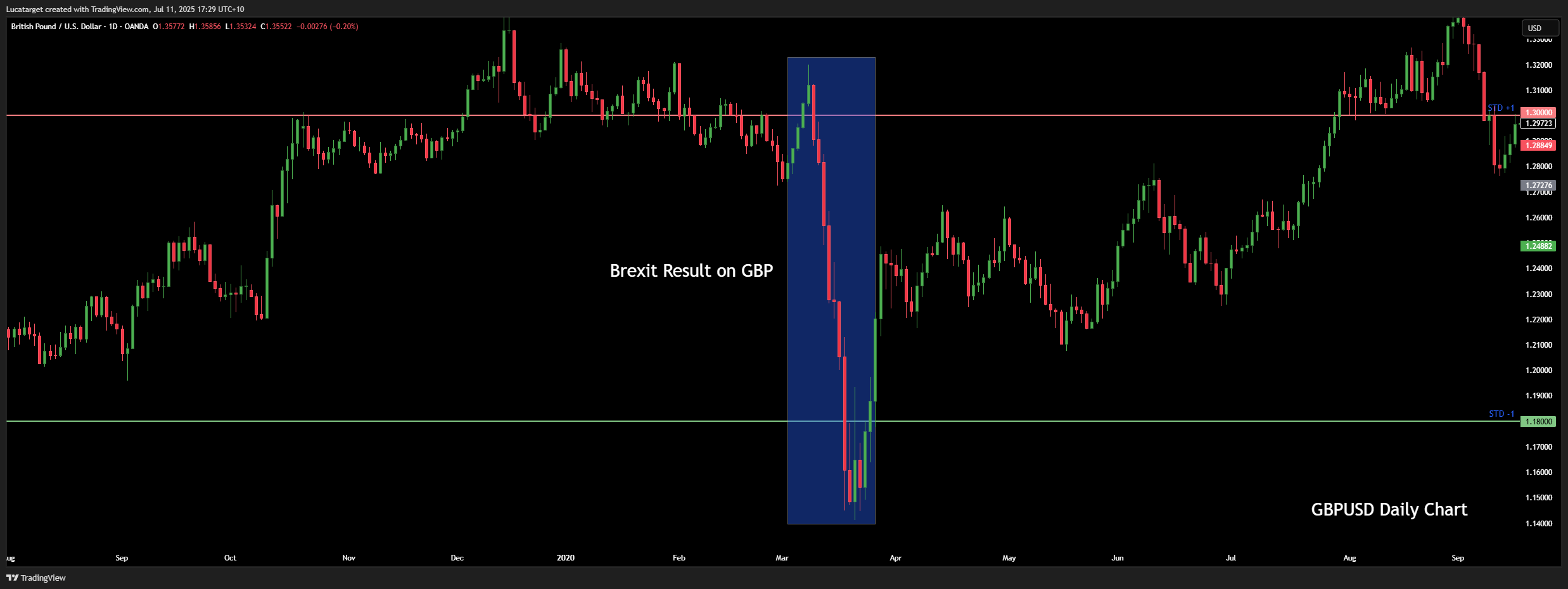
Before you place a trade during an election cycle or geopolitical event, ask yourself this:
What is the market pricing in, and what is it not expecting?
The actual outcome doesn’t move the market as much as the surprise element does. You’re not trading politics you’re trading the difference between expectation and reality.
For example:
If markets expect a pro-business candidate to win, and they do the move might be muted.
If that same candidate unexpectedly loses, you’ll see immediate repricing especially in currencies closely tied to risk sentiment like AUD, NZD, JPY, EUR, GBP.
The same logic applies to conflicts:
Ongoing tension often gets priced in gradually.
But sudden escalations a surprise missile strike, a change in alliances, sanctions lead to unhedged repositioning.
That’s where opportunity lies in the dislocation.
There are recurring patterns you can watch for:
Currencies like the USD, CHF, and JPY tend to gain strength when risk sentiment breaks down. These are your go-to hedges during uncertainty but don’t blindly buy them. Wait for confirmation via price action, bond flows, or equity correlations.
The domestic currency of the country facing an election (e.g., MXN, ZAR, GBP, or TRY) often becomes extremely sensitive to polling data, central bank posture, and public unrest. Use event risk modeling and implied volatility pricing to assess risk before trading these pairs.
During geopolitical flare-ups, commodity-linked currencies like AUD, CAD, and NOK can react indirectly via oil, gold, or industrial metals. When conflict disrupts supply chains or shipping lanes, commodities respond and forex follows.
You don’t need to predict election winners or troop movements. What you need is a framework.
In the days leading up to a known election or event, many institutions reduce exposure. That creates choppy, uncertain price action and often shrinks liquidity. Instead of diving in, use this period to:
Study implied volatility across relevant pairs.
Avoid large position sizing think of this as information gathering.
Once results or escalation headlines hit, don’t rush in immediately. The first reaction is usually driven by algos and knee-jerk sentiment. The second and third waves of flow the ones that follow 2–8 hours later are often cleaner.
Look for:
Breakouts from pre-event ranges.
Retests of structural levels with high volume.
Price action that aligns with macro expectations (e.g., high pressure/tension on middle east = WTI/Brent breakout).
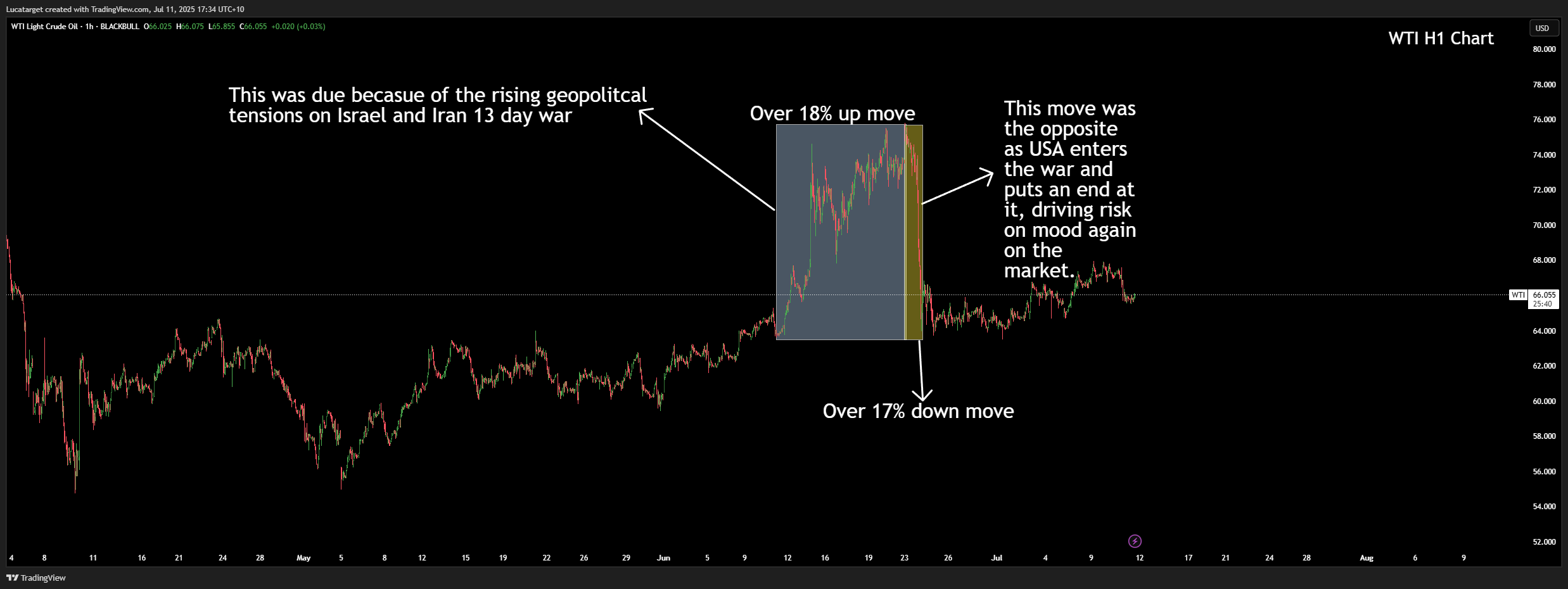
The most consistent trades tend to come after the event, not during it. Once uncertainty resolves, the market chooses direction. Trends emerge. This is where macro alignment, technicals, and sentiment come together.
This is when you want to scale in not when headlines are still flying.
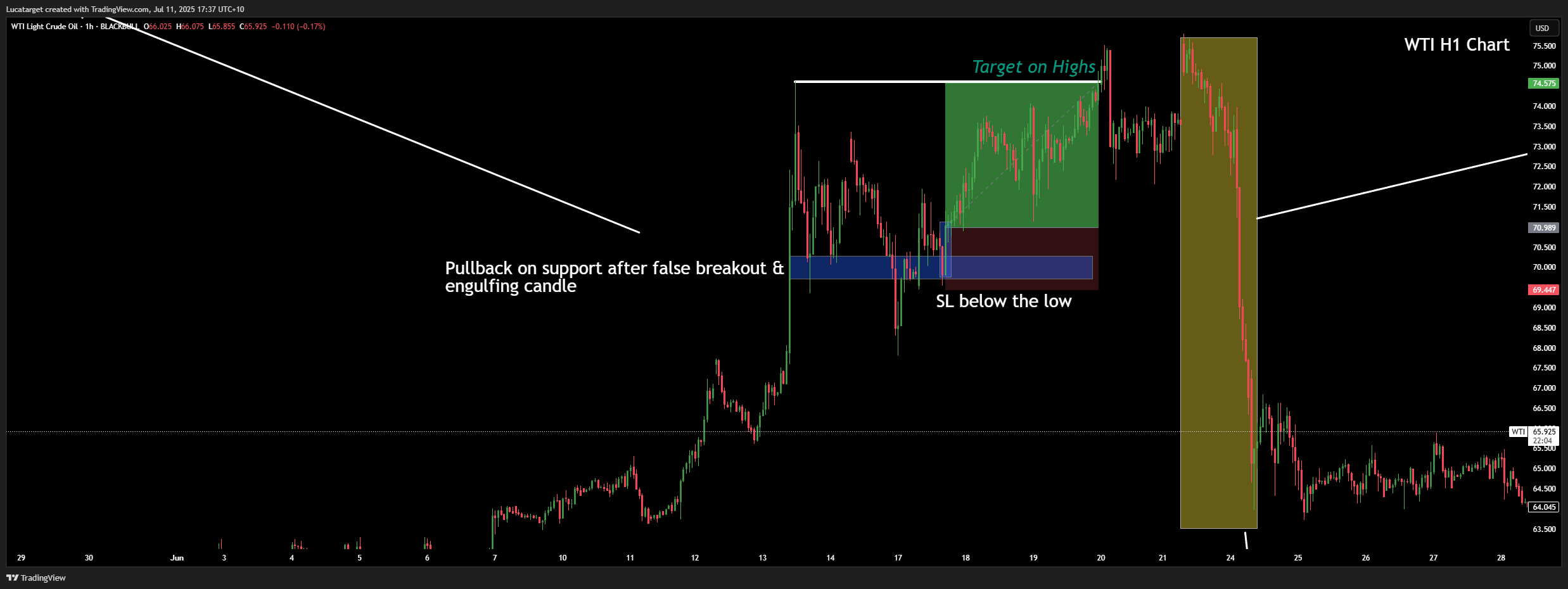
Trading around elections and geopolitical events carries higher tail risk. Which means position size, leverage, and stop placement need to be adjusted.
Use reduced leverage when volatility is rising into the event.
Avoid placing trades right before key announcements.
Use time-based stops for example, exit trades if no movement occurs 6–8 hours post-news.
Consider hedging exposure through negatively correlated pairs.
If you're not adjusting risk for the environment, you're not trading you're gambling.
It’s easy to get caught in the drama of major political or global news. But here’s the truth: markets move not on the event itself, but on how they feel about it.
That’s why the most profitable forex traders don’t chase headlines they trade reactions. They know where the liquidity is. They understand who’s likely trapped. And they let the market come to them.
If you're approaching elections or geopolitical flare-ups without a framework you're late before you begin. But if you’re ready with sentiment reads, structural setups, and tactical patience?
That’s when you stop reacting and start trading with intent.
Q: Why do elections impact the forex market?
A: Elections shift expectations around fiscal policy, regulation, taxation, and central bank direction. Because currencies reflect national economies, any uncertainty or change in leadership can trigger volatility. Traders aren’t just reacting to outcomes they’re pricing in what the new political environment means for growth, inflation, and stability.
Q: What forex pairs are most sensitive to geopolitical events?
A: Safe-haven currencies like the USD, JPY, and CHF tend to gain during global uncertainty. Pairs involving emerging markets or politically unstable countries like USD/TRY, USD/ZAR, or USD/MXN often see extreme volatility. Commodities-linked currencies like AUD or CAD may also react if the conflict impacts energy or metals markets.
Q: Is it safe to trade during elections or global conflicts?
A: Not unless you’re prepared. These events often cause unpredictable price swings, widened spreads, and sharp liquidity drops. The key is to reduce risk: trade smaller, widen stops if necessary, and wait for clear structure to form after the initial volatility. Often, the cleanest opportunities come after the chaos, not during it.
Q: Should I trade before or after the election results are released?
A: Most professional traders avoid large positions right before an election result. The market is often thin and reactive. Post-event trading once the initial move is made and structure confirms offers more controlled conditions. Focus on identifying the reaction, not predicting the result.
Q: How can I use sentiment analysis around these events?
A: Monitor risk sentiment through indicators like the VIX, bond yields, and equity market behavior. If fear is building, capital typically moves into USD, gold, and other defensive assets. If optimism builds after an election or resolution, risk-on pairs (like AUD/JPY or EUR/USD) may trend higher. Let the market’s tone tell you where capital is going not the news itself.
Gold Trading & Strategy
Risk Sentiment & Global Events
Economic Data & Macro Strategy
Trading Skills & Execution
Trading Psychology & Performance
This content may have been written by a third party. ACY makes no representation or warranty and assumes no liability as to the accuracy or completeness of the information provided, nor any loss arising from any investment based on a recommendation, forecast or other information supplies by any third-party. This content is information only, and does not constitute financial, investment or other advice on which you can rely.
ACY Securities is one of Australia's fastest growing multi-asset online trading providers, offering ultra-low-cost trading, rock-solid execution, technologically superior account management and premium market analysis.

Select the categories and companies you wish to follow directly to your person rss feed.
Create Custom RSS Feed
just now
Sign up and join over 5,000 professional members who receive personalized news alerts, curated professional connections, and more for free!
CMC Markets has retired the CMC Connect name and will now present its institutional business as CMC Markets Institutional.
The SEC has approved Cboe's binary options tied to key performance indicators reported by 23 companies, covering more than 100 metrics such as iPhone revenue. The cash-settled contracts pay a fixed $1, Robinhood plans to be the first retail broker to offer them, and trading awaits clearing registration.
Gold is trading around $4,150, recovering sharply after falling to a recent low of $4,073.
Global semiconductor and technology stocks sold off sharply on Thursday, with South Korea’s SK Hynix plunging over 10% and Samsung Electronics falling more than 8%.
Learn gold market structure to identify bullish, bearish and ranging XAUUSD trends using higher highs, higher lows, lower highs and lower lows, support and resistance.
Axi has launched an MCP integration connecting eligible MT5 accounts to Claude, allowing clients to access live market data, track positions, execute trades and update risk parameters through the AI assistant developed by Anthropic. Available to eligible Axi clients with an active MT5 account. Setup runs via Claude.ai.
Movantis has selected Integral to extend its FX liquidity offering for institutional clients including banks, payment networks and digital asset operators, adding an institutional trading platform, direct-to-client API trading and API connectivity into a third-party multi-dealer venue, supporting regional expansion.
Running a venue around the clock is the easy part. Pricing risk when the market underneath it is shut is not. Lars Holst, CEO of GCEX explains how to manage risk in 24/7 markets.
ATFX has released its Q4 2026 Trader Magazine, offering a closer look at the macroeconomic and market forces that could shape trading conditions in the final quarter of the year.
LSEG has announced a collaboration with NVIDIA that lets financial institutions analyse years of LSEG Tick History data in seconds using NVIDIA cuDF on GPUs, without creating another full copy of the dataset. Tick History holds 110 trillion rows across 100 million instruments and more than 580 venues and contributors.