
just now


Liquidity Finder Ltd is incorporated in England and Wales, company number 10610740, registered address 167-169 Great Portland Street, Fifth Floor, London W1W 5PF, United Kingdom.
Published: just now
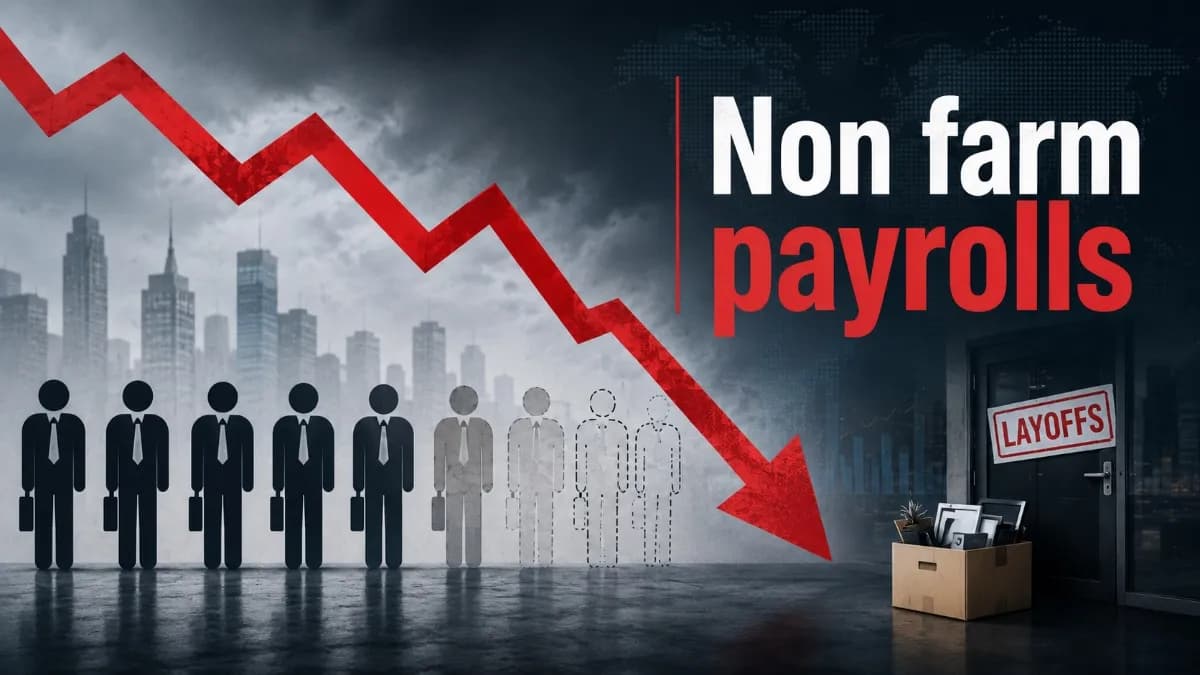
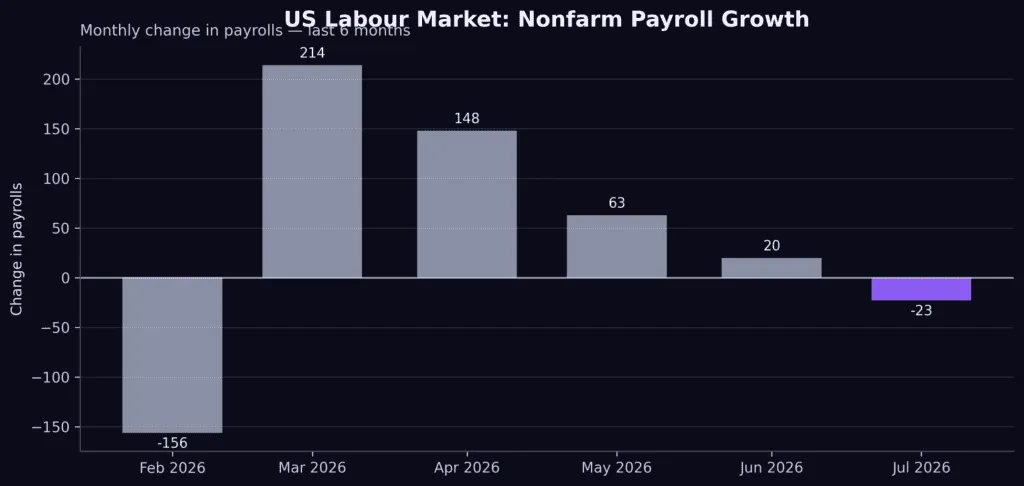
The US labour market delivered a significant surprise this week, with July non-farm payrolls showing a decline of 23,000 jobs. Instead of the steady employment growth investors had been expecting, the latest data showed that the labour market is losing momentum, adding to concerns that the US economy may be entering a softer phase.
The report also included revisions to previous months, reinforcing the message that hiring conditions have been weaker than initially reported. While one jobs report does not define the economy, the direction of travel is becoming increasingly important: employment is no longer providing the same level of support that investors became accustomed to during the post-pandemic expansion.
The immediate market reaction was clear. Softer employment data increased expectations that the Federal Reserve may have more room to cut interest rates, pushing Treasury yields and the US dollar lower. Lower yields are typically supportive for growth assets because they reduce borrowing costs and increase the attractiveness of future earnings.
However, the market now faces an important question:
Are lower yields reflecting a healthy Fed easing cycle, or are they signalling a deeper economic slowdown?
That distinction will depend on what happens in the credit markets.
While equities have remained relatively resilient, corporate bonds are providing a more nuanced picture of investor confidence.
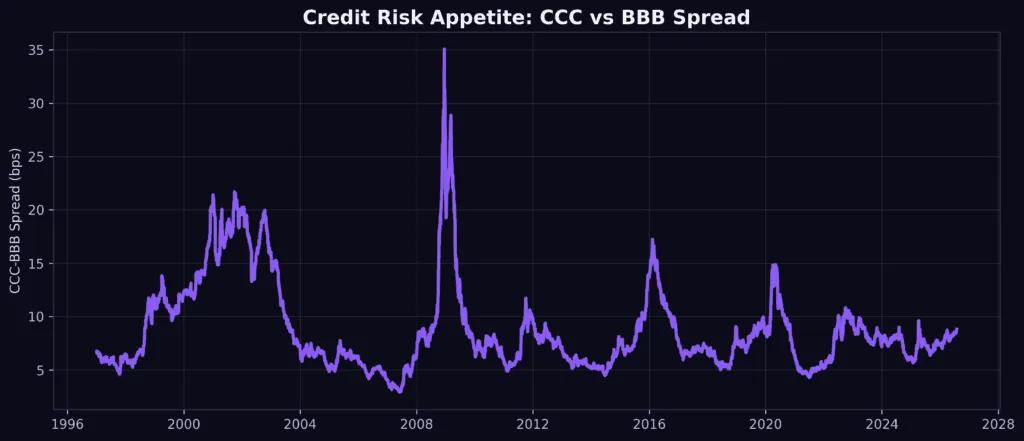
Credit spreads measure how much extra return investors demand to lend money to companies compared with safer US government bonds. When spreads tighten, investors are comfortable taking risk. When spreads widen, investors become more cautious about corporate balance sheets and future earnings.
Recently, the weaker end of the credit market has shown some signs of caution.
CCC-rated companies — the riskiest part of the corporate bond market — have seen spreads widen relative to higher-quality BBB-rated companies. In simple terms, investors are becoming more selective and demanding more compensation to lend to financially weaker businesses.
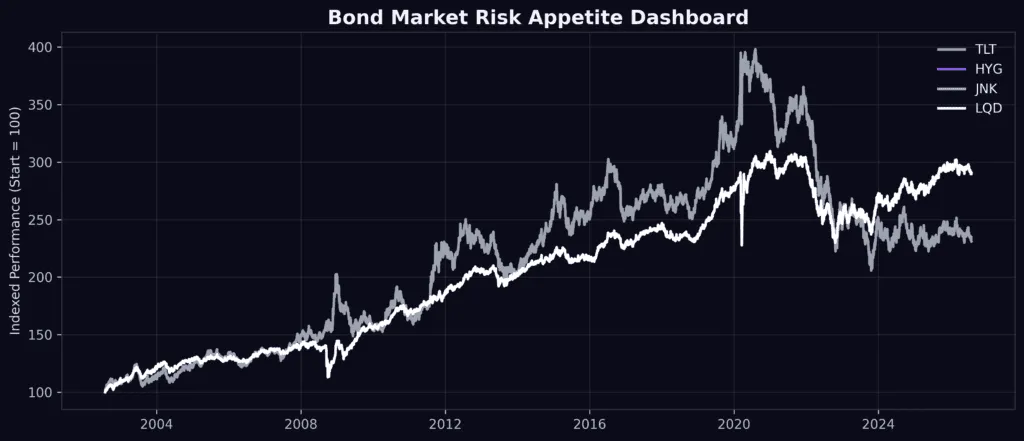
However, this has not yet developed into a broad credit problem. BBB credit remains relatively stable, while high-yield bond ETFs such as HYG and JNK have not shown a major breakdown.
This creates an interesting market backdrop:
The labour market is weakening, but credit markets are not yet confirming a major economic stress event.
For investors, this suggests the market is currently pricing a potential “soft landing” scenario:
The risk is that if CCC weakness spreads into higher-quality corporate bonds, markets may start viewing weaker jobs data differently — not as a reason for rate cuts, but as evidence of deteriorating earnings conditions.
Inflation will be the next major test for the Federal Reserve narrative.
The previous inflation report was relatively benign, helped by falling gasoline prices and softer price pressures across several categories. Expectations are for another relatively contained reading, with headline inflation potentially around 0.1% month-on-month.
Core inflation is expected to be slightly firmer, but cooling housing costs, weaker wage growth and improving business cost pressures could help keep inflation contained.
The market reaction may depend less on the number itself and more on whether it changes expectations heading into the September FOMC meeting.
A softer inflation print would reinforce the argument for Fed easing.
A hotter-than-expected number could challenge the idea that rate cuts are coming quickly.
Consumer spending remains critical because households drive the majority of US economic activity.
Retail sales will provide insight into whether consumers are still supporting growth despite a weakening labour market.
Auto sales were relatively flat, while lower gasoline prices may weigh on fuel-related spending. However, other categories may show modest improvement, helped by seasonal events and increased activity earlier in the month.
The key question:
Is the consumer slowing down, or simply normalising after years of strong spending?
UK growth is expected to remain positive, but the headline figure may overstate the underlying momentum.
Recent monthly GDP data has shown some cooling, while business surveys have been less optimistic than the headline growth numbers suggest.
The key focus will be whether the economy is maintaining momentum into the second half of the year or whether earlier strength was temporary.
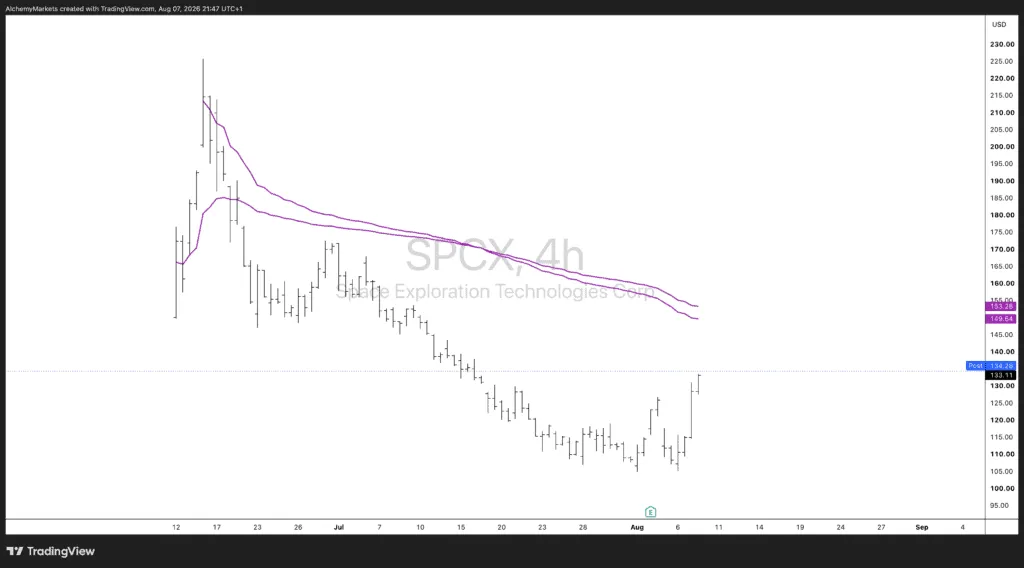
After this week's earnings-driven move, SpaceX has continued to recover from its previous decline and is now approaching an dynamic resistance area.
Price is moving back towards the anchored VWAP, which represents the average price investors have paid since the chosen event, weighted by trading volume.
In simple terms, VWAP shows where the average market participant is positioned. When price trades below VWAP, many buyers from that period may be underwater. When price reclaims VWAP, those investors return to profitability, which can improve sentiment and encourage further demand.
SpaceX is now approaching this volume-weighted average price zone, suggesting the market is testing whether the post-earnings recovery has enough strength to continue.
A sustained move above VWAP would suggest buyers are regaining control and the market is accepting higher prices after earnings.
However, failure around this level would suggest investors are still using the rally as an opportunity to exit positions.
For now, the setup is simple:
Above VWAP: improving momentum and investor confidence.
Rejected at VWAP: earnings optimism may already be priced in.
The market enters next week balancing two opposing forces:
A weaker labour market is increasing expectations for Fed support, but investors will need confirmation from inflation, consumer spending and credit markets that the slowdown remains manageable.
The key theme remains:
Bad economic news can be good news for markets — but only while credit conditions remain healthy.
If inflation continues cooling and corporate credit remains stable, investors may continue to view weaker data as a reason for lower rates.
If credit begins to deteriorate, the market may start focusing less on Fed cuts and more on the risk to earnings.
The next few weeks will determine which narrative wins.
Alchemy Markets is a multi-asset brokerage providing retail traders with the same elite trading conditions, tools, and transparency typically reserved for institutions.
Select the categories and companies you wish to follow directly to your person rss feed.
Create Custom RSS FeedSign up and join over 5,000 professional members who receive personalized news alerts, curated professional connections, and more for free!
Why did gold keep falling after reaching $3,880? See how a failed 4-hour retest confirmed weakness in XAUUSD and why $3,400 is the next weekly support to watch.
Reality television personality Aaron Chalmers and finfluencer Jason Agbodza have been fined after pleading guilty to illegally promoting an unauthorised foreign exchange trading scheme on social media.
UK retail sales rose a stronger-than-expected 0.7% in October, giving sterling some support, while a deepening tech sell-off pushed the dollar lower overnight against all major currencies. Thanim Islam, Head of FX Analysis at Equals, says the dollar remains in charge as the week ends, with the Fed expected to raise rates more than both the Bank of England and the ECB.
Nvidia beats expectations, reporting $115.8bn in revenue and raising its long-term growth outlook, but the stock still struggled to sustain its gains. AI remains fundamentally strong, but investor expectations are becoming more demanding, particularly around capex and profitability. Wall Street suffered a major sell-off, with the S&P 500 entering a six-session losing streak as rate concerns intensified.
iSAM Securities reviews the ris of weekend gold trading
Webull Corporation reported record third quarter 2026 revenue of $218.7 million, up 39% year-on-year, with customer assets reaching $32.4 billion and options contracts volume up 79%. Net income attributable to the company was $31.2 million, while margin debit balances passed $1 billion for the first time.
Anthropic, the company behind the Claude family of AI models, begins trading on the Nasdaq today under the ticker ANT. It priced its shares at $83 last night, above its marketed range of $70 to $78, and raised about $81.3 billion. That makes it the largest initial public offering on record, ahead of the roughly $75 billion SpaceX raised in June. This note covers what investors need to know: the terms, the business, how the company is governed, and what to watch.
Nvidia's first results without Jensen Huang answered the question that has hung over the AI trade since October. Revenue of $115.8 billion beat consensus by about $7 billion, fourth-quarter guidance of $130 billion came in roughly $5 billion above expectations, and the company raised its outlook for next fiscal year to around 75% growth. All of this assumes no data-centre sales to China.
Marex has entered the football financing market through a partnership with specialist sports investment and advisory firm Pinto Capital, targeting clubs in the Premier League and EFL Championship.
Around 110,000 UK retail investors have secured $300 million worth of Anthropic shares in its record-breaking $81 billion IPO. The heavily oversubscribed offer, coordinated by RetailBook, saw smaller investors prioritised, with 63% of applicants receiving their full allocation.