just now

Liquidity Finder Ltd is incorporated in England and Wales, company number 10610740, registered address 167-169 Great Portland Street, Fifth Floor, London W1W 5PF, United Kingdom.
Published: just now

Markets opened the week reacting to a sharp escalation in Middle East tensions, sending oil prices higher while risk assets stumbled. Today, oil gapped up to $75, but is now cooling off to around the 70s.
The initial move highlights just how sensitive energy markets remain to geopolitical risk, particularly when tensions involve key oil transit routes such as the Strait of Hormuz.
Around one fifth of the world’s oil supply moves through this narrow waterway, making it one of the most important energy choke points in global markets. Even the possibility of disruption can quickly push prices higher as traders price in supply risk.
However, history suggests these spikes are often sharp but not always sustained.
Energy markets tend to react immediately when conflicts emerge in oil-producing regions.
During the Gulf War (Aug 1990 - Feb 1991), oil prices surged nearly 97% as traders feared a major disruption to Middle Eastern supply.
Yet once the situation stabilised, prices reversed sharply and eventually dropped more than 50% in January 1991.
A similar dynamic played out during the Russian invasion of Ukraine in February 2022. Oil initially surged roughly 35% in March, only to retrace once markets adjusted to the new supply environment.
This pattern reflects a common dynamic in commodity markets.
Geopolitical shocks often create immediate supply fears, but once markets gain clarity on whether actual production or shipping is disrupted, prices tend to stabilise.
The current situation appears to be following a similar early-stage pattern.
Oil briefly surged toward $75 as traders reacted to rising tensions in the Middle East and the potential risk to key transit routes such as the Strait of Hormuz.
As it stands, the Strait of Hormuz has not been officially closed, and shipping traffic has not fully stopped. For now, the market appears to be pricing in the risk of disruption rather than confirmed supply losses, which explains why oil has already begun cooling back toward the low $70s.
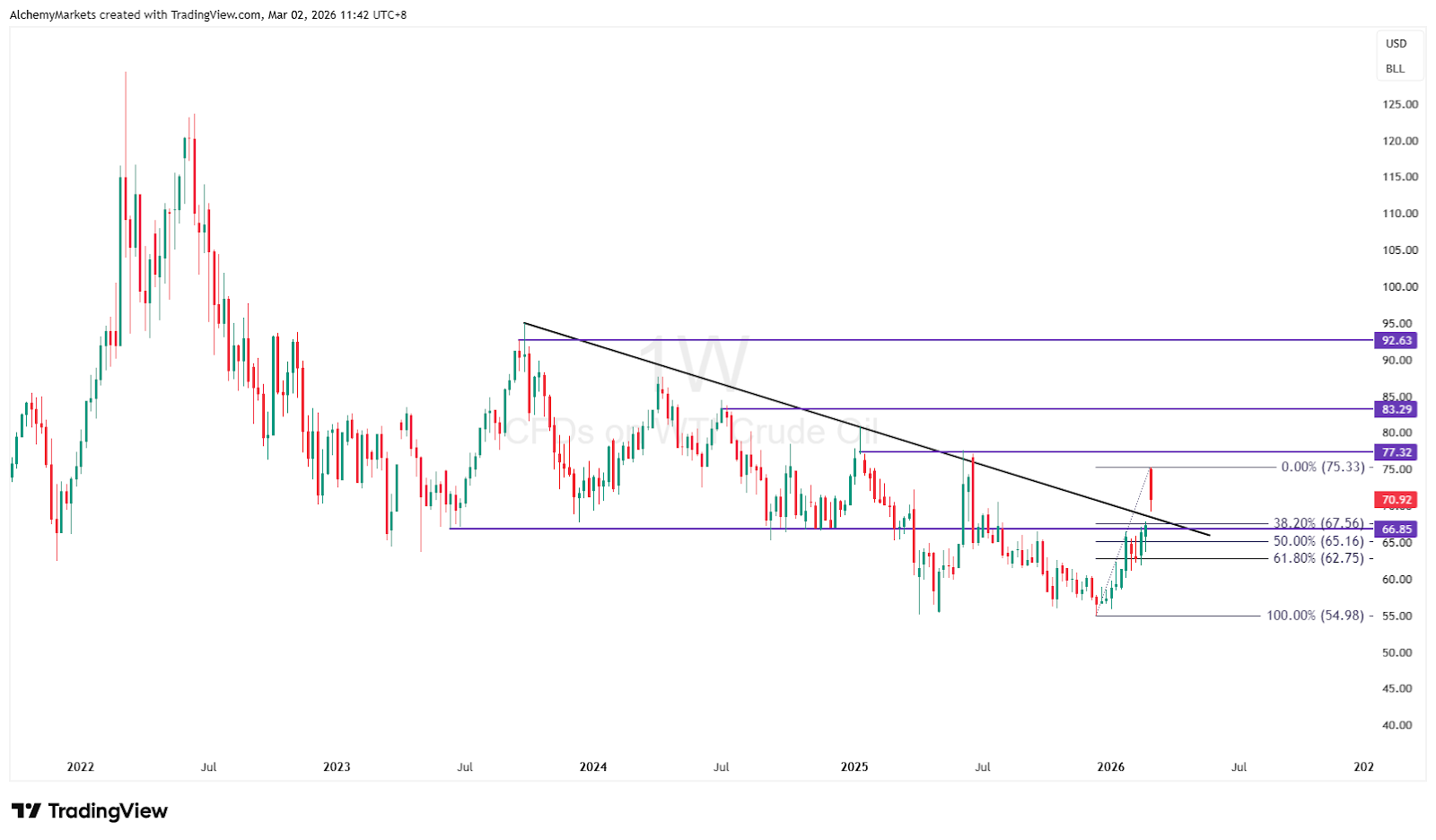
Beyond the headlines, oil is also approaching an important technical area.
The weekly chart shows crude rebounding strongly from the $55 region, where buyers previously stepped in earlier this year. From there, prices rallied back toward the mid-$60s, breaking above a key resistance level ($67) and hinting at a trend reversal.
This $67 region is significant for several reasons:
If oil holds:
However, if prices fail to hold above the $67 breakout area, the move could still prove to be another short-lived geopolitical spike.
With tensions still evolving and the Strait of Hormuz remaining open, traders will be watching closely to see whether the current spike develops into a sustained breakout, or fades as geopolitical uncertainty stabilises.
DISCLAIMER: For educational purposes only. Trading comes with substantial risk, leading to possible loss of your capital. Traders are advised to do their own due diligence before investing.
You may also be interested in:
Oil at a Critical Breakpoint: Will Geopolitics Trigger the Next Major Move?
Alchemy Markets is a multi-asset brokerage providing retail traders with the same elite trading conditions, tools, and transparency typically reserved for institutions.

Select the categories and companies you wish to follow directly to your person rss feed.
Create Custom RSS Feed
just now
Sign up and join over 5,000 professional members who receive personalized news alerts, curated professional connections, and more for free!
CMC Markets has retired the CMC Connect name and will now present its institutional business as CMC Markets Institutional.
The SEC has approved Cboe's binary options tied to key performance indicators reported by 23 companies, covering more than 100 metrics such as iPhone revenue. The cash-settled contracts pay a fixed $1, Robinhood plans to be the first retail broker to offer them, and trading awaits clearing registration.
Gold is trading around $4,150, recovering sharply after falling to a recent low of $4,073.

Global semiconductor and technology stocks sold off sharply on Thursday, with South Korea’s SK Hynix plunging over 10% and Samsung Electronics falling more than 8%.
Learn gold market structure to identify bullish, bearish and ranging XAUUSD trends using higher highs, higher lows, lower highs and lower lows, support and resistance.
Axi has launched an MCP integration connecting eligible MT5 accounts to Claude, allowing clients to access live market data, track positions, execute trades and update risk parameters through the AI assistant developed by Anthropic. Available to eligible Axi clients with an active MT5 account. Setup runs via Claude.ai.
Movantis has selected Integral to extend its FX liquidity offering for institutional clients including banks, payment networks and digital asset operators, adding an institutional trading platform, direct-to-client API trading and API connectivity into a third-party multi-dealer venue, supporting regional expansion.
Running a venue around the clock is the easy part. Pricing risk when the market underneath it is shut is not. Lars Holst, CEO of GCEX explains how to manage risk in 24/7 markets.
ATFX has released its Q4 2026 Trader Magazine, offering a closer look at the macroeconomic and market forces that could shape trading conditions in the final quarter of the year.
LSEG has announced a collaboration with NVIDIA that lets financial institutions analyse years of LSEG Tick History data in seconds using NVIDIA cuDF on GPUs, without creating another full copy of the dataset. Tick History holds 110 trillion rows across 100 million instruments and more than 580 venues and contributors.