just now

Liquidity Finder Ltd is incorporated in England and Wales, company number 10610740, registered address 167-169 Great Portland Street, Fifth Floor, London W1W 5PF, United Kingdom.
Published: just now
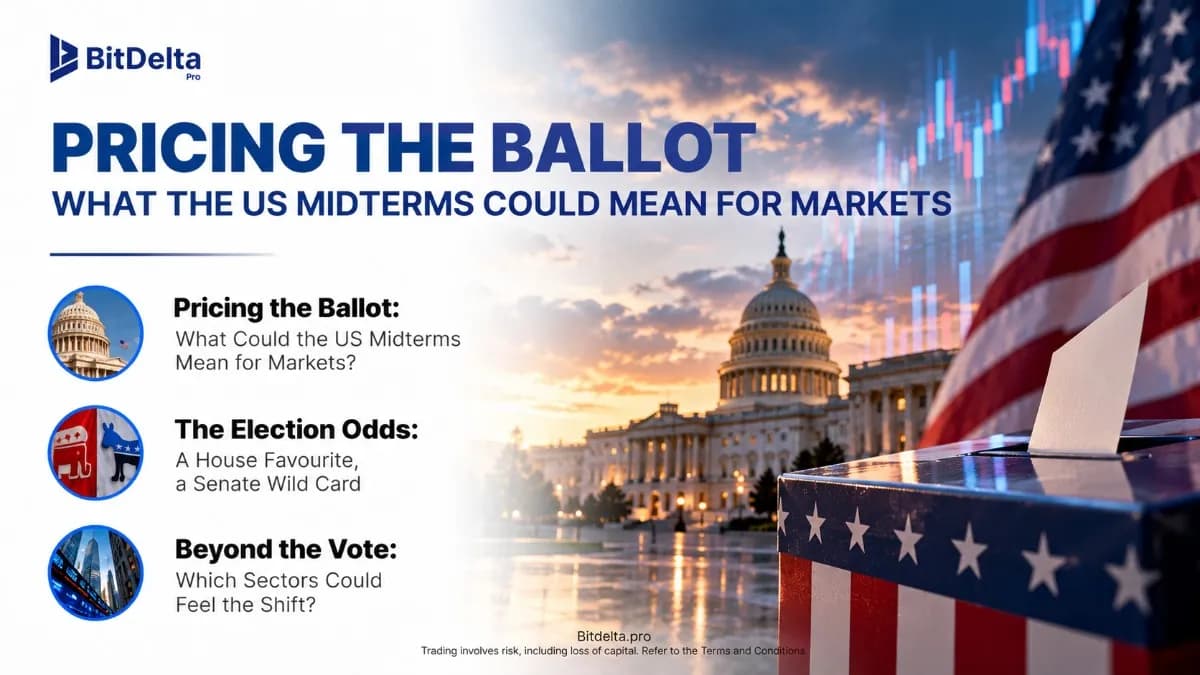
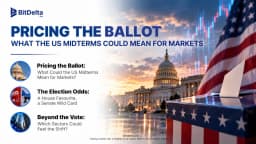
Americans vote on November 3 for all 435 seats in the House of Representatives and a third of the Senate. The presidency is not on the ballot, which means any new Congress will still need the President's signature to turn bills into law. Markets care about the midterms less for the laws that follow and more for what changes in oversight, budgets and the regulatory mood of Washington.
This note sets out where the odds stand, what history says about markets around midterms, and what each of the three realistic outcomes could mean for the sectors our clients follow most closely: AI and technology, healthcare, energy, defense, interest rates and digital assets. It does not take a view on who should win. It takes a view on what each result could mean for portfolios.
Where the Odds Stand
| Outcome | Polymarket | Kalshi | Context |
| Democrats win the House | 92% | 90.7% | Republicans held 220-215 in August |
| Democrats win the Senate | 67% | 64.9% | Swing races: TX, ME, OH, IA |
| Republicans keep both chambers | 7.5% | 9.3% | The least likely outcome |
Source: Polymarket and Kalshi prices compiled by DeFi Rate, October 27, 2026 (2:45am ET); Morgan Stanley Wealth Management for current House composition.
Prediction markets treat a Democratic House as close to settled and the Senate as the real contest. Traditional forecasters are more cautious but point the same way: Decision Desk HQ gave Democrats a 77% chance in the House and 56% in the Senate as of October 18, and generic ballot averages show Democrats ahead by roughly 7 to 8 points. Four Senate races, Texas, Maine, Ohio and Iowa, were rated toss-ups by Decision Desk HQ, which is why the Senate result may not be known on election night.
Reading the House and Senate markets together gives an approximate picture of the three outcomes that matter: Democrats winning both chambers at roughly 65%, a split Congress with a Democratic House and a Republican Senate at roughly 26%, and Republicans holding both at roughly 9%. These combined figures are our own estimate, derived on the assumption that a Democratic Senate comes with a Democratic House.
What History Says
| Pattern | Figure | Period and Source |
| Average S&P 500 total return in midterm years | 4.7% | 1930-2022; Capital Group |
| Average return in non-midterm years | 9.5% | 1930-2022; Capital Group |
| Median volatility in midterm years | ~16% | Since 1970 (13% other years); Capital Group |
| Average S&P 500 return, 12 months after a midterm | 15.4% | Since 1950; S&P Dow Jones Indices |
| Negative 12-month returns after a midterm | None | 1950-2023; Capital Group |
| Post-midterm year, Republican president with split Congress | ~23% | Morgan Stanley (vs ~12% all outcomes) |
Source: Capital Group, Ameriprise citing S&P Dow Jones Indices, Morgan Stanley Wealth Management. Past performance is not indicative of future results.
The historical pattern is consistent: midterm years are weaker and more volatile than other years, volatility tends to peak just before the vote, and markets have tended to rally once the result removes the uncertainty. Morgan Stanley notes the S&P 500 has typically been muted before Election Day and rallied after it. The usual explanation is that markets dislike not knowing more than they dislike any particular outcome.
Two cautions apply this year. First, the averages come from very different economic backdrops, and 2026 combines a Fed that hiked in September with an energy shock that has pushed Brent above $110. Second, the sector most exposed to Washington this time is AI infrastructure, which has no real historical precedent in prior midterms. History is a starting point, not a forecast.
Scenario 1: Democrats Win Both Chambers (~65%)
A Democratic Congress facing a Republican President would mean more oversight and more leverage over budgets, but limited ability to change law without presidential agreement. BNY expects expanded investigations, funding constraints on the administration and frequent vetoes, with budget and debt-ceiling deadlines used as leverage.
AI and technology
This is where the policy debate has moved fastest. Wolfe Research and BNY both expect a House Select Committee on AI with subpoena power. Several Democratic lawmakers have introduced AI-related tax proposals: Senator Mark Kelly's S. 5518 would combine a 5% digital ad tax, an AI usage tax and a 50% excess profits tax on AI companies; Senator Bernie Sanders has proposed a one-time 50% tax on AI company stock to fund a sovereign wealth fund; and bills from Senators Mark Warner and Ron Wyden and Representative Kristen McDonald Rivet would roll back bonus depreciation for data centers. Some candidates have called for pauses on new data center construction. These are proposals from individual members, not a party platform, and none would become law without the President's signature. Their market relevance is that hearings, subpoenas and headline risk can weigh on valuations even when legislation stalls. Citi has described a Democratic sweep as a marginal negative for the AI trade, and Bank of America's Michael Hartnett has warned that a Democratic sweep including a win in Texas could trigger a 10% decline in US stocks.
Healthcare
Healthcare has already moved. The S&P 500 healthcare sector rose more than 9% over the three months to mid-October, second only to energy, with hospital operator Universal Health Services up 21% and insurer Elevance Health up 15%. Analysts link part of the rally to rising odds that a Democratic Congress could delay or reverse Medicaid reimbursement cuts from the 2025 spending law. Citi expects a Democratic sweep could bring increased healthcare subsidies and delayed cuts. Part of this scenario is therefore already in the price.
Energy, defense and trade
On energy, a Democratic Congress has few direct tools to reverse oil and gas leasing but would likely open investigations into industry dealings with the administration and the Interior Department's offshore wind lease buyout, according to S&P Global. On defense, BNY sees spending as unlikely to be cut, though Iran-related supplemental funding would face more scrutiny. On trade, Democrats appear inclined to keep protections for key manufacturing sectors while reducing tariffs on some consumer goods.
Scenario 2: Split Congress (~26%)
A Democratic House with a Republican Senate is the classic gridlock outcome, and markets have historically been comfortable with it because it limits large policy changes. The House alone would still carry oversight and subpoena power, so hearings on AI, energy prices and the administration would happen in this scenario as well. What changes is legislation: TD Securities does not expect meaningful healthcare reform if Democrats win only the House, and none of the AI tax proposals would clear a Republican Senate.
Morgan Stanley's sector view for divided government favors defense, on bipartisan national security support, technology including AI, semiconductors, cybersecurity and software, and financials, on regulatory clarity and M&A activity. It sees pressure on energy, where clean energy rules could fragment, on healthcare and pharma from tariffs and reimbursement scrutiny, on private equity from federal investigations, and on digital assets from tougher scrutiny of custody and stablecoins. Historically, this configuration under a Republican President has produced well above average post-midterm returns in Morgan Stanley's data: about 23%, versus about 12% across all outcomes.
Scenario 3: Republicans Keep Both Chambers (~9%)
A Republican hold would be the least expected result and, in BNY's view, initially supportive for risk assets, reinforcing deregulation, fossil fuel development and the AI buildout. S&P Global sees better prospects for expanded oil and gas leasing, including in Alaska, and for a bipartisan permitting reform package that the gas industry views as its best chance in years. Federal AI regulation would remain limited, leaving state legislatures and utility commissions as the main arena.
The trade-off is the bond market. BNY argues a Republican Congress could add the most pressure on bonds, through spending and tax priorities with limited prospects for budget cuts. And because healthcare stocks have rallied partly on the expectation of a Democratic Congress, that sector carries the clearest risk of a reversal in this scenario.
Sector Map
| Sector | Democrats Win Both | Split Congress | Republicans Hold Both |
| AI and data centers | Hearings, subpoenas, tax proposals (veto-limited) | House oversight; legislation unlikely | Buildout policy continues; states lead regulation |
| Healthcare | Subsidies and delayed Medicaid cuts possible | Little reform expected | Recent rally at risk of reversal |
| Energy | Clean energy support; oil and gas investigations | Fragmented rules; permitting uncertain | More leasing; permitting reform more likely |
| Defense | Spending unlikely to be cut; Iran funding scrutinized | Bipartisan support | Continuity |
| Rates and fiscal | Budget and debt-ceiling standoffs | Shutdown risk persists | Most pressure on bond supply |
Source: BNY Investments, Morgan Stanley Wealth Management, S&P Global Energy, Axios, Citi and TD Securities as reported. BitDelta Pro summary; scenario labels use the approximate probabilities above.
Three Themes That Cut Across Every Outcome
Data centers and power bills. Affordability is the dominant campaign issue, and electricity is part of it. A Bloomberg analysis cited by Morgan Stanley found wholesale power prices near data centers up 267% since 2020, versus 30% nationally. Opposition to data center construction is not confined to one party: Republican Senator Josh Hawley has introduced a bill to revoke opportunity zone tax breaks for data centers. Whoever controls Congress, the political cost of the AI buildout is rising, and state utility commissions in data center hubs such as Texas, Georgia, Ohio and Pennsylvania will matter as much as Washington.
Tariffs and prices. Pew found 40% of Republicans expected tariffs to have a mostly positive effect in October, down from 49% in January, and an AP-NORC poll found 64% of Americans think the President has gone too far with new tariffs. The administration has already exempted some Canadian goods after pressure from Republican Senator Susan Collins, who faces a competitive race. Since 1978, midterm cycles with rising gas prices have seen the President's party lose an average of 32 House seats, according to Morgan Stanley.
The fiscal calendar. BNY expects the federal deficit to stay near or above 6% of GDP in 2027 and 2028 under every scenario. The current government funding resolution expires on December 11, and BNY considers at least one shutdown likely. The new Congress inherits that deadline regardless of who wins.
Digital Assets: The Next Draft
For crypto markets, the midterms matter mostly through timing. The CLARITY Act, the market structure bill that passed the House 294-134 in July 2025, failed a Senate procedural vote 49-50 on September 15, short of the 60 votes needed, after a dispute over ethics language covering officials' crypto income. It has been shelved rather than withdrawn, but a lame-duck revival looks unlikely, which means the next Congress will likely write the next version and statutory action slips into 2027. In the meantime, regulators are filling the gap: the SEC's proposed rules for crypto assets closed for comment on October 20. Morgan Stanley flags tougher congressional scrutiny of custody and stablecoins as a risk under divided government.
What We Are Watching
The Senate count. With four toss-up races, Senate control may not be known on election night. A delayed result extends the period of uncertainty that markets have historically disliked.
AI infrastructure on November 4. The sector most exposed to oversight. A sharp reaction in AI and data center names on a Democratic sweep would test whether headline risk or fundamentals drive pricing.
Healthcare positioning. The sector has already priced part of a Democratic outcome. A surprise in either direction is likely to show up here first.
Treasury yields and the deficit. Any outcome read as fiscally expansive adds pressure at the long end, which matters for every rate-sensitive asset.
December 11. The government funding deadline is the first test of the new balance of power, and a shutdown would land in the same week as the Fed's December meeting.
The Bottom Line
Markets are pricing a Democratic House with high confidence and treating the Senate as the swing factor. With the presidency not on the ballot, the most likely consequence of any outcome is more oversight rather than sweeping new law, and the sectors most exposed to that shift are AI infrastructure and healthcare. History suggests that the resolution of uncertainty tends to matter more for markets than the result itself, and that the year after a midterm has been among the strongest of the presidential cycle. This year's backdrop of rate hikes and an oil shock is a reason to treat that history with care, not to ignore it.
Research | BitDelta Pro
Dubai, UAE
Disclaimer
BitDelta Securities Financial Services LLC, regulated by the Capital Market Authority under Category 5 (Introduction Only), acts solely as an introducer and does not provide trading, execution, dealing, advisory, portfolio management services. All trading, execution, and investment-related services are provided by BitDelta Limited, Mauritius, a licensed Investment Dealer excluding underwriting.
All trading and investments involve risk. The value of investments may fluctuate, and you may receive less than your initial investment.
The information contained in this article is provided for general informational purposes only and does not constitute financial, investment, legal, or professional advice, or a recommendation to buy, sell, or hold any financial product Readers should seek independent professional advice and conduct their own due diligence before making any decisions. Neither the publisher nor the contributors accept liability for any loss arising from reliance on this content.
Appendix: Sources
Odds and Polling
DeFi Rate: 2026 Midterm Predictions, Kalshi vs Polymarket Odds (Oct 27, 2026)
Kalshi: Traders Forecast Democrats to Win 238 House Seats (Oct 26, 2026)
Yahoo News: Latest Midterm Polls and Election Odds (Oct 19, 2026)
Market History
Capital Group: How US Midterm Elections Affect the Markets
Ameriprise: What to Expect From Markets During a Midterm Election Year
U.S. Bank: Stock Market Performance After Midterm Elections
Morgan Stanley: Affordability Could Tip Tight Midterm Elections
Policy and Sectors
BNY: US Midterms 2026, Key Policy and Market Considerations
S&P Global: US Midterms to Shape Energy Policy, Oversight and Investment Outlook
Bloomberg Tax: Democrats Float AI, Data Center Tax Plans as Tool for Midterms
New Jersey Monitor: Democrats Eye Data Center, AI Regulation if Congress Changes Hands
Advisor Perspectives: AI Trade a Key Concern for Stock Investors on Election Risks
Axios: Why Health Care Stocks Are Rallying (Oct 19, 2026)
Axios: Trump Tariffs Test Republicans Ahead of Midterms (Oct 26, 2026)
Digital Assets
BIT Knowledge Hub: CLARITY Act Senate Vote
CryptoSlate: CLARITY Act May Be Heading for Lame Duck
Institutional multi-asset market access across MT5 Ultency, CQG, Iress Pro and BitDelta Terminal, with transparent execution standards and global market coverage.

Select the categories and companies you wish to follow directly to your person rss feed.
Create Custom RSS FeedSign up and join over 5,000 professional members who receive personalized news alerts, curated professional connections, and more for free!
Americans vote on November 3 for all 435 seats in the House of Representatives and a third of the Senate. The presidency is not on the ballot, which means any new Congress will still need the President's signature to turn bills into law. Markets care about the midterms less for the laws that follow and more for what changes in oversight, budgets and the regulatory mood of Washington.
The Australian Securities and Investments Commission has said it is not currently convinced that prediction markets for retail clients are in the public interest. ASIC Chair Sarah Court said prediction market contracts have all the features of a bet, likening them to binary options, which are banned for retail clients.
Binance has confirmed a security incident with an estimated total impact of around $6.3 billion, linked by its initial investigation to a compromised DevOps engineer's laptop. Around $3 billion has been frozen on-chain, and the exchange says it will cover all losses from its SAFU fund and company funds.
US crypto exchange Coinbase has reported net income of $719 million for the third quarter of 2026, up 66% from $432.6 million a year earlier. Prediction markets passed $200 million in annualised revenue, and paid Coinbase One subscribers reached an all-time high.
Webull Securities Co., Ltd., the Japanese subsidiary of Webull Corporation, has started handling US Treasury bonds, giving customers access to about 20,000 bonds as of 30 October 2026. The service lets users trade market-traded bonds like stocks, with real-time prices and yields, from $100.
Intercontinental Exchange and Trade[XYZ] have agreed to bring Trade[XYZ]’s perpetual markets onshore in the US through a new regulated market and clearing structure for round-the-clock retail trading built on Hyperliquid, operated separately from ICE’s institutional futures franchise, subject to regulatory approvals.
The Utah Attorney General's Office has filed 14 criminal charges against KalshiEX, LLC, the operator of US prediction market Kalshi, in a case that names co-founders Tarek Mansour, Chief Executive Officer, and Luana Lopes Lara, Chief Operating Officer, as co-defendants.
US blockchain payments company Ripple and US crypto exchange Coinbase have partnered to make Ripple's US dollar stablecoin, Ripple USD (RLUSD), available across Coinbase's platforms
The UK Financial Conduct Authority (FCA) has secured High Court undertakings to ensure that global crypto exchange HTX, formerly known as Huobi, will not knowingly promote cryptoasset services unlawfully to UK consumers.
US post-trade market infrastructure provider DTCC has launched its DTCC Tokenization Service (DTS) through its subsidiary The Depository Trust Company.